
// QUESTION TOPIC
Organic Compounds Containing Nitrogen questions.
53 published questions across 42 papers, asked from 2022 to 2026. Each question links to the paper it was printed in, with the official answer wherever the exam body publishes one.
Showing 1–12 of 53 · sorted newest year first
Question 56
From JEE (Main) 2026 Session 1, 24 January 2026, Shift 1 — Paper 1 (B.E / B.Tech) Chemistry — 1 question withheld: source figures unavailable
The correct stability order of the following diazonium salts is
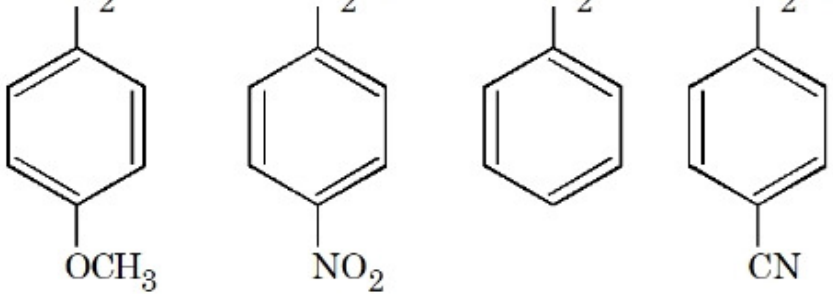
Choose an option first, then open the answer.
Question from the source paper. Answer from the official final answer key (the key rows carrying this paper's Question IDs), version of 2026-02-16. Published documents are listed by the exam body at its document index.
Question 60
From JEE (Main) 2026 Session 1, 28 January 2026, Shift 2 — Paper 1 (B.E / B.Tech) Chemistry
Total number of alkali insoluble solid sulphonamides obtained by reaction of given amines with Hinsberg's reagent is ______. Aniline, N-Methylaniline, Methanamine, N, N – Dimethylmethanamine, N-Methyl methanamine, Phenylmethanamine, N-propylaniline, N-phenylaniline, N, N-Dimethylaniline, Allyl amine, Isopropyl amine
Choose an option first, then open the answer.
Question from the source paper. Answer from the official final answer key (the key rows carrying this paper's Question IDs), version of 2026-02-16. Published documents are listed by the exam body at its document index.
Question 68
From JEE (Main) 2026 Session 2, 2 April 2026, Shift 2 — Paper 1 (B.E / B.Tech) Chemistry
Identify compounds A and E in the following reaction sequence. [Reaction scheme: 1-ethyl-4-nitrobenzene (benzene ring with C₂H₅ on the top carbon and NO₂ on the bottom carbon, para to each other) —(Br₂/AlBr₃)→ A —(Sn/HCl)→ B —(NaNO₂/HCl, 273-278 K)→ C —(C₂H₅OH)→ D —((i) KMnO₄/KOH, (ii) H₃O⁺)→ E]
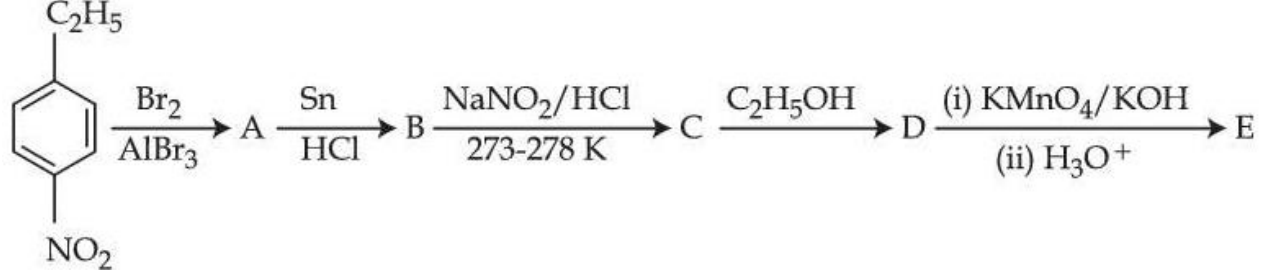
Choose an option first, then open the answer.
Question from the source paper. Answer from the official final answer key (For Centers in India), version of 2026-04-20. Published documents are listed by the exam body at its document index.
Question 67
From JEE (Main) 2026 Session 2, 4 April 2026, Shift 1 — Paper 1 (B.E / B.Tech) Chemistry
Product C of the following reaction sequence will be
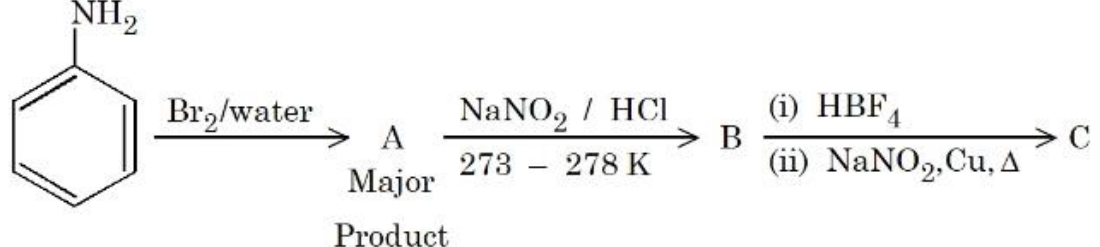
Choose an option first, then open the answer.
Question from the source paper. Answer from the official final answer key (For Centers in India), version of 2026-04-20. Published documents are listed by the exam body at its document index.
Question 67
From JEE (Main) 2026 Session 2, 4 April 2026, Shift 2 — Paper 1 (B.E / B.Tech) Chemistry
The strongest conjugate acid will result from:
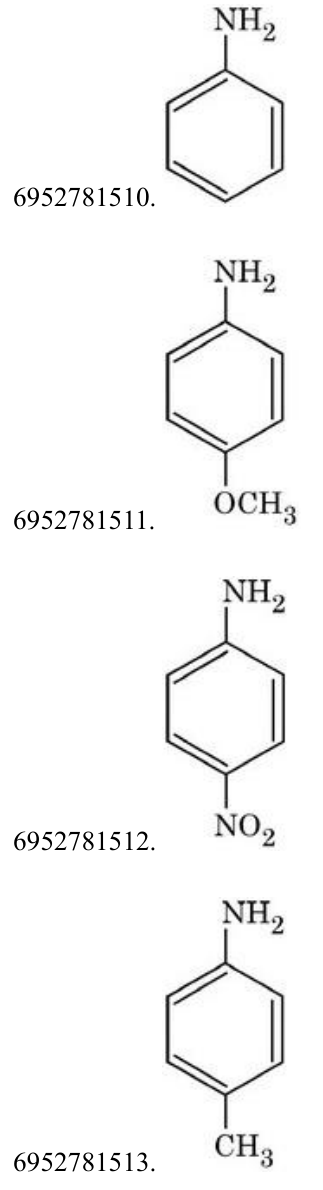
Choose an option first, then open the answer.
Question from the source paper. Answer from the official final answer key (For Centers in India), version of 2026-04-20. Published documents are listed by the exam body at its document index.
Question 66
From JEE (Main) 2026 Session 2, 5 April 2026, Shift 1 — Paper 1 (B.E / B.Tech) Chemistry
Benzyl isocyanide can be obtained from A. Benzyl bromide (benzene ring with CH₂−Br on the top carbon) —AgCN→ B. Benzylamine (benzene ring with CH₂−NH₂ on the top carbon) —CHCl₃ / aq. NaOH→ C. Bromobenzene (benzene ring with Br on the upper-right carbon) —AgCN→ D. Aniline (benzene ring with NH₂ on the upper-right carbon) —CHCl₃ / aq. NaOH→ E. 2-Phenylethyl bromide (benzene ring with CH₂−CH₂−Br) —KCN→ Choose the correct answer from the options given below:
Choose an option first, then open the answer.
Question from the source paper. Answer from the official final answer key (For Centers in India), version of 2026-04-20. Published documents are listed by the exam body at its document index.
Question 68
From JEE (Main) 2026 Session 2, 5 April 2026, Shift 1 — Paper 1 (B.E / B.Tech) Chemistry
Identify the incorrect statements. A. Benzylamine (benzene ring with CH₂−NH₂) is a stronger base than aniline (benzene ring with NH₂). B. p-Methoxyaniline (benzene ring with NH₂ on the top carbon and H₃CO on the bottom carbon, para to each other) can be synthesized by Gabriel phthalimide synthesis. C. 2-Phenylacetamide (benzene ring with CH₂−C(=O)−NH₂) —Br₂, NaOH→ primary aromatic amine D. p-Nitroaniline (benzene ring with NH₂ on the upper-right carbon and O₂N on the lower-left carbon, para to each other) —(i) NaNO₂, HCl, 0°C (ii) Δ→ product will dissolve in NaOH Choose the correct answer from the options given below:
Choose an option first, then open the answer.
Question from the source paper. Answer from the official final answer key (For Centers in India), version of 2026-04-20. Published documents are listed by the exam body at its document index.
Question 67
From JEE (Main) 2026 Session 2, 5 April 2026, Shift 2 — Paper 1 (B.E / B.Tech) Chemistry
Given below are two statements : Statement I : Heating benzamide with bromine in an ethanolic solution of sodium hydroxide will give benzylamine. Statement II : Nitration of aniline with HNO₃/H₂SO₄ at 288 K produces m-nitroaniline in higher amount than o-nitroaniline (pH adjusted). In the light of the above statements, choose the correct answer from the options given below :
Choose an option first, then open the answer.
Question from the source paper. Answer from the official final answer key (For Centers in India), version of 2026-04-20. Published documents are listed by the exam body at its document index.
Question 67
From JEE (Main) 2026 Session 2, 6 April 2026, Shift 2 — Paper 1 (B.E / B.Tech) Chemistry
Consider the following organic reaction sequence. Choose the final product (X) from the following (consider the major product in all intermediate reactions) [CH₃CH₂C(=O)OH —(i) NH₃/Δ, (ii) NaOH/Br₂, (iii) HNO₂/H₂O, 0°C, (iv) C₆H₅N₂Cl, 0°C→ (X) Major Product]
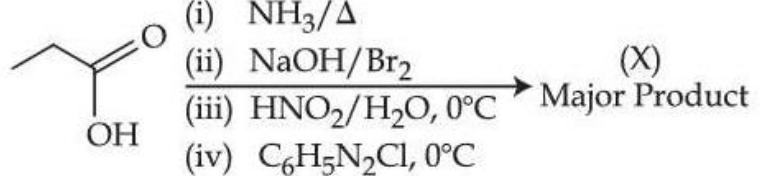
Choose an option first, then open the answer.
Question from the source paper. Answer from the official final answer key (For Centers in India), version of 2026-04-20. Published documents are listed by the exam body at its document index.
Question 68
From JEE (Main) 2026 Session 2, 6 April 2026, Shift 2 — Paper 1 (B.E / B.Tech) Chemistry
The number of compounds from the following which can undergo reaction with Br₂/KOH (alcoholic) to give respective products and these respective products can also be obtained separately by Gabriel phthalimide reaction is : [Six amide structures, printed in two rows of three, shown below]

Choose an option first, then open the answer.
Question from the source paper. Answer from the official final answer key (For Centers in India), version of 2026-04-20. Published documents are listed by the exam body at its document index.
Question 70
From JEE (Main) 2026 Session 2, 6 April 2026, Shift 2 — Paper 1 (B.E / B.Tech) Chemistry
Treatment of a gas 'X' with a freshly prepared ferrous sulphate solution gives a compound 'Y' as a brown ring. The compounds X and Y are.
Choose an option first, then open the answer.
Question from the source paper. Answer from the official final answer key (For Centers in India), version of 2026-04-20. Published documents are listed by the exam body at its document index.
Question 67
From JEE (Main) 2026 Session 2, 8 April 2026, Shift 2 — Paper 1 (B.E / B.Tech) Chemistry
Consider the following reaction. [reactant drawn as a six-membered ring containing N at the upper-right vertex, the ring carbon next to N double-bonded straight up to an O (a lactam), and N bonded to the right to a CH that carries a CH₃ on a vertical bond up and a bond to a –C(=O)H group] (i) NaBH₄/MeOH (ii) NaOH(aq.), Δ (iii) H₃O⁺ → (P) The major product (P) formed is :
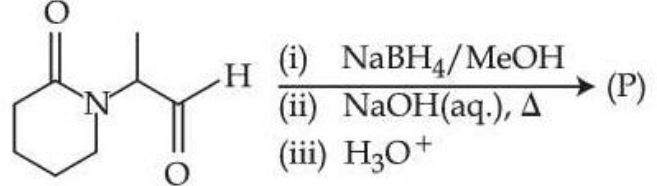
Choose an option first, then open the answer.
Question from the source paper. Answer from the official final answer key (For Centers in India), version of 2026-04-20. Published documents are listed by the exam body at its document index.
How questions are grouped
This page groups Anna University questions by subject. Open a subject code’s syllabus to practise by unit where reviewed questions are available. Other exams may group questions by chapter.
Questions the exam body withdrew, and questions that need unavailable source figures, are withheld rather than served. Each served question links to its source.