
// JEE (Main) / 2026
JEE (Main) 2026 Session 2, 6 April 2026, Shift 2 — Paper 1 (B.E / B.Tech) Chemistry
Chemistry · B.E / B.Tech
Work through the questions
25 questions
Take a moment to try each question before opening the available answer or solution.
Some Basic Concepts in Chemistry
Which of the following contain the same number of atoms ? (Given : Molar mass in g mol⁻¹ of H, He, O and S are 1, 4, 16 and 32 respectively) A. 2 g of O₂ gas B. 4 g of SO₂ gas C. 1400 mL of O₂ at STP D. 0.05 L of He at STP E. 0.0625 mol of H₂ gas Choose the correct answer from the options given below :
- AA and B only
- BB and C only
- CC and D only
- DA, C and E only
View answer or solution
Answer
A, C and E only
The Bohr radius of a hydrogen like species is 70.53 pm. The species and the stationary state (n) are respectively (Given : Hydrogen atom Bohr radius is 52.9 pm)
- ALi²⁺, 3
- BHe⁺, 3
- CHe⁺, 2
- DLi²⁺, 2
View answer or solution
Answer
Li²⁺, 2
Chemical Bonding and Molecular Structure
Given below are two statements : Statement I : The number of compounds among SO₂, SO₃, SF₄, SF₆ and H₂S in which sulphur does not obey the Octet rule is 3. Statement II : Among [H₂O, ClF₃, SF₄], [NH₃, BrF₅, SF₄], [BrF₅, ClF₃, XeF₄] and [XeF₄, ClF₃, H₂O], the number of sets in which all the molecules have one lone pair of electrons on the central atom is 1. In the light of the above statements, choose the correct answer from the options given below :
- ABoth Statement I and Statement II are true
- BBoth Statement I and Statement II are false
- CStatement I is true but Statement II is false
- DStatement I is false but Statement II is true
View answer or solution
Answer
Statement I is false but Statement II is true
Match List - I with List - II. Given V₁ and V₂ are initial and final volumes respectively. List - I (Isothermal process) A. Reversible expansion B. Free expansion C. Irreversible Compression D. Cyclic reversible List - II (Expression) I. q = 0 II. q = nRT ln(V₂/V₁) III. w = −Pₑₓₜ(V₁ − V₂) IV. qᵣₑᵥ/T = 0 Choose the correct answer from the options given below :
- AA-II, B-III, C-I, D-IV
- BA-II, B-I, C-IV, D-III
- CA-II, B-I, C-III, D-IV
- DA-I, B-II, C-III, D-IV
View answer or solution
Answer
A-II, B-I, C-III, D-IV
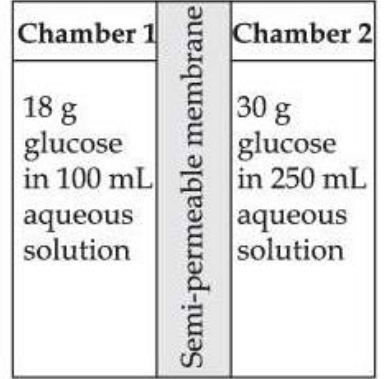
Given below are two statements : Statement I : H₂O molecules move from the chamber 1 to chamber 2. Statement II : The osmotic pressure of a solution prepared by dissolving 50 mg of potassium sulphate (molar mass =174 g/mol) in 2 L of water (at 27 °C) is 0.0107 bar. (Given: R = 0.083 dm³ bar K⁻¹ mol⁻¹ and assume complete dissociation of electrolyte) In the light of the above statements, choose the correct answer from the options given below :
- ABoth Statement I and Statement II are true
- BBoth Statement I and Statement II are false
- CStatement I is true but Statement II is false
- DStatement I is false but Statement II is true
View answer or solution
Answer
Statement I is false but Statement II is true
Given is a concentrated solution of a weak electrolyte AₓBᵧ of concentration 'c' and dissociation constant 'K'. The degree of dissociation is given by :
- A[K × c^(x+y−1)xˣyʸ]^(x+y)
- B(K/(c^(x+y−1)xˣyʸ))^(1/(x+y))
- C(c^(x+y−1)xˣyʸ/K)^(x+y)
- D(c^(x+y−1)xˣyʸ/K)^(1/(x+y))
View answer or solution
Answer
(K/(c^(x+y−1)xˣyʸ))^(1/(x+y))
Redox Reactions and Electrochemistry
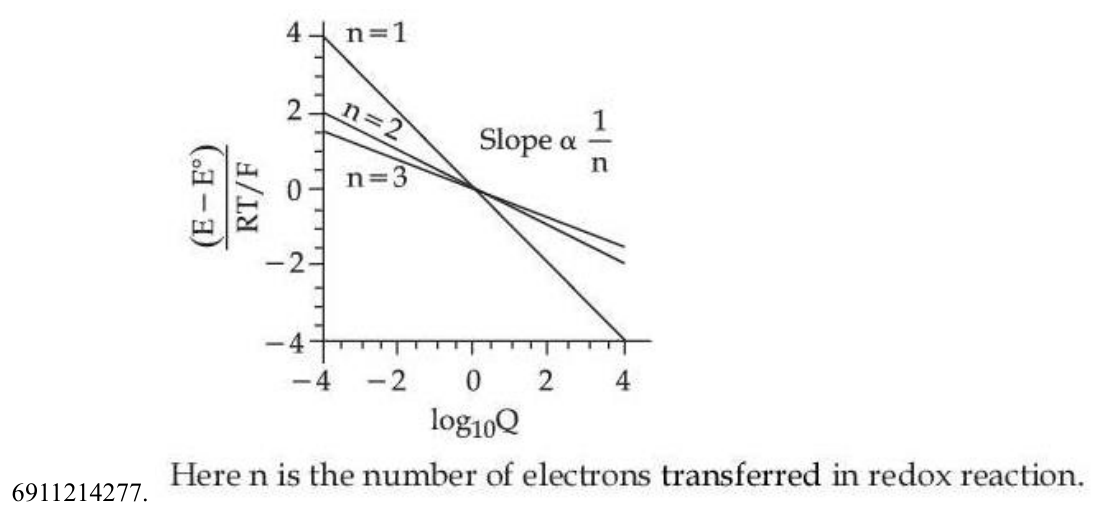
For a general redox reaction Anode: Red₁ → Ox₁ⁿ¹⁺ + n₁e⁻ Cathode: Ox₂ + n₂e⁻ → Red₂ⁿ²⁻ Which of the following statement is incorrect ?
- AThe overall reaction can be written as n₂Red₁ + n₁Ox₂ = n₂Ox₁ⁿ¹⁺ + n₁Red₂ⁿ²⁻
- BThe electrons do not appear in the overall reaction because electrons produced at the anode are consumed at the cathode.
- CGraph: vertical axis (E − E°) / (RT/F) with tick labels 4, 2, 0, −2, −4; horizontal axis log₁₀Q with tick labels −4, −2, 0, 2, 4; three straight lines passing through the common point (log₁₀Q = 0, y = 0), labelled n = 1, n = 2 and n = 3 from steepest to shallowest, annotated "Slope α 1/n". Caption below the graph: Here n is the number of electrons transferred in redox reaction.
- DIf the reaction is carried out reversibly, the electrical work done is equal to the ratio of charge and potential difference through which charge is moved.
View answer or solution
Answer
If the reaction is carried out reversibly, the electrical work done is equal to the ratio of charge and potential difference through which charge is moved.
Classification of Elements and Periodicity in Properties
In a period, the first ionisation enthalpy of the element at extreme left and the negative electron gain enthalpy of the extreme right element, except noble gases, are respectively.
- Alowest and lowest
- Bhighest and lowest
- Clowest and highest
- Dhighest and highest
View answer or solution
Answer
lowest and highest
Given below are two statements : Statement I : F₂O < H₂O < Cl₂O is the correct trend in terms of bond angle. Statement II : SiF₄, SnF₄ and PbF₄ are ionic in nature. In the light of the above statements, choose the correct answer from the options given below :
- ABoth Statement I and Statement II are true
- BBoth Statement I and Statement II are false
- CStatement I is true but Statement II is false
- DStatement I is false but Statement II is true
View answer or solution
Answer
Statement I is true but Statement II is false
Classification of Elements and Periodicity in Properties
The correct order of first (ΔᵢH₁) and second (ΔᵢH₂) ionisation enthalpy values of Cr and Mn are : A. ΔᵢH₁ : Cr > Mn B. ΔᵢH₂ : Cr > Mn C. ΔᵢH₁ : Mn > Cr D. ΔᵢH₂ : Mn > Cr Choose the correct answer from the options given below :
- AA and B only
- BB and C only
- CA and D only
- DC and D only
View answer or solution
Answer
B and C only
Chemical Bonding and Molecular Structure
Which of the following sequences of hybridisation, geometry and magnetic nature are correct for the given coordination compounds ? A. [NiCl₄]²⁻ – sp³, tetrahedral, paramagnetic B. [Ni(NH₃)₆]²⁺ – sp³d², octahedral, paramagnetic C. [Ni(CO)₄] – sp³, tetrahedral, paramagnetic D. [Ni(CN)₄]²⁻ – dsp², square planar, diamagnetic Choose the correct answer from the options given below :
- AA, B, C and D
- BB, C and D only
- CA, C and D only
- DA, B and D only
View answer or solution
Answer
A, B and D only
Purification and Characterisation of Organic Compounds
Given below are two statements : Statement I : A mixture of C₁₂H₂₂O₁₁ (sugar) and NaCl can be separated by dissolving sugar in alcohol, due to differential solubility. Statement II : Rose essence from rose petals is separated by steam distillation due to its high volatility and insolubility in H₂O. In the light of the above statements, choose the correct answer from the options given below :
- ABoth Statement I and Statement II are true
- BBoth Statement I and Statement II are false
- CStatement I is true but Statement II is false
- DStatement I is false but Statement II is true
View answer or solution
Answer
Both Statement I and Statement II are true
Organic Compounds Containing Oxygen
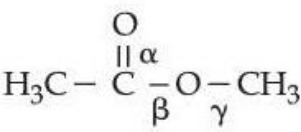
Shown below is the structure of methyl acetate with three different α, β and γ carbon - oxygen bonds. [H₃C – C(=O) – O – CH₃, with the C=O bond labelled α, the acyl C–O bond labelled β and the O–CH₃ bond labelled γ] The correct order of bond lengths of these bonds is :
- Aα > β > γ
- Bα < β < γ
- Cα = β = γ
- Dα < β = γ
View answer or solution
Answer
α < β < γ
Organic Compounds Containing Oxygen
‘x’ is the product which is obtained by the hydrolysis of prop-1-yne in the presence of mercuric sulphate under dilute acidic medium at 333 K. ‘y’ is the product which is obtained by the reaction of ethane nitrile with methyl magnesium bromide in dry ether followed by hydrolysis. IUPAC name of product obtained from ‘x’ and ‘y’ in the presence of barium hydroxide followed by heating is :
- A2 - Methylpent-4-en-3-one
- B4 - Methylpent-3-en-2-one
- C4 - Methylpent-1-ene
- D2 - Methylpent-3-one
View answer or solution
Answer
4 - Methylpent-3-en-2-one
Some Basic Principles of Organic Chemistry
An optically active alkyl bromide C₄H₉Br, reacts with ethanolic KOH to form major compound [A] which reacts with bromine to give compound [B]. Compound [B] reacts with ethanolic KOH and sodamide to give compound [C]. One molecule of water adds to compound [C] on warming with mercuric sulphate and dilute sulphuric acid at 333 K to form compound [D]. The functional group in compound D will be confirmed by :
- AHaloform test
- BLucas test
- CSilver mirror test
- DBenedict test
View answer or solution
Answer
Haloform test
Organic Compounds Containing Oxygen
Consider the following reaction. [Ph – O – CH₂ – Ph + HI → Product] Statement I : In the above reaction, product formed will be a mixture of benzyl alcohol and iodobenzene. Statement II : In the above reaction, the –O–CH₂– bond is cleaved to give the product. In the light of the above statements, choose the correct answer from the options given below :

- ABoth Statement I and Statement II are true
- BBoth Statement I and Statement II are false
- CStatement I is true but Statement II is false
- DStatement I is false but Statement II is true
View answer or solution
Answer
Statement I is false but Statement II is true
Organic Compounds Containing Nitrogen
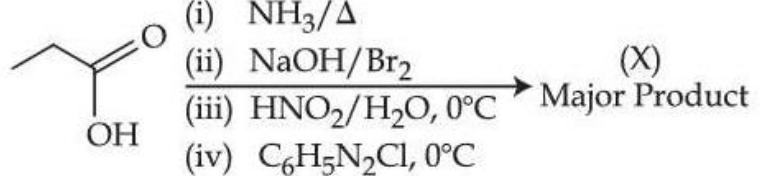
Consider the following organic reaction sequence. Choose the final product (X) from the following (consider the major product in all intermediate reactions) [CH₃CH₂C(=O)OH —(i) NH₃/Δ, (ii) NaOH/Br₂, (iii) HNO₂/H₂O, 0°C, (iv) C₆H₅N₂Cl, 0°C→ (X) Major Product]
- ABenzene
- BPhenol
- CPropanol
- DChlorobenzene
View answer or solution
Answer
Benzene
Organic Compounds Containing Nitrogen
The number of compounds from the following which can undergo reaction with Br₂/KOH (alcoholic) to give respective products and these respective products can also be obtained separately by Gabriel phthalimide reaction is : [Six amide structures, printed in two rows of three, shown below]

- A5
- B4
- C3
- D6
View answer or solution
Answer
3
Chemical Bonding and Molecular Structure
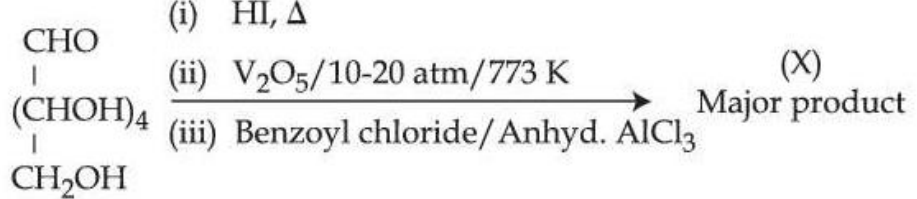
Consider the following reactions. Total number of electrons in the π bonds and lone pair of electrons in the product (X) is : [CHO | (CHOH)₄ | CH₂OH —(i) HI, Δ, (ii) V₂O₅/10-20 atm/773 K, (iii) Benzoyl chloride/Anhyd. AlCl₃→ (X) Major product]
- A12
- B16
- C14
- D18
View answer or solution
Answer
18
Organic Compounds Containing Nitrogen
Treatment of a gas 'X' with a freshly prepared ferrous sulphate solution gives a compound 'Y' as a brown ring. The compounds X and Y are.
- ANO and [Fe(NO)]SO₄
- BNO₂ and [Fe(NO₂)]SO₄
- CN₂O and [Fe(N₂O)]SO₄
- DN₂O₄ and [Fe(N₂O₄)]SO₄
View answer or solution
Answer
NO and [Fe(NO)]SO₄
Some Basic Concepts in Chemistry
An excess of AgNO₃ is added to 100 mL of a 0.05 M solution of tetraaquadichloridochromium (III) chloride. The number of moles of AgCl precipitated will be ___________ ×10⁻³. (Nearest integer)
View answer or solution
Answer
5
An alkane (Y) requires 8 moles of oxygen for complete combustion and on chlorination with Cl₂/hν, (Y) gives only one monochlorinated product (Z). The total number of primary carbon atoms in (Y) is __________.
View answer or solution
Answer
4
Redox Reactions and Electrochemistry
500 mL of 0.2 M MnO₄⁻ solution in basic medium when mixed with 500 mL of 1.5 M KI solution, oxidises iodide ions to liberate molecular iodine. This liberated iodine is then titrated with a standard x M thiosulphate solution in presence of starch till the end point. If 300 mL of thiosulphate was consumed, then the value of x is ________.
View answer or solution
Answer
1
In a closed flask at 600 K, one mole of X₂Y₄(g) attains equilibrium as given below : X₂Y₄(g) ⇌ 2XY₂(g) At equilibrium, 75% X₂Y₄(g) was dissociated and the total pressure is 1 atm. The magnitude of ΔᵣG° (in kJ mol⁻¹) at this temperature is _________. (Nearest Integer) (Given : R = 8.3 J mol⁻¹ K⁻¹; ln 10 = 2.3, log 2 = 0.3, log 3 = 0.48, log 5 = 0.69, log 7 = 0.84)
View answer or solution
Answer
8
Decomposition of a hydrocarbon follows the equation k = (5.5 × 10¹¹ s⁻¹) e^(−28000K/T). The activation energy of reaction is _________ kJ mol⁻¹. (Nearest Integer) Given : R = 8.3 J K⁻¹ mol⁻¹
View answer or solution
Answer
232