
// JEE (Main) / 2026
JEE (Main) 2026 Session 1, 28 January 2026, Shift 2 — Paper 1 (B.E / B.Tech) Chemistry
Chemistry · B.E / B.Tech
Work through the questions
25 questions
Take a moment to try each question before opening the available answer or solution.
The wavelength of photon ‘A’ is 400 nm. The frequency of photon ‘B’ is 10¹⁶ s⁻¹. The wave number of photon ‘C’ is 10⁴ cm⁻¹. The correct order of energy of these photons is :
- AA > B > C
- BC > B > A
- CA > C > B
- DB > A > C
View answer or solution
Answer
B > A > C
Classification of Elements and Periodicity in Properties
Consider the elements N, P, O, S, Cl and F. The number of valence electrons present in the elements with most and least metallic character from the above list is respectively.
- A5 and 6
- B5 and 7
- C7 and 5
- D6 and 7
View answer or solution
Answer
5 and 7
Given below are two statements : Statement I : The increasing order of boiling point of hydrogen halides is HCl < HBr < HI < HF. Statement II : The increasing order of melting point of hydrogen halides is HCl < HBr < HF < HI. In the light of the above statements, choose the correct answer from the options given below :
- AStatement I is false but Statement II is true
- BBoth Statement I and Statement II are true
- CStatement I is true but Statement II is false
- DBoth Statement I and Statement II are false
View answer or solution
Answer
Both Statement I and Statement II are true
Some Basic Principles of Organic Chemistry
The cyclic cations having the same number of hyperconjugation are : Choose the correct answer from the options given below :
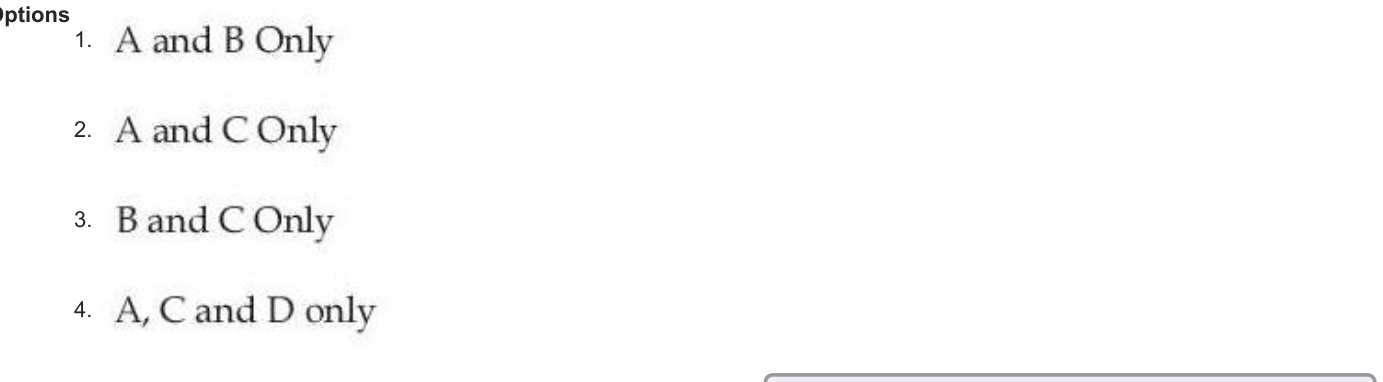
- AA and B Only
- BA and C Only
- CB and C Only
- DA, C and D only
View answer or solution
Answer
A and C Only
Organic Compounds Containing Halogens
A student performed analysis of aliphatic organic compound ‘X’ which on analysis gave C = 61.01%, H = 15.25%, N = 23.74%. This compound, on treatment with HNO₂/H₂O produced another compound ‘Y’ which did not contain any nitrogen atom. However, the compound ‘Y’ upon controlled oxidation produced another compound ‘Z’ that responded to iodoform test. The structure of ‘X’ is :
- ACH₃–CH(CH₃)–NH₂
- BCH₃CH₂CH₂NH₂
- CCH₃–CH₂–CH(NH₂)–CH₃
- DPh–CH(CH₃)–NH₂
View answer or solution
Answer
CH₃–CH(CH₃)–NH₂
Identify the correct statements : The presence of – NO₂ group in benzene ring A. activates the ring towards electrophilic substitutions. B. deactivates the ring towards electrophilic substitutions. C. activates the ring towards nucleophilic substitutions. D. deactivates the ring towards nucleophilic substitutions. Choose the correct answer from the options given below :
- AB and C Only
- BB and D Only
- CA and D Only
- DC and A Only
View answer or solution
Answer
B and C Only
Some Basic Concepts in Chemistry
A student has been given 0.314 g of an organic compound and asked to estimate Sulphur. During the experiment, the student has obtained 0.4813 g of barium sulphate. The percentage of sulphur present in the compound is ______. (Given Molar mass in g mol⁻¹ S : 32, BaSO₄ : 233)
- A42.10%
- B48.24%
- C21.05%
- D63.15%
View answer or solution
Answer
21.05%
Chemical Bonding and Molecular Structure
Match List - I with List - II according to shape. | List - I | List - II | |---|---| | A. XeO₃ | I. BrF₅ | | B. XeF₂ | II. NH₃ | | C. XeO₂F₂ | III. [I₃]⁻ | | D. XeOF₄ | IV. SF₄ | Choose the correct answer from the options given below :
- AA-II, B-III, C-IV, D-I
- BA-II, B-III, C-I, D-IV
- CA-III, B-II, C-IV, D-I
- DA-II, B-I, C-III, D-IV
View answer or solution
Answer
A-II, B-III, C-IV, D-I
Structures of four disaccharides are given below. Among the given disaccharides, the non-reducing sugar is :
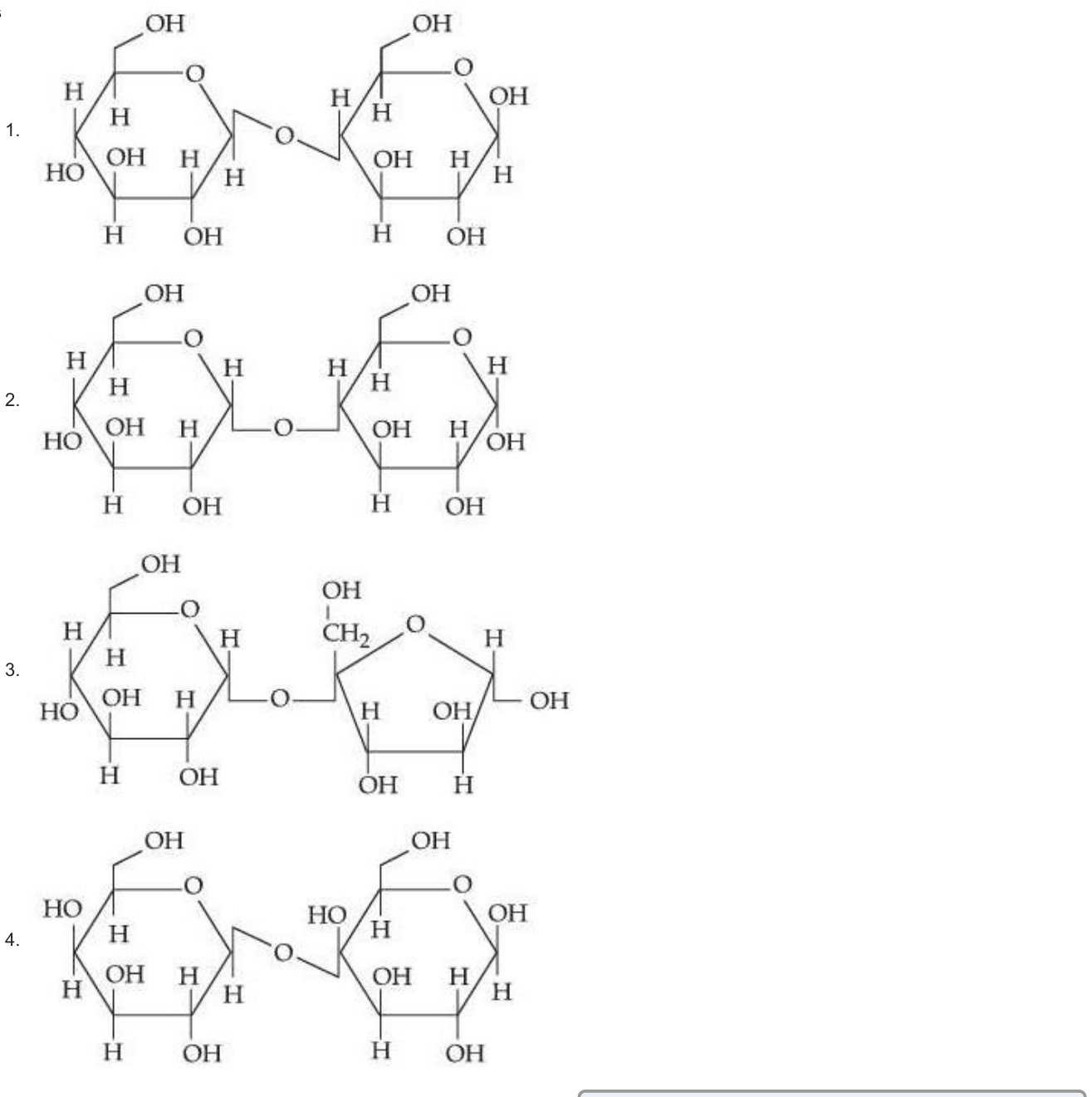
- ATwo six-membered pyranose rings (ring O at the top right of each) joined through an oxygen between C-1 of the left ring and C-4 of the right ring; H is printed below C-1 of the left ring and OH above C-1 of the right ring.
- BTwo six-membered pyranose rings (ring O at the top right of each) joined through an oxygen between C-1 of the left ring and C-4 of the right ring; H is printed above C-1 of the left ring and OH below C-1 of the right ring.
- CA six-membered pyranose ring (ring O at the top right) joined through an oxygen from its C-1 to the carbon of a five-membered furanose ring (ring O at the top) that also carries a CH₂OH group above it; OH is printed above that CH₂.
- DTwo six-membered pyranose rings (ring O at the top right of each) joined through an oxygen between C-1 of the left ring and C-4 of the right ring; OH is printed above C-4 of the left ring and H below it, H below C-1 of the left ring, and OH above C-1 of the right ring.
View answer or solution
Answer
A six-membered pyranose ring (ring O at the top right) joined through an oxygen from its C-1 to the carbon of a five-membered furanose ring (ring O at the top) that also carries a CH₂OH group above it; OH is printed above that CH₂.
Organic Compounds Containing Nitrogen
Total number of alkali insoluble solid sulphonamides obtained by reaction of given amines with Hinsberg's reagent is ______. Aniline, N-Methylaniline, Methanamine, N, N – Dimethylmethanamine, N-Methyl methanamine, Phenylmethanamine, N-propylaniline, N-phenylaniline, N, N-Dimethylaniline, Allyl amine, Isopropyl amine
- A4
- B8
- C2
- D5
View answer or solution
Answer
4
Some Basic Concepts in Chemistry
For the given reaction; CaCO₃ + 2HCl ⟶ CaCl₂ + H₂O + CO₂ If 90 g CaCO₃ is added to 300 mL of HCl which contains 38.55% HCl by mass and has density 1.13 g mL⁻¹, then which of the following option is correct ? Given molar mass of H, Cl, Ca and O are 1, 35.5, 40 and 16 g mol⁻¹ respectively.
- A97.30 g of HCl reacted
- B60.32 g of HCl remains unreacted
- C32.85 g of CaCO₃ remains unreacted
- D64.97 g of HCl remains unreacted
View answer or solution
Answer
64.97 g of HCl remains unreacted
Consider the following aqueous solutions. I. 2.2 g Glucose in 125 mL of solution. II. 1.9 g Calcium chloride in 250 mL of solution. III. 9.0 g Urea in 500 mL of solution. IV. 20.5 g Aluminium sulphate in 750 mL of solution. The correct increasing order of boiling point of these solutions will be : [Given : Molar mass in g mol⁻¹ : H = 1, C = 12, N = 14, O = 16, Cl = 35.5, Ca = 40, Al = 27 and S = 32]
- AII < III < I < IV
- BII < III < IV < I
- CI < II < III < IV
- DIII < I < II < IV
View answer or solution
Answer
I < II < III < IV
Organic Compounds Containing Oxygen
The correct order of acidic strength of the major products formed in the given reactions, is : A. PhNH₂ →[ (1) NaNO₂ + HCl (< 5°C), (2) CuCN, (3) H₃O⁺/Δ ] [A] B. CH₃CH₂CHO →[ [Ag(NH₃)₂]⁺, OH⁻, Δ ] [B] C. CH₄ + O₂ →[ (i) Mo₂O₃, (ii) Na₂Cr₂O₇/H⁺ ] [C] D. PhCH₂MgBr + CO₂ →[ Dry ether, H₃O⁺ ] [D] Choose the correct answer from the options given below :
- AC > A > D > B
- BA > D > C > B
- CC > B > A > D
- DA > D > B > C
View answer or solution
Answer
C > A > D > B
The plot of log₁₀ K vs 1/T gives a straight line. The intercept and slope respectively are (where K is equilibrium constant).
- A−ΔH°/(2·303R), ΔS°/(2·303R)
- BΔS°/(2·303R), −ΔH°/(2·303R)
- C2·303R/ΔH°, 2·303R/ΔS°
- D−ΔS°R/(2·303), ΔH°R/(2·303)
View answer or solution
Answer
ΔS°/(2·303R), −ΔH°/(2·303R)
Organic Compounds Containing Halogens
Which of the following reaction is NOT correctly represented ?
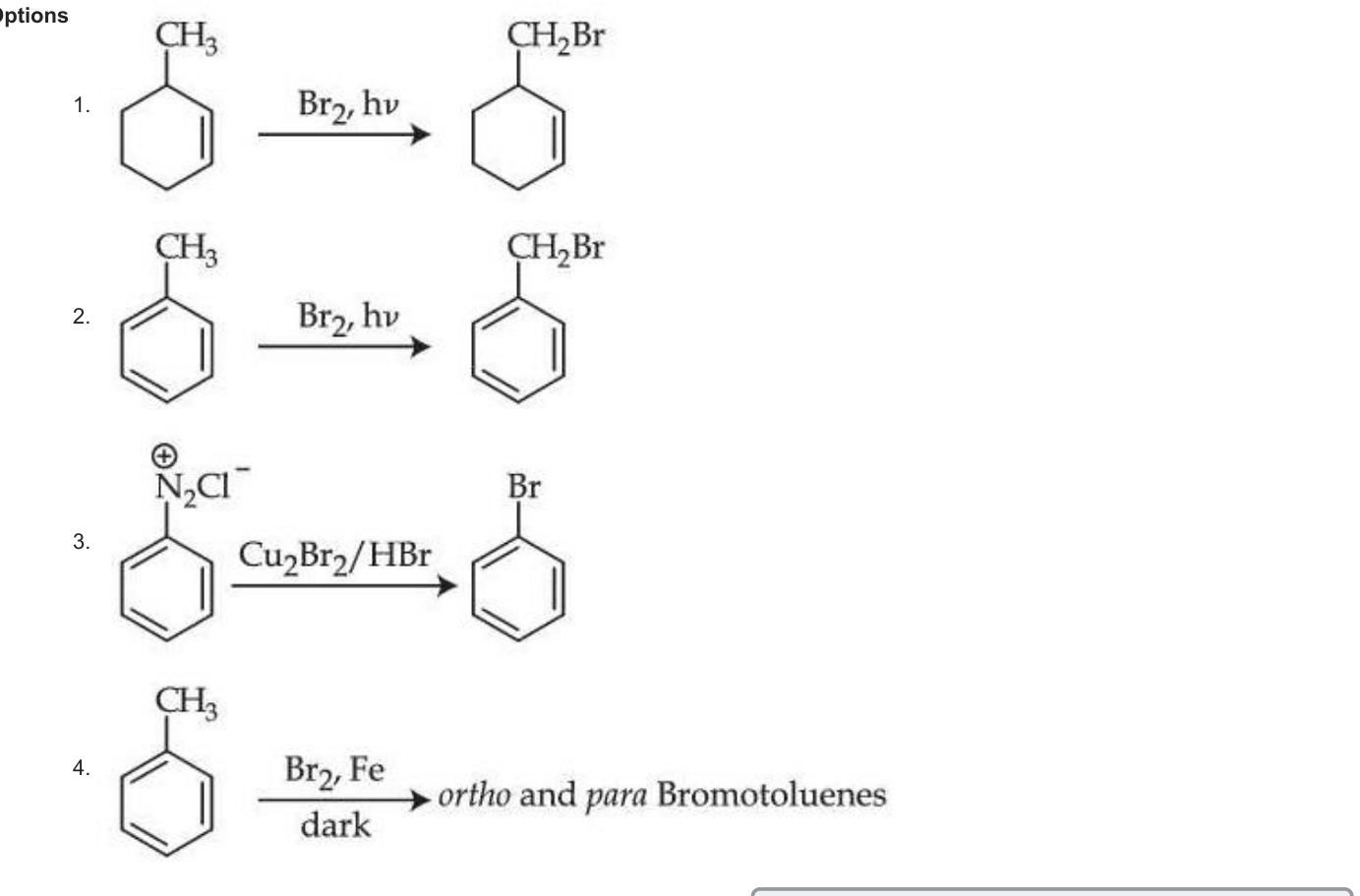
- A3-methylcyclohexene ⟶[ Br₂, hν ] 3-(bromomethyl)cyclohexene
- Btoluene ⟶[ Br₂, hν ] benzyl bromide
- Cbenzenediazonium chloride ⟶[ Cu₂Br₂/HBr ] bromobenzene
- Dtoluene ⟶[ Br₂, Fe in dark ] ortho and para bromotoluenes
View answer or solution
Answer
3-methylcyclohexene ⟶[ Br₂, hν ] 3-(bromomethyl)cyclohexene
The correct increasing order of spin-only magnetic moment values of the complex ions [MnBr₄]²⁻ (A), [Cu(H₂O)₆]²⁺ (B), [Ni(CN)₄]²⁻ (C) and [Ni(H₂O)₆]²⁺ (D) is :
- AC < B < D < A
- BC = D < B < A
- CA = B < C < D
- DA = B < D < C
View answer or solution
Answer
C < B < D < A
Some Basic Concepts in Chemistry
Observe the following equilibrium in a 1 L flask. A(g) = B(g) At T(K), the equilibrium concentrations of A and B are 0.5 M and 0.375 M respectively. 0.1 moles of A is added into the flask and heated to T(K) to establish the equilibrium again. The new equilibrium concentrations (in M) of A and B are respectively
- A0.742, 0.557.
- B0.367, 0.275.
- C0.53, 0.4.
- D0.557, 0.418.
View answer or solution
Answer
0.557, 0.418.
Redox Reactions and Electrochemistry
Consider the following statements about manganate and permanganate ions. Identify the correct statements. A. The geometry of both manganate and permanganate ions is tetrahedral. B. The oxidation states of Mn in manganate and permanganate are + 7 and + 6, respectively. C. Oxidation of Mn(II) salt by peroxodisulphate gives manganate ion as the final product. D. Manganate ion is paramagnetic and permanganate ions is diamagnetic. E. Acidified permanganate ion reduces oxalate, nitrite and iodide ions. Choose the correct answer from the options given below :
- AA, C and D Only
- BA and D Only
- CA, B and C Only
- DA, D and E Only
View answer or solution
Answer
A and D Only
Redox Reactions and Electrochemistry
Consider the following reactions Na₂B₄O₇ ⟶[Δ] 2X + Y CuSO₄ + Y ⟶[Non-Luminous flame] Z + SO₃ 2Z + 2X + Carbon ⟶[Luminous flame] 2Q + Na₂B₄O₇ + CO The oxidation states of Cu in Z and Q, respectively are :
- A+1 and +1
- B+2 and +2
- C+1 and +2
- D+2 and +1
View answer or solution
Answer
+2 and +1
Organic Compounds Containing Oxygen
The reactions which produce alcohol as the product are : A. CH₄ + O₂ ⟶[Mo₂O₃ / Δ] B. 2CH₃CH₃ + 3O₂ ⟶[((CH₃COO)₂Mn) / Δ] C. (CH₃)₃CH ⟶[KMnO₄] D. 2CH₄ + O₂ ⟶[Cu / 523 K / 100 atm.] E. CH₃–CH=CH–CH₃ ⟶[KMnO₄/H⁺] Choose the correct answer from the options given below :
- AC and D Only
- BB, D and E Only
- CA, C and E Only
- DA and D Only
View answer or solution
Answer
C and D Only
A ⟶ B (first reaction) C ⟶ D (second reaction) Consider the above two first-order reactions. The rate constant for first reaction at 500 K is double of the same at 300 K. At 500 K, 50% of the reaction becomes complete in 2 hour. The activation energy of the second reaction is half of that of first reaction. If the rate constant at 500 K of the second reaction becomes double of the rate constant of first reaction at the same temperature; then rate constant for the second reaction at 300 K is ______ × 10⁻¹ hour⁻¹ (nearest integer).
View answer or solution
Answer
5
A volume of x mL of 5 M NaHCO₃ solution was mixed with 10 mL of 2 M H₂CO₃ solution to make an electrolytic buffer. If the same buffer was used in the following electrochemical cell to record a cell potential of 235.3 mV, then the value of x = ______ mL (nearest integer). Sn(s) | Sn(OH)₆²⁻ (0.5 M) | HSnO₂⁻ (0.05 M) | OH⁻ | Bi₂O₃(s) | Bi(s) Consider upto one place of decimal for intermediate calculations [Given : E°(HSnO₂⁻|Sn(OH)₆²⁻) = −0.9 V, E°(Bi₂O₃|Bi) = −0.44 V, pKa(H₂CO₃) = 6.11, (2.303 RT)/F = 0.059 V, Antilog (1.29) = 19.5]
View answer or solution
Answer
78
Some Basic Concepts in Chemistry
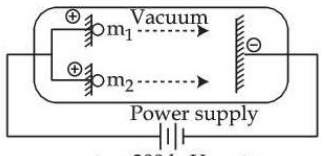
Two positively charged particles m₁ and m₂ have been accelerated across the same potential difference of 200 keV as shown below. [Given mass of m₁ = 1 amu and m₂ = 4 amu] The deBroglie wavelength of m₁ will be x times of m₂. The value of x is ________ (nearest integer)
View answer or solution
Answer
2
Redox Reactions and Electrochemistry
For strong electrolyte Λm increases slowly with dilution and can be represented by the equation Λm = Λ°m − Ac^½ Molar conductivity values of the solutions of strong electrolyte AB at 18°C are given below : c [mol L⁻¹]: 0.04, 0.09, 0.16, 0.25 Λm [S cm² mol⁻¹]: 96.1, 95.7, 95.3, 94.9 The value of constant A based on the above data [in S cm² mol⁻¹/(mol/L)^(1/2)] unit is ______.
View answer or solution
Answer
4
The number of isoelectronic species among Sc³⁺, Cr²⁺, Mn³⁺, Co³⁺ and Fe³⁺ is ‘n’. If ‘n’ moles of AgCl is formed during the reaction of complex with formula CoCl₃(en)₂NH₃ with excess of AgNO₃ solution, then the number of electrons present in the t₂g orbital of the complex is ______.
View answer or solution
Answer
6