
// JEE (Main) / 2026
JEE (Main) 2026 Session 2, 4 April 2026, Shift 2 — Paper 1 (B.E / B.Tech) Chemistry
Chemistry · B.E / B.Tech
Work through the questions
25 questions
Take a moment to try each question before opening the available answer or solution.
The correct order of total number of atoms present in (A) 2 moles of cyclohexane (B) 684 g of sucrose (C) 90.8 L of dihydrogen at STP is:
- AC > A > B
- BC > B > A
- CB > C > A
- DB > A > C
View answer or solution
Answer
B > A > C
The species having identical radii according to the Bohr's theory are: A. H (first orbit) B. He⁺ (first orbit) C. He⁺ (Second orbit) D. Li²⁺ (first orbit) E. Be³⁺ (Second orbit) Choose the correct answer from the options given below:
- AA and C Only
- BA and E Only
- CB and E Only
- DC and D Only
View answer or solution
Answer
A and E Only
Chemical Bonding and Molecular Structure
Which of the following pictorial diagram most correctly represents the π*(π - antibonding) molecular orbital between two atoms if the internuclear axis is taken to be in the z-direction (z-axis →)?
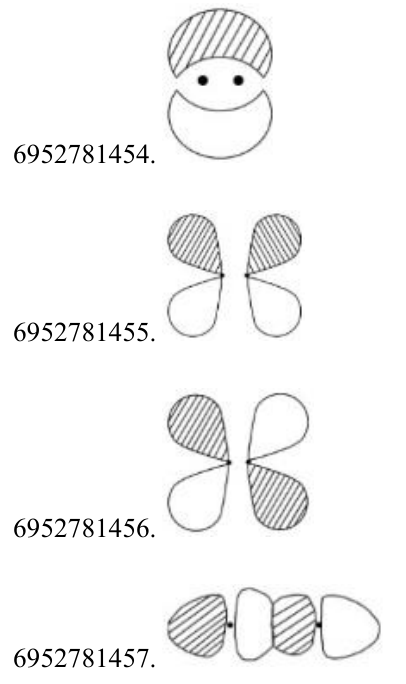
- ADiagram: two overlapping circles, one above the other; the upper circle is diagonally hatched in its upper half, a white horizontal band across the overlap contains two black dots (• •), and the lower circle is unshaded (white).
- BDiagram: four lobes about a horizontal axis with two black dots (nuclei) close together on the axis at the centre; the upper-left and upper-right lobes are diagonally hatched, the lower-left and lower-right lobes are unshaded.
- CDiagram: four lobes about a horizontal axis with two black dots (nuclei) close together on the axis at the centre; the upper-left and the lower-right lobes are diagonally hatched, the upper-right and the lower-left lobes are unshaded.
- DDiagram: four shapes in a horizontal row along the z-axis; from left to right a hatched dome-shaped lobe, a black dot (nucleus), an unshaded tall rounded-rectangle (lens-shaped) form, a hatched dome-shaped lobe, a black dot (nucleus), and an unshaded D-shaped lobe with its flat side facing left.
View answer or solution
Answer
Diagram: four lobes about a horizontal axis with two black dots (nuclei) close together on the axis at the centre; the upper-left and the lower-right lobes are diagonally hatched, the upper-right and the lower-left lobes are unshaded.
At 27 °C, 0.1 M, 1 L K₄[Fe(CN)₆] aqueous solution and 0.1 M, 1 L FeCl₃ aqueous solution are placed in a container separated by a semi permeable membrane AB. Assume complete dissociation of both the solutes. Which of the following statement is correct?
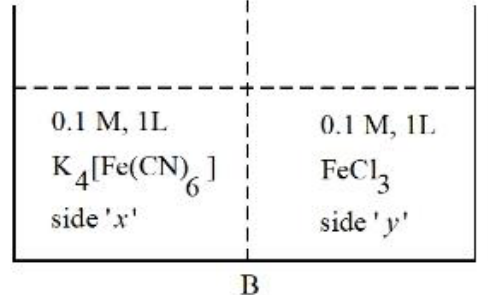
- ABlue color is formed on both sides.
- BIonic solutes in aqueous solution can pass through semi-permeable membrane.
- CSolution on side 'y' is hypotonic.
- DTo cause the reverse flow of solvent during osmosis, external pressure (any value) should be applied to side 'x'.
View answer or solution
Answer
Solution on side 'y' is hypotonic.
20 mL of a solution of acetic acid required 28.4 mL of 0.1 M NaOH for its neutralization. A solution (X) was prepared by mixing 20 mL of the above acetic acid and 14.2 mL of 0.1 M NaOH solution. What is the pH of the solution (X)? (pKₐ value of acetic acid is 4.75).
- A7.0
- B4.75
- C3.5
- D4.82
View answer or solution
Answer
4.75
Match the LIST-I with LIST-II List-I: Reaction A. Williamson Synthesis B. Frieded Craft Reaction C. Bromination of vinyl benzene D. Chlorination of toluene in light List-II: Mechanism I. Electrophilic addition II. Free radical substitution III. Nucleophilic substitution IV. Electrophilic substitution Choose the correct answer from the options given below:
- AA-III, B-I, C-II, D-IV
- BA-III, B-IV, C-II, D-I
- CA-III, B-IV, C-I, D-II
- DA-I, B-III, C-IV, D-II
View answer or solution
Answer
A-III, B-IV, C-I, D-II
Classification of Elements and Periodicity in Properties
The 1ˢᵗ ionization enthalpy for Mg is +737 kJ/mol. The most probable estimated value of the 2ⁿᵈ ionization enthalpy of Mg is ________.
- A−906 kJ/mol
- B−856 kJ/mol
- C+1450 kJ/mol
- D+590 kJ/mol
View answer or solution
Answer
+1450 kJ/mol
Principles Related to Practical Chemistry
The electronegativity of a group 13 element 'E' is same as that of Ge (on Pauling scale and upto one decimal point). The CORRECT statements about E³⁺ are A. It can act as a reducing agent. B. It can act as an oxidizing agent. C. E³⁺ is more stable than E⁺. D. The standard electrode potential value for E³⁺/E is positive. Choose the correct answer from the options given below:
- AA and C Only
- BB and C Only
- CB and D Only
- DA and D Only
View answer or solution
Answer
B and D Only
Pairs of elements with the same number of electrons in their respective 4f orbital are [Atomic number. Eu-63, Gd-64, Dy-66, Ho-67, Tm-69, Yb-70, Lu-71, Hf-72] A. (Eu and Gd) B. (Dy and Ho) C. (Yb and Hf) D. (Lu and Tm) Choose the correct answer from the options given below:
- AB and C Only
- BA and B Only
- CA and D Only
- DA and C Only
View answer or solution
Answer
A and C Only
Consider the metal complexes [Ni(en)₃]²⁺ (A), [NiCl₄]²⁻ (B) and [Ni(NH₃)₆]²⁺(C). Choose the CORRECT option by considering the number of unpaired electrons present in (A), (B) and (C) respectively and the order of frequency of absorption.
- A2, 2, 2 and (A) > (C) > (B)
- B0, 2, 0 and (A) > (C) > (B)
- C2, 2, 0 and (B) > (C) > (A)
- D2, 2, 2 and (C) > (A) > (B)
View answer or solution
Answer
2, 2, 2 and (A) > (C) > (B)
Chemical Bonding and Molecular Structure
Consider the following molecules/species: The correct order of carbon – oxygen double bond length is :
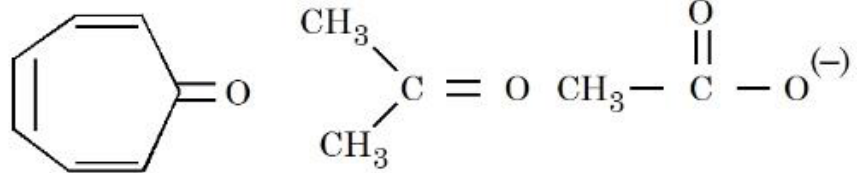
- Ax > y > z
- By > z > x
- Cz > x > y
- Dx > z > y
View answer or solution
Answer
x > z > y
Consider |x| is the difference in oxidation states of Mn in highest manganese fluoride and highest manganese oxide. The ions with |x| number of unpaired electrons from the following are: A. Sc³⁺ B. Zn²⁺ C. V²⁺ D. Fe²⁺ E. Co²⁺ Choose the correct answer from the options given below:
- AA and B Only
- BC, D and E Only
- CC and E Only
- DB and E Only
View answer or solution
Answer
C and E Only
Consider the given graph showing variation of reactant concentration with time. Three different reactions were started with identical initial concentration of reactants. Which of the following statement is correct?
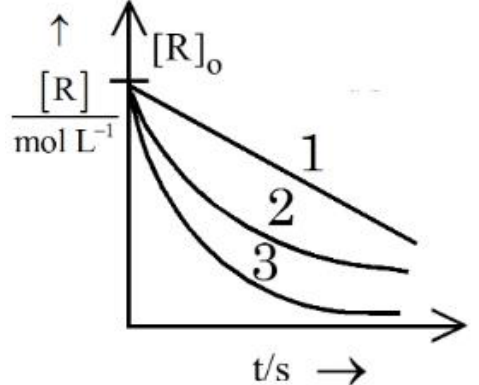
- AThe order of all the three reactions is same.
- BThe rate constant of reaction 3 is larger than the rate constant of reaction 2 if the order of reaction is same for both.
- CThe SI unit of rate constant of reaction 1 is s⁻¹.
- DThermal decomposition of HI on gold surface is an example of reaction 2.
View answer or solution
Answer
The rate constant of reaction 3 is larger than the rate constant of reaction 2 if the order of reaction is same for both.
Some Basic Concepts in Chemistry
Compound (X) is subjected to the sequence of reactions as shown above. Molar mass of the major product (Y) formed is _____________ g mol⁻¹. (Given molar mass in g mol⁻¹ C:12, H: 1, O: 16)
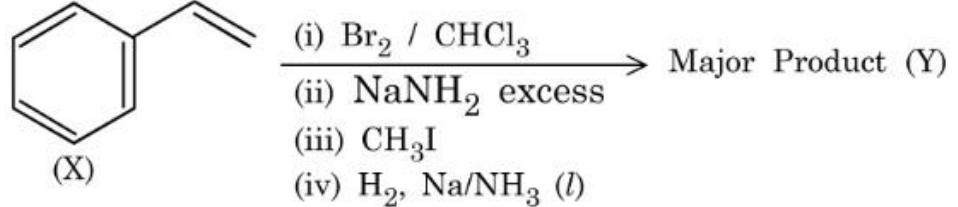
- A90
- B118
- C160
- D125
View answer or solution
Answer
118
Some Basic Principles of Organic Chemistry
The following structures are
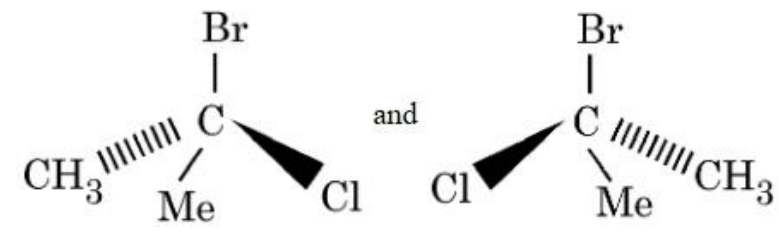
- Aenantiomers.
- Bidentical molecules.
- Cdiastereomers.
- Dmeso compounds.
View answer or solution
Answer
identical molecules.
Organic Compounds Containing Oxygen
The descending order of acidity among the following compounds is: A. [Figure: hexagon with a circle inside it and an OH group attached to the upper-right vertex] B. [Figure: hexagon with a circle inside it, an OH group attached to the upper-right vertex and an O₂N group attached to the lower-left vertex] C. [Figure: hexagon with a circle inside it, an OH group attached to the upper-right vertex and an H₃CO group attached to the lower-left vertex] D. [Figure: hexagon with a circle inside it, a COOH group attached to the upper-right vertex and an O₂N group attached to the lower-left vertex] E. [Figure: hexagon with a circle inside it and a COOH group attached to the upper-right vertex] Choose the correct answer from the options given below:
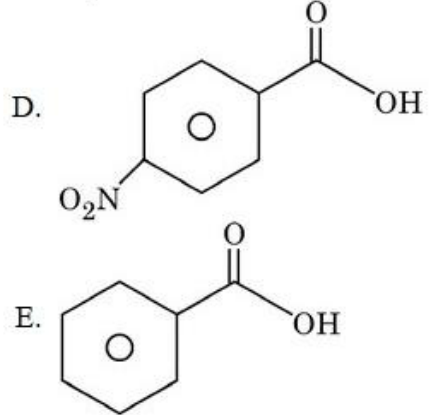
- AB > D > E > A > C
- BD > B > E > A > C
- CC > A > B > D > E
- DD > E > B > A > C
View answer or solution
Answer
D > E > B > A > C
Organic Compounds Containing Nitrogen
The strongest conjugate acid will result from:
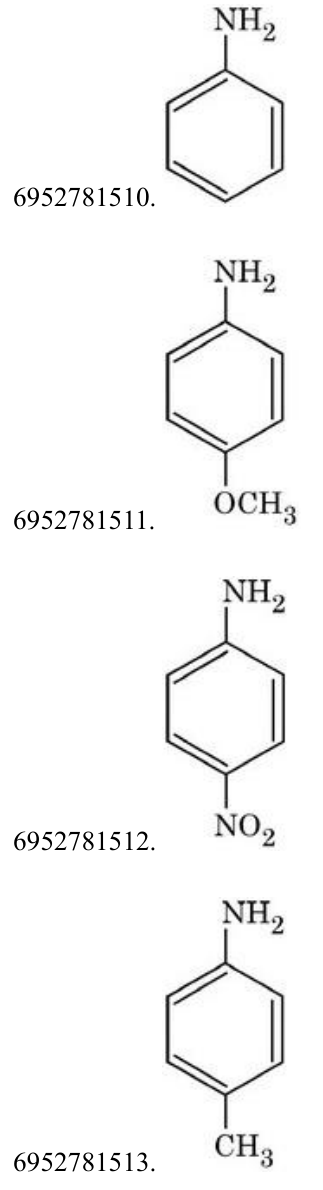
- AStructure: a benzene ring (hexagon with three alternating double bonds) with an NH₂ group attached to the top vertex (aniline).
- BStructure: a benzene ring (hexagon with three alternating double bonds) with NH₂ attached to the top vertex and OCH₃ attached to the bottom vertex, para to the NH₂ (p-methoxyaniline).
- CStructure: a benzene ring (hexagon with three alternating double bonds) with NH₂ attached to the top vertex and NO₂ attached to the bottom vertex, para to the NH₂ (p-nitroaniline).
- DStructure: a benzene ring (hexagon with three alternating double bonds) with NH₂ attached to the top vertex and CH₃ attached to the bottom vertex, para to the NH₂ (p-toluidine).
View answer or solution
Answer
Structure: a benzene ring (hexagon with three alternating double bonds) with NH₂ attached to the top vertex and NO₂ attached to the bottom vertex, para to the NH₂ (p-nitroaniline).
A D-aldotetrose on oxidation with concentrated HNO₃ resulted in optically inactive dicarboxylic acid. The structure of the D-aldotetrose is:
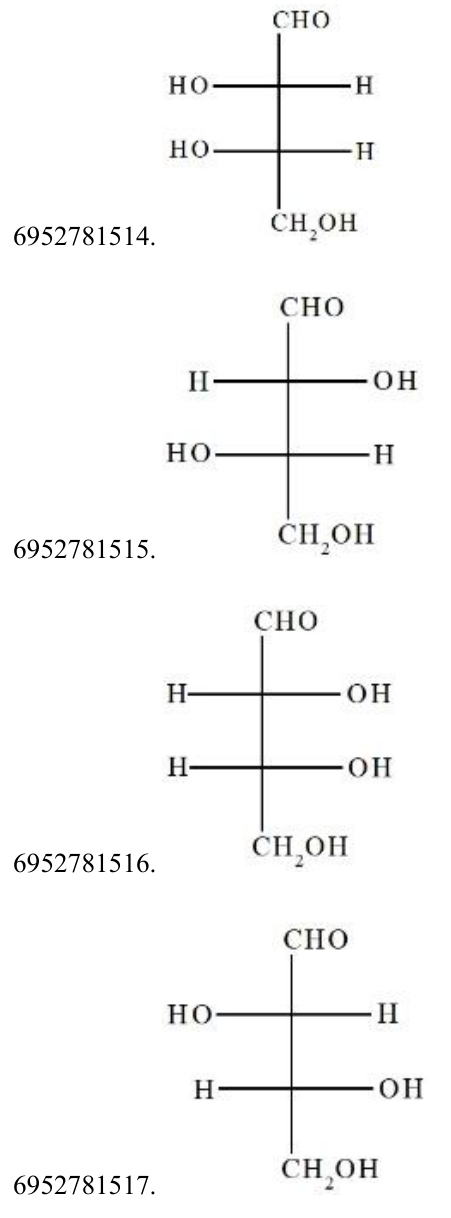
- AFischer projection: CHO at the top; at the upper stereocentre HO on the left and H on the right; at the lower stereocentre HO on the left and H on the right; CH₂OH at the bottom.
- BFischer projection: CHO at the top; at the upper stereocentre H on the left and OH on the right; at the lower stereocentre HO on the left and H on the right; CH₂OH at the bottom.
- CFischer projection: CHO at the top; at the upper stereocentre H on the left and OH on the right; at the lower stereocentre H on the left and OH on the right; CH₂OH at the bottom.
- DFischer projection: CHO at the top; at the upper stereocentre HO on the left and H on the right; at the lower stereocentre H on the left and OH on the right; CH₂OH at the bottom.
View answer or solution
Answer
Fischer projection: CHO at the top; at the upper stereocentre H on the left and OH on the right; at the lower stereocentre H on the left and OH on the right; CH₂OH at the bottom.
Redox Reactions and Electrochemistry
Among Fe³⁺, Pb²⁺, Cu²⁺ and Mn²⁺, identify the one that gets precipitated out while passing H₂S in presence of NH₄OH as group reagent. The highest possible oxidation state of the corresponding metal is
- A+3
- B+4
- C+2
- D+7
View answer or solution
Answer
+7
Organic Compounds Containing Oxygen
Match the LIST-I with LIST-II List-I: Compound A. [Figure: plain hexagon (no double bonds) with an OH group attached to the upper-right vertex] B. [Figure: plain hexagon (no double bonds) with an NH₂ group attached to the upper-right vertex] C. [Figure: plain hexagon (no double bonds) with a CHO group attached to the upper-right vertex] D. [Figure: hexagon with three alternating double bonds drawn as inner lines and an OH group attached to the upper-right vertex] List-II: Test I. Hinsberg's reagent test II. Phthalein dye test III. Lucas test IV. Tollen's test Choose the correct answer from the options given below:
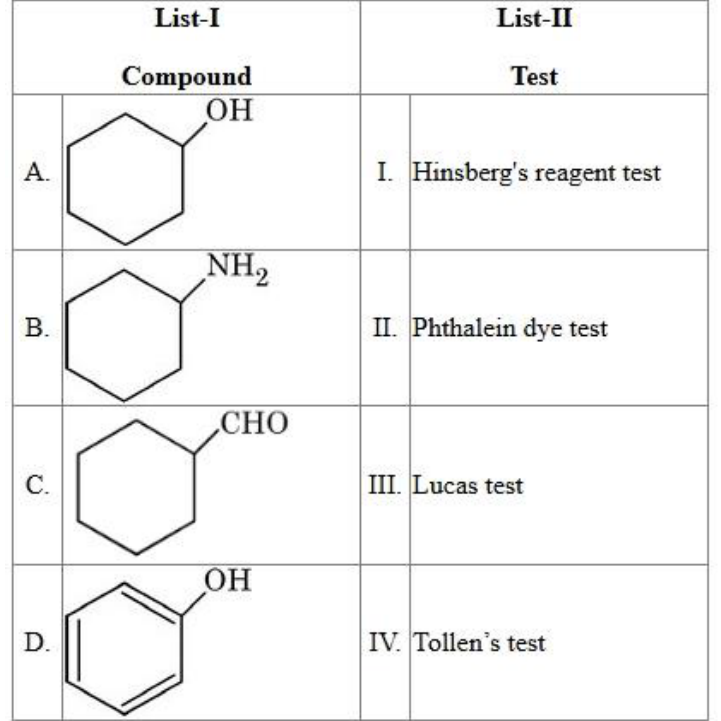
- AA-III, B-I, C-IV, D-II
- BA-III, B-IV, C-I, D-II
- CA-I, B-III, C-II, D-IV
- DA-I, B-II, C-III, D-IV
View answer or solution
Answer
A-III, B-I, C-IV, D-II
If 3.365g of ethanol (l) is burnt completely in a bomb calorimeter at 298.15 K, the heat produced is 99.472 kJ. The |ΔH°f| of ethanol at 298.15 K is ___________ ×10² kJ mol⁻¹. (Nearest integer) Given: Standard enthalpy for combustion of graphite = −393.5 kJ mol⁻¹ Standard enthalpy of formation of water (l) = −285.8 kJ mol⁻¹ Molar mass in g mol⁻¹ of C, H, O are 12 , 1 and 16 respectively
View answer or solution
Answer
3
For the following reaction at 50 °C and at 2 atm pressure, 2N₂O₅(g) ⇌ 2N₂O₄(g) + O₂(g) N₂O₅ is 50% dissociated. The magnitude of standard free energy change at this temperature is x. x = __________ J mol⁻¹ [Nearest integer]. Given : R = 8.314 J mol⁻¹ K⁻¹, log 2 = 0.30, log 3 = 0.48, ln10 = 2.303, °C + 273 = K
View answer or solution
Answer
2474
Redox Reactions and Electrochemistry
An electrochemical cell, consist of the following two redox couples, M^(x+)(aq)/M(s) [E°red = + 0.15 V] and Fe³⁺(aq)/Fe(s) [E°red = − 0.036 V]. The cell EMF (E_cell) is recorded to be 0.2057 V. If the reaction quotient of the electrochemical reaction is found to be 10⁻², then the value of x is ________ (Nearest integer) [Given : M is a p-block metal and 2.303RT/F = 0.059 V]
View answer or solution
Answer
2
For a first order reaction A → B Table: t/min | [A]/M 0 | 0.6500 x | 0.0650 20 | 0.00065 x = __________ min. (Nearest integer)
View answer or solution
Answer
7
Purification and Characterisation of Organic Compounds
In sulphur estimation, 2.0 × 10⁻³ mol of an organic compound (X) (molar mass 76 g mol⁻¹) gave 0.4813 g of barium sulphate (molar mass 233 g mol⁻¹). The percentage of sulphur in the compound (X) is __________ ×10⁻¹ % (Nearest integer)
View answer or solution
Answer
435