
// JEE (Main) / 2026
JEE (Main) 2026 Session 1, 24 January 2026, Shift 1 — Paper 1 (B.E / B.Tech) Chemistry
Chemistry · B.E / B.Tech
Questions
24 + 1
Has an official figure
Withheld — the source figure is not published, so the question is stored with the paper and not served
Work through the questions
24 questions
Take a moment to try each question before opening the available answer or solution.
Consider three metal chlorides x, y and z, where x is water soluble at room temperature, y is sparingly soluble in water at room temperature and z is soluble in hot water. x, y and z are respectively
- AAlCl₃, PbCl₂ and BaCl₂
- BMgCl₂, AgCl and AlCl₃
- CCuCl₂, AgCl and PbCl₂
- DAgCl, Hg₂Cl₂ and PbCl₂
View answer or solution
Answer
CuCl₂, AgCl and PbCl₂
Organic Compounds Containing Oxygen
A student is given one compound among the following compounds that gives positive test with Tollen's reagent. The compound is :
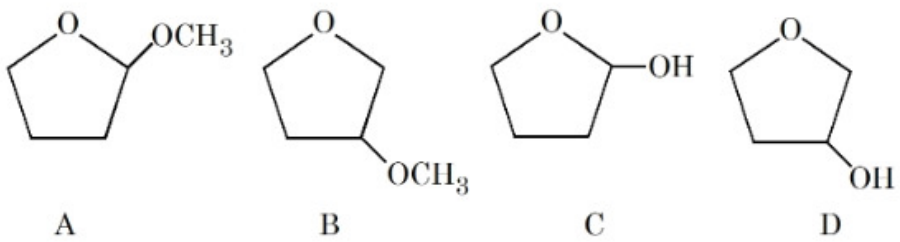
- AA
- BD
- CB
- DC
View answer or solution
Answer
C
Chemical Bonding and Molecular Structure
Given below are two statements: Statement I: The number of paramagnetic species among [CoF₆]³⁻, [TiF₆]³⁻, V₂O₅ and [Fe(CN)₆]³⁻ is 3. Statement II: K₄[Fe(CN)₆] < K₃[Fe(CN)₆] < [Fe(H₂O)₆] SO₄.H₂O < [Fe(H₂O)₆]Cl₃ is the correct order in terms of number of unpaired electron(s) present in the complexes. In the light of the above statements, choose the correct answer from the options given below
- AStatement I is true but Statement II is false
- BBoth Statement I and Statement II are false
- CStatement I is false but Statement II is true
- DBoth Statement I and Statement II are true
View answer or solution
Answer
Both Statement I and Statement II are true
A solution is prepared by dissolving 0.3 g of a non-volatile non-electrolyte solute 'A' of molar mass 60 g mol⁻¹ and 0.9 g of a non-volatile non-electrolyte solute 'B' of molar mass 180 g mol⁻¹ in 100 mL H₂O at 27°C. Osmotic pressure of the solution will be [Given: R = 0.082 L atm K⁻¹ mol⁻¹]
- A1.47 atm
- B0.82 atm
- C2.46 atm
- D1.23 atm
View answer or solution
Answer
2.46 atm
Chemical Bonding and Molecular Structure
Given below are statements about some molecules/ions. Identify the CORRECT statements. A. The dipole moment value of NF₃ is higher than that of NH₃. B. The dipole moment value of BeH₂ is zero. C. The bond order of O₂²⁻ and F₂ is same. D. The formal charge on the central oxygen atom of ozone is −1. E. In NO₂, all the three atoms satisfy the octet rule, hence it is very stable. Choose the correct answer from the options given below:
- AB & C Only
- BA, C & D Only
- CA, B, C, D & E
- DB, C & D Only
View answer or solution
Answer
B & C Only
Organic Compounds Containing Nitrogen
The correct stability order of the following diazonium salts is
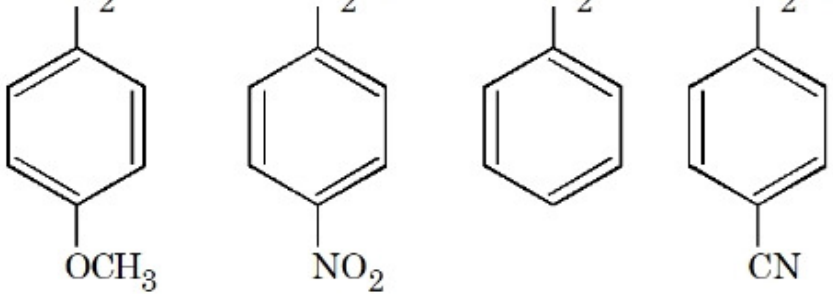
- AA > C > D > B
- BC > D > B > A
- CA > B > C > D
- DC > A > D > B
View answer or solution
Answer
A > C > D > B
Organic Compounds Containing Halogens
Match the LIST-I with LIST-II | List-I | List-II | |---|---| | **Chloro derivative** | **Example** | | A. Vinyl Chloride | I. CH₂ = CH − CH₂Cl | | B. Benzyl Chloride | II. CH₃ − CH(Cl)CH₃ | | C. Alkyl Chloride | III. CH₂ = CHCl | | D. Allyl Chloride | IV. | Choose the correct answer from the options given below:
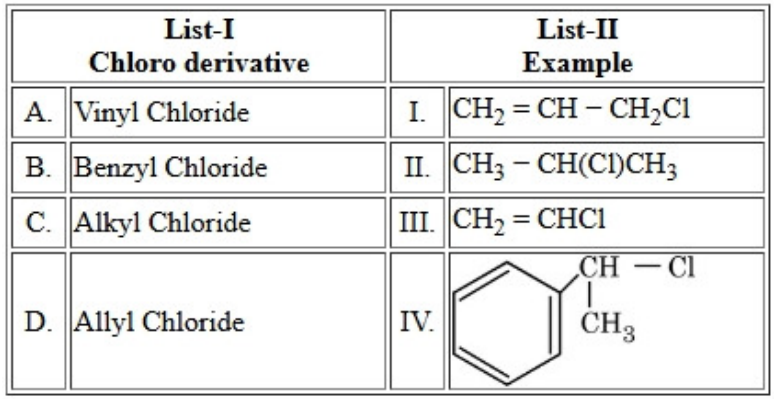
- AA-III, B-IV, C-II, D-I
- BA-I, B-II, C-IV, D-III
- CA-IV, B-I, C-III, D-II
- DA-III, B-IV, C-I, D-II
View answer or solution
Answer
A-III, B-IV, C-II, D-I
Classification of Elements and Periodicity in Properties
Given below are two statements: Statement I: K > Mg > Al > B is the correct order in terms of metallic character. Statement II: Atomic radius is always greater than the ionic radius for any element. In the light of the above statements, choose the correct answer from the options given below
- ABoth Statement I and Statement II are false
- BStatement I is true but Statement II is false
- CStatement I is false but Statement II is true
- DBoth Statement I and Statement II are true
View answer or solution
Answer
Statement I is true but Statement II is false
Arrange the following alkenes in decreasing order of stability. Choose the correct answer from the options given below:
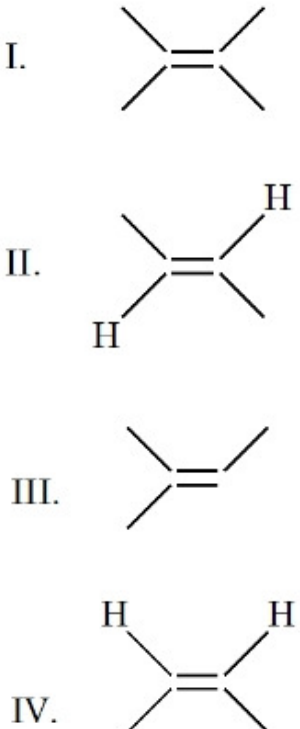
- AIII > I > II > IV
- BIII > II > I > IV
- CI > III > II > IV
- DI > III > IV > II
View answer or solution
Answer
I > III > II > IV
Some Basic Principles of Organic Chemistry
Given below are two statements: Statement I: ‘C − Cl’ bond is stronger in CH₂ = CH − Cl than CH₃− CH₂− Cl Statement II: The given optically active molecule, on hydrolysis gives a solution that can rotate the plane polarized light. In the light of the above statements, choose the correct answer from the options given below

- AStatement I is true but Statement II is false
- BBoth Statement I and Statement II are true
- CStatement I is false but Statement II is true
- DBoth Statement I and Statement II are false
View answer or solution
Answer
Statement I is true but Statement II is false
Match the LIST-I with LIST-II | List-I | List-II | |---|---| | **Isothermal process for ideal gas system** | **Work done (V_f > V_i)** | | A. Reversible expansion | I. w = 0 | | B. Free expansion | II. w = −nRT ln(V_f/V_i) | | C. Irreversible expansion | III. w = −p_ex(V_f − V_i) | | D. Irreversible compression | IV. w = −p_ex(V_i − V_f) | Choose the correct answer from the options given below:
- AA-IV, B-I, C-III, D-II
- BA-IV, B-II, C-III, D-I
- CA-II, B-I, C-III, D-IV
- DA-I, B-III, C-II, D-IV
View answer or solution
Answer
A-II, B-I, C-III, D-IV
‘W’ g of a non-volatile electrolyte solid solute of molar mass ‘M’ g mol⁻¹ when dissolved in 100 mL water, decreases vapour pressure of water from 640 mm Hg to 600 mm Hg. If aqueous solution of the electrolyte boils at 375 K and K_b for water is 0.52 K kg mol⁻¹, then the mole fraction of the electrolyte solute (x₂) in the solution can be expressed as (Given : density of water = 1 g/mL and boiling point of water = 373 K)
- A(1.3/8) × (W/M)
- B(16/2.6) × (W/M)
- C(2.6/16) × (M/W)
- D(1.3/8) × (M/W)
View answer or solution
Answer
(1.3/8) × (W/M)
Among the following, the CORRECT combinations are A. IF₃ → T-shaped (sp³d) B. IF₅ → Square pyramidal (sp³d²) C. IF₇ → Pentagonal bipyramidal (sp³d³) D. ClO₄⁻ → Square planar (sp²d) Choose the correct answer from the options given below:
- AA and B Only
- BB, C and D Only
- CA, B, C and D
- DA, B and C Only
View answer or solution
Answer
A, B and C Only
Some Basic Concepts in Chemistry
Consider the following two reactions A and B. Numerical value of [molar mass of x + molar mass of y] is ____.
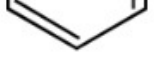
- A46
- B4
- C88
- D160
View answer or solution
Answer
46
Consider a mixture ‘X’ which is made by dissolving 0.4 mol of [Co(NH₃)₅SO₄]Br and 0.4 mol of [Co(NH₃)₅Br]SO₄ in water to make 4 L of solution. When 2 L of mixture ‘X’ is allowed to react with excess of AgNO₃, it forms precipitate ‘Y’. The rest 2 L of mixture ‘X’ reacts with excess BaCl₂ to form precipitate ‘Z’. Which of the following statements is CORRECT?
- A0.2 mol of ‘Z’ is formed.
- B0.1 mol of ‘Y’ is formed.
- C‘Y’ is BaSO₄ and ‘Z’ is AgBr.
- D0.4 mol of ‘Z’ is formed.
View answer or solution
Answer
0.2 mol of ‘Z’ is formed.
Some Basic Principles of Organic Chemistry
Arrange the following carbanions in the decreasing order of stability. I. p − Br − C₆H₄ − CH₂⁻ II. C₆H₅ − CH₂⁻ III. p − CH₃O − C₆H₄ − CH₂⁻ IV. p − CHO − C₆H₄ − CH₂⁻ V. p − CH₃ − C₆H₄ − CH₂⁻ Choose the correct answer from the options given below:
- AI > II > IV > V > III
- BIV > I > II > V > III
- CIV > II > I > III > V
- DI > IV > II > V > III
View answer or solution
Answer
IV > I > II > V > III
Purification and Characterisation of Organic Compounds
A → D is an endothermic reaction occurring in three steps (elementary). (i) A → B ΔH_i = +ve (ii) B → C ΔH_ii = −ve (iii) C → D ΔH_iii = −ve Which of the following graphs between potential energy (y-axis) vs reaction coordinate (x-axis) correctly represents the reaction profile of A → D?
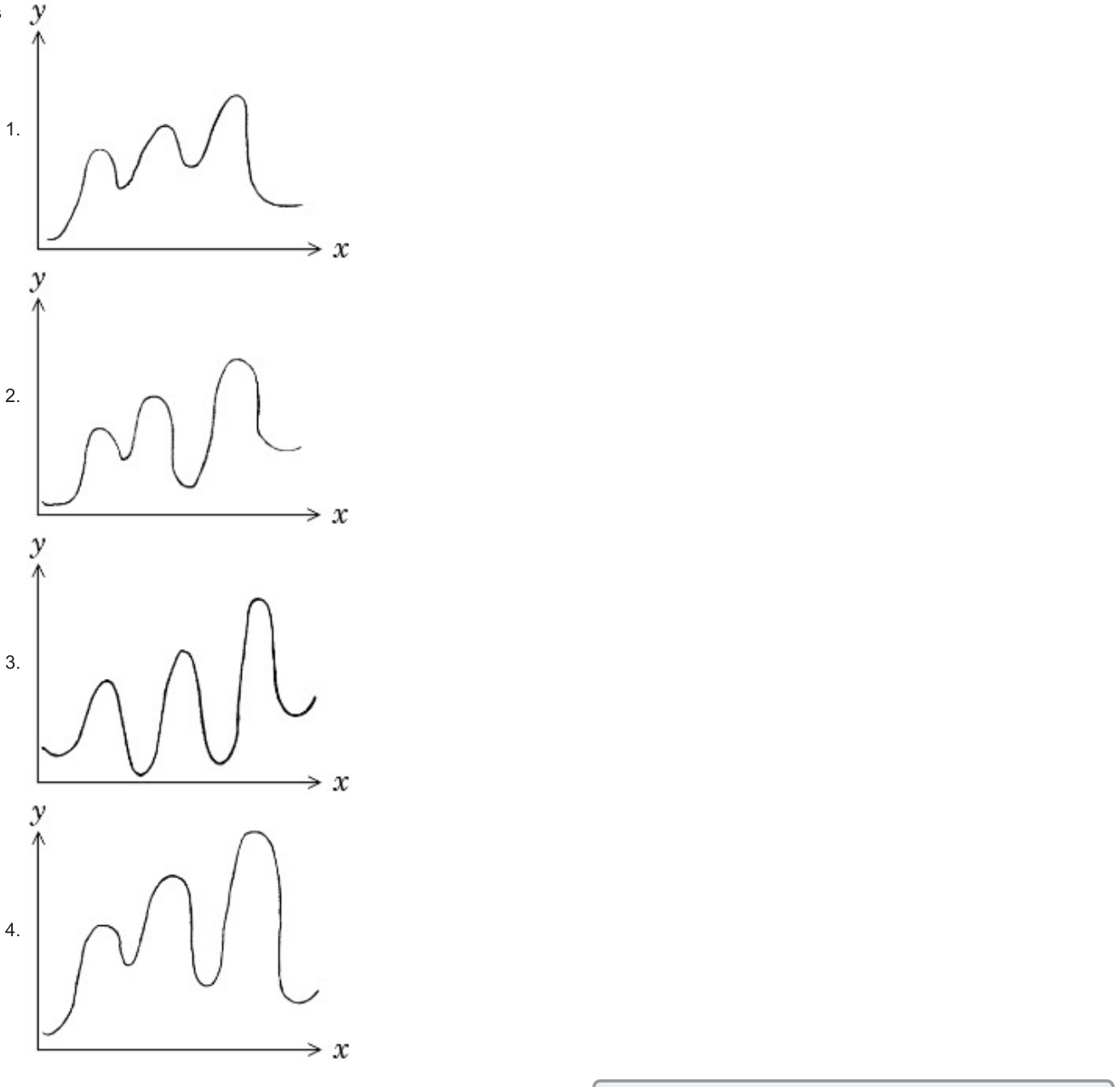
- AGraph: y (potential energy) against x (reaction coordinate); three peaks, each taller than the one before, separated by shallow valleys of about the same height that stay well above the starting level, and after the third peak the curve drops to a final level that lies below both valleys but above the starting level.
- BGraph: y (potential energy) against x (reaction coordinate); three peaks, each taller than the one before, the valley between the first and second peaks shallow while the valley between the second and third peaks drops almost to the starting level, and after the third peak the curve levels off above both valleys and above the starting level.
- CGraph: y (potential energy) against x (reaction coordinate); three peaks, each taller than the one before with the third much the tallest, both valleys falling back almost to the starting level, and after the third peak the curve drops and then turns up slightly at the far right, well above both valleys.
- DGraph: y (potential energy) against x (reaction coordinate); three peaks, each taller than the one before with the third much the tallest, the valley between the second and third peaks deeper than the one between the first and second, and after the third peak the curve falls steeply to a final level below both valleys, ending with a slight upturn at the far right.
View answer or solution
Answer
Graph: y (potential energy) against x (reaction coordinate); three peaks, each taller than the one before with the third much the tallest, the valley between the second and third peaks deeper than the one between the first and second, and after the third peak the curve falls steeply to a final level below both valleys, ending with a slight upturn at the far right.
At 27 °C in presence of a catalyst, activation energy of a reaction is lowered by 10 kJ mol⁻¹. The logarithm of ratio of k(catalysed)/k(uncatalysed) is.... (Consider that the frequency factor for both the reactions is same)
- A17.41
- B3.482
- C0.1741
- D1.741
View answer or solution
Answer
1.741
Principles Related to Practical Chemistry
A hydroxy compound (X) with molar mass 122 g mol⁻¹ is acetylated with acetic anhydride, using a large excess of the reagent ensuring complete acetylation of all hydroxyl groups. The product obtained has a molar mass of 290 g mol⁻¹. The number of hydroxyl groups present in compound (X) is:
- A3
- B4
- C2
- D5
View answer or solution
Answer
4
The hydrogen spectrum consists of several spectral lines in Lyman series (L₁, L₂, L₃...; L₁ has lowest energy among Lyman series). Similarly it consists of several spectral lines in Balmer series (B₁, B₂, B₃ ... ; B₁ has lowest energy among Balmer lines). The energy of L₁ is x times the energy of B₁. The value of x is ______ × 10⁻¹ . (Nearest integer)
View answer or solution
Answer
54
Redox Reactions and Electrochemistry
Electricity is passed through an acidic solution of Cu²⁺ till all the Cu²⁺ was exhausted, leading to the deposition of 300 mg of Cu metal. However, a current of 600 mA was continued to pass through the same solution for another 28 minutes by keeping the total volume of the solution fixed at 200 mL. The total volume of oxygen evolved at STP during the entire process is ______ mL. (Nearest integer) [Given: Cu²⁺ (aq) + 2e⁻ → Cu(s) E°red = + 0.34 V O₂(g) + 4H⁺ + 4e⁻ → 2H₂O E°red = + 1.23 V Molar mass of Cu = 63.54 g mol⁻¹ Molar mass of O₂ = 32 g mol⁻¹ Faraday Constant = 96500 C mol⁻¹ Molar volume at STP = 22.4 L]
View answer or solution
Answer
111
Purification and Characterisation of Organic Compounds
In Dumas method for estimation of nitrogen, 0.50 g of an organic compound gave 70 mL of nitrogen collected at 300 K and 715 mm pressure. The percentage of nitrogen in the organic compound is ______ %. (Aqueous tension at 300 K is 15 mm).
View answer or solution
Answer
15
Redox Reactions and Electrochemistry
X and Y are the number of electrons involved, respectively during the oxidation of I⁻ to I₂ and S²⁻ to S by acidified K₂Cr₂O₇. The value of X + Y is ______.
View answer or solution
Answer
12
Consider two Group IV metal ions X²⁺ and Y²⁺. A solution containing 0.01 M X²⁺ and 0.01 M Y²⁺ is saturated with H₂S. The pH at which the metal sulphide YS will form as a precipitate is ______. (Nearest integer) (Given: K_sp (XS) = 1 × 10⁻²² at 25°C, K_sp (YS) = 4 × 10⁻¹⁶ at 25°C, [H₂S] = 0.1M in solution, K_a1 × K_a2 (H₂S) = 1.0 × 10⁻²¹ , log 2 = 0.30, log 3 = 0.48, log 5 = 0.70)
View answer or solution
Answer
4