
// JEE (Main) / 2026
JEE (Main) 2026 Session 2, 8 April 2026, Shift 2 — Paper 1 (B.E / B.Tech) Chemistry
Chemistry · B.E / B.Tech
Work through the questions
25 questions
Take a moment to try each question before opening the available answer or solution.
Some Basic Concepts in Chemistry
Match List - I with List - II. List - I : Mass of substance — A. 1.8 mg water; B. 9.8 mg sulphuric acid; C. 1.8 mg carbon; D. 5.85 mg salt (NaCl). List - II : Number of atoms — I. 2×10⁻⁴×N_A; II. 1.5×10⁻⁴×N_A; III. 3×10⁻⁴×N_A; IV. 7×10⁻⁴×N_A. Choose the correct answer from the options given below :
- AA-IV, B-III, C-I, D-II
- BA-III, B-II, C-IV, D-I
- CA-III, B-IV, C-II, D-I
- DA-III, B-IV, C-I, D-II
View answer or solution
Answer
A-III, B-IV, C-II, D-I
Some Basic Concepts in Chemistry
Given below are two statements : Given : Molar mass of C, H, O, Cl are 12, 1, 16 and 35.5 g mol⁻¹, respectively Statement I : In 30% (w/w) solution of methanol in CCl₄(at T K), the mole fraction of CCl₄ is equal to 0.33. Statement II : Mixture of methanol and CCl₄ shows positive deviation from Raoult's law. In the light of the above statements, choose the correct answer from the options given below :
- ABoth Statement I and Statement II are true
- BBoth Statement I and Statement II are false
- CStatement I is true but Statement II is false
- DStatement I is false but Statement II is true
View answer or solution
Answer
Both Statement I and Statement II are true
Chemical Bonding and Molecular Structure
Bromine trifluoride autoionizes to form BrF₂⁺ and BrF₄⁻. The shapes of the cation and anion are respectively ________, and ________.
- Abent, square planar
- Blinear, square planar
- Cbent, see-saw
- Dlinear, tetrahedral
View answer or solution
Answer
bent, square planar
Which of the following statements are not correct ? A. For water, magnitude of K_b is more than the magnitude of K_f. B. The elevation in boiling point of water when a non-volatile solute is added to it is larger in magnitude than its depression in freezing point. C. Osmotic pressure measurement is preferred over any other colligative property to determine molar mass of proteins and polymers. D. The dimerised form of benzoic acid in benzene is C₆H₅—C(=O)(—OH) ····· O=C(—OH)—C₆H₅ Choose the correct answer from the options given below :
- AA and B only
- BA and D only
- CA, B and D only
- DA, C and D only
View answer or solution
Answer
A, B and D only
Consider the following reactions in which all the reactants and products are present in gaseous state. 2xy ⇌ x₂ + y₂ K₁ = 2.5 × 10⁵ ; xy + (1/2)z₂ ⇌ xyz K₂ = 5 × 10⁻³. The value of K₃ for the equilibrium (1/2)x₂ + (1/2)y₂ + (1/2)z₂ ⇌ xyz is :
- A2.5×10⁻³
- B2.5×10³
- C1.0×10⁻⁵
- D5×10⁻³
View answer or solution
Answer
1.0×10⁻⁵
Redox Reactions and Electrochemistry
Given at 298 K : E°(Fe²⁺/Fe) = X Volt ; E°(Fe³⁺/Fe) = Y Volt. The E°(Fe³⁺/Fe²⁺) in Volt at 298 K is given by :
- A2X−3Y
- B3Y−2X
- C3Y+2X
- DY+X
View answer or solution
Answer
3Y−2X
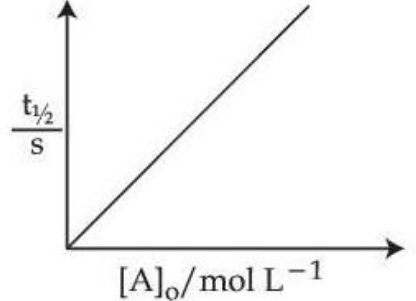
Given below are two statements : R = 8.314 J K⁻¹ mol⁻¹ and 1 cal = 4.2 J Statement I : When Ea = 12.6 kcal/mol, the room temperature rate constant is doubled by a 10 °C increase in temperature (298 K to 308 K) Statement II : For a first order reactions A → B, [graph of t₁/₂ versus initial concentration of A] Here [A]₀ is the initial concentration of A and t₁/₂ is half life of reaction. In the light of the above statements, choose the correct answer from the options given below :
- ABoth Statement I and Statement II are true
- BBoth Statement I and Statement II are false
- CStatement I is true but Statement II is false
- DStatement I is false but Statement II is true
View answer or solution
Answer
Statement I is true but Statement II is false
Match List - I with List - II. List - I : Electronic configuration of neutral atom (where n = 2) — A. ns²; B. ns²np¹; C. ns²np³; D. ns²np⁶. List - II : 1st Ionization Energy (kJ mol⁻¹) — I. 2080; II. 899; III. 800; IV. 1402. Choose the correct answer from the options given below :
- AA-II, B-III, C-IV, D-I
- BA-IV, B-III, C-II, D-I
- CA-III, B-II, C-IV, D-I
- DA-III, B-II, C-I, D-IV
View answer or solution
Answer
A-II, B-III, C-IV, D-I
Chemical Bonding and Molecular Structure
Find the correct statements related to group 15 hydrides. A. Reducing nature increases from NH₃ to BiH₃ B. Tendency to donate lone pair of electrons decreases from NH₃ to BiH₃ C. The stability of hydrides decreases from NH₃ to BiH₃ D. HEH bond angle decreases from NH₃ to SbH₃ (E = Elements of group 15) Choose the correct answer from the options given below :
- AA and B only
- BB and C only
- CA, B, C and D
- DA, C and D Only
View answer or solution
Answer
A, B, C and D
Given below are two statements : Statement I : The number of pairs among [Ti⁴⁺, V²⁺], [V²⁺, Mn²⁺], [Mn²⁺, Fe³⁺] and [V²⁺, Cr²⁺] in which both ions are coloured is 3. Statement II : The number of pairs among [La³⁺, Yb²⁺], [Lu³⁺, Ce⁴⁺] and [Ac³⁺, Lr³⁺] ions in which both are diamagnetic is 3. In the light of the above statements, choose the correct from the options given below :
- ABoth Statement I and Statement II are correct
- BBoth Statement I and Statement II are incorrect
- CStatement I is correct but Statement II is incorrect
- DStatement I is incorrect but Statement II is correct
View answer or solution
Answer
Both Statement I and Statement II are correct
Given below are two statements for catalytic properties of transition metals. Statement I : First row transition metals which act as catalyst utilise their 3d electrons only for formation of bonds between reactant molecules and atoms on the surface of catalyst. Statement II : There is increase in the concentration of reactants on the surface of catalyst which strengthens the bonds in reacting molecules. In the light of the above statements, choose the correct answer from the options given below :
- ABoth Statement I and Statement II are correct
- BBoth Statement I and Statement II are incorrect
- CStatement I is correct but Statement II is incorrect
- DStatement I is incorrect but Statement II is correct
View answer or solution
Answer
Both Statement I and Statement II are incorrect
Given below are two statements : Statement I : Vapours of the liquid with higher boiling point condense before vapours of the liquid with lower boiling points in fractional distillation. Statement II : The vapours rising up in the fractionating column become richer in high boiling component of the mixture. In the light of the above statements, choose the correct answer from the options given below :
- ABoth Statement I and Statement II are true
- BBoth Statement I and Statement II are false
- CStatement I is true but Statement II is false
- DStatement I is false but Statement II is true
View answer or solution
Answer
Statement I is true but Statement II is false
Some Basic Principles of Organic Chemistry
The major product of which of the following reaction is not obtained by rearrangement reaction ?
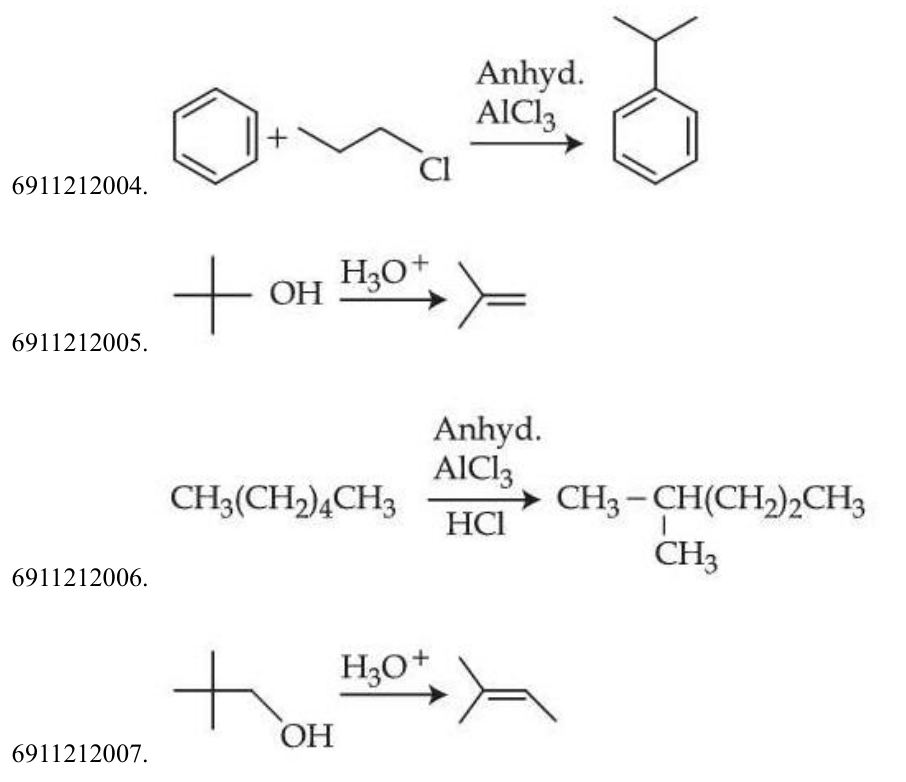
- ABenzene (hexagon with three inner double bonds) + CH₃CH₂CH₂Cl (three-carbon zigzag chain terminating in Cl) —(Anhyd. AlCl₃)→ isopropylbenzene (cumene): a benzene ring carrying a CH(CH₃)₂ group, drawn as a ring–CH bond with two methyl lines spreading up-left and up-right from the CH
- B(CH₃)₃C–OH (a cross-shaped tert-butyl group: central carbon with three short methyl lines going up, left and down, bonded to the right to OH) —(H₃O⁺)→ 2-methylpropene, CH₂=C(CH₃)₂, drawn as a carbon with two methyl lines going up-left and down-left, double-bonded to CH₂ on the right
- CCH₃(CH₂)₄CH₃ —(Anhyd. AlCl₃ / HCl)→ CH₃–CH(CH₃)(CH₂)₂CH₃ (2-methylhexane; the CH carries a CH₃ drawn on a vertical bond below it)
- D(CH₃)₃C–CH₂–OH (a cross-shaped tert-butyl group whose right arm continues through CH₂ down to OH) —(H₃O⁺)→ (CH₃)₂C=CH–CH₃ (2-methylbut-2-ene; drawn as a carbon with two methyl lines going up-left and down-left, double-bonded to a CH that carries a methyl line going down-right)
View answer or solution
Answer
(CH₃)₃C–OH (a cross-shaped tert-butyl group: central carbon with three short methyl lines going up, left and down, bonded to the right to OH) —(H₃O⁺)→ 2-methylpropene, CH₂=C(CH₃)₂, drawn as a carbon with two methyl lines going up-left and down-left, double-bonded to CH₂ on the right
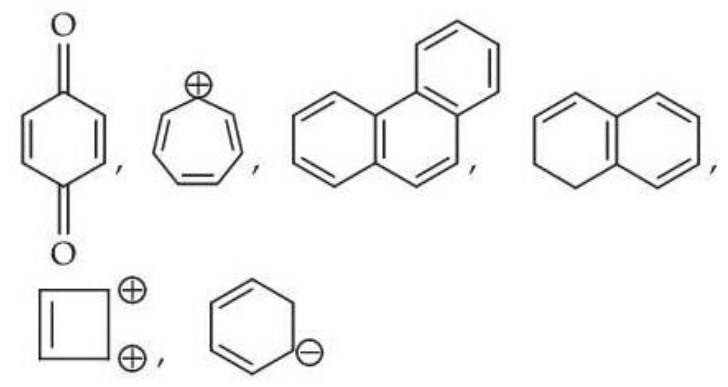
The total number of aromatic compounds/species from the following is
- A6
- B4
- C3
- D5
View answer or solution
Answer
3
Organic Compounds Containing Halogens
n-Butane on monochlorination under photochemical condition gives an optically active compound “P”. “P” on further chlorination gives dichloro compounds. The number of dichloro compounds obtained (ignore stereoisomers) is :
- A3
- B4
- C5
- D6
View answer or solution
Answer
4
Given below are two statements : Statement I : Due to increase in van der Waals forces, the order of boiling points is CH₃CH₂CH₂I > CH₃CH₂I > CH₃I. Statement II : As [1,4-dichlorobenzene: benzene ring drawn as a hexagon with Cl at the top vertex and Cl at the bottom vertex] is more symmetric, its melting point is higher than [1,2-dichlorobenzene: benzene ring drawn as a hexagon with Cl on the two adjacent right-hand vertices], however its boiling point is lower than [1,2-dichlorobenzene: benzene ring drawn as a hexagon with Cl on the two adjacent right-hand vertices]. In the light of the above statements, choose the correct answer from the options given below :
- ABoth Statement I and Statement II are true
- BBoth Statement I and Statement II are false
- CStatement I is true but Statement II is false
- DStatement I is false but Statement II is true
View answer or solution
Answer
Both Statement I and Statement II are true
Organic Compounds Containing Nitrogen
Consider the following reaction. [reactant drawn as a six-membered ring containing N at the upper-right vertex, the ring carbon next to N double-bonded straight up to an O (a lactam), and N bonded to the right to a CH that carries a CH₃ on a vertical bond up and a bond to a –C(=O)H group] (i) NaBH₄/MeOH (ii) NaOH(aq.), Δ (iii) H₃O⁺ → (P) The major product (P) formed is :
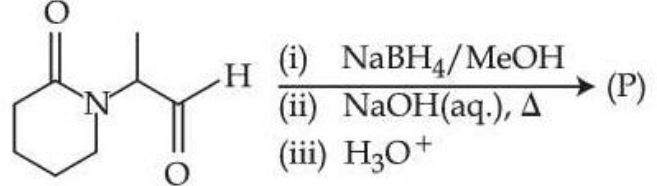
- AN-substituted piperidine (saturated six-membered ring containing N) bearing on the nitrogen the group –CH(CH₃)–CH₂–OH: the ring N bonded to a CH that carries a CH₃ on a vertical bond up and a bond down-right to a CH₂ that is bonded to OH
- BPiperidine ring (six-membered ring containing N) in which the ring carbon next to N bears an OH on a vertical bond up, and the nitrogen carries the group –CH(CH₃)–CHO (a CH with a CH₃ on a vertical bond up and a bond down-right to a C double-bonded to O with an H attached)
- CHO–C(=O)–CH₂–CH₂–CH₂–CH₂–NH–CH(CH₃)–CH₂–OH: a chain of four CH₂ between the carboxyl carbon and the N, drawn as a zigzag starting at the C whose double bond goes up to O and whose left bond goes to HO, and ending at an N that carries an H drawn below it and is bonded to a CH bearing a CH₃ up and a CH₂–OH to the right
- DHO–CH₂–CH₂–CH₂–CH₂–CH₂–NH–CH(CH₃)–CH₂–OH: an open zigzag chain of five CH₂ starting at the OH group on the left and ending at an N that carries an H drawn below it and is bonded to a CH bearing a CH₃ up and a CH₂–OH to the right
View answer or solution
Answer
HO–C(=O)–CH₂–CH₂–CH₂–CH₂–NH–CH(CH₃)–CH₂–OH: a chain of four CH₂ between the carboxyl carbon and the N, drawn as a zigzag starting at the C whose double bond goes up to O and whose left bond goes to HO, and ending at an N that carries an H drawn below it and is bonded to a CH bearing a CH₃ up and a CH₂–OH to the right
Organic Compounds Containing Nitrogen
Which statements are True ? A. In Hoffmann bromamide degradation, 4 moles of NaOH and 2 moles of Br₂ are consumed per mole of an amide B. Hoffmann bromamide reaction is not given by alkyl amides. C. Primary amines can be synthesized by Hoffmann bromamide degradation. D. Secondary amide on reaction with Br₂ and NaOH will give secondary amine. E. The by-products of Hoffmann degradation are Na₂CO₃, NaBr and H₂O. Choose the correct answer from the options given below :
- AA, C and E only
- BB, C and D only
- CC and E only
- DC, D and E only
View answer or solution
Answer
C and E only
The incorrect statement from the following with respect to carbohydrates is :
- AAll monosaccharides are reducing sugars.
- BThe monosaccharide units obtained from hydrolysis of oligosaccharides are always the same.
- CStarch and cellulose are typical examples of polysaccharides, which are very high molecular weight compounds of more than ten monosaccharide units.
- DOpen chain and cyclic structures co-exist at equilibrium that are responsible for certain properties as in the case of D–(+)–glucose.
View answer or solution
Answer
The monosaccharide units obtained from hydrolysis of oligosaccharides are always the same.
Which of the following amino acid will give violet coloured complex with neutral ferric chloride solution ?
- AThreonine
- BSerine
- CTyrosine
- DCysteine
View answer or solution
Answer
Tyrosine
Number of paramagnetic complexes among the following is __________. [MnBr₄]²⁻, [NiCl₄]²⁻, [Ni(CN)₄]²⁻, [Ni(CO)₄], [CoF₆]³⁻, [Fe(CN)₆]⁴⁻, [Mn(CN)₆]³⁻, [Ti(CN)₆]³⁻, [Cu(H₂O)₆]²⁺, [Co(C₂O₄)₃]³⁻
View answer or solution
Answer
6
'x' is the product which is obtained from benzene by reacting it with carbon monoxide and hydrogen chloride in the presence of cuprous chloride. 'y' is the major product obtained from the benzene by reacting it with ethanoyl chloride in the presence of anhydrous AlCl₃. Product (major) obtained by heating x and y in the presence of alkali is z. Total number of π (pi) electrons in z is __________.
View answer or solution
Answer
16
Consider two radiations of wavelengths 1. λ₁ = 2000 Å 2. λ₂ = 6000 Å The ratio of the energies of these two radiations (E₁/E₂) is __________ (Nearest integer).
View answer or solution
Answer
3
Consider the reaction 2H₂S(g) + 3O₂(g) → 2H₂O(l) + 2SO₂(g) The magnitude of enthalpy change for the reaction in kJ mol⁻¹ is __________. (Nearest integer) Given : ΔfH⊖(H₂S) = −20.1 kJ mol⁻¹, ΔfH⊖(H₂O) = −286.0 kJ mol⁻¹, ΔfH⊖(SO₂) = −297.0 kJ mol⁻¹
View answer or solution
Answer
1126
Solid carbon, CaO and CaCO₃ are mixed and allowed to attain equilibrium at T K. CaCO₃(s) ⇌ CaO(s) + CO₂(g) Kp₁ = 0.08 atm ; C(s) + CO₂(g) ⇌2CO(g) Kp₂ = 2 atm The partial pressure of CO is __________ × 10⁻¹ atm
View answer or solution
Answer
4