
// JEE (Main) / 2026
JEE (Main) 2026 Session 2, 4 April 2026, Shift 1 — Paper 1 (B.E / B.Tech) Chemistry
Chemistry · B.E / B.Tech
Work through the questions
25 questions
Take a moment to try each question before opening the available answer or solution.
Some Basic Concepts in Chemistry
Number of moles and number of molecules in 1.4187 L of SO₂ at STP respectively are
- A0.1266; 3.812 × 10²²
- B0.0633; 3.812 × 10²²
- C0.1266; 7.6238 × 10²²
- D0.0633; 7.6238 × 10²²
View answer or solution
Answer
0.0633; 3.812 × 10²²
What is the ratio of wave number of first line (lowest energy line) of Balmer series of H atomic spectrum to first line of its Brackett series?
- A5:1
- B5:0.81
- C5:1.75
- D5:27
View answer or solution
Answer
5:0.81
Which of the following is correct set of 4 quantum numbers of 19th electron in Chromium (Atomic number = 24) in accordance with Aufbau principle?
- An = 3, l = 2, m = +2, s = +1/2
- Bn = 3, l = 2, m = −2, s = +1/2
- Cn = 4, l = 1, m = 0, s = +1/2
- Dn = 4, l = 0, m = 0, s = +1/2
View answer or solution
Answer
n = 4, l = 0, m = 0, s = +1/2
Given below are two statements: Statement I: For an ideal gas, heat capacity at constant volume is always greater than the heat capacity at constant pressure. Statement II: In a constant volume process, no work is produced and all the heat withdrawn goes into the chaotic motion and is reflected by a temperature increase of the ideal gas. In the light of the above statements, choose the correct answer from the options given below
- ABoth Statement I and Statement II are true
- BBoth Statement I and Statement II are false
- CStatement I is true but Statement II is false
- DStatement I is false but Statement II is true
View answer or solution
Answer
Statement I is false but Statement II is true
At T(K), the equilibrium constant of A₂(g) + B₂(g) ⇌ C(g) is 2.7 × 10⁻⁵. What is the equilibrium constant for (1/3)A₂(g) + (1/3)B₂(g) ⇌ (1/3)C(g) at the same temperature?
- A(2.7 × 10⁻⁵)³
- B6 × 10⁻²
- C√(2.7 × 10⁻⁵)
- D3 × 10⁻²
View answer or solution
Answer
3 × 10⁻²
Redox Reactions and Electrochemistry
In order to oxidise a mixture of 1 mole each of FeC₂O₄, Fe₂(C₂O₄)₃, FeSO₄ and Fe₂(SO₄)₃ in acidic medium, the number of moles of KMnO₄ required is
- A3
- B2
- C5
- D7
View answer or solution
Answer
2
Consider the first order reaction R → P. The fraction of molecules decomposed in the given first order reaction can be expressed as
- A1 − e^{k₁t}
- B1 + e^{k₁t}
- C1 + e^{−k₁t}
- D1 − e^{−k₁t}
View answer or solution
Answer
1 − e^{−k₁t}
Classification of Elements and Periodicity in Properties
A monoatomic anion (A⁻) has 45 neutrons and 36 electrons. Atomic mass, group in the periodic table and physical state at room temperature of the element (A) respectively are
- A80, 17, liquid
- B81, 16, solid
- C80, 16, gas
- D81, 15, gas
View answer or solution
Answer
80, 17, liquid
Chemical Bonding and Molecular Structure
Given below are two statements: Statement I: The covalency of oxygen is generally two but it can exceed upto four. The oxidation state of oxygen in SO₂ is −2 and in OF₂ it is +2. Statement II: The anomalous behaviour of oxygen when compared to the other elements of group 16 is due to its small size and high electronegativity. In the light of the above statements, choose the correct answer from the options given below
- ABoth Statement I and Statement II are true
- BBoth Statement I and Statement II are false
- CStatement I is true but Statement II is false
- DStatement I is false but Statement II is true
View answer or solution
Answer
Both Statement I and Statement II are true
The correct statements among the following are, A. Mo(VI) and W(VI) are less stable than Cr(VI). B. Ce⁴⁺ and Tb⁴⁺ are oxidant while Eu²⁺ and Yb²⁺ are reductant. C. Cm and Am have seven unpaired electrons. D. Actinoid contraction is greater from element to element than lanthanoid contraction. Choose the correct answer from the options given below:
- AA and B Only
- BC and D Only
- CB and D Only
- DA and C Only
View answer or solution
Answer
B and D Only
Redox Reactions and Electrochemistry
Correct statements from the following are A. Potassium dichromate is an oxidising agent and it oxidises FeSO₄ to Fe₂(SO₄)₃ in acidic medium. B. Sodium dichromate can be used as primary standard in volumetric estimation. C. CrO₄²⁻ and Cr₂O₇²⁻ are interconvertible in aqueous solution by varying the pH of the solution. D. Cr-O-Cr bond angle in Cr₂O₇²⁻ is 126°. Choose the correct answer from the options given below:
- AA, B and C Only
- BA, C and D Only
- CA and C Only
- DB and D Only
View answer or solution
Answer
A, C and D Only
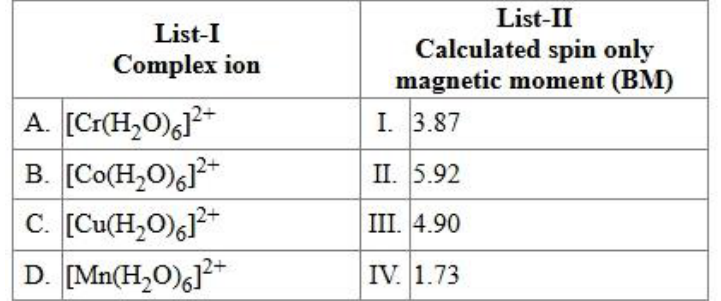
Match the LIST-I with LIST-II. List-I (Complex ion): A. [Cr(H₂O)₆]²⁺, B. [Co(H₂O)₆]²⁺, C. [Cu(H₂O)₆]²⁺, D. [Mn(H₂O)₆]²⁺. List-II (Calculated spin only magnetic moment (BM)): I. 3.87, II. 5.92, III. 4.90, IV. 1.73. Choose the correct answer from the options given below:
- AA-I, B-III, C-IV, D-II
- BA-II, B-I, C-III, D-IV
- CA-IV, B-II, C-I, D-III
- DA-III, B-I, C-IV, D-II
View answer or solution
Answer
A-III, B-I, C-IV, D-II
Some Basic Principles of Organic Chemistry
Increasing order of electron withdrawing power of following functional groups is: a. – CN, b. – COOH, c. – NO₂, d. – I
- Ac < b < d < a
- Bc < a < b < d
- Cd < b < a < c
- Da < b < c < d
View answer or solution
Answer
d < b < a < c
An alkene (X) on ozonolysis followed by reduction gives following products. H–C(=O)–H (2 moles), H–C(=O)–C(=O)–C(=O)–H, CH₃–C(=O)–C(=O)–C(=O)–CH₃. The alkene (X) is:
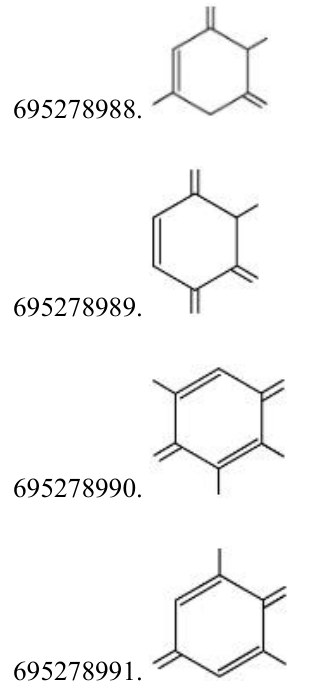
- ACyclohexadiene ring drawn as a hexagon with vertices numbered clockwise from the top as C1 (top), C2 (upper right), C3 (lower right), C4 (bottom), C5 (lower left), C6 (upper left); ring double bond between C5 and C6 (left edge); exocyclic =CH₂ at C1 (pointing straight up) and exocyclic =CH₂ at C3 (pointing down-right); a CH₃ group on C2 (bond up-right) and a CH₃ group on C5 (bond down-left).
- BCyclohexadiene ring drawn as a hexagon with vertices numbered clockwise from the top as C1 (top), C2 (upper right), C3 (lower right), C4 (bottom), C5 (lower left), C6 (upper left); ring double bond between C5 and C6 (left edge); exocyclic =CH₂ at C1 (pointing straight up), exocyclic =CH₂ at C3 (pointing down-right) and exocyclic =CH₂ at C4 (pointing straight down); a CH₃ group on C2 (bond up-right).
- CCyclohexadiene ring drawn as a hexagon with vertices numbered clockwise from the top as C1 (top), C2 (upper right), C3 (lower right), C4 (bottom), C5 (lower left), C6 (upper left); ring double bond between C6 and C1 (upper-left edge); exocyclic =CH₂ at C2 (pointing up-right) and exocyclic =CH₂ at C5 (pointing down-left); a CH₃ group on C6 (bond up-left), a CH₃ group on C3 (bond down-right) and a CH₃ group on C4 (bond straight down).
- DCyclohexadiene ring drawn as a hexagon with vertices numbered clockwise from the top as C1 (top), C2 (upper right), C3 (lower right), C4 (bottom), C5 (lower left), C6 (upper left); ring double bonds between C6 and C1 (upper-left edge) and between C3 and C4 (lower-right edge); exocyclic =CH₂ at C2 (pointing up-right) and exocyclic =CH₂ at C5 (pointing down-left); a CH₃ group on C1 (bond straight up) and a CH₃ group on C3 (bond down-right).
View answer or solution
Answer
Cyclohexadiene ring drawn as a hexagon with vertices numbered clockwise from the top as C1 (top), C2 (upper right), C3 (lower right), C4 (bottom), C5 (lower left), C6 (upper left); ring double bonds between C6 and C1 (upper-left edge) and between C3 and C4 (lower-right edge); exocyclic =CH₂ at C2 (pointing up-right) and exocyclic =CH₂ at C5 (pointing down-left); a CH₃ group on C1 (bond straight up) and a CH₃ group on C3 (bond down-right).
Organic Compounds Containing Halogens
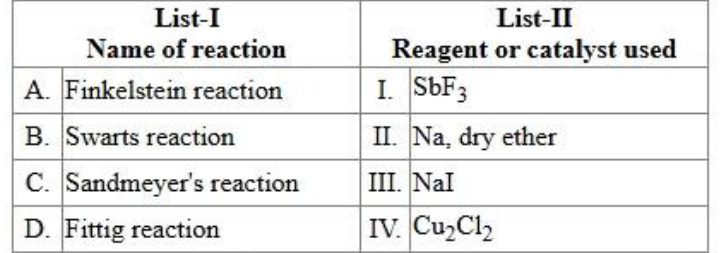
Match the LIST-I with LIST-II. List-I (Name of reaction): A. Finkelstein reaction, B. Swarts reaction, C. Sandmeyer's reaction, D. Fittig reaction. List-II (Reagent or catalyst used): I. SbF₃, II. Na, dry ether, III. NaI, IV. Cu₂Cl₂. Choose the correct answer from the options given below:
- AA-I, B-IV, C-III, D-II
- BA-III, B-I, C-IV, D-II
- CA-IV, B-II, C-I, D-III
- DA-I, B-III, C-II, D-IV
View answer or solution
Answer
A-III, B-I, C-IV, D-II
Organic Compounds Containing Oxygen
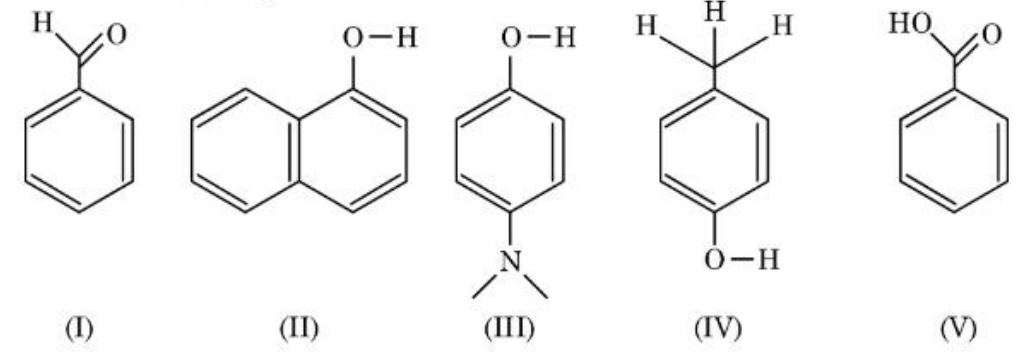
Amongst the following, the total number of compounds soluble in aqueous NaOH at room temperature is: (I) benzaldehyde (benzene ring with –CHO at the top vertex); (II) naphthalen-1-ol (naphthalene, drawn as two fused hexagons sharing a vertical edge, with –O–H on the top vertex of the right ring); (III) 4-(dimethylamino)phenol (benzene ring with –O–H at the top vertex and –N(CH₃)₂ at the bottom vertex, para); (IV) 4-(hydroxymethyl)phenol (benzene ring with –CH₂–O–H at the top vertex and –O–H at the bottom vertex, para); (V) benzoic acid (benzene ring with –C(=O)–O–H at the top vertex); (VI) N,N-dimethylcyclohexanamine (cyclohexane ring, no double bonds, with –N(CH₃)₂ at the top vertex); (VII) naphthalene-1-carboxylic acid (naphthalene with –C(=O)–O–H on the top vertex of the right ring); (VIII) 1,4-di-tert-butylbenzene (benzene ring with two tert-butyl groups, drawn as a carbon carrying three methyl lines, at the top and bottom vertices, para); (IX) naphthalen-1-ylmethanol (naphthalene with a –CH₂–O–H chain on the top vertex of the right ring).
- A5
- B4
- C6
- D3
View answer or solution
Answer
5
Organic Compounds Containing Nitrogen
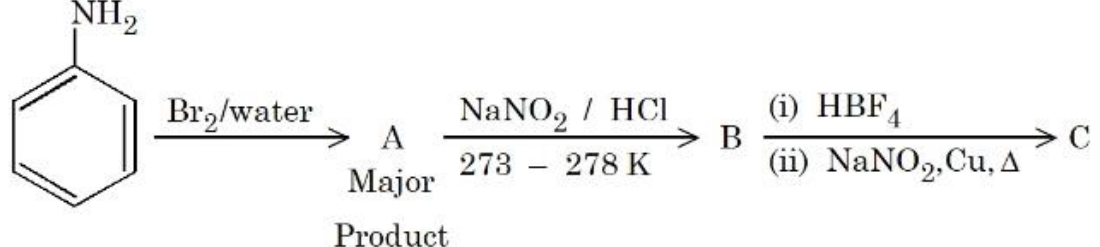
Product C of the following reaction sequence will be
- A1-Bromo-4-nitrobenzene
- B1, 3, 5-Tribromo-2-nitrobenzene
- C4-Bromo-1-nitrobenzene
- D1, 3, 5-Tribromobenzene
View answer or solution
Answer
1, 3, 5-Tribromo-2-nitrobenzene
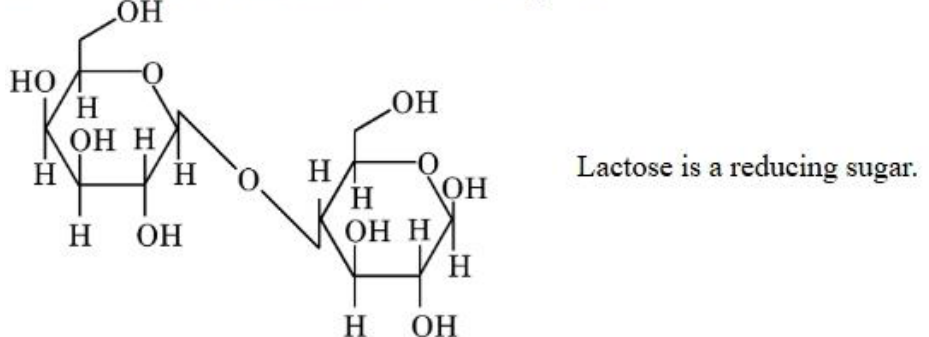
Given below are two statements: Statement I: The structure of Maltose is given below: [structure of maltose] Maltose is a non-reducing sugar. Statement II: The structure of Lactose is given below: [structure of lactose] Lactose is a reducing sugar. In the light of the above statements, choose the correct answer from the options given below
- ABoth Statement I and Statement II are true
- BBoth Statement I and Statement II are false
- CStatement I is true but Statement II is false
- DStatement I is false but Statement II is true
View answer or solution
Answer
Statement I is false but Statement II is true
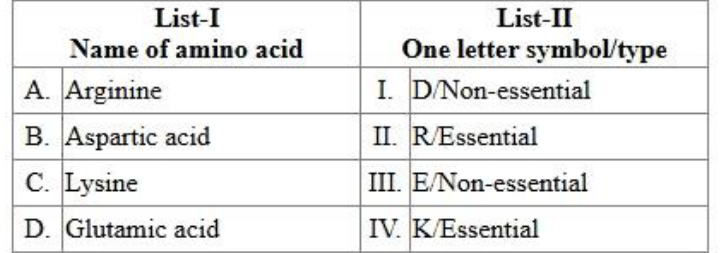
Match the LIST-I with LIST-II. List-I (Name of amino acid): A. Arginine, B. Aspartic acid, C. Lysine, D. Glutamic acid. List-II (One letter symbol/type): I. D/Non-essential, II. R/Essential, III. E/Non-essential, IV. K/Essential. Choose the correct answer from the options given below:
- AA-II, B-I, C-IV, D-III
- BA-IV, B-III, C-II, D-I
- CA-III, B-IV, C-I, D-II
- DA-II, B-IV, C-I, D-III
View answer or solution
Answer
A-II, B-I, C-IV, D-III
Organic Compounds Containing Oxygen
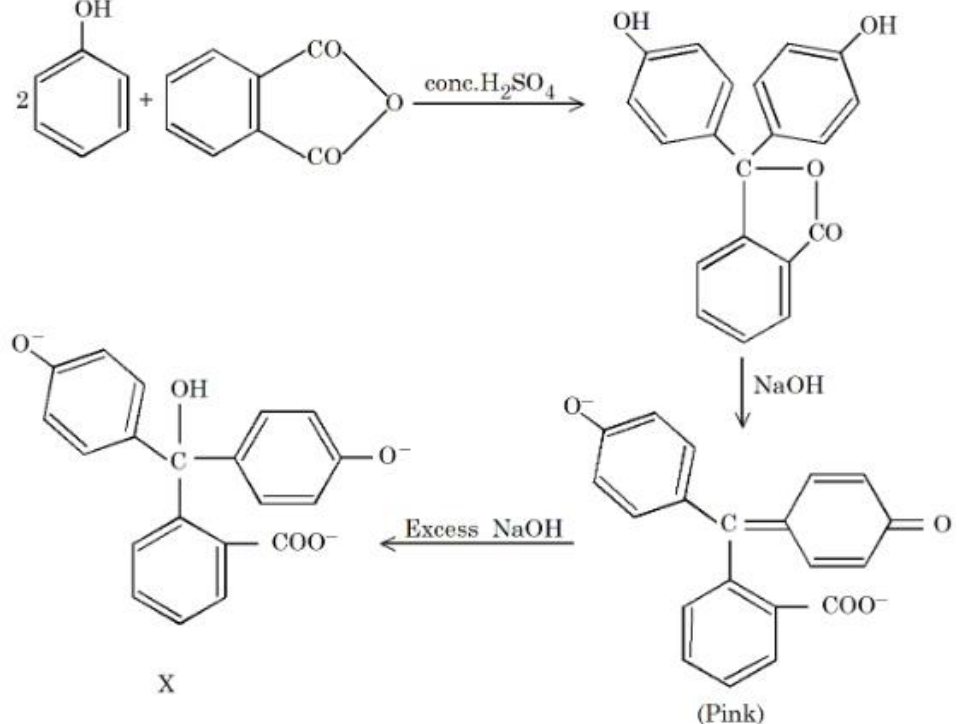
Identify the colour of compound 'X' in the sequence of the reaction.
- AViolet
- BGreen
- CRed
- DColourless
View answer or solution
Answer
Colourless
Chemical Bonding and Molecular Structure
According to Lewis theory, the total number of σ bond-pairs and lone pair of electrons around the central atom of XeO₆⁴⁻ ion is ______.
View answer or solution
Answer
6
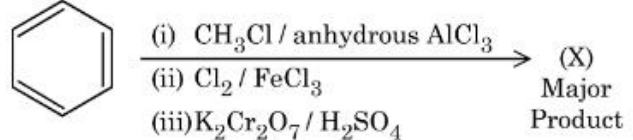
Consider the following sequence of reactions to give the major product (X). Benzene ring with a single vertical bond drawn upward from its top vertex --(i) CH₃Cl/anhydrous AlCl₃; (ii) Cl₂/FeCl₃; (iii)K₂Cr₂O₇/H₂SO₄--> (X) Major Product. P g of the major product (X) formed is reacted with NaHCO₃ solution to liberate a gas which occupied 11.2 dm³ at STP. P = _____ g. (Given molar mass in g mol⁻¹ H:1, C:12, O:16, Cl:35.5)
View answer or solution
Answer
78
Organic Compounds Containing Halogens
2.0 g of a bromo hydrocarbon (X) was subjected to Carius analysis, gave 3.36 g of AgBr. The percentage of carbon in the compound (X) is 26.7%. Total number of carbon atoms in the empirical formula for compound (X) is ______. (Given molar mass in g mol⁻¹ H:1, C:12, Br : 80, Ag : 108)
View answer or solution
Answer
5
The pH of a solution obtained by mixing 5 mL of 0.1 M NH₄OH solution with 250 mL of 0.1 M NH₄Cl solution is ______ × 10⁻². (Nearest integer) Given: pK_b (NH₄OH) = 4.74 log 2 = 0.30 log 3 = 0.48 log 5 = 0.70
View answer or solution
Answer
756
A non-volatile, non-electrolyte solid solute when dissolved in 40 g of a solvent, the vapour pressure of the solvent decreased from 760 mm Hg to 750 mm Hg. If the same solution boils at 320 K, then the number of moles of the solvent present in the solution is ______. (Nearest integer) [Given: boiling point of the pure solvent = 319.5 K. K_b of the solvent = 0.3 K kg mol⁻¹]
View answer or solution
Answer
5