
// THE QUESTION BANK
A little focus.
A better attempt.
Find your topic. Work through a few questions. Open the official answer when one is available.
Loading your next set of questions…
// THE QUESTION BANK
Find your topic. Work through a few questions. Open the official answer when one is available.
YOUR SELECTION
Showing 1–12 · 16 papers
Question 61
From JEE (Main) 2026 Session 1, 21 January 2026, Shift 1 — Paper 1 (B.E / B.Tech) Chemistry
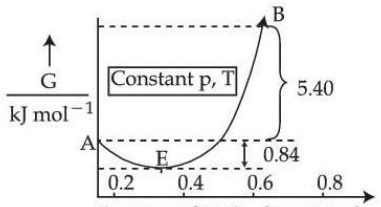
For the reaction, N₂O₄ ⇌ 2NO₂, graph is plotted as shown below. Identify correct statements. A. Standard free energy change for the reaction is −5.40 kJ mol⁻¹. B. As ΔG⊖ in graph is positive, N₂O₄ will not dissociate into NO₂ at all. C. Reverse reaction will go to completion. D. When 1 mole of N₂O₄ changes into equilibrium mixture, value of ΔG⊖ = −0.84 kJ mol⁻¹ E. When 2 mole of NO₂ changes into equilibrium mixture, ΔG⊖ for equilibrium mixture is −6.24 kJ mol⁻¹. Choose the correct answer from the options given below :
Choose an option first, then open the answer.
Question from the source paper. Answer from the official final answer key (the key rows carrying this paper's Question IDs), version of 2026-02-16. Published documents are listed by the exam body at its document index.
Question 68
From JEE (Main) 2026 Session 1, 21 January 2026, Shift 1 — Paper 1 (B.E / B.Tech) Chemistry
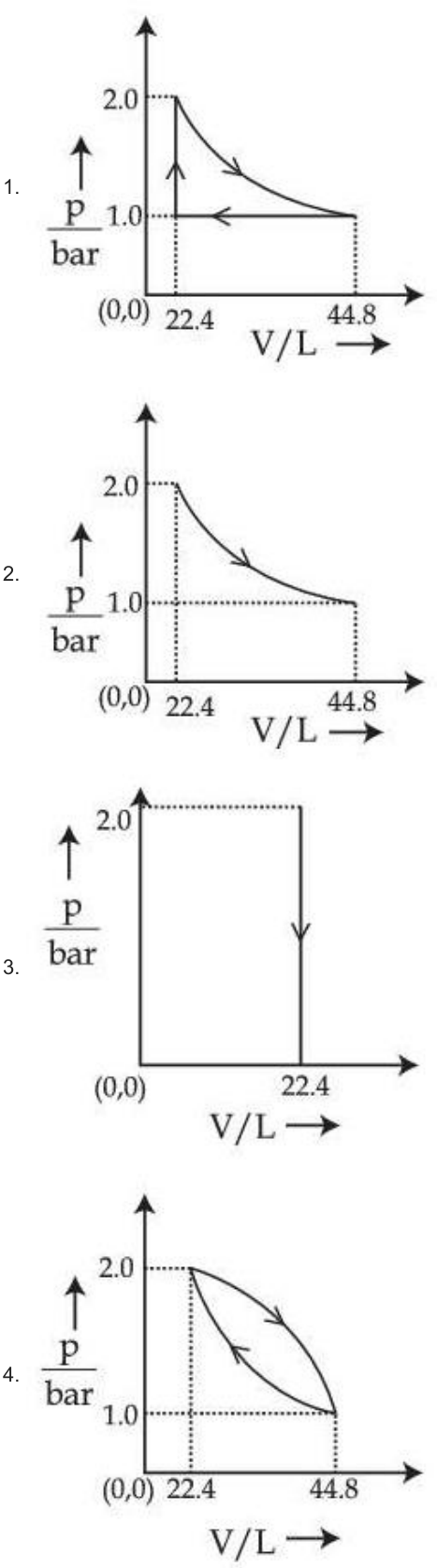
Which of the following graphs between pressure 'p' versus volume 'V' represents the maximum work done ?
Choose an option first, then open the answer.
Question from the source paper. Answer from the official final answer key (the key rows carrying this paper's Question IDs), version of 2026-02-16. Published documents are listed by the exam body at its document index.
Question 74
From JEE (Main) 2026 Session 1, 21 January 2026, Shift 1 — Paper 1 (B.E / B.Tech) Chemistry
Use the following data : | Substance | Δf H⊖ (500K) / kJ mol⁻¹ | S⊖ (500K) / J K⁻¹ mol⁻¹ | | AB(g) | 32 | 222 | | A₂(g) | 6 | 146 | | B₂(g) | x | 280 | One mole each of A₂(g) and B₂(g) are taken in a 1 L closed flask and allowed to establish the equilibrium at 500K. A₂(g) + B₂(g) ⇌ 2AB(g) The value of x (in kJ mol⁻¹) is ________. (Nearest integer) (Given : log K = 2.2 R = 8.3 J K⁻¹ mol⁻¹)
This question was printed without answer options.
Open the answer when you are ready.
Question from the source paper. Answer from the official final answer key (the key rows carrying this paper's Question IDs), version of 2026-02-16. Published documents are listed by the exam body at its document index.
Question 63
From JEE (Main) 2026 Session 1, 21 January 2026, Shift 2 — Paper 1 (B.E / B.Tech) Chemistry
Consider the following data : Δ_f H^⊖ (methane, g) = − X kJ mol⁻¹ Enthalpy of sublimation of graphite = Y kJ mol⁻¹ Dissociation enthalpy of H₂ = Z kJ mol⁻¹ The bond enthalpy of C − H bond is given by :
Choose an option first, then open the answer.
Question from the source paper. Answer from the official final answer key (the key rows carrying this paper's Question IDs), version of 2026-02-16. Published documents are listed by the exam body at its document index.
Question 64
From JEE (Main) 2026 Session 1, 21 January 2026, Shift 2 — Paper 1 (B.E / B.Tech) Chemistry
Given below are two statements : Statement I : The correct order in terms of bond dissociation enthalpy is Cl₂>Br₂>F₂>I₂. Statement II : The correct trend in the covalent character of the metal halides is [SnCl₄>SnCl₂], [PbCl₄>PbCl₂] and [UF₄>UF₆]. In the light of the above statements, choose the correct answer from the options given below :
Choose an option first, then open the answer.
Question from the source paper. Answer from the official final answer key (the key rows carrying this paper's Question IDs), version of 2026-02-16. Published documents are listed by the exam body at its document index.
Question 60
From JEE (Main) 2026 Session 1, 22 January 2026, Shift 1 — Paper 1 (B.E / B.Tech) Chemistry
Match the LIST-I with LIST-II | List-I | List-II | |---|---| | **Thermodynamic Process** | **Magnitude in kJ** | | A. Work done in reversible, isothermal expansion of 2 mol of ideal gas from 2 dm³ to 20 dm³ at 300 K. | I. 4 | | B. Work done in irreversible isothermal expansion of 1 mol ideal gas from 1 m³ to 3 m³ at 300 K against a constant pressure of 3kPa. | II. 11.5 | | C. Change in internal energy for adiabatic expansion of a 1 mol ideal gas with change of temperature = 320 K and C̄_V = 3/2 R. | III. 6 | | D. Change in enthalpy at constant pressure of 1 mol ideal gas with change of temperature = 337 K and C̄_p = 5/2 R. | IV. 7 | Choose the correct answer from the options given below:
Choose an option first, then open the answer.
Question from the source paper. Answer from the official final answer key (the key rows carrying this paper's Question IDs), version of 2026-02-16. Published documents are listed by the exam body at its document index.
Question 56
From JEE (Main) 2026 Session 1, 23 January 2026, Shift 1 — Paper 1 (B.E / B.Tech) Chemistry
A cup of water at 5°C (system) is placed in a microwave oven and the oven is turned on for one minute during which the water begins to boil. Which of the following option is true ?
Choose an option first, then open the answer.
Question from the source paper. Answer from the official final answer key (the key rows carrying this paper's Question IDs), version of 2026-02-16. Published documents are listed by the exam body at its document index.
Question 58
From JEE (Main) 2026 Session 1, 23 January 2026, Shift 2 — Paper 1 (B.E / B.Tech) Chemistry
It is noticed that Pb²⁺ is more stable than Pb⁴⁺ but Sn²⁺ is less stable than Sn⁴⁺. Observe the following reactions. PbO₂ + Pb → 2PbO; ΔᵣG°(1) SnO₂ + Sn → 2SnO; ΔᵣG°(2) Identify the correct set from the following
Choose an option first, then open the answer.
Question from the source paper. Answer from the official final answer key (the key rows carrying this paper's Question IDs), version of 2026-02-16. Published documents are listed by the exam body at its document index.
Question 61
From JEE (Main) 2026 Session 1, 24 January 2026, Shift 1 — Paper 1 (B.E / B.Tech) Chemistry — 1 question withheld: source figures unavailable
Match the LIST-I with LIST-II | List-I | List-II | |---|---| | **Isothermal process for ideal gas system** | **Work done (V_f > V_i)** | | A. Reversible expansion | I. w = 0 | | B. Free expansion | II. w = −nRT ln(V_f/V_i) | | C. Irreversible expansion | III. w = −p_ex(V_f − V_i) | | D. Irreversible compression | IV. w = −p_ex(V_i − V_f) | Choose the correct answer from the options given below:
Choose an option first, then open the answer.
Question from the source paper. Answer from the official final answer key (the key rows carrying this paper's Question IDs), version of 2026-02-16. Published documents are listed by the exam body at its document index.
Question 60
From JEE (Main) 2026 Session 1, 24 January 2026, Shift 2 — Paper 1 (B.E / B.Tech) Chemistry
The heat of atomisation of methane and ethane are 'x' kJ mol⁻¹ and 'y' kJ mol⁻¹ respectively. The longest wavelength (λ) of light capable of breaking the C–C bond can be expressed in SI unit as:
Choose an option first, then open the answer.
Question from the source paper. Answer from the official final answer key (the key rows carrying this paper's Question IDs), version of 2026-02-16. Published documents are listed by the exam body at its document index.
Question 52
From JEE (Main) 2026 Session 1, 28 January 2026, Shift 1 — Paper 1 (B.E / B.Tech) Chemistry
20.0 dm³ of an ideal gas 'X' at 600 K and 0.5 MPa undergoes isothermal reversible expansion until pressure of the gas is 0.2 MPa. Which of the following option is correct? (Given: log 2 = 0.3010 and log 5 = 0.6989)
Choose an option first, then open the answer.
Question from the source paper. Answer from the official final answer key (the key rows carrying this paper's Question IDs), version of 2026-02-16. Published documents are listed by the exam body at its document index.
Question 54
From JEE (Main) 2026 Session 2, 2 April 2026, Shift 1 — Paper 1 (B.E / B.Tech) Chemistry
Consider the following data. (i) 2Al(s) + 6HCl(aq) → Al₂Cl₆(aq) + 3H₂(g) + 1200 kJ/mol (ii) H₂(g) + Cl₂(g) → 2HCl(g) + 164 kJ/mol. (iii) HCl(g) + aq → HCl(aq) + 83 kJ/mol. (iv) Al₂Cl₆(s) + aq → Al₂Cl₆(aq) + 663 kJ/mol The enthalpy of formation of anhydrous solid Al₂Cl₆ is :
Choose an option first, then open the answer.
Question from the source paper. Answer from the official final answer key (For Centers in India), version of 2026-04-20. Published documents are listed by the exam body at its document index.
Questions the exam body withdrew, and questions that need unavailable source figures, are stored with their papers and withheld here. Each served question links to its source paper.
This is self-study practice. It does not issue assessment results, certificates or profile proof. Attempts on this page reset when you leave it.