
// JEE (Main) / 2026
JEE (Main) 2026 Session 1, 24 January 2026, Shift 2 — Paper 1 (B.E / B.Tech) Chemistry
Chemistry · B.E / B.Tech
Work through the questions
25 questions
Take a moment to try each question before opening the available answer or solution.
Some Basic Principles of Organic Chemistry
Find out the statements which are not true. A. Resonating structures with more number of covalent bonds and lesser charge separation are more stable. B. In electromeric effect, an unsaturated system shows +E effect with nucleophile and −E effect with electrophile. C. Inductive effect is responsible for high melting point, boiling point and dipole moment of polar compounds. D. The greater the number of alkyl groups attached to the doubly bonded carbon atoms, higher is the heat of hydrogenation. E. Stability of carbanion increases with the increase in s − character of the carbon carrying the negative charge. Choose the correct answer from the options given below:
- AA, C & D only
- BB, D & E only
- CA, D & E only
- DB & D only
View answer or solution
Answer
B & D only
Principles Related to Practical Chemistry
A student has planned to prepare acetanilide from aniline using acetic anhydride. The student has started from 9.3 g of aniline. However, the student has managed to obtain 11 g of dry acetanilide. The % yield of this reaction is :-
- A81.5%
- B59.5%
- C72.5%
- D97.5%
View answer or solution
Answer
81.5%
The number of possible tripeptides formed involving alanine (ala), glycine (gly) and valine (val), where no amino acid has been used more than once is:
- A8
- B3
- C6
- D4
View answer or solution
Answer
6
Two liquids A and B form an ideal solution at temperature T K. At T K, the vapour pressures of pure A and B are 55 and 15 kN m⁻² respectively. What is the mole fraction of A in solution of A and B in equilibrium with a vapour in which the mole fraction of A is 0.8?
- A0.5217
- B0.663
- C0.480
- D0.340
View answer or solution
Answer
0.5217
Chemical Bonding and Molecular Structure
Pair of species among the following having same bond order as well as paramagnetic character will be-
- AO₂⁻, N₂⁺
- BO₂⁺, N₂²⁻
- CO₂⁺, N₂⁻
- DO₂⁻, N₂⁻
View answer or solution
Answer
O₂⁺, N₂⁻
Some Basic Concepts in Chemistry
At 298 K, the mole percentage of N₂(g) in air is 80%. Water is in equilibrium with air at a pressure of 10 atm. What is the mole fraction of N₂(g) in water at 298 K? (K_H for N₂ is 6.5 × 10⁷ mm Hg)
- A1.17 × 10⁻⁴
- B1.23 × 10⁻⁷
- C9.35 × 10⁵
- D9.35 × 10⁻⁵
View answer or solution
Answer
9.35 × 10⁻⁵
Redox Reactions and Electrochemistry
Choose the INCORRECT statement
- ACO₂ is the most acidic oxide among the dioxides of group of 14 elements.
- BAmong the isotopes of carbon, ¹³C is a radioactive isotope.
- CCarbon exhibits negative oxidation states along with +4 and +2.
- DCarbon cannot exceed its covalency more than four.
View answer or solution
Answer
Among the isotopes of carbon, ¹³C is a radioactive isotope.
Organic Compounds Containing Oxygen
From the following, how many compounds contain at least one secondary alcohol? Choose the correct answer from the options given below:
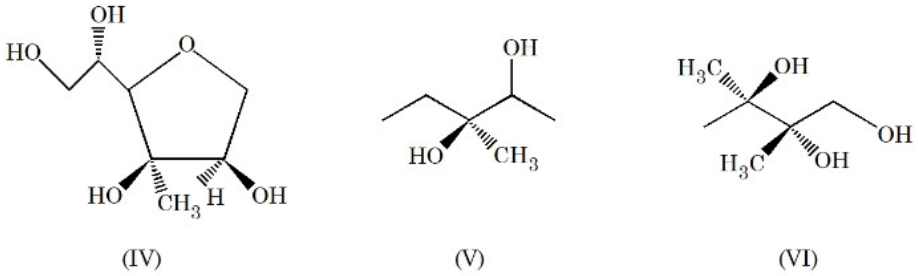
- AThree
- BTwo
- CFour
- DFive
View answer or solution
Answer
Three
Principles Related to Practical Chemistry
In the Group analysis of cations, Ba²⁺ & Ca²⁺ are precipitated respectively as
- Asulphide & sulphide
- Bcarbonate & carbonate
- Chydroxide & carbonate
- Dchromate & sulphide
View answer or solution
Answer
carbonate & carbonate
The heat of atomisation of methane and ethane are 'x' kJ mol⁻¹ and 'y' kJ mol⁻¹ respectively. The longest wavelength (λ) of light capable of breaking the C–C bond can be expressed in SI unit as:
- A(N_A hc)/(250(4y − 6x))
- BN_A hc (y − 6x/4)⁻¹
- C(N_A hc)/(250(y − 6x))
- Dhc/1000 ((y − 6x)/4)⁻¹
View answer or solution
Answer
(N_A hc)/(250(4y − 6x))
The wavelength of light absorbed for the following complexes are in the order [Co(NH₃)₆]³⁺ ; [Co(H₂O)₆]³⁺ ; [Co(CN)₆]³⁻ ; [Co(NH₃)₅(H₂O)]³⁺; [CoF₆]³⁻ (I) (II) (III) (IV) (V)
- AIII < I < IV < II < V
- BIII < IV < I < II < V
- CIII < I < IV < V < II
- DIII < I < II < IV < V
View answer or solution
Answer
III < I < IV < II < V
Consider the following gaseous equilibrium in a closed container of volume ‘V’ at T(K). P₂(g) + Q₂(g) ⇌ 2PQ(g) 2 moles each of P₂(g), Q₂(g) and PQ(g) are present at equilibrium. Now one mole each of 'P₂' and 'Q₂' are added to the equilibrium keeping the temperature at T(K). The number of moles of P₂, Q₂ and PQ at the new equilibrium, respectively, are
- A2.67, 2.67, 2.67
- B2.56, 1.62, 2.24
- C1.21, 2.24, 1.56
- D1.66, 1.66, 1.66
View answer or solution
Answer
2.67, 2.67, 2.67
Classification of Elements and Periodicity in Properties
The correct order of C, N, O and F in terms of second ionisation potential is
- AF < N < C < O
- BC < O < N < F
- CC < F < N < O
- DC < N < F < O
View answer or solution
Answer
C < N < F < O
Redox Reactions and Electrochemistry
"X" is an oxoanion of the lightest element of group 7 (in the periodic table). The metal is in +6 oxidation state in "X". The color of the potassium salt of X is
- Apurple
- Byellow
- Corange
- Dgreen
View answer or solution
Answer
green
Some Basic Concepts in Chemistry
One mole of Cl₂(g) was passed into 2 L of cold 2M KOH solution. After the reaction, the concentrations of Cl⁻, ClO⁻ and OH⁻ are respectively (assume volume remains constant)
- A0.75M, 0.75M, 1M
- B0.5M, 0.5M, 1M
- C0.5M, 0.5M, 0.5M
- D1M, 1M, 1M
View answer or solution
Answer
0.5M, 0.5M, 1M
Some Basic Principles of Organic Chemistry
Given below are two statements: Statement I: There are several conformers for n-butane. Out of those conformers, (X) is the least stable and most stable conformer is (Y) Statement II: As the dihedral angle increases, torsional strain decreases from (X) to (Y). In the light of the above statements, choose the correct answer from the options given below
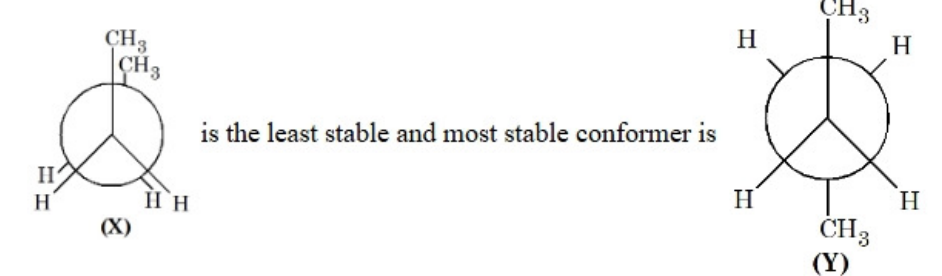
- AStatement I is false but Statement II is true
- BBoth Statement I and Statement II are true
- CStatement I is true but Statement II is false
- DBoth Statement I and Statement II are false
View answer or solution
Answer
Both Statement I and Statement II are true
Organic Compounds Containing Oxygen
The unsaturated ether on acidic hydrolysis produces carbonyl compounds as shown below:- CH₃ − CH = CH − O − CH = CH₂ ↓ H₃O⁽⁺⁾ CH₃ − CH₂ − CH = O and O = CH − CH₃ Based on this, predict the solution/reagent that will help to distinguish "P" and "Q" obtained in the following reaction:- CH₃ − CH = CH − O − C(CH₃) = CH₂ →(H₃O⁽⁺⁾, Δ) P + Q
- ALucas reagent
- BSaturated NaHSO₃ solution
- CFehling solution
- D2, 4 - DNP reagent
View answer or solution
Answer
Fehling solution
Chemical Bonding and Molecular Structure
Given below are two statements: Statement I: The dipole moment of R-CN is greater than R-NC and R-NC can undergo hydrolysis under acidic medium to produce R − C(=O) − OH. Statement II: R-CN hydrolyses under acidic medium to produce a compound which on treatment with SOCl₂, followed by the addition of NH₃ gives another compound(x). This compound (x) on treatment with NaOCl/NaOH gives a product, that on treatment with CHCl₃/KOH/Δ produces R-NC In the light of the above statements, choose the correct answer from the options given below
- AStatement I is true but Statement II is false
- BBoth Statement I and Statement II are true
- CBoth Statement I and Statement II are false
- DStatement I is false but Statement II is true
View answer or solution
Answer
Statement I is false but Statement II is true
The wavelength of spectral line obtained in the spectrum of Li²⁺ ion, when the transition takes place between two levels whose sum is 4 and difference is 2, is
- A2.28 × 10⁻⁷ cm
- B2.28 × 10⁻⁶ cm
- C1.14 × 10⁻⁷ cm
- D1.14 × 10⁻⁶ cm
View answer or solution
Answer
1.14 × 10⁻⁶ cm
Organic Compounds Containing Oxygen
Given below are two statements: Statement I: Cross aldol condensation between two different aldehydes will always produce four different products. Statement II: When semicarbazide reacts with a mixture of benzaldehyde and acetophenone under optimum pH, it forms a condensation product with acetophenone only. In the light of the above statements, choose the correct answer from the options given below
- AStatement I is true but Statement II is false
- BBoth Statement I and Statement II are true
- CStatement I is false but Statement II is true
- DBoth Statement I and Statement II are false
View answer or solution
Answer
Both Statement I and Statement II are false
Organic Compounds Containing Halogens
Grignard reagent RMgBr (P) reacts with water and forms a gas (Q). One gram of Q occupies 1.4 dm³ at STP. (P) on reaction with dry ice in dry ether followed by H₃O⁺ forms a compound (Z). 0.1 mole of (Z) will weigh ______ g. (Nearest integer)
View answer or solution
Answer
6
Molar conductivity of a weak acid HQ of concentration 0.18 M was found to be 1/30 of the molar conductivity of another weak acid HZ with concentration of 0.02 M. If λ°_Q⁻ happened to be equal with λ°_Z⁻, then the difference of the pKₐ values of the two weak acids (pKₐ(HQ) − pKₐ(HZ)) is ______ (Nearest integer). [Given: degree of dissociation (α) << 1 for both weak acids, λ° : limiting molar conductivity of ions]
View answer or solution
Answer
2
The half–life of ⁶⁵Zn is 245 days. After x days, 75% of original activity remained. The value of x in days is ______. (Nearest integer) (Given: log 3 = 0.4771 and log 2 = 0.3010)
View answer or solution
Answer
102
A chromium complex with a formula CrCl₃.6H₂O has a spin only magnetic moment value of 3.87 BM and its solution conductivity corresponds to 1 : 2 electrolyte. 2.75 g of the complex solution was initially passed through a cation exchanger. The solution obtained after the process was reacted with excess of AgNO₃. The amount of AgCl formed in the above process is ____ g. (Nearest integer) [Given: Molar mass in g mol⁻¹ Cr : 52; Cl: 35.5, Ag:108, O:16, H:1]
View answer or solution
Answer
3
Some Basic Concepts in Chemistry
0.25 g of an organic compound "A" containing carbon, hydrogen and oxygen was analysed using the combustion method. There was an increase in mass of CaCl₂ tube and potash tube at the end of the experiment. The amount was found to be 0.15 g and 0.1837 g, respectively. The percentage of oxygen in compound A is ______ %. (Nearest integer) (Given: molar mass in g mol⁻¹ H : 1, C : 12, O : 16)
View answer or solution
Answer
73