
// JEE (Main) / 2026
JEE (Main) 2026 Session 1, 23 January 2026, Shift 2 — Paper 1 (B.E / B.Tech) Chemistry
Chemistry · B.E / B.Tech
Work through the questions
25 questions
Take a moment to try each question before opening the available answer or solution.
Identify the CORRECT set of details from the following: A. [Co(NH₃)₆]³⁺ : Inner orbital complex; d²sp³ hybridized B. [MnCl₆]³⁻ : Outer orbital complex; sp³d² hybridized C. [CoF₆]³⁻ : Outer orbital complex; d²sp³ hybridized D. [FeF₆]³⁻ : Outer orbital complex; sp³d² hybridized E. [Ni(CN)₄]²⁻ : Inner orbital complex; sp³ hybridized Choose the correct answer from the options given below:
- AA, B & D Only
- BC & D Only
- CA, B, C, D & E
- DA, C & E Only
View answer or solution
Answer
A, B & D Only
Classification of Elements and Periodicity in Properties
Given below are two statements: Statement I: The second ionisation enthalpy of Na is larger than the corresponding ionisation enthalpy of Mg. Statement II: The ionic radius of O²⁻ is larger than that of F⁻. In the light of the above statements, choose the correct answer from the options given below
- AStatement I is false but Statement II is true
- BBoth Statement I and Statement II are true
- CStatement I is true but Statement II is false
- DBoth Statement I and Statement II are false
View answer or solution
Answer
Both Statement I and Statement II are true
Redox Reactions and Electrochemistry
Consider the above electrochemical cell where a metal electrode (M) is undergoing redox reaction by forming M⁺ (M → M⁺ + e⁻). The cation M⁺ is present in two different concentrations c₁ and c₂ as shown above. Which of the following statement is correct for generating a positive cell potential?
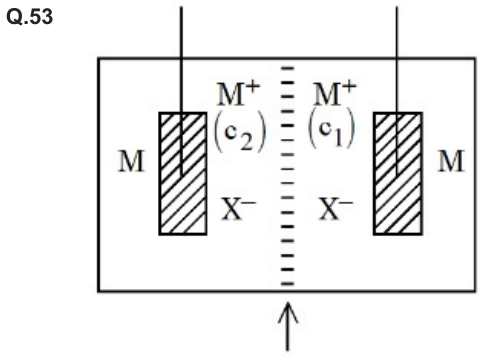
- AIf c₁ is present at anode, then c₁ = c₂.
- BIf c₁ is present at cathode, then c₁ > c₂.
- CIf c₁ is present at anode, then c₁ > c₂.
- DIf c₁ is present at cathode, then c₁ < c₂.
View answer or solution
Answer
If c₁ is present at cathode, then c₁ > c₂.
Identify the INCORRECT statements from the following: A. Notation ²⁴₁₂Mg represents 24 protons and 12 neutrons. B. Wavelength of a radiation of frequency 4.5 × 10¹⁵ s⁻¹ is 6.7 × 10⁻⁸ m. C. One radiation has wavelength = λ₁ (900 nm) and energy = E₁. Other radiation has wavelength = λ₂ (300 nm) and energy = E₂. E₁ : E₂ = 3 : 1. D. Number of photons of light of wavelength 2000 pm that provides 1 J of energy is 1.006 × 10¹⁶. Choose the correct answer from the options given below:
- AA and B Only
- BA and C Only
- CA and D Only
- DB and C Only
View answer or solution
Answer
A and C Only
Some Basic Concepts in Chemistry
A student has been given a compound "x" of molecular formula- C₆H₇N. 'x' is sparingly soluble in water. However, on addition of dilute mineral acid, 'x' becomes soluble in water. 'x' when treated with CHCl₃ and KOH(alc), 'y' is produced. 'y' has a specific unpleasant smell. On treatment with benzenesulphonyl chloride, 'x' gives a compound 'z' which is soluble in alkali. The number of different "H" atoms present in 'z' is:-
- A5
- B8
- C4
- D7
View answer or solution
Answer
7
Organic Compounds Containing Oxygen
A mixed ether (P), when heated with excess of hot concentrated hydrogen iodide produces two different alkyl iodides which when treated with aq. NaOH give compounds (Q) and (R). Both (Q) and (R) give yellow precipitate with NaOI. Identify the mixed ether (P):
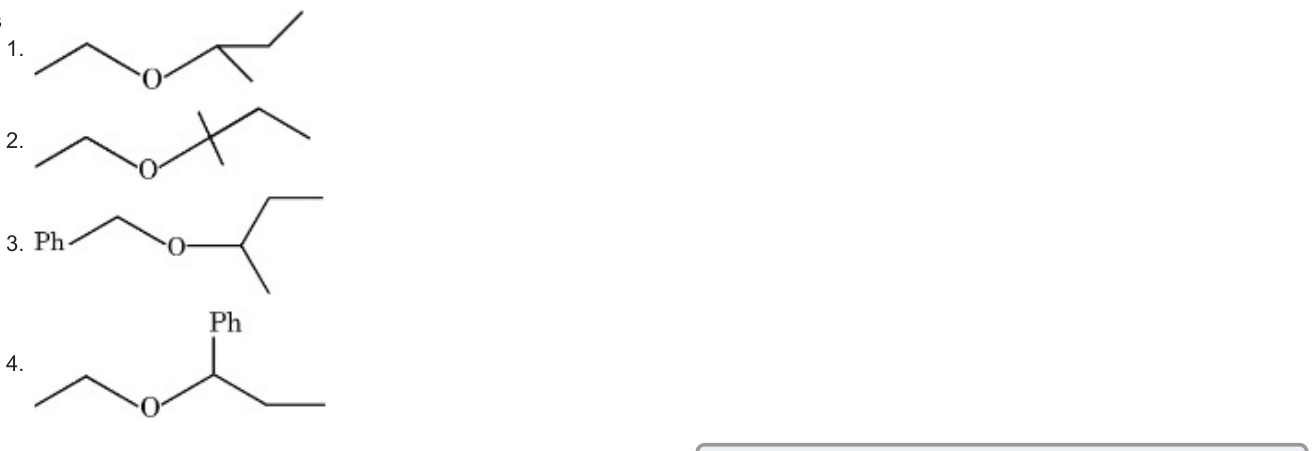
- ACH₃CH₂–O–CH(CH₃)–CH₂CH₃ (skeletal drawing: an ethyl group on the left bonded to O, and O bonded to a CH that carries a methyl branch running down-right and an ethyl chain running to the right)
- BCH₃CH₂–O–C(CH₃)₂–CH₂CH₃ (skeletal drawing: an ethyl group on the left bonded to O, and O bonded to a carbon that carries two methyl branches, one up-left and one down-right, and an ethyl chain running to the upper right)
- CC₆H₅CH₂–O–CH(CH₃)–CH₂CH₃ (skeletal drawing: 'Ph' bonded to a CH₂ which is bonded to O, and O bonded to a CH that carries a methyl branch running down-right and an ethyl chain running to the upper right)
- DCH₃CH₂–O–CH(C₆H₅)–CH₂CH₃ (skeletal drawing: an ethyl group on the left bonded to O, and O bonded to a CH that carries 'Ph' on a vertical bond above and an ethyl chain running to the lower right)
View answer or solution
Answer
CH₃CH₂–O–CH(CH₃)–CH₂CH₃ (skeletal drawing: an ethyl group on the left bonded to O, and O bonded to a CH that carries a methyl branch running down-right and an ethyl chain running to the right)
Observe the following reactions at T(K). I. A → products. II. 5Br⁻(aq) + BrO₃⁻(aq) + 6H⁺(aq) → 3Br₂(aq) + 3H₂O(l) Both the reactions are started at 10.00 am. The rates of these reactions at 10.10 am are same. The value of −Δ[Br⁻]/Δt at 10.10 am is 2 × 10⁻⁴ mol L⁻¹ min⁻¹. The concentration of A at 10.10 am is 10⁻² mol L⁻¹. What is the first order rate constant (in min⁻¹) of reaction I?
- A2 × 10⁻³
- B10⁻³
- C10⁻²
- D4 × 10⁻³
View answer or solution
Answer
4 × 10⁻³
It is noticed that Pb²⁺ is more stable than Pb⁴⁺ but Sn²⁺ is less stable than Sn⁴⁺. Observe the following reactions. PbO₂ + Pb → 2PbO; ΔᵣG°(1) SnO₂ + Sn → 2SnO; ΔᵣG°(2) Identify the correct set from the following
- AΔᵣG°(1) < 0 ; ΔᵣG°(2) < 0
- BΔᵣG°(1) > 0 ; ΔᵣG°(2) > 0
- CΔᵣG°(1) < 0 ; ΔᵣG°(2) > 0
- DΔᵣG°(1) > 0 ; ΔᵣG°(2) < 0
View answer or solution
Answer
ΔᵣG°(1) < 0 ; ΔᵣG°(2) > 0
Redox Reactions and Electrochemistry
The oxidation state of chromium in the final product formed in the reaction between KI and acidified K₂Cr₂O₇ solution is:
- A+4
- B+2
- C+3
- D+6
View answer or solution
Answer
+3
Chemical Bonding and Molecular Structure
Which statements are NOT TRUE about XeO₂F₂? A. It has a see-saw shape. B. Xe has 5 electron pairs in its valence shell in XeO₂F₂. C. The O–Xe–O bond angle is close to 180°. D. The F–Xe–F bond angle is close to 180°. E. Xe has 16 valence electrons in XeO₂F₂. Choose the correct answer from the options given below:
- AB and D Only
- BA and D Only
- CB, D and E Only
- DB, C and E Only
View answer or solution
Answer
B, C and E Only
Some Basic Principles of Organic Chemistry
Given below are two statements: Statement I: (CH₃)₃C⊕ is more stable than CH₃⊕ as nine hyperconjugation interactions are possible in (CH₃)₃C⊕. Statement II: CH₃⊕ is less stable than (CH₃)₃C⊕ as only three hyperconjugation interactions are possible in CH₃⊕. In the light of the above statements, choose the correct answer from the options given below
- AStatement I is true but Statement II is false
- BBoth Statement I and Statement II are true
- CStatement I is false but Statement II is true
- DBoth Statement I and Statement II are false
View answer or solution
Answer
Statement I is true but Statement II is false
Given above is the concentration vs time plot for a dissociation reaction : A → nB . Based on the data of the initial phase of the reaction (initial 10 min), the value of n is ______.
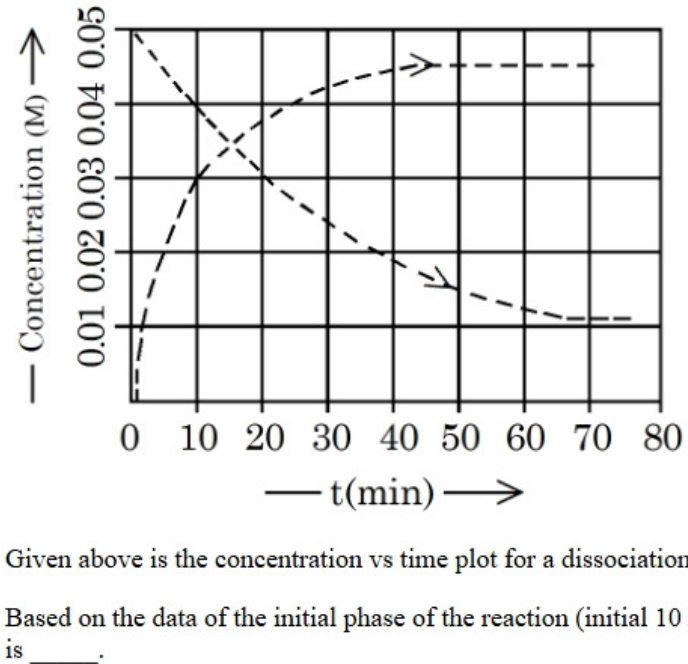
- A3
- B2
- C4
- D5
View answer or solution
Answer
3
Organic Compounds Containing Halogens
Iodoform test can differentiate between A. Methanol and Ethanol B. CH₃COOH and CH₃CH₂COOH C. Cyclohexene and cyclohexanone D. Diethyl ether and Pentan-3-one E. Anisole and acetone Choose the correct answer from the options given below:
- AA & D Only
- BA & E Only
- CA, B & E Only
- DB, C & E Only
View answer or solution
Answer
A & E Only
Chemical Bonding and Molecular Structure
Elements X and Y belong to Group 15. The difference between the electronegativity values of 'X' and phosphorus is higher than that of the difference between phosphorus and 'Y'. 'X' & 'Y' are respectively
- AAs & Bi
- BBi & N
- CAs & Sb
- DN & As
View answer or solution
Answer
N & As
Some Basic Principles of Organic Chemistry
Both human DNA and RNA are chiral molecules. The chirality in DNA and RNA arises due to the presence of
- AChiral phosphate unit
- BD–sugar component
- CBase unit
- DL–sugar component
View answer or solution
Answer
D–sugar component
Organic Compounds Containing Halogens
(i) Zn, Δ (ii) HBr ⟶ (P) Major Product Identify (P)
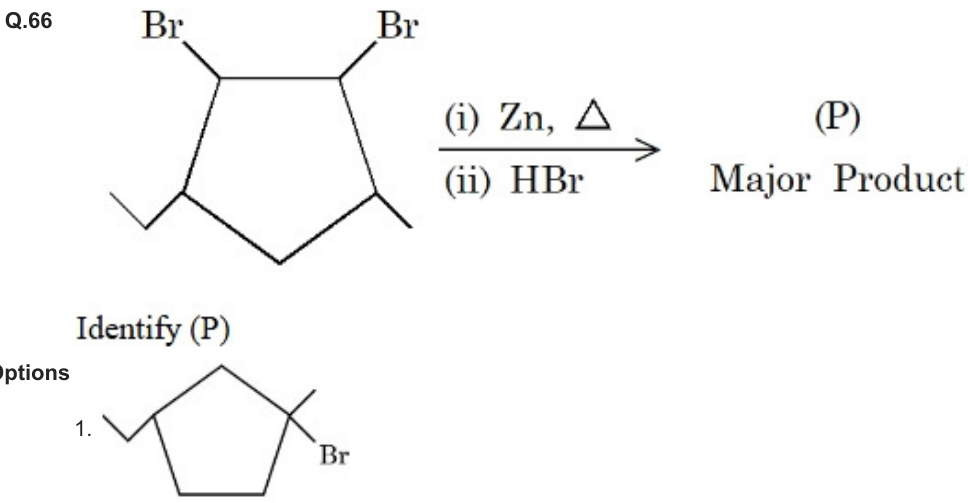
- ACyclopentane ring carrying Br and CH₃ on the same carbon and an ethyl group on the carbon three positions away from it (1-bromo-3-ethyl-1-methylcyclopentane)
- BCyclopentane ring carrying Br and an ethyl group on the same carbon and a methyl group on the carbon three positions away from it (1-bromo-1-ethyl-3-methylcyclopentane)
- CCyclopentane ring carrying Br on one carbon, an ethyl group on the adjacent carbon and a methyl group on the fourth carbon (1-bromo-2-ethyl-4-methylcyclopentane)
- DCyclopentane ring carrying Br on one carbon, an ethyl group on one adjacent carbon and a methyl group on the other adjacent carbon (1-bromo-2-ethyl-5-methylcyclopentane)
View answer or solution
Answer
Cyclopentane ring carrying Br and CH₃ on the same carbon and an ethyl group on the carbon three positions away from it (1-bromo-3-ethyl-1-methylcyclopentane)
Purification and Characterisation of Organic Compounds
In Carius method 0.2425 g of an organic compound gave 0.5253 g silver chloride. The percentage of chlorine in the organic compound is
- A34.79%
- B37.57%
- C87.65%
- D53.58%
View answer or solution
Answer
53.58%
The work functions of two metals (M_A and M_B) are in the 1 : 2 ratio. When these metals are exposed to photons of energy 6 eV, the kinetic energy of liberated electrons of M_A : M_B is in the ratio of 2.642 : 1. The work functions (in eV) of M_A and M_B are respectively.
- A1.4, 2.8
- B3.1, 6.2
- C1.5, 3.0
- D2.3, 4.6
View answer or solution
Answer
2.3, 4.6
Given below are two statements: Statement I: [benzene ring drawn in Kekulé style with NH₂ on the upper-right vertex and NH₂ on the lower-right vertex] can be synthesized from [benzene ring drawn in Kekulé style with a —CH₂—CH₂—CH₃ chain on the upper-right vertex and a —CH₂—CH₂—CH₃ chain on the lower-right vertex] using simpler reagents in the order i) Acidic KMnO₄, ii) Ammonia, iii) Bromine and alkali Statement II: [benzene ring drawn with a circle inside, CH₃ on the top vertex and NH₂ on the bottom vertex] can be converted into [benzene ring drawn with a circle inside, CH₃ on the top vertex, Br on the lower-left vertex and Br on the lower-right vertex] using reagents in the order i) Bromine-H₂O ii) NaNO₂/HCl (0 - 5 °C) (iii) Aq. H₃PO₂. In the light of the above statements, choose the correct answer from the options given below
- AStatement I is true but Statement II is false
- BBoth Statement I and Statement II are true
- CStatement I is false but Statement II is true
- DBoth Statement I and Statement II are false
View answer or solution
Answer
Both Statement I and Statement II are true
Organic Compounds Containing Oxygen
Which of the following statements are TRUE about Haloform reaction?: A. Sodium hypochlorite reacts with KI to give KOI. B. KOI is a reducing agent. C. α, β-unsaturated methylketone (CH₃—CH=CH—C(=O)—CH₃) will give iodoform reaction. D. Isopropyl alcohol will not give iodoform test. E. Methanoic acid will give positive iodoform test. Choose the correct answer from the options given below:

- AB, D & E Only
- BA, B & C Only
- CA, C & E Only
- DA & C Only
View answer or solution
Answer
A & C Only
Two liquids A and B form an ideal solution. At 320 K, the vapour pressure of the solution, containing 3 mol of A and 1 mol of B is 500 mm Hg. At the same temperature, if 1 mol of A is further added to this solution, vapour pressure of the solution increases by 20 mm Hg. Vapour pressure (in mm Hg) of B in pure state is _______. (Nearest integer)
View answer or solution
Answer
200
Consider the following reaction of benzene. [benzene ring drawn in Kekulé style + H₃C—C(=O)—CH₂—CH₂—C(=O)—Cl —(anhydrous AlCl₃)→ (P) —(aq NaOH, Δ)→ (Q)] In compound (Q), the percentage of oxygen is ________%. (Nearest integer)

View answer or solution
Answer
10
Principles Related to Practical Chemistry
200 cc of x × 10⁻³ M potassium dichromate is required to oxidise 750 cc of 0.6 M Mohr's salt solution in acidic medium. Here x = ______.
View answer or solution
Answer
375
Total number of unpaired electrons present in the central metal atoms/ions of [Ni(CO)₄], [NiCl₄]²⁻, [PtCl₂(NH₃)₂], [Ni(CN)₄]²⁻ and [Pt(CN)₄]²⁻ is ________.
View answer or solution
Answer
2
X₂(g) + Y₂(g) ⇌ 2Z(g) X₂(g) and Y₂(g) are added to a 1 L flask and it is found that the system attains the above equilibrium at T(K) with the number of moles of X₂(g), Y₂(g) and Z(g) being 3, 3 and 9 mol respectively (equilibrium moles). Under this condition of equilibrium, 10 mol of Z(g) is added to the flask and the temperature is maintained at T(K). Then the number of moles of Z(g) in the flask when the new equilibrium is established is ______. (Nearest integer)
View answer or solution
Answer
15