
// JEE (Main) / 2026
JEE (Main) 2026 Session 1, 22 January 2026, Shift 1 — Paper 1 (B.E / B.Tech) Chemistry
Chemistry · B.E / B.Tech
Work through the questions
25 questions
Take a moment to try each question before opening the available answer or solution.
Some Basic Concepts in Chemistry
Consider a solution of CO₂(g) dissolved in water in a closed container. Which one of the following plots correctly represents variation of log (partial pressure of CO₂ in vapour phase above water) [y-axis] with log (mole fraction of CO₂ in water) [x-axis] at 25°C?
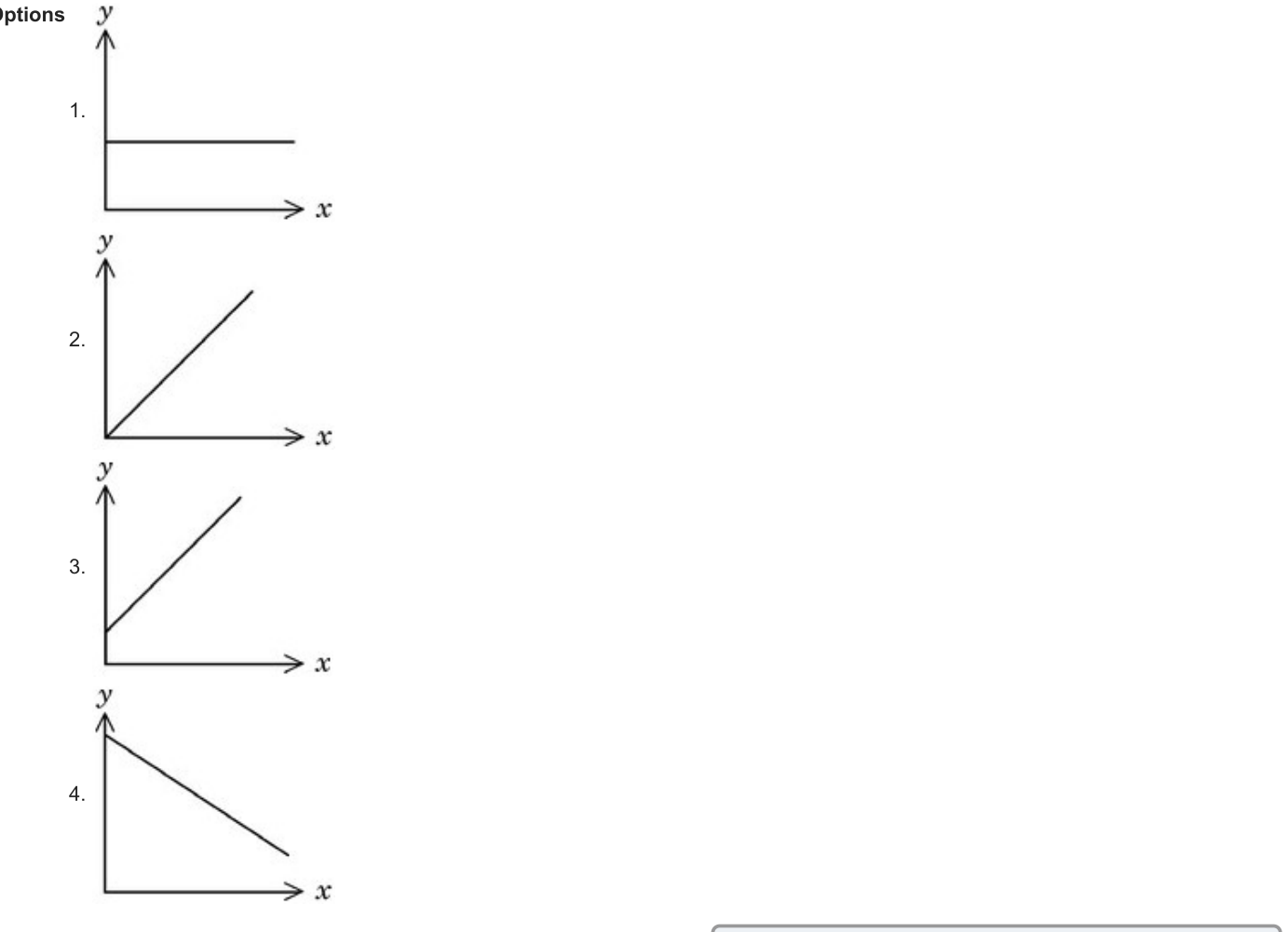
- AGraph: a horizontal line parallel to the x-axis, starting on the y-axis above the origin.
- BGraph: a straight line through the origin with positive slope.
- CGraph: a straight line with positive slope, starting on the y-axis above the origin.
- DGraph: a straight line with negative slope, starting on the y-axis above the origin.
View answer or solution
Answer
Graph: a straight line with positive slope, starting on the y-axis above the origin.
Given below are two statements: Statement I: The Henry’s law constant K_H is constant with respect to variations in solution’s concentration over the range for which the solution is ideally dilute. Statement II: K_H does not differ for the same solute in different solvents. In the light of the above statements, choose the correct answer from the options given below
- ABoth Statement I and Statement II are true
- BBoth Statement I and Statement II are false
- CStatement I is true but Statement II is false
- DStatement I is false but Statement II is true
View answer or solution
Answer
Statement I is true but Statement II is false
Some Basic Principles of Organic Chemistry
The correct order of reactivity of CH₃Br in methanol with the following nucleophiles is F⁻, I⁻, C₂H₅O⁻ and C₆H₅O⁻
- AI⁻ > C₂H₅O⁻ > C₆H₅O⁻ > F⁻
- BI⁻ > C₆H₅O⁻ > F⁻ > C₂H₅O⁻
- CI⁻ > C₂H₅O⁻ > F⁻ > C₆H₅O⁻
- DI⁻ > F⁻ > C₆H₅O⁻ > C₂H₅O⁻
View answer or solution
Answer
I⁻ > C₂H₅O⁻ > C₆H₅O⁻ > F⁻
Given below are two statements: Statement I: The halogen that makes longest bond with hydrogen in HX, has the smallest covalent radius in its group. Statement II: A group 15 element’s hydride EH₃ has the lowest boiling point among corresponding hydrides of other group 15 elements. The maximum covalency of that element E is 4. In the light of the above statements, choose the correct answer from the options given below
- AStatement I is true but Statement II is false
- BBoth Statement I and Statement II are false
- CStatement I is false but Statement II is true
- DBoth Statement I and Statement II are true
View answer or solution
Answer
Both Statement I and Statement II are false
Given below are two statements: Statement I: Sucrose is dextrorotatory. However, sucrose upon hydrolysis gives a solution having mixture of products. This solution shows laevorotation. Statement II: Hydrolysis of sucrose gives glucose and fructose. Since the laevorotation of glucose is more than the dextrorotation of fructose, the resulting solution becomes laevorotatory. In the light of the above statements, choose the correct answer from the options given below
- ABoth Statement I and Statement II are true
- BBoth Statement I and Statement II are false
- CStatement I is false but Statement II is true
- DStatement I is true but Statement II is false
View answer or solution
Answer
Statement I is true but Statement II is false
Some Basic Concepts in Chemistry
In the reaction, 2Al(s) + 6HCl (aq) → 2 Al³⁺(aq) + 6 Cl⁻(aq) + 3H₂(g)
- A67.2 L H₂(g) at STP is produced for every mole of Al that reacts.
- B11.2 L H₂(g) at STP is produced for every mole of HCl consumed.
- C33.6 L H₂(g) is produced regardless of temperature and pressure for every mole of Al that reacts.
- D12 L HCl(aq) is consumed for every 6L H₂(g) produced.
View answer or solution
Answer
11.2 L H₂(g) at STP is produced for every mole of HCl consumed.
A → product (First order reaction). Three sets of experiment were performed for a reaction under similar experimental conditions: Run 1 ⇒ 100 mL of 10 M solution of reactant A Run 2 ⇒ 200 mL of 10 M solution of reactant A Run 3 ⇒ 100 mL of 10 M solution of reactant A + 100 mL of H₂O added. The correct variation of rate of reaction is
- ARun 1 = Run 2 = Run 3
- BRun 1 < Run 2 < Run 3
- CRun 3 < Run 1 = Run 2
- DRun 3 < Run 1 < Run 2
View answer or solution
Answer
Run 3 < Run 1 = Run 2
Organic Compounds Containing Oxygen
Match the LIST-I with LIST-II List-I: Reagents A. NH₂ – NH₂, KOH B. Ag(NH₃)₂OH C. Aq. CuSO₄, Sodium Potassium tartrate, KOH D. Zn - Hg, HCl List-II: Name of Reaction involving carbonyl compounds I. Tollen’s Test II. Clemmensen Reduction III. Wolff - Kishner Reduction IV. Fehling’s Test Choose the correct answer from the options given below:
- AA-III, B-IV, C-I, D-II
- BA-II, B-I, C-IV, D-III
- CA-IV, B-III, C-II, D-I
- DA-III, B-I, C-IV, D-II
View answer or solution
Answer
A-III, B-I, C-IV, D-II
A first row transition metal (M) does not liberate H₂ gas from dilute HCl. 1 mol of aqueous solution of MSO₄ is treated with excess of aqueous KCN and then H₂S(g) is passed through the solution. The amount of MS (metal sulphide) formed from the above reaction is ________ mol.
- A3
- B2
- C0
- D1
View answer or solution
Answer
0
Match the LIST-I with LIST-II | List-I | List-II | |---|---| | **Thermodynamic Process** | **Magnitude in kJ** | | A. Work done in reversible, isothermal expansion of 2 mol of ideal gas from 2 dm³ to 20 dm³ at 300 K. | I. 4 | | B. Work done in irreversible isothermal expansion of 1 mol ideal gas from 1 m³ to 3 m³ at 300 K against a constant pressure of 3kPa. | II. 11.5 | | C. Change in internal energy for adiabatic expansion of a 1 mol ideal gas with change of temperature = 320 K and C̄_V = 3/2 R. | III. 6 | | D. Change in enthalpy at constant pressure of 1 mol ideal gas with change of temperature = 337 K and C̄_p = 5/2 R. | IV. 7 | Choose the correct answer from the options given below:
- AA-III, B-II, C-IV, D-I
- BA-I, B-II, C-III, D-IV
- CA-II, B-I, C-III, D-IV
- DA-II, B-III, C-I, D-IV
View answer or solution
Answer
A-II, B-III, C-I, D-IV
Purification and Characterisation of Organic Compounds
Given below are two statements: Statement I: Phenol on treatment with CHCl₃/aq. KOH under refluxing condition, followed by acidification produces p-hydroxy benzaldehyde as the major product and o-hydroxy benzaldehyde as the minor product. Statement II: The mixture of p-hydroxybenzaldehyde and o-hydroxybenzaldehyde can be easily separated through steam distillation. In the light of the above statements, choose the correct answer from the options given below
- ABoth Statement I and Statement II are false
- BStatement I is false but Statement II is true
- CBoth Statement I and Statement II are true
- DStatement I is true but Statement II is false
View answer or solution
Answer
Statement I is false but Statement II is true
Classification of Elements and Periodicity in Properties
A ‘p’-block element (E) and hydrogen form a binary cation (EHₓ)⁺, while EH₃ on treatment with K₂HgI₄ in alkaline medium gives a precipitate of basic mercury(II)amido-iodine. Given below are first ionisation enthalpy values (kJ mol⁻¹) for first element each from group 13, 14, 15 and 16. Identify the correct first ionisation enthalpy value for element E.
- A1086
- B801
- C1312
- D1402
View answer or solution
Answer
1402
Some Basic Principles of Organic Chemistry
The correct order of the rate of reaction of the following reactants with nucleophile by S_N1 mechanism is : (Given : Structures I and II are rigid)
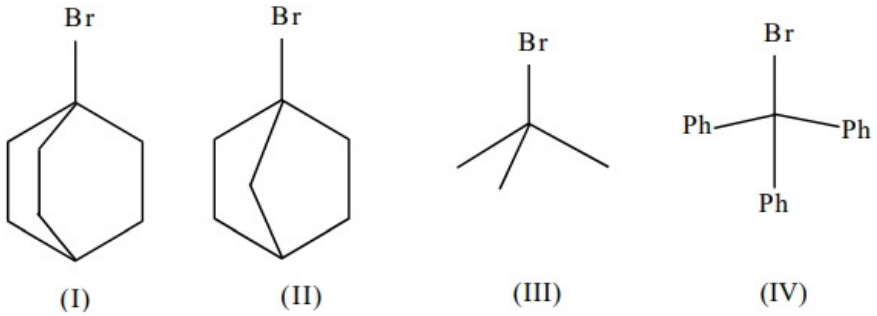
- AI < II < III < IV
- BII < I < III < IV
- CIV < III < II < I
- DIII < I < II < IV
View answer or solution
Answer
II < I < III < IV
'A' is a neutral organic compound (M. F : C₈H₉ON). On treatment with aqueous Br₂/HO⁻(−), 'A' forms a compound 'B' which is soluble in dilute acid. 'B' on treatment with aqueous NaNO₂ / HCl (0-5 °C) produces a compound 'C' which on treatment with CuCN/NaCN produces 'D'. Hydrolysis of 'D' produces 'E' which is also obtainable from the hydrolysis of 'A'. 'E' on treatment with acidified KMnO₄ produces 'F'. 'F' contains two different types of hydrogen atoms. The structure of 'A' is
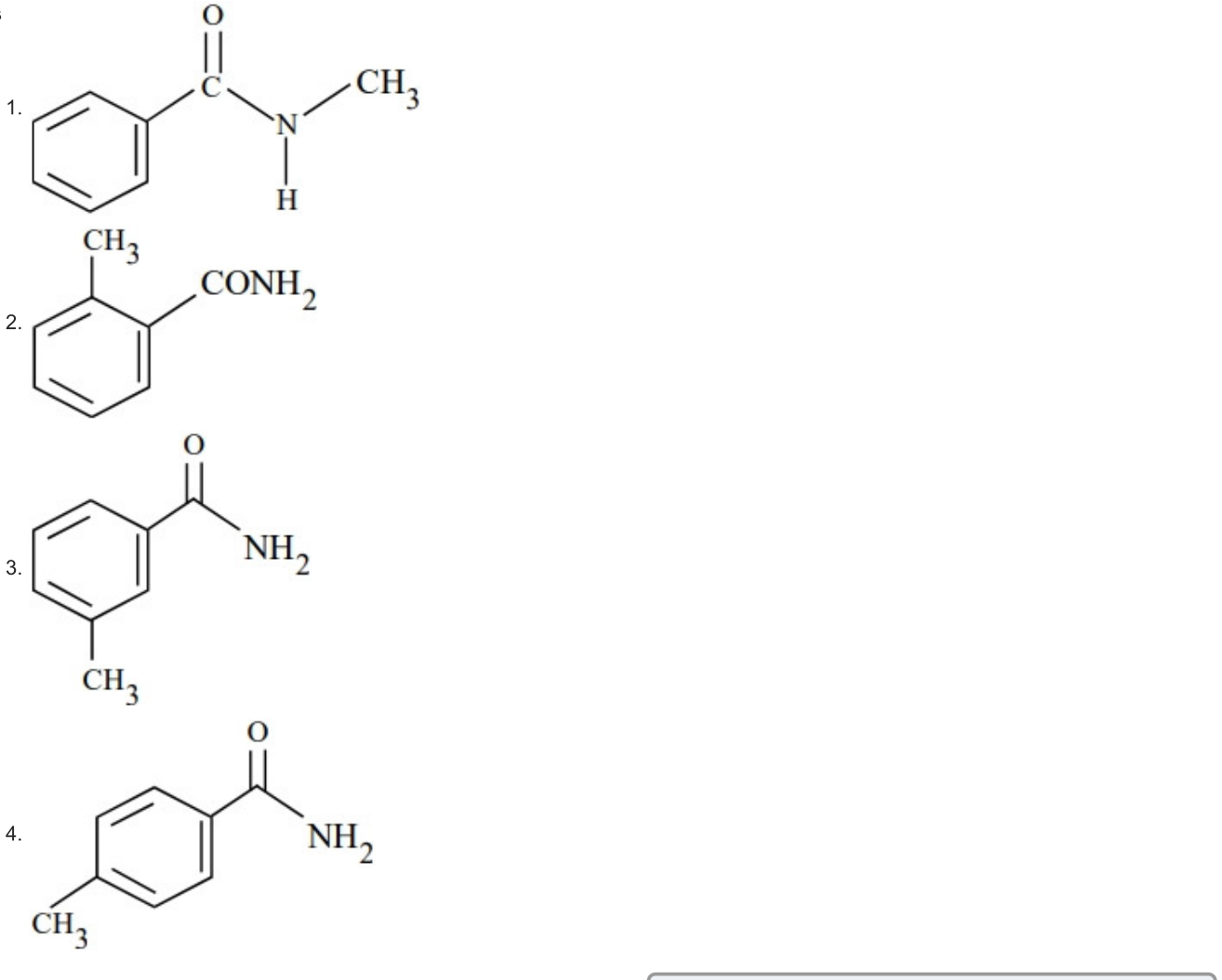
- AC₆H₅–C(=O)–NH–CH₃ (N-methylbenzamide)
- B2-CH₃–C₆H₄–CONH₂ (2-methylbenzamide)
- C3-CH₃–C₆H₄–CONH₂ (3-methylbenzamide)
- D4-CH₃–C₆H₄–CONH₂ (4-methylbenzamide)
View answer or solution
Answer
4-CH₃–C₆H₄–CONH₂ (4-methylbenzamide)
Chemical Bonding and Molecular Structure
As compared with chlorocyclohexane, which of the following statements correctly apply to chlorobenzene? A. The magnitude of negative charge is more on chlorine atom. B. The C – Cl bond has partial double bond character. C. C – Cl bond is less polar. D. C – Cl bond is longer due to repulsion between delocalised electrons of the aromatic ring and lone pairs of electrons of chlorine. E. The C – Cl bond is formed using sp² hybridised orbital of carbon. Choose the correct answer from the options given below:
- AB, C and E Only
- BA, C and E Only
- CB, C and D Only
- DA, D and E Only
View answer or solution
Answer
B, C and E Only
Chemical Bonding and Molecular Structure
Consider the transition metal ions Mn³⁺, Cr³⁺, Fe³⁺ and Co³⁺ and all form low spin octahedral complexes. The correct decreasing order of unpaired electrons in their respective d-orbitals of the complexes is
- AFe³⁺ > Co³⁺ > Mn³⁺ > Cr³⁺
- BCr³⁺ > Mn³⁺ > Fe³⁺ > Co³⁺
- CMn³⁺ > Fe³⁺ > Co³⁺ > Cr³⁺
- DCr³⁺ > Fe³⁺ > Co³⁺ > Mn³⁺
View answer or solution
Answer
Cr³⁺ > Mn³⁺ > Fe³⁺ > Co³⁺
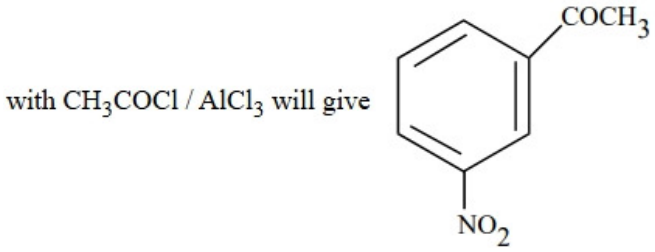
Given below are two statements: Statement I: Benzene is nitrated to give nitrobenzene, which on further treatment with CH₃COCl / AlCl₃ will give [3-nitroacetophenone: a benzene ring with COCH₃ on the upper-right vertex and NO₂ on the bottom vertex] Statement II: –NO₂ group is a m-directing, and deactivating group. In the light of the above statements, choose the most appropriate answer from the options given below
- AStatement I is correct but Statement II is incorrect
- BBoth Statement I and Statement II are incorrect
- CStatement I is incorrect but Statement II is correct
- DBoth Statement I and Statement II are correct
View answer or solution
Answer
Statement I is incorrect but Statement II is correct
Chemical Bonding and Molecular Structure
Two p-block elements X and Y form fluorides of the type EF₃. The fluoride compound XF₃ is a Lewis acid and YF₃ is a Lewis base. The hybridizations of the central atoms of XF₃ and YF₃ respectively are
- ABoth sp³
- BBoth sp²
- Csp² and sp³
- Dsp³ and sp²
View answer or solution
Answer
sp² and sp³
Chemical Bonding and Molecular Structure
The formal charges on the atoms marked as (1) to (4) in the Lewis representation of HNO₃ molecule respectively are

- A0, 0, −1, +1
- B+1, 0, 0, −1
- C0, +1, 0, −1
- D0, −1, 0, +1
View answer or solution
Answer
0, +1, 0, −1
The energy required by electrons, present in the first Bohr orbit of hydrogen atom to be excited to second Bohr orbit is ________ J mol⁻¹. Given: R_H = 2.18 × 10⁻¹¹ ergs.
- A1.635 × 10⁻¹⁸
- B9.835 × 10¹²
- C1.635 × 10⁻¹¹
- D9.835 × 10⁵
View answer or solution
Answer
9.835 × 10⁵
The temperature at which the rate constants of the given below two gaseous reactions become equal is ________ K. (Nearest integer) X ⟶ Y k₁ = 10⁶ e^(−30000/T) P ⟶ Q k₂ = 10⁴ e^(−24000/T) Given: ln 10 = 2.303
View answer or solution
Answer
1303
Purification and Characterisation of Organic Compounds
Sodium fusion extract of an organic compound (Y) with CHCl₃ and chlorine water gives violet color to the CHCl₃ layer. 0.15g of (Y) gave 0.12 g of the silver halide precipitate in Carius method. Percentage of halogen in the compound (Y) is ________. (Nearest integer) (Given : molar mass g mol⁻¹ C : 12, H : 1, Cl : 35.5, Br : 80, I : 127)
View answer or solution
Answer
43
Dissociation of a gas A₂ takes place according to the following chemical reaction. At equilibrium, the total pressure is 1 bar at 300K. A₂(g) ⇌ 2A(g) The standard Gibbs energy of formation of the involved substances has been provided below: | Substance | ΔG_f°/ kJ mol⁻¹ | | A₂ | −100.00 | | A | −50.832 | The degree of dissociation of A₂(g) is given by (x × 10⁻²)^(1/2) where x = ________. (Nearest integer). [Given: R = 8 J mol⁻¹ K⁻¹, log 2 = 0.3010, log 3 = 0.48] Assume degree of dissociation is not negligible.
View answer or solution
Answer
33
Some Basic Concepts in Chemistry
The cycloalkene (X) on bromination consumes one mole of bromine per mole of (X) and gives the product (Y) in which C:Br ratio is 3:1. The percentage of bromine in the product (Y) is ________%. (Nearest integer) (Given : molar mass in g mol⁻¹ H : 1, C : 12, O : 16, Br : 80)
View answer or solution
Answer
66
Redox Reactions and Electrochemistry
Consider the following electrochemical cell at 298K Pt | HSnO₂⁻ (aq) | Sn(OH)₆²⁻(aq) | OH⁻(aq) | Bi₂O₃(s) | Bi (s). If the reaction quotient at a given time is 10⁶, then the cell EMF (E_cell) is ________ × 10⁻¹ V (Nearest integer). Given the standard half-cell reduction potential as E°_(Bi₂O₃/Bi,OH⁻) = −0.44 V and E°_(Sn(OH)₆²⁻/HSnO₂⁻,OH⁻) = −0.90 V
View answer or solution
Answer
4