
// JEE (Main) / 2026
JEE (Main) 2026 Session 2, 2 April 2026, Shift 1 — Paper 1 (B.E / B.Tech) Chemistry
Chemistry · B.E / B.Tech
Work through the questions
25 questions
Take a moment to try each question before opening the available answer or solution.
Some Basic Concepts in Chemistry
The mass of iron converted into Fe₃O₄ by the action of 18 g of steam is : (Given : Molar mass of H, O and Fe are 1, 16 and 56 g mol⁻¹ respectively) Assume iron is present in excess :
- A2.1 g
- B4.2 g
- C21 g
- D42 g
View answer or solution
Answer
42 g
What is the energy (in J atom⁻¹) required for the following process ? Li²⁺(g) → Li³⁺(g) + e⁻ (Take the ionization energy for the H atom in the ground state as 2.18 × 10⁻¹⁸ J atom⁻¹)
- A8.72 × 10⁻¹⁸
- B1.962 × 10⁻¹⁸
- C1.962 × 10⁻¹⁷
- D6.54 × 10⁻¹⁷
View answer or solution
Answer
1.962 × 10⁻¹⁷
Chemical Bonding and Molecular Structure
Given below are two statements : Statement (I) : The correct sequence of bond lengths in the following species is : O₂⁺ < O₂ < O₂⁻ < O₂²⁻ Statement (II) : The correct sequence of number of unpaired electrons in the following species is : O₂ > O₂⁺ > O₂⁻ > O₂²⁻ In the light of the above statements, choose the correct answer from the options given below :
- ABoth Statement I and Statement II are true
- BBoth Statement I and Statement II are false
- CStatement I is true but Statement II is false
- DStatement I is false but Statement II is true
View answer or solution
Answer
Statement I is true but Statement II is false
Consider the following data. (i) 2Al(s) + 6HCl(aq) → Al₂Cl₆(aq) + 3H₂(g) + 1200 kJ/mol (ii) H₂(g) + Cl₂(g) → 2HCl(g) + 164 kJ/mol. (iii) HCl(g) + aq → HCl(aq) + 83 kJ/mol. (iv) Al₂Cl₆(s) + aq → Al₂Cl₆(aq) + 663 kJ/mol The enthalpy of formation of anhydrous solid Al₂Cl₆ is :
- A− 648 kJ mol⁻¹
- B− 1350 kJ mol⁻¹
- C− 2002 kJ mol⁻¹
- D− 1527 kJ mol⁻¹
View answer or solution
Answer
− 1527 kJ mol⁻¹
19.5 g of fluoro acetic acid (molar mass = 78 g mol⁻¹) is dissolved in 500 g of water at 298 K. The depression in the freezing point of water was 1°C. What is K_a of fluoro acetic acid ? (For water, K_f = 1.86 K kg mol⁻¹). Assume molarity and molality to have same values.
- A10⁻⁶
- B4 × 10⁻⁴
- C3 × 10⁻⁵
- D3 × 10⁻³
View answer or solution
Answer
3 × 10⁻³
The solubility product constants of Ag₂CrO₄ and AgBr are 32x and 4y respectively at 298 K. The value of (molarity of Ag₂CrO₄ / molarity of AgBr) can be expressed as :
- A(2∛x)/y
- B2√(x/y)
- C√(x/y)
- D∛x/√y
View answer or solution
Answer
∛x/√y
An electrochemical cell is constructed using half cells in the direction of spontaneous change Fe(OH)₂(s) + 2e⁻ → Fe(s) + 2OH⁻(aq) E⁰ = − 0.88 V and AgBr(s) + e⁻ → Ag(s) + Br⁻(aq) E⁰ = + 0.07 V Which of the following option is correct ?
- AOverall reaction Fe(s)+2OH⁻(aq)+2AgBr(s) = Fe(OH)₂(s)+2Ag(s)+2Br⁻(aq)
- BE⁰cell = −0.95 V
- CFe is reduced in the electrochemical cell
- DE⁰cell is an extensive property
View answer or solution
Answer
Overall reaction Fe(s)+2OH⁻(aq)+2AgBr(s) = Fe(OH)₂(s)+2Ag(s)+2Br⁻(aq)
t₁₀₀% is the time required for the 100% completion of the reaction while t₁/₂ is the time required for 50% of the reaction to be completed. Which of the following option correctly represents the relation between t₁₀₀% and t₁/₂ for zero and first order reactions respectively ?
- At₁₀₀% = (t₁/₂)² and t₁₀₀% = (t₁/₂)^−∞
- Bt₁₀₀% = 2t₁/₂ and t₁₀₀% = (t₁/₂)^∞
- Ct₁₀₀% = 2t₁/₂ and t₁₀₀% = (2t₁/₂)²
- Dt₁₀₀% = (t₁/₂)^∞ and t₁₀₀% = 2t₁/₂
View answer or solution
Answer
t₁₀₀% = 2t₁/₂ and t₁₀₀% = (t₁/₂)^∞
Classification of Elements and Periodicity in Properties
Given below are two statements : Statement (I) : The first ionisation enthalpy of the elements Na, Mg, Cl and Ar follows the order Na > Mg > Cl > Ar. Statement (II) : Among Ca, Al, Fe and B, the third ionisation enthalpy is very high for Ca. In the light of the above statements, choose the correct answer from the options given below :
- ABoth Statement I and Statement II are true
- BBoth Statement I and Statement II are false
- CStatement I is true but Statement II is false
- DStatement I is false but Statement II is true
View answer or solution
Answer
Statement I is false but Statement II is true
Redox Reactions and Electrochemistry
Given below are two statements : Statement (I) : Oxidising power of halogens decreases in the order F₂ > Cl₂ > Br₂ > I₂, which is the basis of "Layer test". Statement (II) : "Layer test" to identify Br₂ and I₂ in aqueous solution involves the oxidation of bromide or iodide into Br₂ or I₂ respectively with Cl₂, which is a type of displacement redox reaction. In the light of the above statements, choose the correct answer from the options given below :
- ABoth Statement I and Statement II are true
- BBoth Statement I and Statement II are false
- CStatement I is true but Statement II is false
- DStatement I is false but Statement II is true
View answer or solution
Answer
Both Statement I and Statement II are true
Redox Reactions and Electrochemistry
Which of the following sets includes all the species that will change the orange colour of K₂Cr₂O₇ in acidic medium ?
- AFe²⁺, Sn²⁺, I⁻, S²⁻
- BS²⁻, Fe³⁺, I⁻, C₂O₄²⁻
- CFe²⁺, NO₂⁻, SO₂, Sn⁴⁺
- DFe³⁺, SO₄²⁻, S²⁻, Sn⁴⁺
View answer or solution
Answer
Fe²⁺, Sn²⁺, I⁻, S²⁻
Match List - I with List - II. List - I : Chromium (III) Complexes (en = ethylene diamine) — A. [Cr(CN)₆]³⁻, B. [CrF₆]³⁻, C. [Cr(H₂O)₆]³⁺, D. [Cr(en)₃]³⁺ ; List - II : Δ₀(cm⁻¹) — I. 15,060, II. 17,400, III. 22,300, IV. 26,600. Choose the correct answer from the options given below :
- AA-I, B-II, C-III, D-IV
- BA-II, B-III, C-IV, D-I
- CA-III, B-IV, C-I, D-II
- DA-IV, B-I, C-II, D-III
View answer or solution
Answer
A-IV, B-I, C-II, D-III
Purification and Characterisation of Organic Compounds
Given below are two statements : Statement (I) : 1,2,3-Trihydroxypropane can be separated from water by simple distillation. Statement (II) : An azeotropic mixture cannot be separated by fractional distillation. In the light of the above statements, choose the correct answer from the options given below :
- ABoth Statement I and Statement II are true
- BBoth Statement I and Statement II are false
- CStatement I is true but Statement II is false
- DStatement I is false but Statement II is true
View answer or solution
Answer
Statement I is false but Statement II is true
Some Basic Principles of Organic Chemistry
Given below are two statements : Statement (I) : Benzyl chloride reacts faster in S_N1 mechanism than ethyl chloride. Statement (II) : Ethyl carbocation intermediate is less stabilized by hyperconjugation than benzyl carbocation by resonance. In the light of the above statements, choose the correct answer from the options given below :
- ABoth Statement I and Statement II are true
- BBoth Statement I and Statement II are false
- CStatement I is true but Statement II is false
- DStatement I is false but Statement II is true
View answer or solution
Answer
Both Statement I and Statement II are true
Some Basic Principles of Organic Chemistry
In IUPAC nomenclature, the correct order of decreasing priority of functional group is :
- A−CONH₂, >C = O, −CHO, −NH₂, −C ≡ C−
- B−CONH₂, −COOCH₃, −CHO, −NH₂, −OH
- C−CONH₂, −CHO, >C = O, −NH₂, −C ≡ C−
- D−CONH₂, −CHO, −CN, −NH₂, −C ≡ C−
View answer or solution
Answer
−CONH₂, −CHO, >C = O, −NH₂, −C ≡ C−
Some Basic Principles of Organic Chemistry
For the given molecule, "x", the preferred site for the attack of the electrophile is :
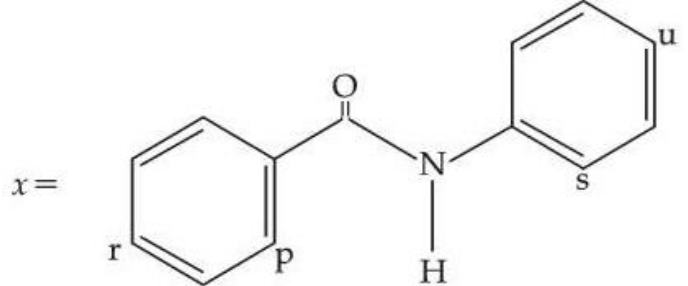
- APredominantly at "r"
- B"r" and "u"
- C"p" and "s"
- DPredominantly at "u"
View answer or solution
Answer
Predominantly at "u"
Organic Compounds Containing Oxygen
Match List - I with List - II. List - I : Mixture of Compounds — A. Diethyl amine + Ethyl amine, B. Acetaldehyde + Acetone, C. Ethanol + Phenol, D. Benzoic acid + Cinnamic acid ; List - II : Reagent used to distinguish — I. Bromine water, II. CHCl₃ + KOH, Δ, III. Neutral FeCl₃, IV. Ammoniacal silver nitrate. Choose the correct answer from the options given below :
- AA-IV, B-II, C-I, D-III
- BA-IV, B-II, C-III, D-I
- CA-II, B-IV, C-I, D-III
- DA-II, B-IV, C-III, D-I
View answer or solution
Answer
A-II, B-IV, C-III, D-I
Consider the three aromatic molecules (P, Q and R) whose structures have been given below : The correct order regarding the reactivity of these compounds with Ph−N ≡ N Cl(−) under optimum but slightly acidic medium is :
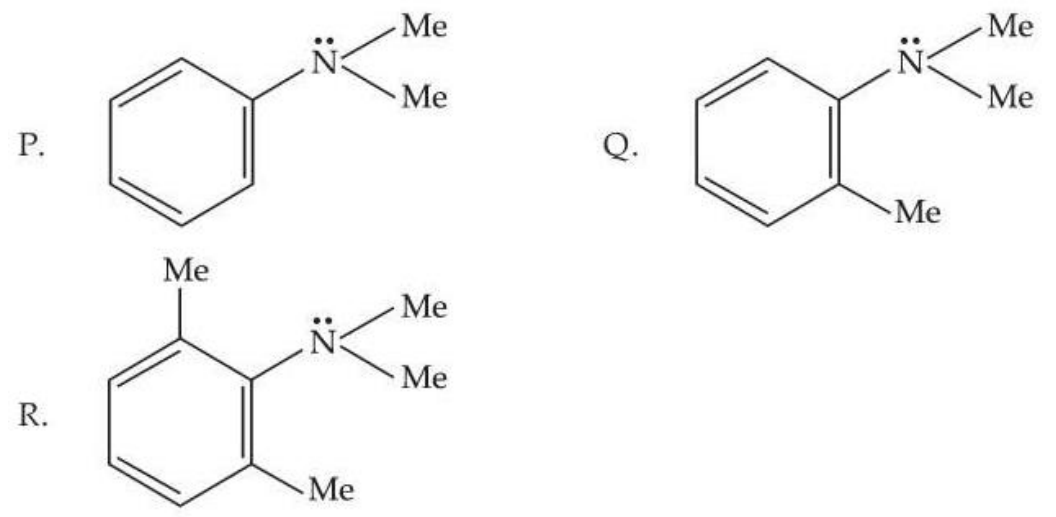
- AP > Q > R
- BR > P > Q
- CR > Q > P
- DP > R > Q
View answer or solution
Answer
P > Q > R
Match List - I with List - II. List - I : Vitamin — A. Vitamin B₁, B. Vitamin B₂, C. Vitamin B₆, D. Vitamin C ; List - II : Name — I. Pyridoxine, II. Ascorbic acid, III. Thiamine, IV. Riboflavin. Choose the correct answer from the options given below :
- AA-II, B-I, C-III, D-IV
- BA-IV, B-III, C-II, D-I
- CA-III, B-IV, C-I, D-II
- DA-I, B-III, C-II, D-IV
View answer or solution
Answer
A-III, B-IV, C-I, D-II
Principles Related to Practical Chemistry
A salt with few drops of conc. HCl gives apple green colour in flame test. The group precipitate of the salt is dissolved in acetic acid and treated with K₂CrO₄ to give yellow precipitate. When the sodium carbonate extract of the salt solution is heated with conc. HNO₃ and ammonium molybdate, it resulted a canary yellow precipitate. The cation and anion present in the salt are respectively,
- ACa²⁺ and SO₄²⁻
- BBa²⁺ and PO₄³⁻
- CMn²⁺ and PO₄³⁻
- DBa²⁺ and SO₄²⁻
View answer or solution
Answer
Ba²⁺ and PO₄³⁻
5.33 g of CrCl₃·6H₂O, which is a 1 : 3 electrolyte, is dissolved in water and is passed through a cation exchanger. The chloride ions in the eluted solution, on treatment with AgNO₃ results in 8.61 g of AgCl. The ratio of moles of complex reacted and moles of AgCl formed is ________ × 10⁻². (Nearest integer) [Molar mass in g mol⁻¹ Cr : 52, Ag : 108, Cl : 35.5, H : 1, O : 16]
View answer or solution
Answer
33
Consider the isomers of hydrocarbon with molecular formula C₅H₁₀. These isomers do not decolourise KMnO₄ solution. These isomers are subjected to chlorination with chlorine in presence of light to give monochloro compounds. The total number of monochloro compounds (structural isomers only) formed is ________.
View answer or solution
Answer
14
One mole of an alkane (x) requires 8 mole oxygen for complete combustion. Sum of number of carbon and hydrogen atoms in the alkane (x) is ________.
View answer or solution
Answer
17
For reaction A → P, rate constant k = 1.5 × 10³ s⁻¹ at 27°C. If activation energy for the above reaction is 60 kJ mol⁻¹, then the temperature (in °C) at which rate constant, k = 4.5 × 10³ s⁻¹ is ________. (Nearest integer). Given : log 2 = 0.30, log 3 = 0.48, R = 8.3 J K⁻¹ mol⁻¹, ln 10 = 2.3
View answer or solution
Answer
41
At the transition temperature T, A ⇌ B and ΔG⁰ = 105 − 35 log T where A and B are two states of substance X. The transition temperature in °C when pressure is 1 atm is ________. (Nearest integer)
View answer or solution
Answer
727