
// JEE (Main) / 2026
JEE (Main) 2026 Session 1, 23 January 2026, Shift 1 — Paper 1 (B.E / B.Tech) Chemistry
Chemistry · B.E / B.Tech
Work through the questions
25 questions
Take a moment to try each question before opening the available answer or solution.
Classification of Elements and Periodicity in Properties
The correct trend in the first ionization enthalpies of the elements in the 3rd period of periodic table is :
- ASi<S<Al<P<Cl
- BAl<S<P<Si<Cl
- CS<Si<Al<P<Cl
- DAl<Si<S<P<Cl
View answer or solution
Answer
Al<Si<S<P<Cl
Given, (A) n = 5, m_l = − 1 (B) n = 3, l = 2, m_l = − 1, m_s = + 1/2 The maximum number of electron(s) in an atom that can have the quantum numbers as given in (A) and (B) respectively are :
- A8 and 1
- B2 and 4
- C26 and 1
- D4 and 1
View answer or solution
Answer
8 and 1
Which of the following statements regarding the energy of the stationary state is true in the following one - electron systems ?
- A− 2.18 × 10⁻¹⁸ J for third orbit of Li²⁺ ion
- B+ 2.18 × 10⁻¹⁸ J for second orbit of He⁺ ion
- C+ 8.72 × 10⁻¹⁸ J for first orbit of He⁺ ion
- D− 1.09 × 10⁻¹⁸ J for second orbit of H atom.
View answer or solution
Answer
− 2.18 × 10⁻¹⁸ J for third orbit of Li²⁺ ion
Organic Compounds Containing Oxygen
From the given following (A to D) cyclic structures, those which will not react with Tollen's reagent are :
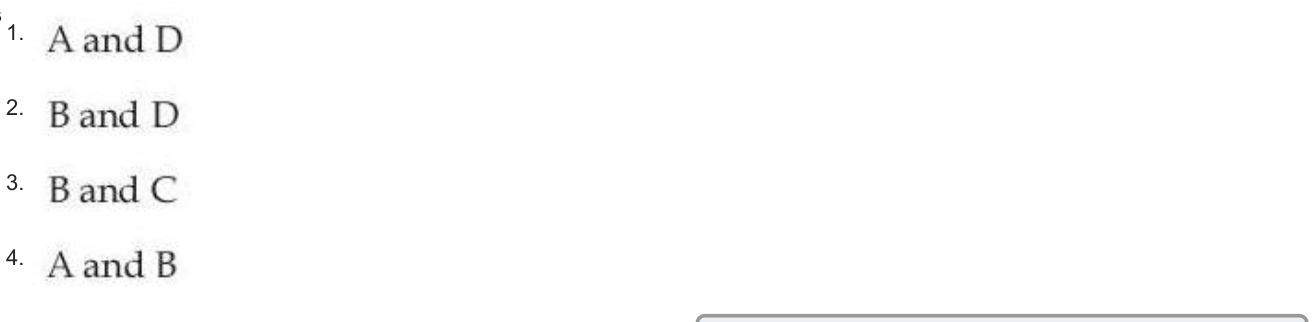
- AA and D
- BB and D
- CB and C
- DA and B
View answer or solution
Answer
B and C
Given below are two statements : Statement I : Sublimation is used for the separation and purification of compounds with low melting point. Statement II : The boiling point of a liquid increases as the external pressure is reduced. In the light of the above statements, choose the correct answer from the options given below :
- AStatement I is true but Statement II is false
- BStatement II is true but Statement I is false
- CBoth Statement I and Statement II are true
- DBoth Statement I and Statement II are false
View answer or solution
Answer
Both Statement I and Statement II are false
A cup of water at 5°C (system) is placed in a microwave oven and the oven is turned on for one minute during which the water begins to boil. Which of the following option is true ?
- Aq = + ve, w = 0, ΔU = − ve
- Bq = + ve, w = − ve, ΔU = + ve
- Cq = − ve, w = − ve, ΔU = − ve
- Dq = + ve, w = − ve, ΔU = − ve
View answer or solution
Answer
q = + ve, w = − ve, ΔU = + ve
Some Basic Concepts in Chemistry
Which one of the following graphs accurately represents the plot of partial pressure of CS₂ vs its mole fraction in a mixture of acetone and CS₂ at constant temperature ?
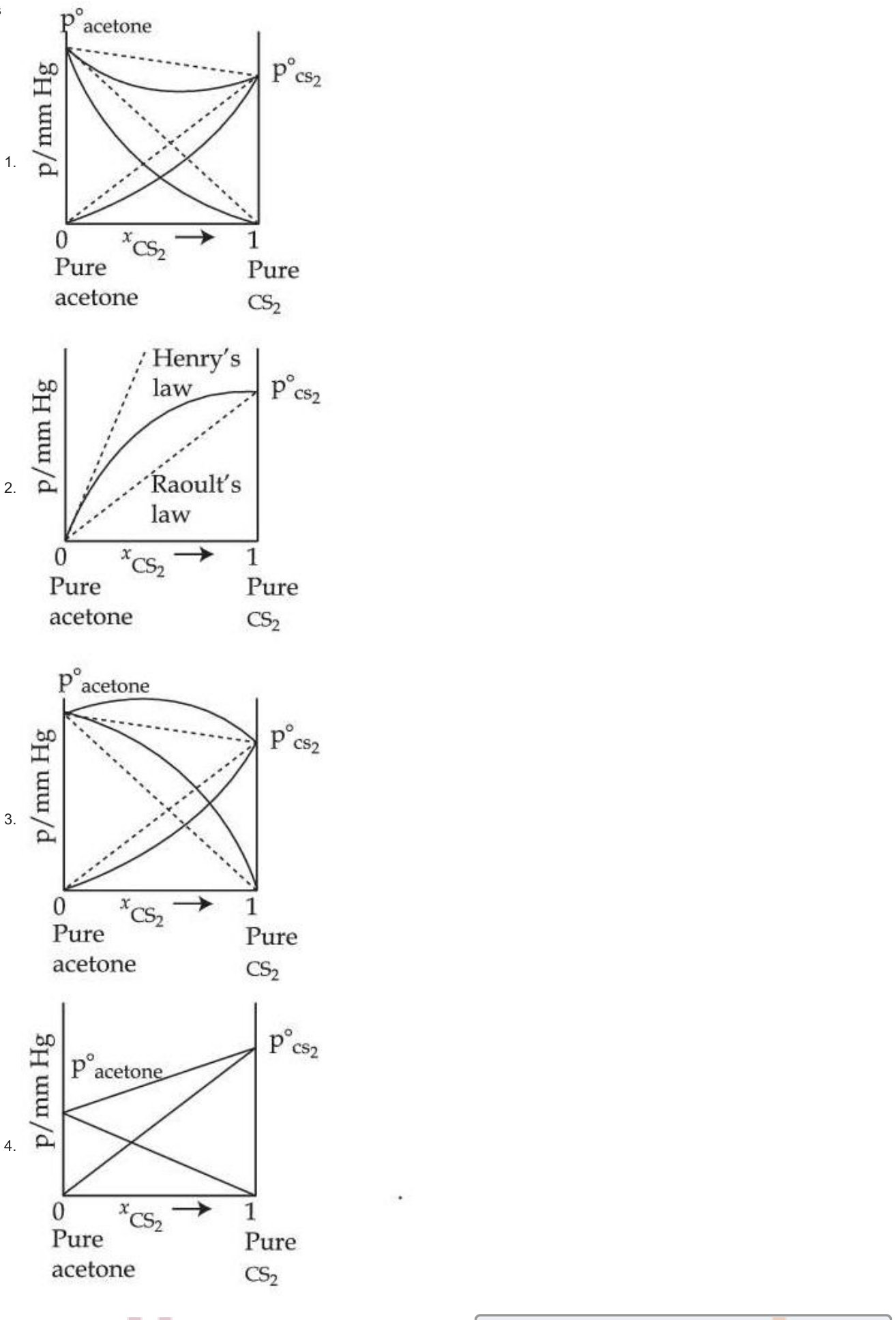
- AGraph: p/mm Hg plotted against x_CS2 from 0 (pure acetone) to 1 (pure CS2), with p°_acetone marked on the left axis and p°_CS2 on the right; the acetone partial-pressure curve dips below its dashed straight line while the CS₂ partial-pressure curve rises above its dashed line.
- BGraph: p/mm Hg plotted against x_CS2 from 0 (pure acetone) to 1 (pure CS2), with a single rising curve for the CS₂ partial pressure that lies below the dashed Henry's law line and above the dashed Raoult's law line, ending at p°_CS2 at x = 1.
- CGraph: p/mm Hg plotted against x_CS2 from 0 (pure acetone) to 1 (pure CS2), with p°_acetone marked on the left axis; the acetone curve rises above p°_acetone and then falls to zero at x = 1, while the CS₂ curve rises above its dashed line up to p°_CS2.
- DGraph: p/mm Hg plotted against x_CS2 from 0 (pure acetone) to 1 (pure CS2), showing only straight lines — one rising from a point on the left axis (marked p°_acetone) to p°_CS2 at x = 1, one rising from the origin to p°_CS2 at x = 1, and one falling from the left-axis point to zero at x = 1.
View answer or solution
Answer
Graph: p/mm Hg plotted against x_CS2 from 0 (pure acetone) to 1 (pure CS2), with a single rising curve for the CS₂ partial pressure that lies below the dashed Henry's law line and above the dashed Raoult's law line, ending at p°_CS2 at x = 1.
Redox Reactions and Electrochemistry
In the given electrochemical cell, Ag(s) | AgCl(s) | FeCl₂(aq), FeCl₃(aq) | Pt(s) at 298 K, the cell potential (E_cell) will increase when : A. Concentration of Fe²⁺ is increased. B. Concentration of Fe³⁺ is decreased. C. Concentration of Fe²⁺ is decreased. D. Concentration of Fe³⁺ is increased. E. Concentration of Cl⁻ is increased. Choose the correct answer from the options given below :
- AC, D and E Only
- BA and B Only
- CB Only
- DA and E Only
View answer or solution
Answer
C, D and E Only
Chemical Bonding and Molecular Structure
But-2-yne and hydrogen (one mole each) are separately treated with (i) Pd/C and (ii) Na/ liq. NH₃ to give the products X and Y respectively. Identify the incorrect statements. A. X and Y are stereoisomers. B. Dipole moment of X is zero. C. Boiling point of X is higher than Y. D. X and Y react with O₃/Zn + H₂O to give different products. Choose the correct answer from the options given below :
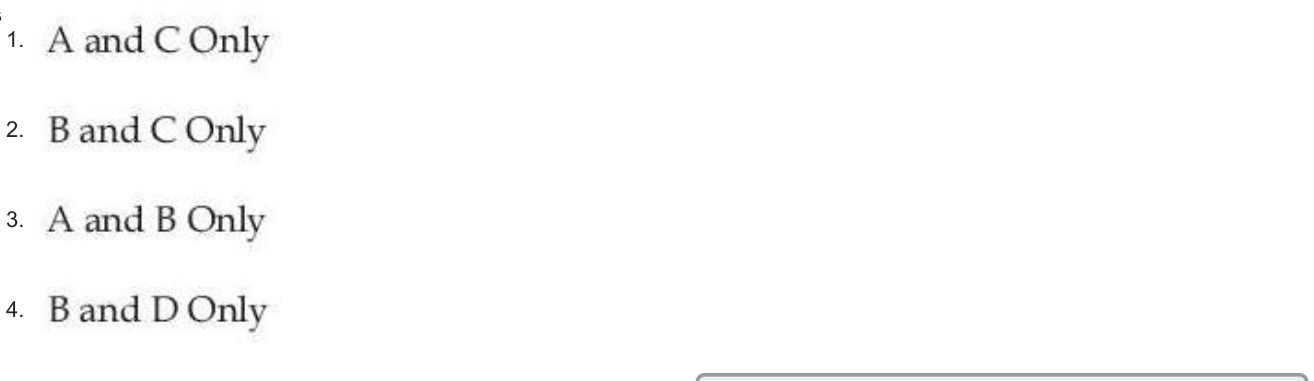
- AA and C Only
- BB and C Only
- CA and B Only
- DB and D Only
View answer or solution
Answer
B and D Only
Some Basic Principles of Organic Chemistry
Match List - I with List - II. | List - I | List - II | |---|---| | **Functional group (detection)** | **Change observed during detection** | | A. Unsaturation (Baeyer’s test) | I. Red colour appears | | B. Alcoholic group (Ceric ammonium nitrate test) | II. Silver mirror appears | | C. Aldehyde group (Tollen’s reagent) | III. Violet colour appears | | D. Phenolic group (FeCl₃ test) | IV. Discharge of pink colour | Choose the correct answer from the options given below :
- AA-IV, B-III, C-II, D-I
- BA-III, B-IV, C-I, D-II
- CA-III, B-IV, C-II, D-I
- DA-IV, B-I, C-II, D-III
View answer or solution
Answer
A-IV, B-I, C-II, D-III
Consider the general reaction given below at 400 K xA(g) ⇌ yB(g). The values of Kₚ and K_c are studied under the same condition of temperature but variation in x and y. (i) Kₚ = 85.87 and K_c = 2.586 appropriate units (ii) Kₚ = 0.862 and K_c = 28.62 appropriate units The values of x and y in (i) and (ii) respectively are :
- A| (i) | (ii) | |---|---| | 3, 1 | 3, 1 |
- B| (i) | (ii) | |---|---| | 4, 1 | 4, 1 |
- C| (i) | (ii) | |---|---| | 1, 2 | 2, 1 |
- D| (i) | (ii) | |---|---| | 1, 3 | 2, 1 |
View answer or solution
Answer
| (i) | (ii) | |---|---| | 1, 2 | 2, 1 |
Given below are two statements : Statement I : [CoBr₄]²⁻ ion will absorb light of lower energy than [CoCl₄]²⁻ ion. Statement II : In [CoI₄]²⁻ ion, the energy separation between the two set of d-orbitals is more than [CoCl₄]²⁻ ion. In the light of the above statements, choose the correct answer from the options given below :
- ABoth Statement I and Statement II are false
- BBoth Statement I and Statement II are true
- CStatement I is false but Statement II is true
- DStatement I is true but Statement II is false
View answer or solution
Answer
Statement I is true but Statement II is false
Compound ‘P’ undergoes the following sequence of reactions : ‘P’ —(i) NH₃, (ii) Δ→ Q —(i) KOH, Br₂, (ii) CHCl₃, KOH (alc), Δ→ [a cyclohexane ring drawn as a hexagon with an –NC group on a bond from the upper-right vertex] ‘P’ is :
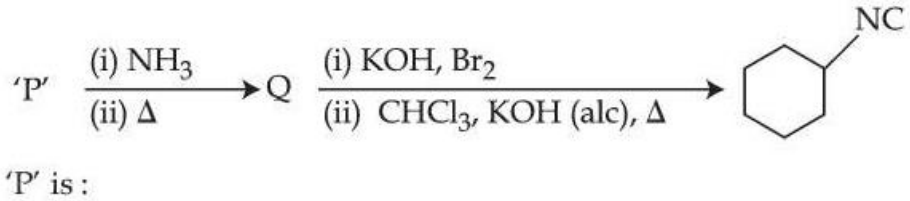
- AC₆H₁₁–C(=O)–NH₂ (cyclohexanecarboxamide)
- BC₆H₁₁–C(=O)–OH (cyclohexanecarboxylic acid)
- CC₆H₁₁–CH₂–CHO (2-cyclohexylethanal)
- DC₆H₁₁–C(=O)–CH₂–CH₃ (1-cyclohexylpropan-1-one)
View answer or solution
Answer
C₆H₁₁–C(=O)–OH (cyclohexanecarboxylic acid)
Consider the following compounds a. [a benzene ring drawn as a hexagon with a Cl on the top vertex] b. [a benzene ring drawn as a hexagon with a NO₂ on the top vertex] c. [a benzene ring drawn as a hexagon with an OCH₃ on the top vertex] Arrange these compounds in the increasing order of reactivity with nitrating mixture.
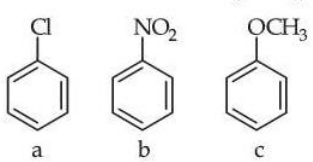
- Ab < c < a
- Bc < b < a
- Cb < a < c
- Dc < a < b
View answer or solution
Answer
b < a < c
(X) [a benzene ring drawn as a hexagon with a –CH(Br)–CH₃ group on the upper-right vertex] —?→ (Y) [a benzene ring drawn as a hexagon with a –CH₂–CH₂–COOH group on the upper-right vertex] The correct sequence of reagents for the above conversion of X to Y is :
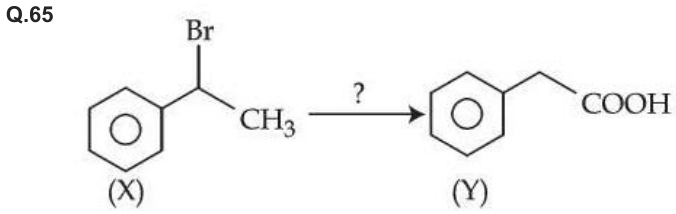
- A(i) NaOH (aq), (ii) Jones reagent, (iii) H₃O⁺
- B(i) Jones reagent, (ii) NaOEt, (iii) Hot KMnO₄/KOH
- C(i) B₂H₆/H₂O₂, (ii) NaOEt, (iii) Jones reagent
- D(i) NaOEt, (ii) B₂H₆/H₂O₂, (iii) Jones reagent
View answer or solution
Answer
(i) NaOEt, (ii) B₂H₆/H₂O₂, (iii) Jones reagent
‘x’ is the product which is obtained from propanenitrile and stannous chloride in the presence of hydrochloric acid followed by hydrolysis. ‘y’ is the product which is obtained from the but-2-ene by the ozonolysis followed by hydrolysis. From the following, which product is not obtained when one mole of ‘x’ and one mole of ‘y’ react with each other in the presence of alkali followed by heating ?
- APent-2-enal
- B2-Methylpent-2-enal
- C2-Methylbut-2-enal
- D3-Methylbut-2-enal
View answer or solution
Answer
3-Methylbut-2-enal
Consider the following sequence of reactions. 4-Nitrotoluene [a benzene ring drawn as a hexagon with CH₃ on the top vertex and NO₂ on the bottom vertex] —(i) Sn, HCl/Δ, (ii) pH neutralisation→ (A) —(i) (H₃CCO)₂O, (ii) Br₂/AcOH→ (B) Assuming that the reaction proceeds to completion, then 137 mg of 4-nitrotoluene will produce ________ mg of B. (Given molar mass in g mol⁻¹ H : 1, C : 12, N : 14, O : 16, Br : 80)
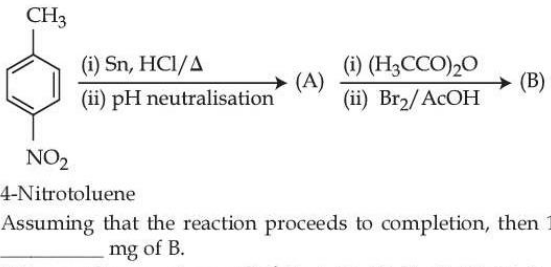
- A208
- B228
- C301
- D146
View answer or solution
Answer
228
Classification of Elements and Periodicity in Properties
The correct statements from the following are : A. Ionic radii of trivalent cations of group 13 elements decreases down the group. B. Electronegativity of group 13 elements decreases down the group. C. Among the group 13 elements, Boron has highest first ionisation enthalpy. D. The trichloride and triiodide of group 13 elements are covalent in nature. Choose the correct answer from the options given below :
- AA and C Only
- BC and D Only
- CB and D Only
- DA and D Only
View answer or solution
Answer
C and D Only
The statements that are incorrect about the nickel(II) complex of dimethylglyoxime are : A. It is red in colour. B. It has a high solubility in water at pH = 9. C. The Ni ion has two unpaired d-electrons. D. The N – Ni – N bond angle is almost close to 90°. E. The complex contains four five-membered metallacycles (metal containing rings). Choose the correct answer from the options given below :
- AB, C and E Only
- BC and D Only
- CC and E Only
- DA, D and B Only
View answer or solution
Answer
B, C and E Only
Chemical Bonding and Molecular Structure
Identify the molecule (X) with maximum number of lone pairs of electrons (obtained using Lewis dot structure) among HNO₃, H₂SO₄, NF₃ and O₃. Choose the correct bond angle made by the central atom of the molecule (X).
- A107°
- B120°
- C102°
- D116°
View answer or solution
Answer
102°
The crystal field splitting energy of [Co(oxalate)₃]³⁻ complex is 'n' times that of the [Cr(oxalate)₃]³⁻ complex. Here 'n' is ________. (Assume Δ₀ > P)
View answer or solution
Answer
2
For the following gas phase equilibrium reaction at constant temperature, NH₃(g) ⇌ 1/2 N₂(g) + 3/2 H₂(g) if the total pressure is √3 atm and the pressure equilibrium constant (Kₚ) is 9 atm, then the degree of dissociation is given as (x × 10⁻²)⁻¹/². The value of x is ________. (nearest integer)
View answer or solution
Answer
125
Some Basic Concepts in Chemistry
x mg of pure HCl was used to make an aqueous solution. 25.0 mL of 0.1 M Ba(OH)₂ solution is used when the HCl solution was titrated against it. The numerical value of x is ________ × 10⁻¹. (Nearest integer) Given : Molar mass of HCl and Ba(OH)₂ are 36.5 and 171.0 g mol⁻¹ respectively.
View answer or solution
Answer
1825
Some Basic Principles of Organic Chemistry
Consider all the structural isomers with molecular formula C₅H₁₁Br are separately treated with KOH(aq) to give respective substitution products, without any rearrangement. The number of products which can exhibit optical isomerism from these is ________.
View answer or solution
Answer
3; 6
For the thermal decomposition of reactant AB(g), the following plot is constructed. The half life of the reaction is 'x' min. x = ________ min. (Nearest integer)
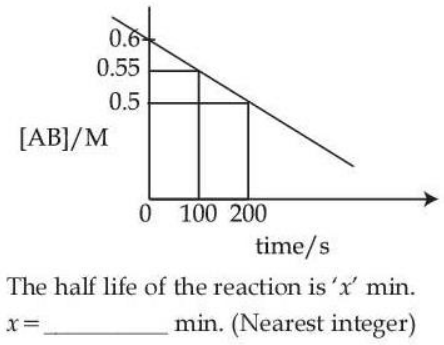
View answer or solution
Answer
10