
// JEE (Main) / 2025
JEE (Main) 2025 Session 2, 3 April 2025, Shift 1 — Paper 1 (B.E / B.Tech) Chemistry
Chemistry · B.E / B.Tech
Work through the questions
25 questions
Take a moment to try each question before opening the available answer or solution.
Which of the following properties will change when system containing solution 1 will become solution 2? [Solution 1: 10 mol of solute x + 10 L of water → Solution 2: 1 L of solution 1 + 1 mol of solute x + 1 L of water]
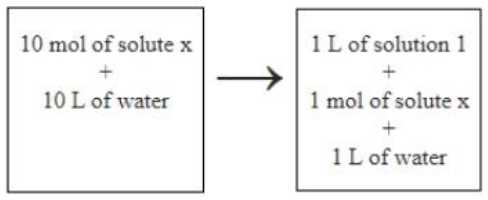
- AMolar heat capacity
- BConcentration
- CGibbs free energy
- DDensity
View answer or solution
Answer
Gibbs free energy
Redox Reactions and Electrochemistry
Correct order of limiting molar conductivity for cations in water at 298 K is :
- AH⁺ > Na⁺ > Ca²⁺ > Mg²⁺ > K⁺
- BH⁺ > Ca²⁺ > Mg²⁺ > K⁺ > Na⁺
- CMg²⁺ > H⁺ > Ca²⁺ > K⁺ > Na⁺
- DH⁺ > Na⁺ > K⁺ > Ca²⁺ > Mg²⁺
View answer or solution
Answer
H⁺ > Ca²⁺ > Mg²⁺ > K⁺ > Na⁺
The metal ions that have the calculated spin-only magnetic moment value of 4.9 B.M. are : A. Cr²⁺ B. Fe²⁺ C. Fe³⁺ D. Co²⁺ E. Mn³⁺ Choose the correct answer from the options given below:
- AB and E Only
- BA, D and E Only
- CA, B and E Only
- DA, C and E Only
View answer or solution
Answer
A, B and E Only
In a reaction A + B → C, initial concentrations of A and B are related as [A]₀ = 8[B]₀. The half lives of A and B are 10 min and 40 min, respectively. If they start to disappear at the same time, both following first order kinetics, after how much time will the concentration of both the reactants be same ?
- A60 min
- B40 min
- C20 min
- D80 min
View answer or solution
Answer
40 min
Redox Reactions and Electrochemistry
Given below are two statements: Statement I : The N - N single bond is weaker and longer than that of P - P single bond. Statement II : Compounds of group 15 elements in + 3 oxidation states readily undergo disproportionation reactions. In the light of the above statements, choose the correct answer from the options given below
- ABoth Statement I and Statement II are false
- BBoth Statement I and Statement II are true
- CStatement I is true but Statement II is false
- DStatement I is false but Statement II is true
View answer or solution
Answer
Both Statement I and Statement II are false
Given below are two statements: Statement I : A catalyst cannot alter the equilibrium constant (K_c) of the reaction, temperature remaining constant. Statement II : A homogenous catalyst can change the equilibrium composition of a system, temperature remaining constant. In the light of the above statements, choose the correct answer from the options given below
- AStatement I is false but Statement II is true
- BBoth Statement I and Statement II are false
- CBoth Statement I and Statement II are true
- DStatement I is true but Statement II is false
View answer or solution
Answer
Statement I is true but Statement II is false
Some Basic Concepts in Chemistry
Among 10⁻⁹ g (each) of the following elements, which one will have the highest number of atoms? Element: Pb, Po, Pr and Pt
- APb
- BPr
- CPo
- DPt
View answer or solution
Answer
Pr
Organic Compounds Containing Halogens
Number of molecules from below which cannot give iodoform reaction is: Ethanol, Isopropyl alcohol, Bromoacetone, 2-Butanol, 2-Butanone, Butanal, 2-Pentanone, 3-Pentanone, Pentanal and 3-Pentanol.
- A5
- B2
- C4
- D3
View answer or solution
Answer
4
In the following system, PCl₅(g) ⇌ PCl₃(g) + Cl₂(g) at equilibrium, upon addition of xenon gas at constant T & p, the concentration of
- APCl₅, PCl₃ & Cl₂ remain constant
- BPCl₅ will increase
- CCl₂ will decrease
- DPCl₃ will increase
View answer or solution
Answer
PCl₃ will increase
Chemical Bonding and Molecular Structure
Which of the following statements are correct ? A. The process of adding an electron to a neutral gaseous atom is always exothermic. B. The process of removing an electron from an isolated gaseous atom is always endothermic. C. The 1ˢᵗ ionization energy of boron is less than that of beryllium. D. The electronegativity of C is 2.5 in CH₄ and CCl₄ E. Li is the most electropositive among elements of group I. Choose the correct answer from the options given below:
- AB and C Only
- BB and D Only
- CA, C and D Only
- DB, C and E Only
View answer or solution
Answer
B and C Only
The correct order of the complexes [Co(NH₃)₅(H₂O)]³⁺ (A), [Co(NH₃)₆]³⁺ (B), [Co(CN)₆]³⁻ (C) and [CoCl(NH₃)₅]²⁺ (D) in terms of wavelength of light absorbed is
- AC > B > D > A
- BD > A > B > C
- CC > B > A > D
- DD > C > B > A
View answer or solution
Answer
D > A > B > C
The least acidic compound, among the following is:

- AC
- BA
- CB
- DD
View answer or solution
Answer
D
Which of the following is the correct structure of L–Fructose?
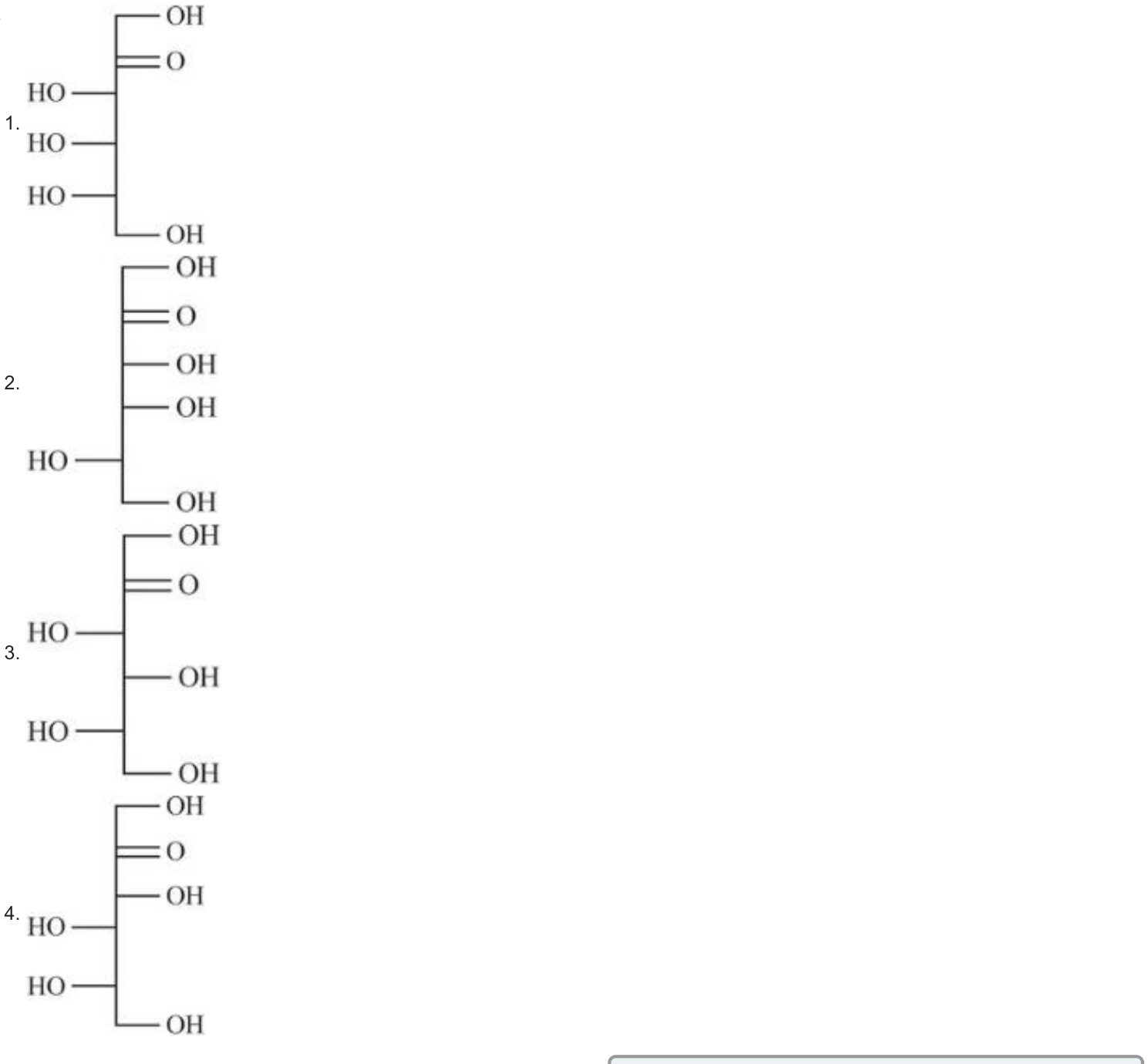
- AFischer projection of a ketohexose: CH₂OH at the top, C=O on the second carbon, then three carbons each bearing OH on the left, and CH₂OH at the bottom.
- BFischer projection of a ketohexose: CH₂OH at the top, C=O on the second carbon, then two carbons bearing OH on the right, then one carbon bearing OH on the left, and CH₂OH at the bottom.
- CFischer projection of a ketohexose: CH₂OH at the top, C=O on the second carbon, then a carbon bearing OH on the left, a carbon bearing OH on the right, a carbon bearing OH on the left, and CH₂OH at the bottom.
- DFischer projection of a ketohexose: CH₂OH at the top, C=O on the second carbon, then a carbon bearing OH on the right, then two carbons bearing OH on the left, and CH₂OH at the bottom.
View answer or solution
Answer
Fischer projection of a ketohexose: CH₂OH at the top, C=O on the second carbon, then a carbon bearing OH on the right, then two carbons bearing OH on the left, and CH₂OH at the bottom.
Which of the following postulate of Bohr's model of hydrogen atom is not in agreement with quantum mechanical model of an atom?
- AAn atom in a stationary state does not emit electromagnetic radiation as long as it stays in the same state.
- BAn atom can take only certain distinct energies E₁, E₂, E₃ , etc. These allowed states of constant energy are called the stationary states of atom.
- CThe electron in a H atom's stationary state moves in a circle around the nucleus.
- DWhen an electron makes a transition from a higher energy stationary state to a lower energy stationary state, then it emits a photon of light.
View answer or solution
Answer
The electron in a H atom's stationary state moves in a circle around the nucleus.
Chemical Bonding and Molecular Structure
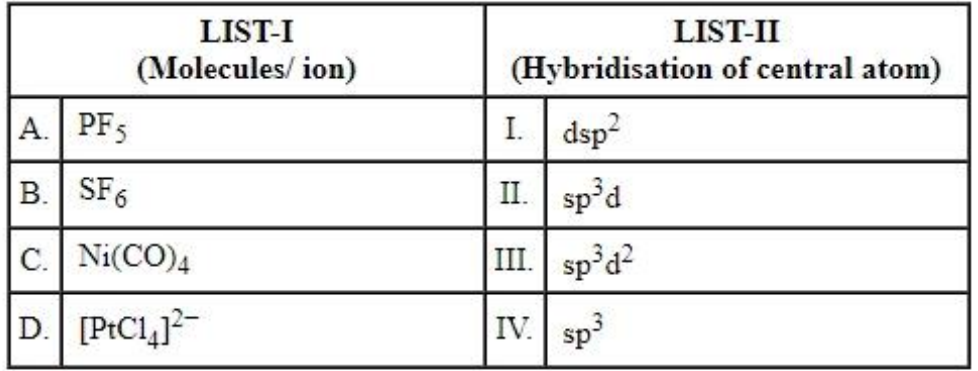
Match the LIST-I with LIST-II | LIST-I (Molecules/ ion) | LIST-II (Hybridisation of central atom) | |---|---| | A. PF₅ | I. dsp² | | B. SF₆ | II. sp³d | | C. Ni(CO)₄ | III. sp³d² | | D. [PtCl₄]²⁻ | IV. sp³ | Choose the correct answer from the options given below:
- AA-IV, B-I, C-II, D-III
- BA-II, B-III, C-IV, D-I
- CA-I, B-II, C-III, D-IV
- DA-III, B-I, C-IV, D-II
View answer or solution
Answer
A-II, B-III, C-IV, D-I
Some Basic Principles of Organic Chemistry
Identify the correct statements from the following. A. CH₃–CH₂–C(=O)–CH₂–CH₃ and CH₃–C(=O)–CH₂–CH₂–CH₃ are metamers B. CH₃–CH₂–CH₂–CN and CH₃–CH₂–CH₂–NC are functional isomers C. CH₃–CH₂–CH₂–CH₂–OH and CH₃–CH₂–CH₂–CH(OH)–CH₃ are position isomers D. CH₃–CH₂–CH₂–CH₂–NH₂ and CH₃–CH₂–NH–CH₂–CH₂–CH₃ are homologous Choose the correct answer from the options given below:

- AA & B Only
- BB & C Only
- CC & D Only
- DA,B & C Only
View answer or solution
Answer
A & B Only
Which compound would give 3-methyl-6-oxoheptanal upon ozonolysis?
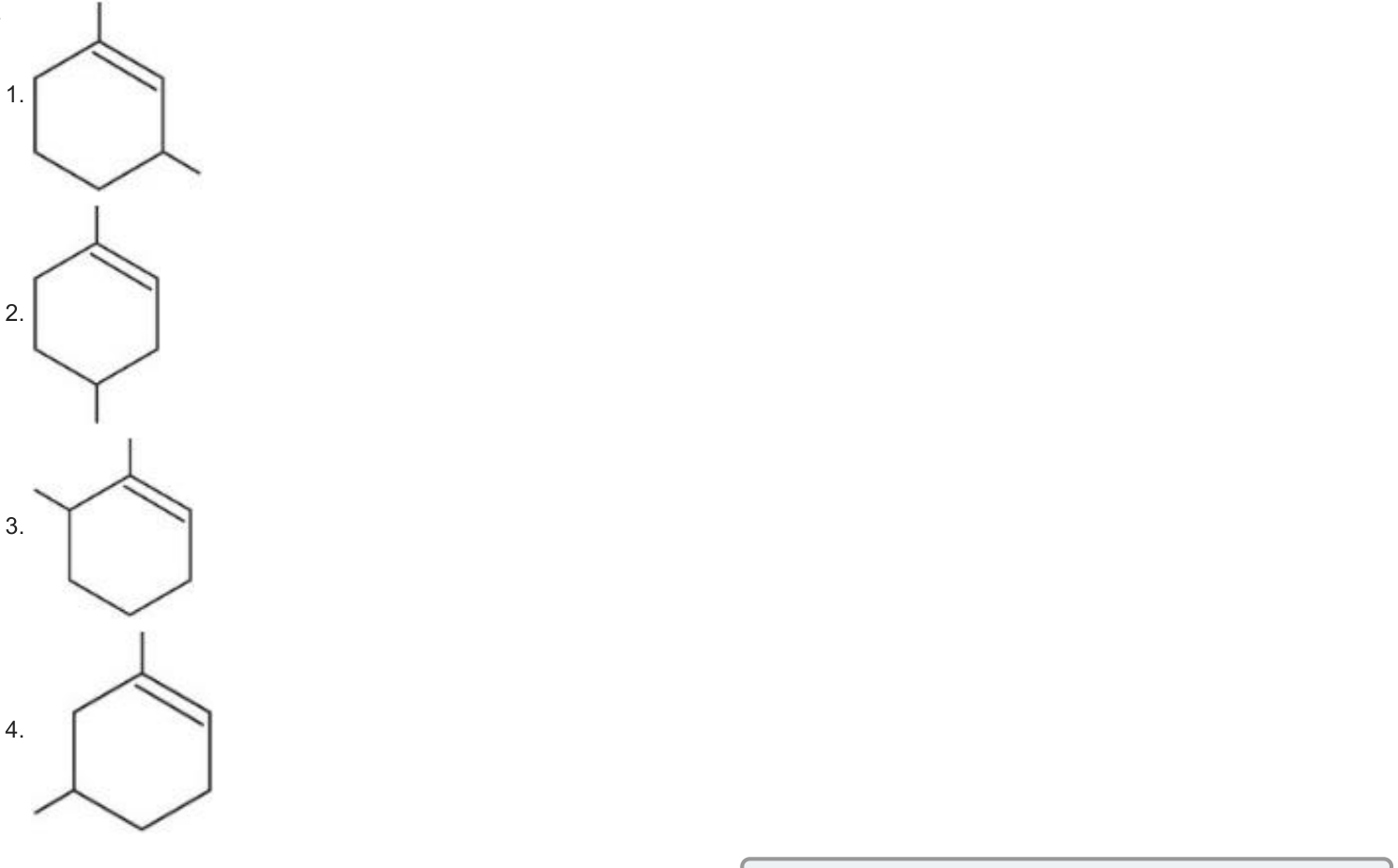
- AA cyclohexene ring drawn with the double bond between the top vertex and the upper-right vertex, a methyl group on the top vertex and a methyl group on the lower-right vertex (1,3-dimethylcyclohex-1-ene).
- BA cyclohexene ring drawn with the double bond between the top vertex and the upper-right vertex, a methyl group on the top vertex and a methyl group on the bottom vertex (1,4-dimethylcyclohex-1-ene).
- CA cyclohexene ring drawn with the double bond between the top vertex and the upper-right vertex, a methyl group on the top vertex and a methyl group on the upper-left vertex (1,6-dimethylcyclohex-1-ene).
- DA cyclohexene ring drawn with the double bond between the top vertex and the upper-right vertex, a methyl group on the top vertex and a methyl group on the lower-left vertex (1,5-dimethylcyclohex-1-ene).
View answer or solution
Answer
A cyclohexene ring drawn with the double bond between the top vertex and the upper-right vertex, a methyl group on the top vertex and a methyl group on the bottom vertex (1,4-dimethylcyclohex-1-ene).
Identify [A], [B] and [C], respectively in the following reaction sequence: [A] —(NaNO₂, HCl above the arrow; 273 – 278 K below it)→ [a benzene ring drawn as a hexagon with three double bonds, carrying an N₂⁺ group with a Cl⁻ counter-ion on the top vertex] —(KI)→ [B] —(2 Na above the arrow; Dry ether below it)→ [C]
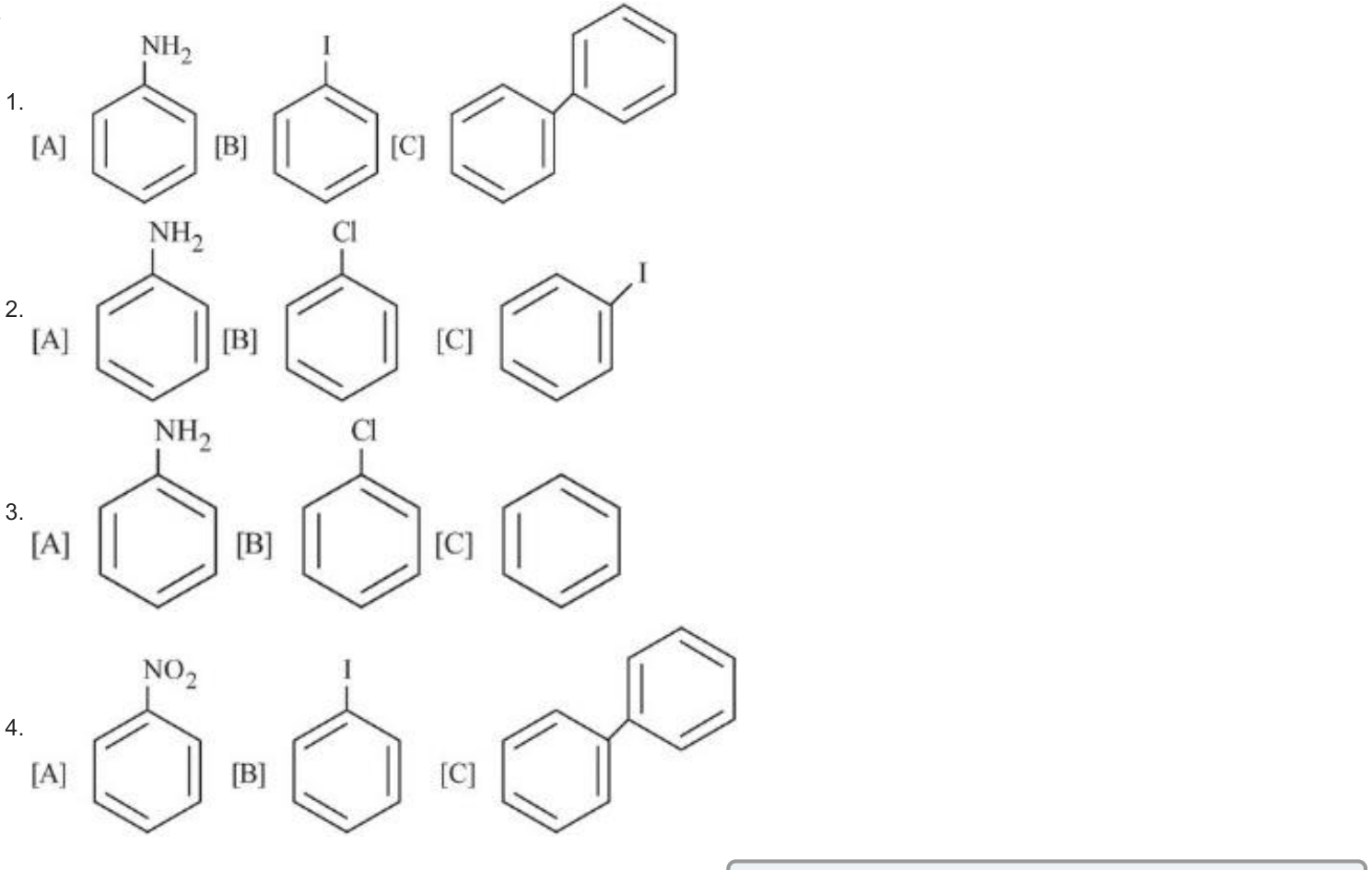
- A[A] aniline (a benzene ring with NH₂ on the top vertex), [B] iodobenzene (a benzene ring with I on the top vertex), [C] biphenyl (two benzene rings joined by a single bond).
- B[A] aniline (a benzene ring with NH₂ on the top vertex), [B] chlorobenzene (a benzene ring with Cl on the top vertex), [C] iodobenzene (a benzene ring with I on the upper-right vertex).
- C[A] aniline (a benzene ring with NH₂ on the top vertex), [B] chlorobenzene (a benzene ring with Cl on the top vertex), [C] benzene (a benzene ring with no substituent).
- D[A] nitrobenzene (a benzene ring with NO₂ on the top vertex), [B] iodobenzene (a benzene ring with I on the top vertex), [C] biphenyl (two benzene rings joined by a single bond).
View answer or solution
Answer
[A] aniline (a benzene ring with NH₂ on the top vertex), [B] iodobenzene (a benzene ring with I on the top vertex), [C] biphenyl (two benzene rings joined by a single bond).
2 moles each of ethylene glycol and glucose are dissolved in 500 g of water. The boiling point of the resulting solution is: (Given : Ebullioscopic constant of water = 0.52 K kg mol⁻¹)
- A375.3 K
- B377.3 K
- C379.2 K
- D277.3 K
View answer or solution
Answer
377.3 K
Organic Compounds Containing Nitrogen
In the following reactions, which one is NOT correct?
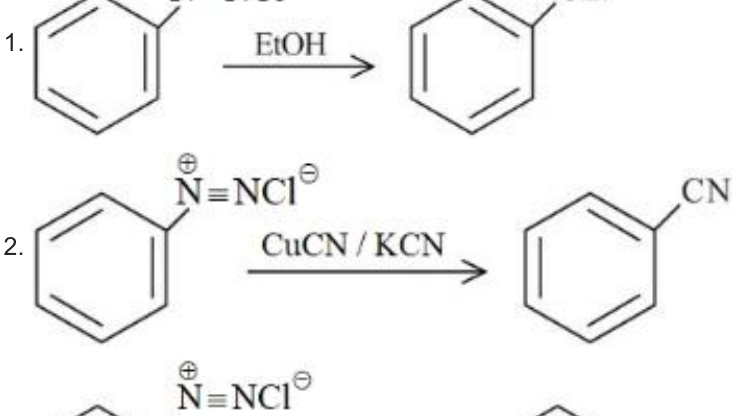
- AC₆H₅–N⁺≡NCl⁻ (a benzene ring drawn as a hexagon with three alternating inner double-bond lines, bonded to the diazonium group N⁺≡NCl⁻) —(EtOH)→ C₆H₅–OEt (a benzene ring drawn as a hexagon with three alternating inner double-bond lines, bonded to an –OEt group)
- BC₆H₅–N⁺≡NCl⁻ (a benzene ring drawn as a hexagon with three alternating inner double-bond lines, bonded to the diazonium group N⁺≡NCl⁻) —(CuCN / KCN)→ C₆H₅–CN (a benzene ring drawn as a hexagon with three alternating inner double-bond lines, bonded to a –CN group)
- CC₆H₅–N⁺≡NCl⁻ (a benzene ring drawn as a hexagon with three alternating inner double-bond lines, bonded to the diazonium group N⁺≡NCl⁻) —(H₃PO₂ / H₂O)→ C₆H₆ (a benzene ring drawn as a hexagon with three alternating inner double-bond lines)
- DC₆H₅–N⁺≡NCl⁻ (a benzene ring drawn as a hexagon with three alternating inner double-bond lines, bonded to the diazonium group N⁺≡NCl⁻) —(Potassium Iodide)→ C₆H₅–I (a benzene ring drawn as a hexagon with three alternating inner double-bond lines, bonded to an –I group)
View answer or solution
Answer
C₆H₅–N⁺≡NCl⁻ (a benzene ring drawn as a hexagon with three alternating inner double-bond lines, bonded to the diazonium group N⁺≡NCl⁻) —(EtOH)→ C₆H₅–OEt (a benzene ring drawn as a hexagon with three alternating inner double-bond lines, bonded to an –OEt group)
Purification and Characterisation of Organic Compounds
During estimation of nitrogen by Dumas' method of compound X (0.42 g) ___________ mL of N₂ gas will be liberated at STP. (nearest integer) (Given molar mass in g mol⁻¹ : C : 12, H : 1, N : 14)

View answer or solution
Answer
109
Consider the following reactions A + NaCl (Little amount) + H₂SO₄ → CrO₂Cl₂ + Side Products CrO₂Cl₂ (Vapour) + NaOH → B + NaCl + H₂O B + H⁺ → C + H₂O The number of terminal ‘O’ present in the compound ‘C’ is ___________.
View answer or solution
Answer
6
The number of optical isomers exhibited by the iron complex (A) obtained from the following reaction is ___________. FeCl₃ + KOH + H₂C₂O₄ → A
View answer or solution
Answer
2
Purification and Characterisation of Organic Compounds
0.5 g of an organic compound on combustion gave 1.46 g of CO₂ and 0.9 g of H₂O. The percentage of carbon in the compound is ___________. (Nearest integer) [Given : Molar mass (in g mol⁻¹) C : 12, H : 1, O : 16]
View answer or solution
Answer
80
Given : ΔH⊖_sub [C (graphite)] = 710 kJ mol⁻¹ Δ_C–H H⊖ = 414 kJ mol⁻¹ Δ_H–H H⊖ = 436 kJ mol⁻¹ Δ_C=C H⊖ = 611 kJ mol⁻¹ The Δ_f H⊖ for CH₂ = CH₂ is ___________ kJ mol⁻¹ (nearest integer value)
View answer or solution
Answer
25