
// QUESTION TOPIC
Hydrocarbons questions.
242 published questions across 89 papers, asked from 2022 to 2026. Each question links to the paper it was printed in, with the official answer wherever the exam body publishes one.
Showing 1–12 of 242 · sorted newest year first
Question 51
From JEE (Main) 2026 Session 1, 21 January 2026, Shift 1 — Paper 1 (B.E / B.Tech) Chemistry
Given below are two statements : Statement I : The number of species among SF₄, NH₄⁺, [NiCl₄]²⁻, XeF₄, [PtCl₄]²⁻, SeF₄ and [Ni(CN)₄]²⁻ , that have tetrahedral geometry is 3. Statement II : In the set [NO₂, BeH₂, BF₃, AlCl₃], all the molecules have incomplete octet around central atom. In the light of the above statements, choose the correct answer from the options given below :
Choose an option first, then open the answer.
Question from the source paper. Answer from the official final answer key (the key rows carrying this paper's Question IDs), version of 2026-02-16. Published documents are listed by the exam body at its document index.
Question 55
From JEE (Main) 2026 Session 1, 21 January 2026, Shift 1 — Paper 1 (B.E / B.Tech) Chemistry
Identify A in the following reaction.
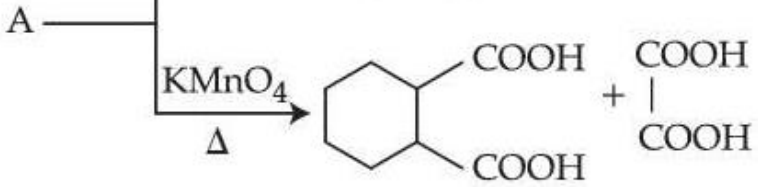
Choose an option first, then open the answer.
Question from the source paper. Answer from the official final answer key (the key rows carrying this paper's Question IDs), version of 2026-02-16. Published documents are listed by the exam body at its document index.
Question 75
From JEE (Main) 2026 Session 1, 21 January 2026, Shift 1 — Paper 1 (B.E / B.Tech) Chemistry
Consider the following reaction sequence [benzene ring drawn as a hexagon with three alternating double bonds —(conc.HNO₃ + conc.H₂SO₄ above the arrow, 333 K below it)→ P —(1. Sn/HCl/Δ, 2. pH neutralised)→ Q —((CH₃CO)₂O)→ R —(conc.HNO₃ + conc.H₂SO₄)→ S (major product) —(1. HCl/EtOH, Δ, 2. pH neutralised)→ T] The percentage of nitrogen in product 'T' formed is ________ %. (Nearest integer) (Given molar mass in g mol⁻¹ H : 1, C : 12, N : 14, O : 16)
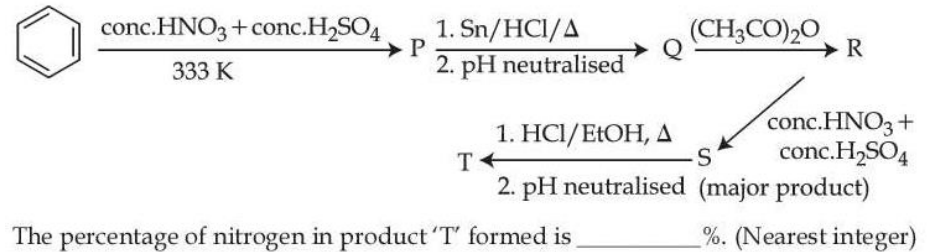
This question was printed without answer options.
Open the answer when you are ready.
Question from the source paper. Answer from the official final answer key (the key rows carrying this paper's Question IDs), version of 2026-02-16. Published documents are listed by the exam body at its document index.
Question 64
From JEE (Main) 2026 Session 1, 22 January 2026, Shift 1 — Paper 1 (B.E / B.Tech) Chemistry
'A' is a neutral organic compound (M. F : C₈H₉ON). On treatment with aqueous Br₂/HO⁻(−), 'A' forms a compound 'B' which is soluble in dilute acid. 'B' on treatment with aqueous NaNO₂ / HCl (0-5 °C) produces a compound 'C' which on treatment with CuCN/NaCN produces 'D'. Hydrolysis of 'D' produces 'E' which is also obtainable from the hydrolysis of 'A'. 'E' on treatment with acidified KMnO₄ produces 'F'. 'F' contains two different types of hydrogen atoms. The structure of 'A' is
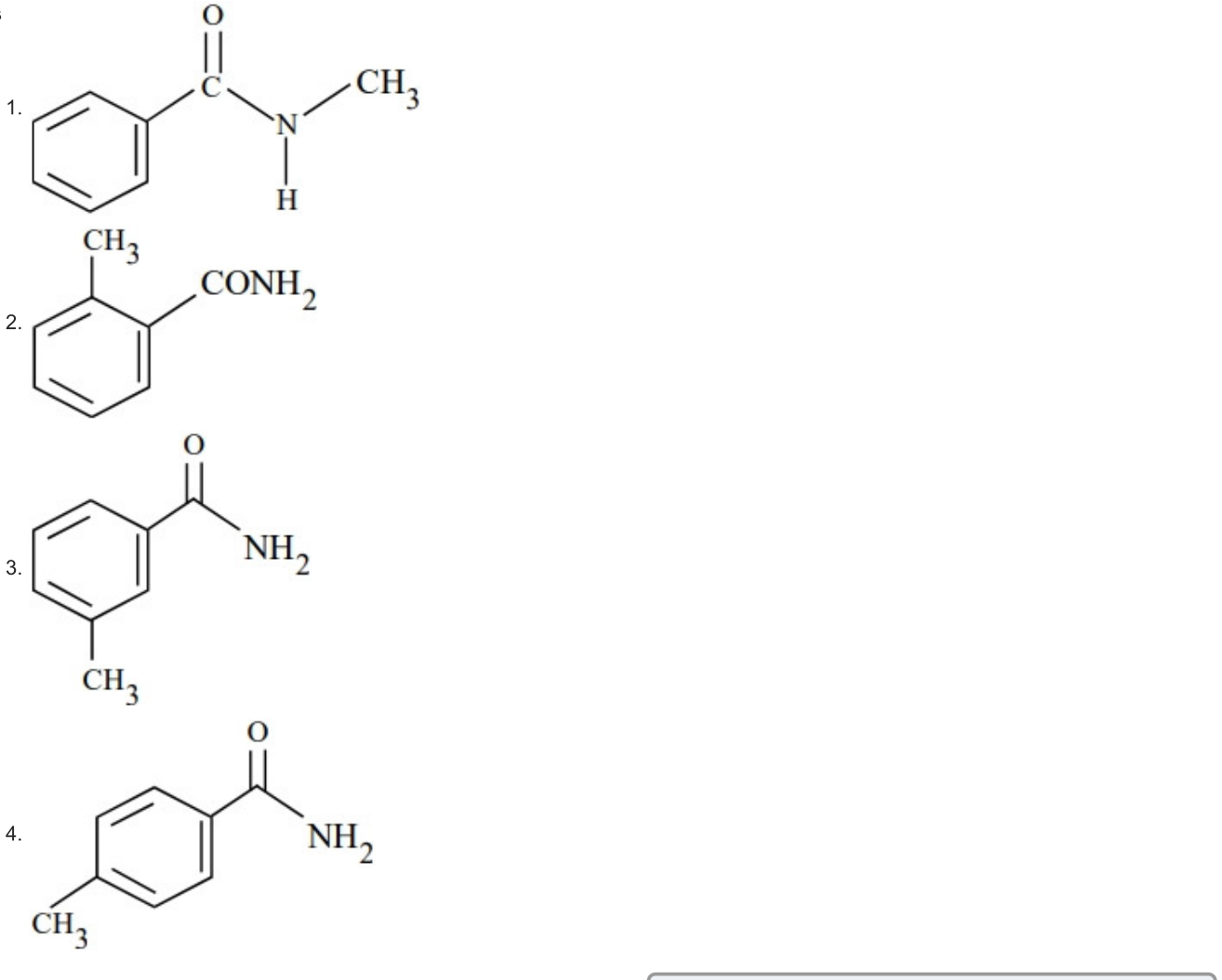
Choose an option first, then open the answer.
Question from the source paper. Answer from the official final answer key (the key rows carrying this paper's Question IDs), version of 2026-02-16. Published documents are listed by the exam body at its document index.
Question 67
From JEE (Main) 2026 Session 1, 22 January 2026, Shift 1 — Paper 1 (B.E / B.Tech) Chemistry
Given below are two statements: Statement I: Benzene is nitrated to give nitrobenzene, which on further treatment with CH₃COCl / AlCl₃ will give [3-nitroacetophenone: a benzene ring with COCH₃ on the upper-right vertex and NO₂ on the bottom vertex] Statement II: –NO₂ group is a m-directing, and deactivating group. In the light of the above statements, choose the most appropriate answer from the options given below
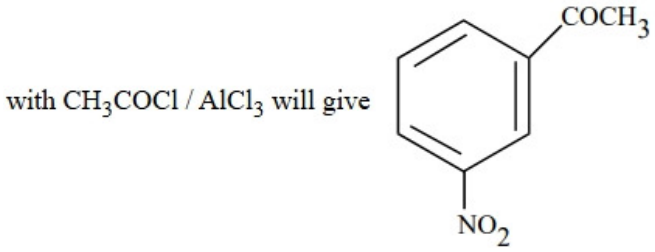
Choose an option first, then open the answer.
Question from the source paper. Answer from the official final answer key (the key rows carrying this paper's Question IDs), version of 2026-02-16. Published documents are listed by the exam body at its document index.
Question 55
From JEE (Main) 2026 Session 1, 22 January 2026, Shift 2 — Paper 1 (B.E / B.Tech) Chemistry
Consider the following reaction : 2NaNH₂ ⟶ X ⟶ Y The product Y formed is :
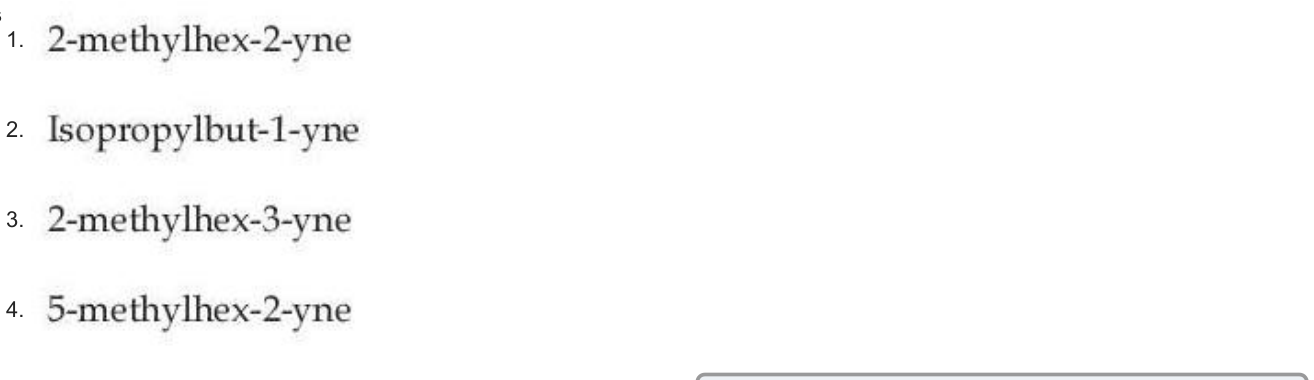
Choose an option first, then open the answer.
Question from the source paper. Answer from the official final answer key (the key rows carrying this paper's Question IDs), version of 2026-02-16. Published documents are listed by the exam body at its document index.
Question 57
From JEE (Main) 2026 Session 1, 22 January 2026, Shift 2 — Paper 1 (B.E / B.Tech) Chemistry
[cyclohexane ring bearing a –CH₂–CH₂–NH₂ group] ⟶[C₆H₅COCl/NaOH] [A] ⟶[LiAlH₄/H₂O] [B] The final product [B] is :
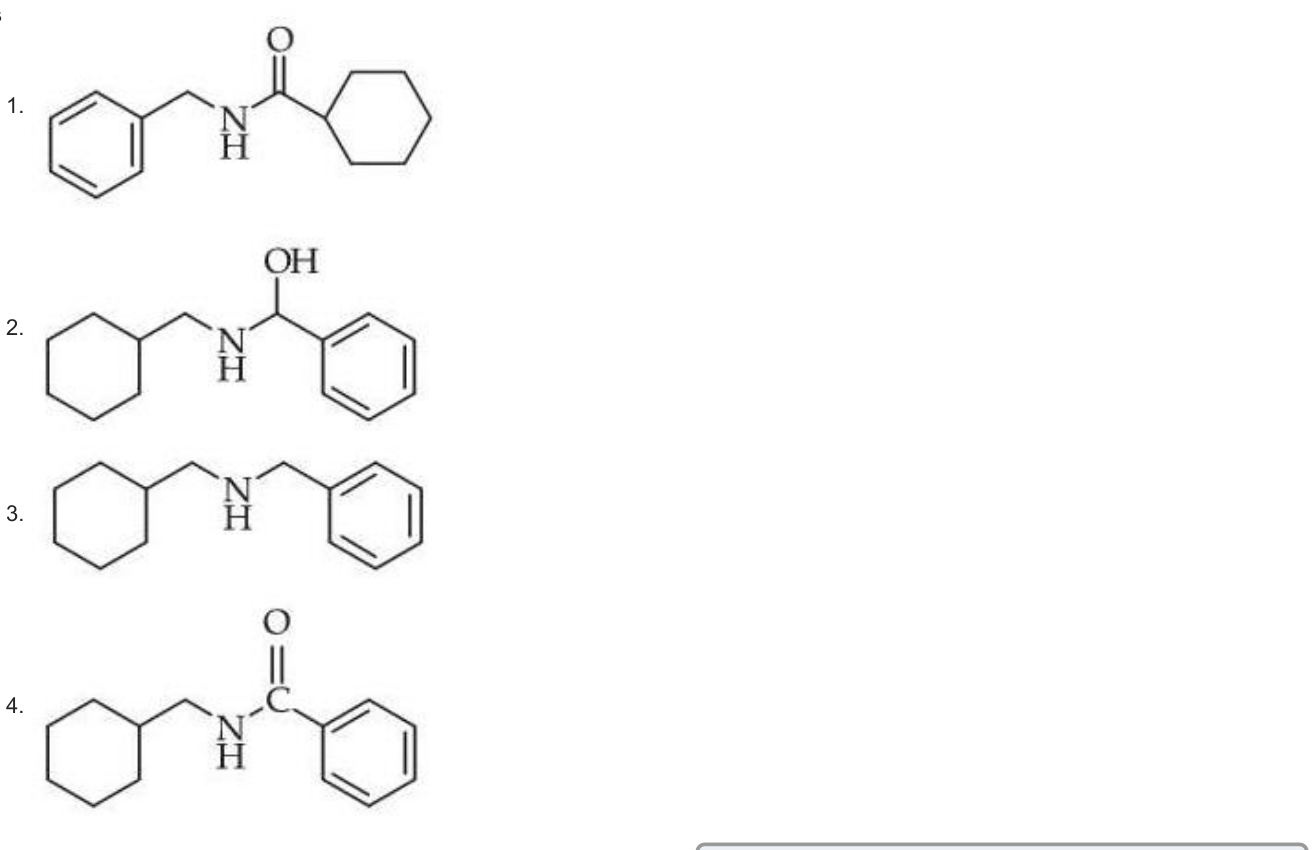
Choose an option first, then open the answer.
Question from the source paper. Answer from the official final answer key (the key rows carrying this paper's Question IDs), version of 2026-02-16. Published documents are listed by the exam body at its document index.
Question 63
From JEE (Main) 2026 Session 1, 23 January 2026, Shift 1 — Paper 1 (B.E / B.Tech) Chemistry
Compound ‘P’ undergoes the following sequence of reactions : ‘P’ —(i) NH₃, (ii) Δ→ Q —(i) KOH, Br₂, (ii) CHCl₃, KOH (alc), Δ→ [a cyclohexane ring drawn as a hexagon with an –NC group on a bond from the upper-right vertex] ‘P’ is :
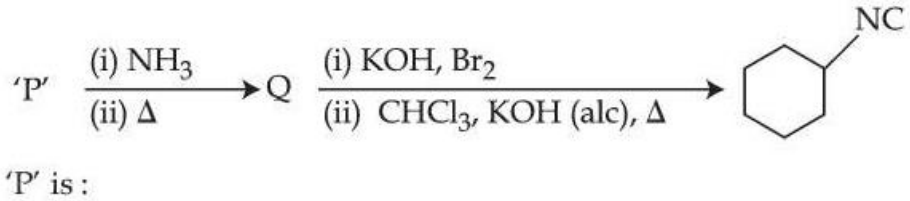
Choose an option first, then open the answer.
Question from the source paper. Answer from the official final answer key (the key rows carrying this paper's Question IDs), version of 2026-02-16. Published documents are listed by the exam body at its document index.
Question 64
From JEE (Main) 2026 Session 1, 23 January 2026, Shift 1 — Paper 1 (B.E / B.Tech) Chemistry
Consider the following compounds a. [a benzene ring drawn as a hexagon with a Cl on the top vertex] b. [a benzene ring drawn as a hexagon with a NO₂ on the top vertex] c. [a benzene ring drawn as a hexagon with an OCH₃ on the top vertex] Arrange these compounds in the increasing order of reactivity with nitrating mixture.
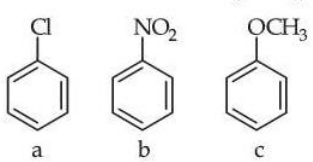
Choose an option first, then open the answer.
Question from the source paper. Answer from the official final answer key (the key rows carrying this paper's Question IDs), version of 2026-02-16. Published documents are listed by the exam body at its document index.
Question 65
From JEE (Main) 2026 Session 1, 23 January 2026, Shift 1 — Paper 1 (B.E / B.Tech) Chemistry
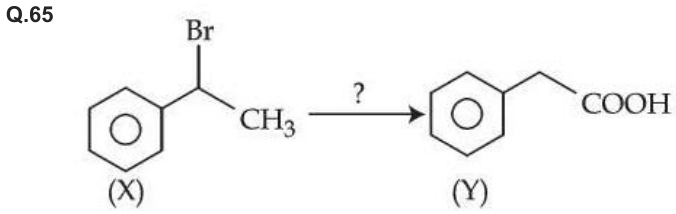
(X) [a benzene ring drawn as a hexagon with a –CH(Br)–CH₃ group on the upper-right vertex] —?→ (Y) [a benzene ring drawn as a hexagon with a –CH₂–CH₂–COOH group on the upper-right vertex] The correct sequence of reagents for the above conversion of X to Y is :
Choose an option first, then open the answer.
Question from the source paper. Answer from the official final answer key (the key rows carrying this paper's Question IDs), version of 2026-02-16. Published documents are listed by the exam body at its document index.
Question 66
From JEE (Main) 2026 Session 1, 23 January 2026, Shift 1 — Paper 1 (B.E / B.Tech) Chemistry
‘x’ is the product which is obtained from propanenitrile and stannous chloride in the presence of hydrochloric acid followed by hydrolysis. ‘y’ is the product which is obtained from the but-2-ene by the ozonolysis followed by hydrolysis. From the following, which product is not obtained when one mole of ‘x’ and one mole of ‘y’ react with each other in the presence of alkali followed by heating ?
Choose an option first, then open the answer.
Question from the source paper. Answer from the official final answer key (the key rows carrying this paper's Question IDs), version of 2026-02-16. Published documents are listed by the exam body at its document index.
Question 67
From JEE (Main) 2026 Session 1, 23 January 2026, Shift 1 — Paper 1 (B.E / B.Tech) Chemistry
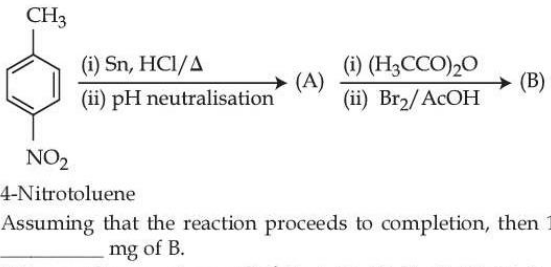
Consider the following sequence of reactions. 4-Nitrotoluene [a benzene ring drawn as a hexagon with CH₃ on the top vertex and NO₂ on the bottom vertex] —(i) Sn, HCl/Δ, (ii) pH neutralisation→ (A) —(i) (H₃CCO)₂O, (ii) Br₂/AcOH→ (B) Assuming that the reaction proceeds to completion, then 137 mg of 4-nitrotoluene will produce ________ mg of B. (Given molar mass in g mol⁻¹ H : 1, C : 12, N : 14, O : 16, Br : 80)
Choose an option first, then open the answer.
Question from the source paper. Answer from the official final answer key (the key rows carrying this paper's Question IDs), version of 2026-02-16. Published documents are listed by the exam body at its document index.
How questions are grouped
This page groups Anna University questions by subject. Open a subject code’s syllabus to practise by unit where reviewed questions are available. Other exams may group questions by chapter.
Questions the exam body withdrew, and questions that need unavailable source figures, are withheld rather than served. Each served question links to its source.