
// QUESTION TOPIC
Some Basic Principles of Organic Chemistry questions.
108 published questions across 64 papers, asked from 2022 to 2026. Each question links to the paper it was printed in, with the official answer wherever the exam body publishes one.
Showing 1–12 of 108 · sorted newest year first
Question 53
From JEE (Main) 2026 Session 1, 21 January 2026, Shift 1 — Paper 1 (B.E / B.Tech) Chemistry
A hydrocarbon 'P' (C₄H₈) on reaction with HCl gives an optically active compound 'Q' (C₄H₉Cl) which on reaction with one mole of ammonia gives compound 'R' (C₄H₁₁N). 'R' on diazotization followed by hydrolysis gives 'S'. Identify P, Q, R and S.
Choose an option first, then open the answer.
Question from the source paper. Answer from the official final answer key (the key rows carrying this paper's Question IDs), version of 2026-02-16. Published documents are listed by the exam body at its document index.
Question 63
From JEE (Main) 2026 Session 1, 21 January 2026, Shift 1 — Paper 1 (B.E / B.Tech) Chemistry
Identify correct statements from the following : A. Propanal and propanone are functional isomers. B. Ethoxyethane and methoxypropane are metamers. C. But-2-ene shows optical isomerism. D. But-1-ene and but-2-ene are functional isomers. E. Pentane and 2, 2-dimethyl propane are chain isomers. Choose the correct answer from the options given below :
Choose an option first, then open the answer.
Question from the source paper. Answer from the official final answer key (the key rows carrying this paper's Question IDs), version of 2026-02-16. Published documents are listed by the exam body at its document index.
Question 69
From JEE (Main) 2026 Session 1, 21 January 2026, Shift 1 — Paper 1 (B.E / B.Tech) Chemistry
From the following, the least stable structure is :
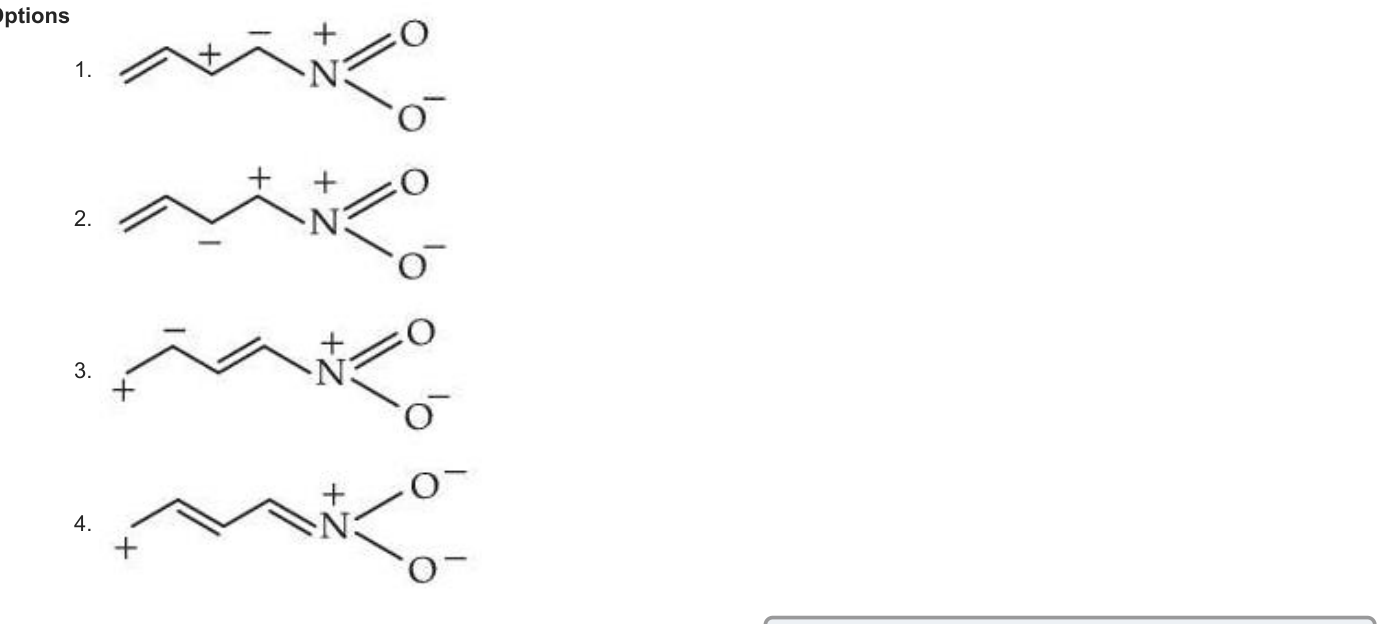
Choose an option first, then open the answer.
Question from the source paper. Answer from the official final answer key (the key rows carrying this paper's Question IDs), version of 2026-02-16. Published documents are listed by the exam body at its document index.
Question 56
From JEE (Main) 2026 Session 1, 21 January 2026, Shift 2 — Paper 1 (B.E / B.Tech) Chemistry
The correct order of the rate of the reaction for the following reaction with respect to nucleophiles is : CH₃Br + Nu⊖ ⟶ CH₃Nu + Br⊖
Choose an option first, then open the answer.
Question from the source paper. Answer from the official final answer key (the key rows carrying this paper's Question IDs), version of 2026-02-16. Published documents are listed by the exam body at its document index.
Question 62
From JEE (Main) 2026 Session 1, 21 January 2026, Shift 2 — Paper 1 (B.E / B.Tech) Chemistry
Match List - I with List - II. List - I — Pair of Compounds A. 2-Methylpropene and but-1-ene B. Cis-but-2-ene and trans-but-2-ene C. 2-Butanol and diethyl ether D. But-1-ene and but-2-ene List - II — Type of Isomers I. Stereoisomers II. Position isomers III. Chain isomers IV. Functional group isomers Choose the correct answer from the options given below :
Choose an option first, then open the answer.
Question from the source paper. Answer from the official final answer key (the key rows carrying this paper's Question IDs), version of 2026-02-16. Published documents are listed by the exam body at its document index.
Question 70
From JEE (Main) 2026 Session 1, 21 January 2026, Shift 2 — Paper 1 (B.E / B.Tech) Chemistry
Given below are four compounds : (a) n-propyl chloride (b) iso-propyl chloride (c) sec-butyl chloride (d) neo-pentyl chloride Percentage of carbon in the one which exhibits optical isomerism is :
Choose an option first, then open the answer.
Question from the source paper. Answer from the official final answer key (the key rows carrying this paper's Question IDs), version of 2026-02-16. Published documents are listed by the exam body at its document index.
Question 53
From JEE (Main) 2026 Session 1, 22 January 2026, Shift 1 — Paper 1 (B.E / B.Tech) Chemistry
The correct order of reactivity of CH₃Br in methanol with the following nucleophiles is F⁻, I⁻, C₂H₅O⁻ and C₆H₅O⁻
Choose an option first, then open the answer.
Question from the source paper. Answer from the official final answer key (the key rows carrying this paper's Question IDs), version of 2026-02-16. Published documents are listed by the exam body at its document index.
Question 63
From JEE (Main) 2026 Session 1, 22 January 2026, Shift 1 — Paper 1 (B.E / B.Tech) Chemistry
The correct order of the rate of reaction of the following reactants with nucleophile by S_N1 mechanism is : (Given : Structures I and II are rigid)
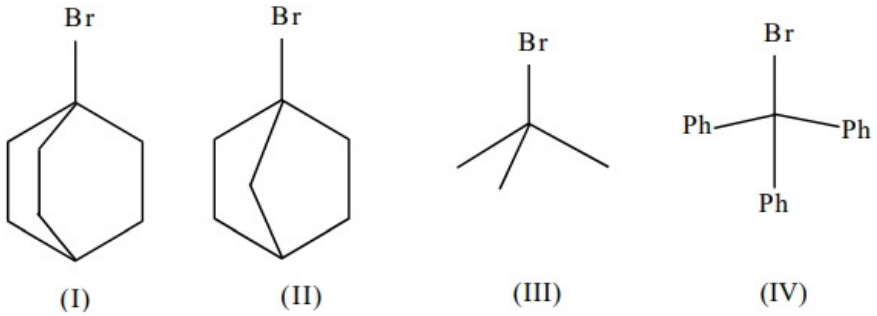
Choose an option first, then open the answer.
Question from the source paper. Answer from the official final answer key (the key rows carrying this paper's Question IDs), version of 2026-02-16. Published documents are listed by the exam body at its document index.
Question 60
From JEE (Main) 2026 Session 1, 23 January 2026, Shift 1 — Paper 1 (B.E / B.Tech) Chemistry
Match List - I with List - II. | List - I | List - II | |---|---| | **Functional group (detection)** | **Change observed during detection** | | A. Unsaturation (Baeyer’s test) | I. Red colour appears | | B. Alcoholic group (Ceric ammonium nitrate test) | II. Silver mirror appears | | C. Aldehyde group (Tollen’s reagent) | III. Violet colour appears | | D. Phenolic group (FeCl₃ test) | IV. Discharge of pink colour | Choose the correct answer from the options given below :
Choose an option first, then open the answer.
Question from the source paper. Answer from the official final answer key (the key rows carrying this paper's Question IDs), version of 2026-02-16. Published documents are listed by the exam body at its document index.
Question 74
From JEE (Main) 2026 Session 1, 23 January 2026, Shift 1 — Paper 1 (B.E / B.Tech) Chemistry
Consider all the structural isomers with molecular formula C₅H₁₁Br are separately treated with KOH(aq) to give respective substitution products, without any rearrangement. The number of products which can exhibit optical isomerism from these is ________.
This question was printed without answer options.
Open the answer when you are ready.
Question from the source paper. Answer from the official final answer key (the key rows carrying this paper's Question IDs), version of 2026-02-16. Published documents are listed by the exam body at its document index.
Question 61
From JEE (Main) 2026 Session 1, 23 January 2026, Shift 2 — Paper 1 (B.E / B.Tech) Chemistry
Given below are two statements: Statement I: (CH₃)₃C⊕ is more stable than CH₃⊕ as nine hyperconjugation interactions are possible in (CH₃)₃C⊕. Statement II: CH₃⊕ is less stable than (CH₃)₃C⊕ as only three hyperconjugation interactions are possible in CH₃⊕. In the light of the above statements, choose the correct answer from the options given below
Choose an option first, then open the answer.
Question from the source paper. Answer from the official final answer key (the key rows carrying this paper's Question IDs), version of 2026-02-16. Published documents are listed by the exam body at its document index.
Question 65
From JEE (Main) 2026 Session 1, 23 January 2026, Shift 2 — Paper 1 (B.E / B.Tech) Chemistry
Both human DNA and RNA are chiral molecules. The chirality in DNA and RNA arises due to the presence of
Choose an option first, then open the answer.
Question from the source paper. Answer from the official final answer key (the key rows carrying this paper's Question IDs), version of 2026-02-16. Published documents are listed by the exam body at its document index.
How questions are grouped
This page groups Anna University questions by subject. Open a subject code’s syllabus to practise by unit where reviewed questions are available. Other exams may group questions by chapter.
Questions the exam body withdrew, and questions that need unavailable source figures, are withheld rather than served. Each served question links to its source.