
// QUESTION TOPIC
Chemical Bonding and Molecular Structure questions.
192 published questions across 90 papers, asked from 2022 to 2026. Each question links to the paper it was printed in, with the official answer wherever the exam body publishes one.
Showing 1–12 of 192 · sorted newest year first
Question 58
From JEE (Main) 2026 Session 1, 21 January 2026, Shift 1 — Paper 1 (B.E / B.Tech) Chemistry
Given below are two statements : Statement I : Among [Cu(NH₃)₄]²⁺, [Ni(en)₃]²⁺, [Ni(NH₃)₆]²⁺ and [Mn(H₂O)₆]²⁺, [Mn(H₂O)₆]²⁺ has the maximum number of unpaired electrons. Statement II : The number of pairs among {[NiCl₄]²⁻, [Ni(CO)₄]}, {[NiCl₄]²⁻, [Ni(CN)₄]²⁻} and {[Ni(CO)₄], [Ni(CN)₄]²⁻} that contain only diamagnetic species is two. In the light of the above statements, choose the correct answer from the options given below :
Choose an option first, then open the answer.
Question from the source paper. Answer from the official final answer key (the key rows carrying this paper's Question IDs), version of 2026-02-16. Published documents are listed by the exam body at its document index.
Question 53
From JEE (Main) 2026 Session 1, 21 January 2026, Shift 2 — Paper 1 (B.E / B.Tech) Chemistry
The correct increasing order of C−H(A), C−O(B), C=O(C) and C≡N(D) bonds in terms of covalent bond length is :
Choose an option first, then open the answer.
Question from the source paper. Answer from the official final answer key (the key rows carrying this paper's Question IDs), version of 2026-02-16. Published documents are listed by the exam body at its document index.
Question 66
From JEE (Main) 2026 Session 1, 21 January 2026, Shift 2 — Paper 1 (B.E / B.Tech) Chemistry
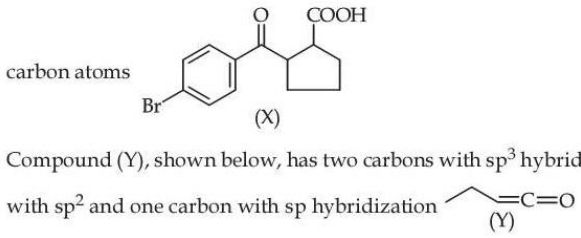
Given below are two statements : Statement I : Compound (X), shown below, dissolves in NaHCO₃ solution and has two chiral carbon atoms. Statement II : Compound (Y), shown below, has two carbons with sp³ hybridization, one carbon with sp² and one carbon with sp hybridization. In the light of the above statements, choose the correct answer from the options given below :
Choose an option first, then open the answer.
Question from the source paper. Answer from the official final answer key (the key rows carrying this paper's Question IDs), version of 2026-02-16. Published documents are listed by the exam body at its document index.
Question 71
From JEE (Main) 2026 Session 1, 21 January 2026, Shift 2 — Paper 1 (B.E / B.Tech) Chemistry
Identify the metal ions among Co²⁺, Ni²⁺, Fe²⁺, V³⁺ and Ti²⁺ having a spin-only magnetic moment value more than 3.0 BM. The sum of unpaired electrons present in the high spin octahedral complexes formed by those metal ions is ________.
This question was printed without answer options.
Open the answer when you are ready.
Question from the source paper. Answer from the official final answer key (the key rows carrying this paper's Question IDs), version of 2026-02-16. Published documents are listed by the exam body at its document index.
Question 65
From JEE (Main) 2026 Session 1, 22 January 2026, Shift 1 — Paper 1 (B.E / B.Tech) Chemistry
As compared with chlorocyclohexane, which of the following statements correctly apply to chlorobenzene? A. The magnitude of negative charge is more on chlorine atom. B. The C – Cl bond has partial double bond character. C. C – Cl bond is less polar. D. C – Cl bond is longer due to repulsion between delocalised electrons of the aromatic ring and lone pairs of electrons of chlorine. E. The C – Cl bond is formed using sp² hybridised orbital of carbon. Choose the correct answer from the options given below:
Choose an option first, then open the answer.
Question from the source paper. Answer from the official final answer key (the key rows carrying this paper's Question IDs), version of 2026-02-16. Published documents are listed by the exam body at its document index.
Question 66
From JEE (Main) 2026 Session 1, 22 January 2026, Shift 1 — Paper 1 (B.E / B.Tech) Chemistry
Consider the transition metal ions Mn³⁺, Cr³⁺, Fe³⁺ and Co³⁺ and all form low spin octahedral complexes. The correct decreasing order of unpaired electrons in their respective d-orbitals of the complexes is
Choose an option first, then open the answer.
Question from the source paper. Answer from the official final answer key (the key rows carrying this paper's Question IDs), version of 2026-02-16. Published documents are listed by the exam body at its document index.
Question 68
From JEE (Main) 2026 Session 1, 22 January 2026, Shift 1 — Paper 1 (B.E / B.Tech) Chemistry
Two p-block elements X and Y form fluorides of the type EF₃. The fluoride compound XF₃ is a Lewis acid and YF₃ is a Lewis base. The hybridizations of the central atoms of XF₃ and YF₃ respectively are
Choose an option first, then open the answer.
Question from the source paper. Answer from the official final answer key (the key rows carrying this paper's Question IDs), version of 2026-02-16. Published documents are listed by the exam body at its document index.
Question 69
From JEE (Main) 2026 Session 1, 22 January 2026, Shift 1 — Paper 1 (B.E / B.Tech) Chemistry
The formal charges on the atoms marked as (1) to (4) in the Lewis representation of HNO₃ molecule respectively are

Choose an option first, then open the answer.
Question from the source paper. Answer from the official final answer key (the key rows carrying this paper's Question IDs), version of 2026-02-16. Published documents are listed by the exam body at its document index.
Question 51
From JEE (Main) 2026 Session 1, 22 January 2026, Shift 2 — Paper 1 (B.E / B.Tech) Chemistry
Among H₂S, H₂O, NF₃, NH₃ and CHCl₃, identify the molecule (X) with lowest dipole moment value. The number of lone pairs of electrons present on the central atom of the molecule (X) is :
Choose an option first, then open the answer.
Question from the source paper. Answer from the official final answer key (the key rows carrying this paper's Question IDs), version of 2026-02-16. Published documents are listed by the exam body at its document index.
Question 59
From JEE (Main) 2026 Session 1, 23 January 2026, Shift 1 — Paper 1 (B.E / B.Tech) Chemistry
But-2-yne and hydrogen (one mole each) are separately treated with (i) Pd/C and (ii) Na/ liq. NH₃ to give the products X and Y respectively. Identify the incorrect statements. A. X and Y are stereoisomers. B. Dipole moment of X is zero. C. Boiling point of X is higher than Y. D. X and Y react with O₃/Zn + H₂O to give different products. Choose the correct answer from the options given below :
Choose an option first, then open the answer.
Question from the source paper. Answer from the official final answer key (the key rows carrying this paper's Question IDs), version of 2026-02-16. Published documents are listed by the exam body at its document index.
Question 70
From JEE (Main) 2026 Session 1, 23 January 2026, Shift 1 — Paper 1 (B.E / B.Tech) Chemistry
Identify the molecule (X) with maximum number of lone pairs of electrons (obtained using Lewis dot structure) among HNO₃, H₂SO₄, NF₃ and O₃. Choose the correct bond angle made by the central atom of the molecule (X).
Choose an option first, then open the answer.
Question from the source paper. Answer from the official final answer key (the key rows carrying this paper's Question IDs), version of 2026-02-16. Published documents are listed by the exam body at its document index.
Question 60
From JEE (Main) 2026 Session 1, 23 January 2026, Shift 2 — Paper 1 (B.E / B.Tech) Chemistry
Which statements are NOT TRUE about XeO₂F₂? A. It has a see-saw shape. B. Xe has 5 electron pairs in its valence shell in XeO₂F₂. C. The O–Xe–O bond angle is close to 180°. D. The F–Xe–F bond angle is close to 180°. E. Xe has 16 valence electrons in XeO₂F₂. Choose the correct answer from the options given below:
Choose an option first, then open the answer.
Question from the source paper. Answer from the official final answer key (the key rows carrying this paper's Question IDs), version of 2026-02-16. Published documents are listed by the exam body at its document index.
How questions are grouped
This page groups Anna University questions by subject. Open a subject code’s syllabus to practise by unit where reviewed questions are available. Other exams may group questions by chapter.
Questions the exam body withdrew, and questions that need unavailable source figures, are withheld rather than served. Each served question links to its source.