
// JEE (Main) / 2025
JEE (Main) 2025 Session 2, 3 April 2025, Shift 1 — Paper 1 (B.E / B.Tech) Physics
Physics · B.E / B.Tech
Questions
24 + 1
Has an official figure
Withheld — the source figure is not published, so the question is stored with the paper and not served
Work through the questions
24 questions
Take a moment to try each question before opening the available answer or solution.
Match the LIST-I with LIST-II | LIST-I | LIST-II | |---|---| | A. ¹₀n + ²³⁵₉₂U → ¹⁴⁰₅₄Xe + ⁹⁴₃₈Sr + 2¹₀n | I. Chemical reaction | | B. 2H₂ + O₂ → 2H₂O | II. Fusion with +ve Q value | | C. ²₁H + ²₁H → ³₂He + ¹₀n | III. Fission | | D. ¹₁H + ³₁H → ²₁H + ²₁H | IV. Fusion with -ve Q value | Choose the correct answer from the options given below:
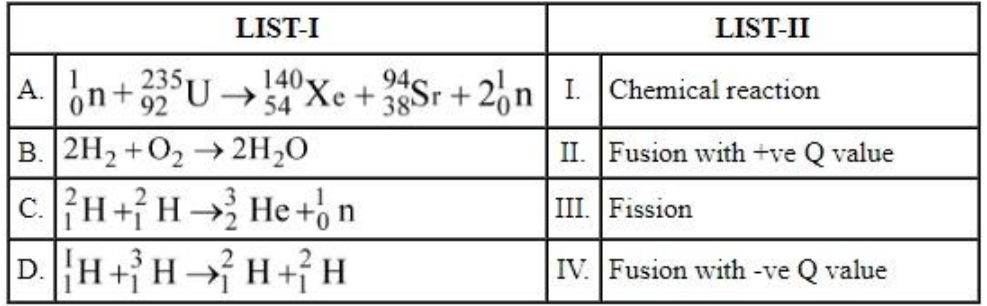
- AA-II, B-I, C-IV, D-III
- BA-II, B-I, C-III, D-IV
- CA-III, B-I, C-II, D-IV
- DA-III, B-I, C-IV, D-II
View answer or solution
Answer
A-III, B-I, C-II, D-IV
Dual Nature of Matter and Radiation
The work function of a metal is 3 eV. The color of the visible light that is required to cause emission of photoelectrons is
- AYellow
- BGreen
- CRed
- DBlue
View answer or solution
Answer
Blue
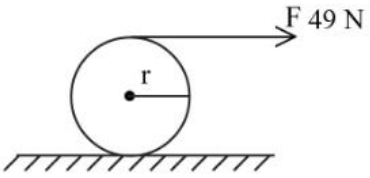
A force of 49 N acts tangentially at the highest point of a sphere (solid) of mass 20 kg, kept on a rough horizontal plane. If the sphere rolls without slipping, then the acceleration of the center of the sphere is
- A3.5 m/s²
- B0.35 m/s²
- C2.5 m/s²
- D0.25 m/s²
View answer or solution
Answer
3.5 m/s²
The radiation pressure exerted by a 450 W light source on a perfectly reflecting surface placed at 2m away from it, is
- A3 × 10⁻⁸ Pascals
- B0
- C6 × 10⁻⁸ Pascals
- D1.5 × 10⁻⁸ Pascals
View answer or solution
Answer
6 × 10⁻⁸ Pascals
A person measures mass of 3 different particles as 435.42 g, 226.3 g and 0.125 g. According to the rules for arithmetic operations with significant figures, the addition of the masses of 3 particles will be.
- A661.845 g
- B662 g
- C661.84 g
- D661.8 g
View answer or solution
Answer
661.8 g
The angle of projection of a particle is measured from the vertical axis as φ and the maximum height reached by the particle is hₘ. Here hₘ as function of φ can be presented as
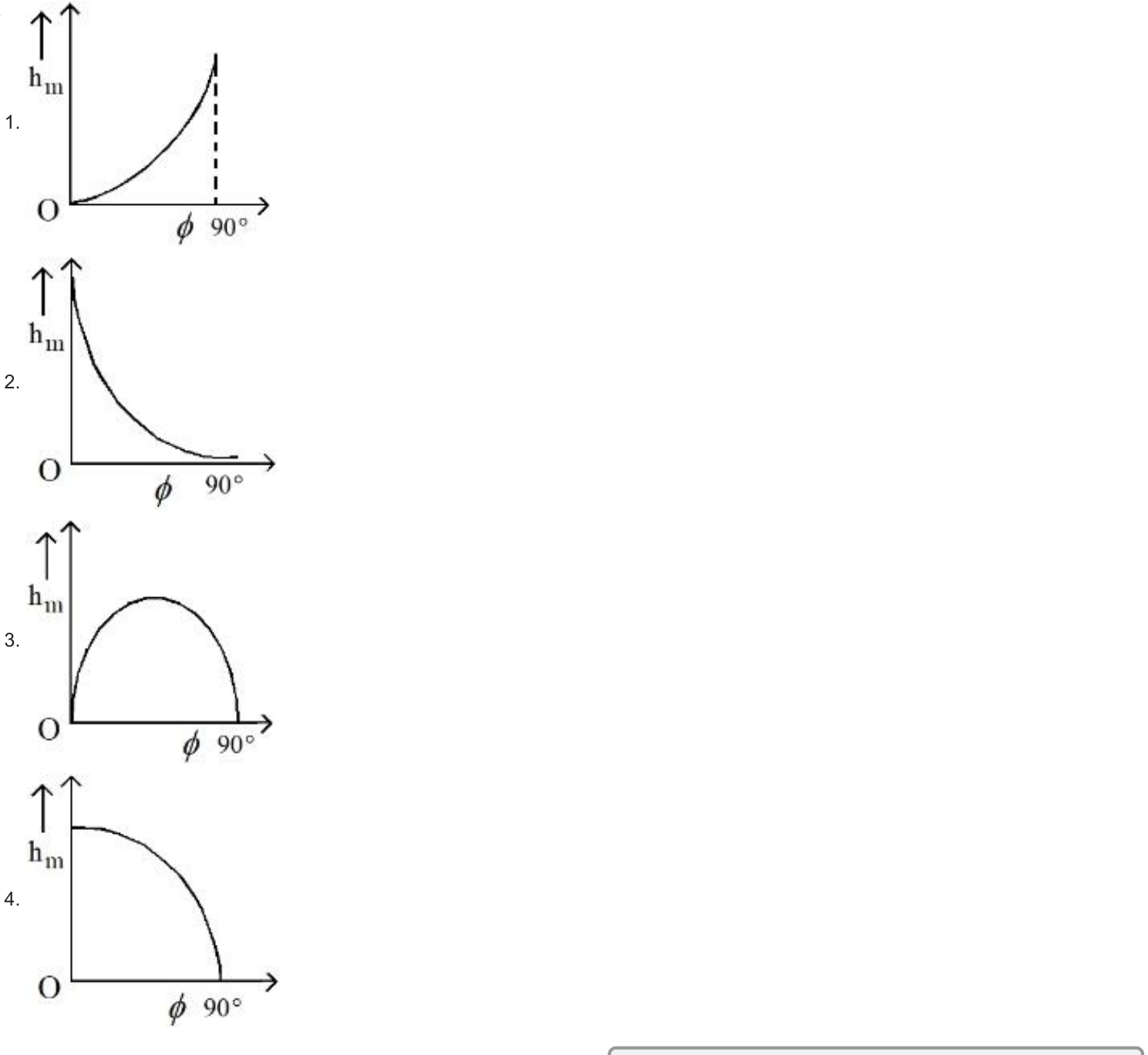
- AGraph: hₘ on the vertical axis against φ on the horizontal axis (O at the origin, 90° marked), with a curve rising from the origin with increasing slope up to a vertical dashed line at φ = 90°.
- BGraph: hₘ on the vertical axis against φ on the horizontal axis (O at the origin, 90° marked), with a curve falling steeply from a high value on the hₘ axis at φ = 0 and levelling off towards the φ axis, approaching zero before 90°.
- CGraph: hₘ on the vertical axis against φ on the horizontal axis (O at the origin, 90° marked), with an arch (inverted U) that starts at the origin, rises to a maximum at an intermediate φ and falls back to zero at φ = 90°.
- DGraph: hₘ on the vertical axis against φ on the horizontal axis (O at the origin, 90° marked), with a curve starting at its maximum on the hₘ axis at φ = 0, falling gradually and then steeply to zero at φ = 90°.
View answer or solution
Answer
Graph: hₘ on the vertical axis against φ on the horizontal axis (O at the origin, 90° marked), with a curve starting at its maximum on the hₘ axis at φ = 0, falling gradually and then steeply to zero at φ = 90°.
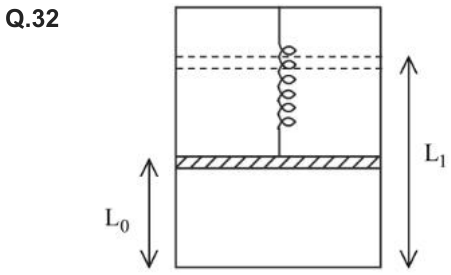
A piston of mass M is hung from a massless spring whose restoring force law goes as F= –kx³, where k is the spring constant of appropriate dimension. The piston separates the vertical chamber into two parts, where the bottom part is filled with ‘n’ moles of an ideal gas. An external work is done on the gas isothermally (at a constant temperature T) with the help of a heating filament (with negligible volume) mounted in lower part of the chamber, so that the piston goes up from a height L₀ to L₁, the total energy delivered by the filament is :(Assume spring to be in its natural length before heating)
- AnRT ln(L₁/L₀) + Mg(L₁ − L₀) + (k/4)(L₁⁴ − L₀⁴)
- BnRT ln(L₁²/L₀²) + (Mg/2)(L₁ − L₀) + (k/4)(L₁⁴ − L₀⁴)
- CnRT ln(L₁/L₀) + Mg(L₁ − L₀) + (3k/4)(L₁⁴ − L₀⁴)
- D3nRT ln(L₁/L₀) + 2Mg(L₁ − L₀) + (k/3)(L₁³ − L₀³)
View answer or solution
Answer
nRT ln(L₁/L₀) + Mg(L₁ − L₀) + (k/4)(L₁⁴ − L₀⁴)
During the melting of a slab of ice at 273 K at atmospheric pressure:
- AInternal energy of the ice-water system decreases.
- BPositive work is done on the ice-water system by the atmosphere.
- CPositive work is done by the ice-water system on the atmosphere.
- DInternal energy of ice-water system remains unchanged.
View answer or solution
Answer
Positive work is done on the ice-water system by the atmosphere.
Choose the correct logic circuit for the given truth table having inputs A and B. [Truth table: Inputs A, Inputs B → Output Y; (0, 0) → 0; (0, 1) → 0; (1, 0) → 1; (1, 1) → 1]
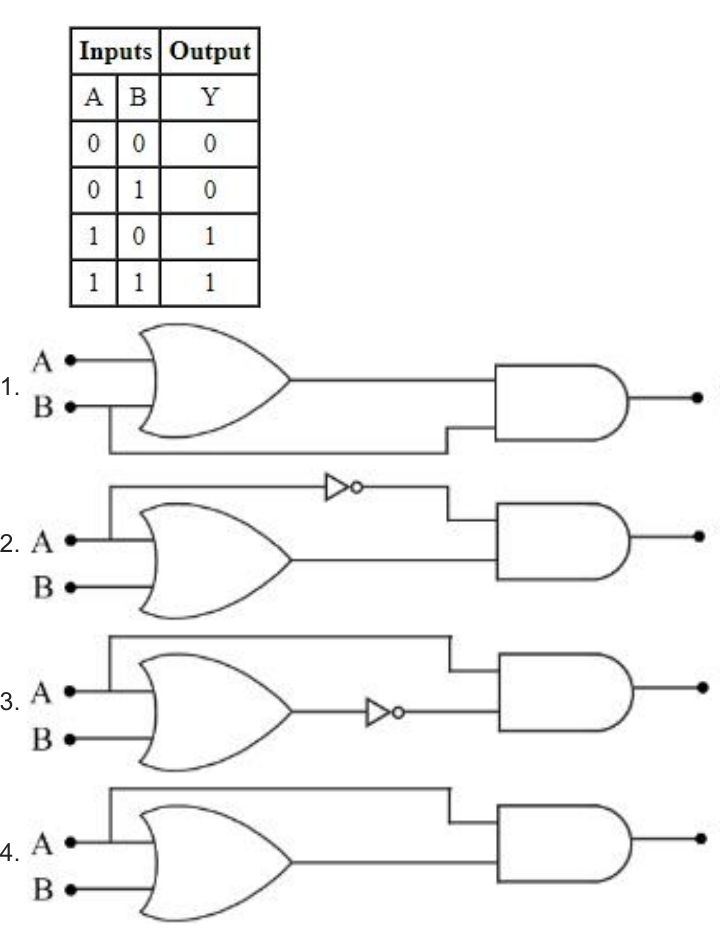
- ACircuit: inputs A and B feed an OR gate; the OR output goes to the upper input of an AND gate, while B is tapped and wired to the lower input of the AND gate; the AND output is Y.
- BCircuit: inputs A and B feed an OR gate; A is tapped and passed through a NOT gate to the upper input of an AND gate, while the OR output goes to the lower input of the AND gate; the AND output is Y.
- CCircuit: inputs A and B feed an OR gate; A is tapped and wired to the upper input of an AND gate, while the OR output is passed through a NOT gate to the lower input of the AND gate; the AND output is Y.
- DCircuit: inputs A and B feed an OR gate; A is tapped and wired to the upper input of an AND gate, while the OR output goes directly to the lower input of the AND gate; the AND output is Y.
View answer or solution
Answer
Circuit: inputs A and B feed an OR gate; A is tapped and wired to the upper input of an AND gate, while the OR output goes directly to the lower input of the AND gate; the AND output is Y.
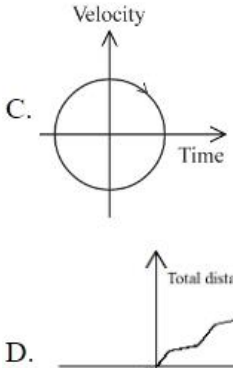
Which of the following curves possibly represent one-dimensional motion of a particle? A. Graph: Phase on the vertical axis against time on the horizontal axis; a straight line of positive slope that starts below the origin at t = 0 and crosses the time axis at a later time. B. Graph: Velocity on the vertical axis against displacement on the horizontal axis; a circle centred at O with an arrowhead on its upper right arc pointing clockwise. C. Graph: Velocity on the vertical axis against Time on the horizontal axis; a circle centred at the origin with an arrowhead on its upper right arc pointing clockwise. D. Graph: Total distance on the vertical axis against time on the horizontal axis; a curve starting from the origin, rising steeply at first and then flattening, with a sharp kink midway after which it rises again and flattens out towards a plateau. Choose the correct answer from the options given below:
- AA and B only
- BA, B and C only
- CA, C and D only
- DA, B and D only
View answer or solution
Answer
A, B and D only
Properties of Solids and Liquids
Consider a completely full cylindrical water tank of height 1.6 m and of cross-sectional area 0.5 m². It has a small hole in its side at a height 90 cm from the bottom. Assume, the cross-sectional area of the hole to be negligibly small as compared to that of the water tank. If a load 50 kg is applied at the top surface of the water in the tank then the velocity of the water coming out at the instant when the hole is opened is: (g = 10 m/s²)
- A2 m/s
- B3 m/s
- C5 m/s
- D4 m/s
View answer or solution
Answer
4 m/s
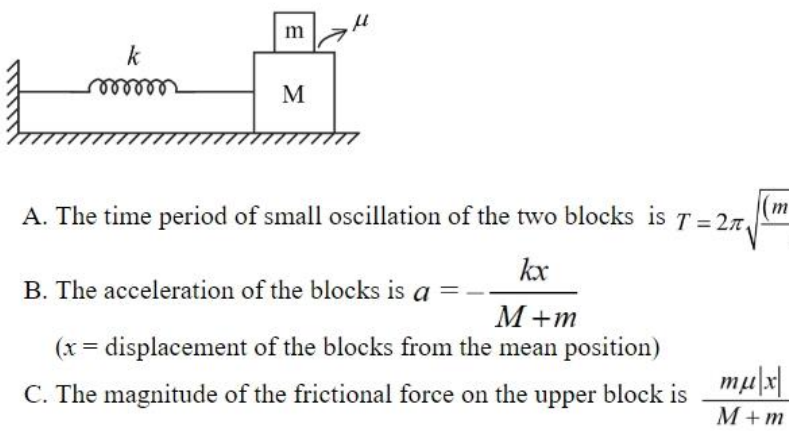
Two blocks of masses m and M, (M > m), are placed on a frictionless table as shown in figure. A massless spring with spring constant k is attached with the lower block. If the system is slightly displaced and released, then (μ = coefficient of friction between the two blocks) A. The time period of small oscillation of the two blocks is T = 2π√((m + M)/k) B. The acceleration of the blocks is a = −kx/(M + m) (x = displacement of the blocks from the mean position) C. The magnitude of the frictional force on the upper block is mμ|x|/(M + m) D. The maximum amplitude of the upper block, if it does not slip, is μ(M + m)g/k E. Maximum frictional force can be μ(M + m) g. Choose the correct answer from the options given below:
- AA, B, D Only
- BC, D, E Only
- CA, B, C Only
- DB, C, D Only
View answer or solution
Answer
A, B, D Only
The electrostatic potential on the surface of uniformly charged spherical shell of radius R = 10 cm is 120 V. The potential at the centre of shell, at a distance r = 5 cm from centre, and at a distance r = 15 cm from the centre of the shell respectively, are:
- A0V, 0V, 80V
- B40V, 40V, 80V
- C0V, 120V, 40V
- D120V, 120V, 80V
View answer or solution
Answer
120V, 120V, 80V
A particle is released from height S above the surface of the earth. At certain height its kinetic energy is three times its potential energy. The height from the surface of the earth and the speed of the particle at that instant are respectively.
- AS/4, 3gS/2
- BS/2, 3gS/2
- CS/2, √(3gS/2)
- DS/4, √(3gS/2)
View answer or solution
Answer
S/4, √(3gS/2)
Match the LIST-I with LIST-II | LIST-I | LIST-II | |---|---| | A. Gravitational constant | I. [LT⁻²] | | B. Gravitational potential energy | II. [L²T⁻²] | | C. Gravitational potential | III. [ML²T⁻²] | | D. Acceleration due to gravity | IV. [M⁻¹L³T⁻²] | Choose the correct answer from the options given below:
- AA-II, B-IV, C-III, D-I
- BA-III, B-II, C-I, D-IV
- CA-I, B-III, C-IV, D-II
- DA-IV, B-III, C-II, D-I
View answer or solution
Answer
A-IV, B-III, C-II, D-I
Consider following statements for refraction of light through prism, when angle of deviation is minimum. A. The refracted ray inside prism becomes parallel to the base. B. Larger angle prisms provide smaller angle of minimum deviation. C. Angle of incidence and angle of emergence becomes equal. D. There are always two sets of angle of incidence for which deviation will be same except at minimum deviation setting. E. Angle of refraction becomes double of prism angle. Choose the correct answer from the options given below:
- AB, D and E Only
- BA, C and D Only
- CB, C and D Only
- DA, B and E Only
View answer or solution
Answer
A, C and D Only
The radii of curvature for a thin convex lens are 10 cm and 15 cm respectively. The focal length of the lens is 12 cm. The refractive index of the lens material is
- A1.2
- B1.8
- C1.4
- D1.5
View answer or solution
Answer
1.5
A gas is kept in a container having walls which are thermally non-conducting. Initially the gas has a volume of 800 cm³ and temperature 27°C. The change in temperature when the gas is adiabatically compressed to 200 cm³ is: (Take γ = 1.5 ; γ is the ratio of specific heats at constant pressure and at constant volume)
- A327 K
- B600 K
- C300 K
- D522 K
View answer or solution
Answer
300 K
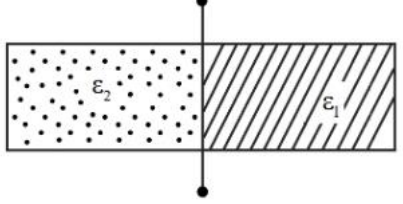
A parallel plate capacitor is filled equally(half) with two dielectrics of dielectric constants ε₁ and ε₂, as shown in figures. The distance between the plates is d and area of each plate is A. If capacitance in first configuration and second configuration are C₁ and C₂ respectively, then C₁/C₂ is :
- Aε₀(ε₁ + ε₂)/2
- Bε₁ε₂/(ε₁ + ε₂)
- Cε₁ε₂²/(ε₁ + ε₂)²
- D4ε₁ε₂/(ε₁ + ε₂)²
View answer or solution
Answer
4ε₁ε₂/(ε₁ + ε₂)²
Magnetic Effects of Current and Magnetism
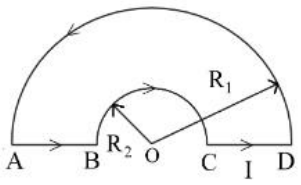
A loop ABCDA, carrying current I = 12 A, is placed in a plane, consists of two semi-circular segments of radius R₁ = 6π m and R₂ = 4π m. The magnitude of the resultant magnetic field at center O is k×10⁻⁷ T. The value of k is ________. (Given μ₀ = 4π × 10⁻⁷ T m A⁻¹)
View answer or solution
Answer
1
Magnetic Effects of Current and Magnetism
A 4.0 cm long straight wire carrying a current of 8A is placed perpendicular to a uniform magnetic field of strength 0.15 T. The magnetic force on the wire is ________ mN.
View answer or solution
Answer
48
Three identical spheres of mass m, are placed at the vertices of an equilateral triangle of length a. When released, they interact only through gravitational force and collide after a time T = 4 seconds. If the sides of the triangle are increased to length 2a and also the masses of the spheres are made 2m, then they will collide after ________ seconds.
View answer or solution
Answer
8
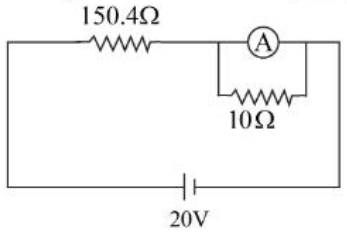
In the figure shown below, a resistance of 150.4 Ω is connected in series to an ammeter A of resistance 240 Ω. A shunt resistance of 10 Ω is connected in parallel with the ammeter. The reading of the ammeter is ________ mA.
View answer or solution
Answer
5
Two coherent monochromatic light beams of intensities 4I and 9I are superimposed. The difference between the maximum and minimum intensities in the resulting interference pattern is xI. The value of x is ________.
View answer or solution
Answer
24