
// JEE (Main) / 2025
JEE (Main) 2025 Session 1, 29 January 2025, Shift 1 — Paper 1 (B.E / B.Tech) Chemistry
Chemistry · B.E / B.Tech
Work through the questions
25 questions
Take a moment to try each question before opening the available answer or solution.
Match List - I with List - II. List - I (Structure) (A) H₃C–CH₂–CH(C₂H₅)–CH₂–CH(CH₃)–C₂H₅ (B) (CH₃)₂C(C₃H₇)₂ (C) 2-methylpenta-1,3-diene (skeletal structure drawn) (D) 4-methylpenta-1,3-diene (skeletal structure drawn) List - II (IUPAC Name) (I) 4-Methylpent-1-ene (II) 3-Ethyl-5-methylheptane (III) 4,4-Dimethylheptane (IV) 2-Methyl-1,3-pentadiene Choose the correct answer from the options given below :
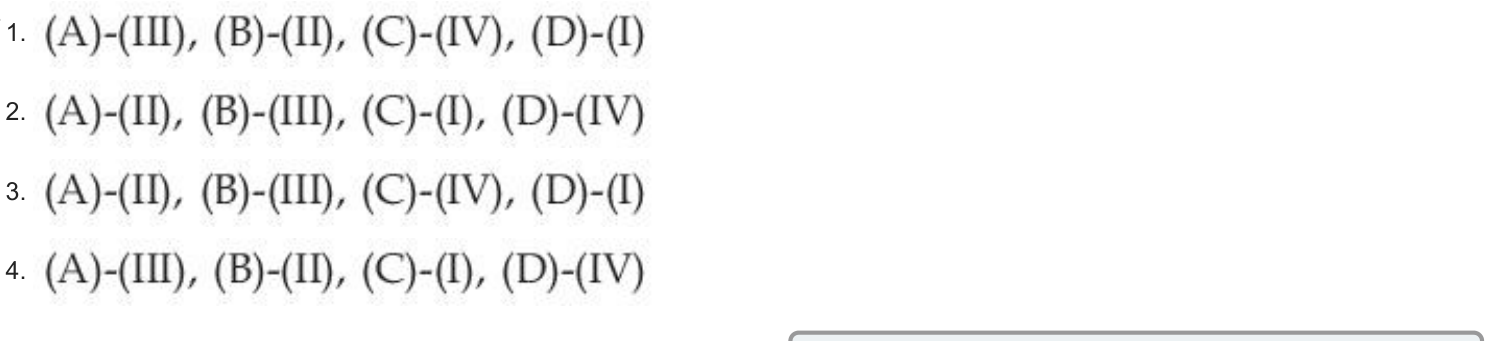
- A(A)-(III), (B)-(II), (C)-(IV), (D)-(I)
- B(A)-(II), (B)-(III), (C)-(I), (D)-(IV)
- C(A)-(II), (B)-(III), (C)-(IV), (D)-(I)
- D(A)-(III), (B)-(II), (C)-(I), (D)-(IV)
View answer or solution
Answer
(A)-(II), (B)-(III), (C)-(IV), (D)-(I)
Redox Reactions and Electrochemistry
The molar conductivity of a weak electrolyte when plotted against the square root of its concentration, which of the following is expected to be observed ?
- AA small decrease in molar conductivity is observed at infinite dilution.
- BMolar conductivity decreases sharply with increase in concentration.
- CA small increase in molar conductivity is observed at infinite dilution.
- DMolar conductivity increases sharply with increase in concentration.
View answer or solution
Answer
Molar conductivity decreases sharply with increase in concentration.
Organic Compounds Containing Halogens
In the following substitution reaction : [Reaction scheme printed: a benzene ring drawn as a hexagon with three alternating inner double bonds, Br on the top carbon, Br on the upper-right carbon (ortho to the first Br) and NO₂ on the bottom carbon (para to the top Br) —C₂H₅ONa above the arrow and C₂H₅OH below it→ P, Product] product 'P' formed is :
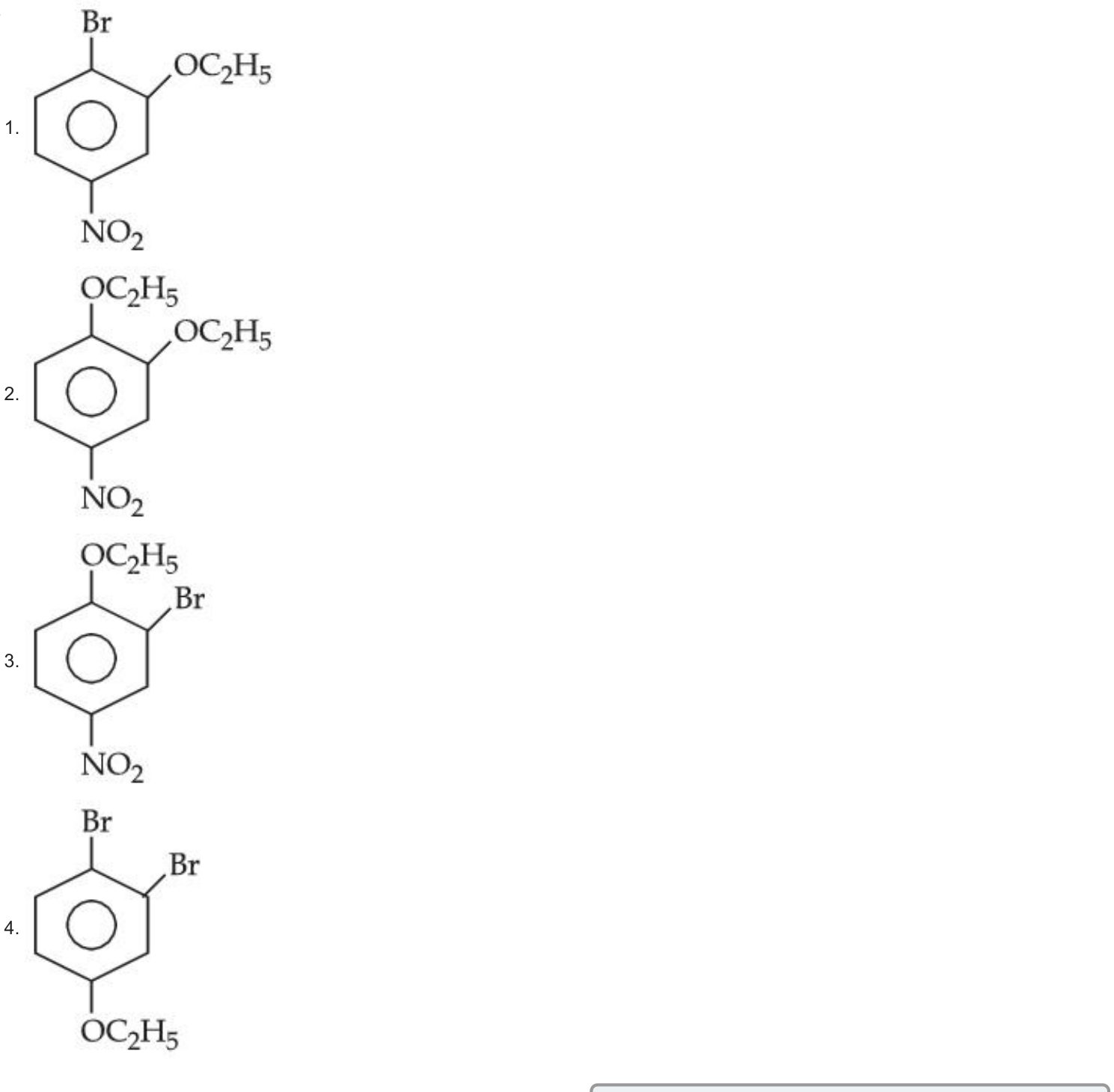
- ABenzene ring with Br on the top carbon, OC₂H₅ on the upper-right carbon (ortho to the top Br) and NO₂ on the bottom carbon (para to the top Br) - 1-bromo-2-ethoxy-4-nitrobenzene
- BBenzene ring with OC₂H₅ on the top carbon, OC₂H₅ on the upper-right carbon (ortho to the first OC₂H₅) and NO₂ on the bottom carbon (para to the top OC₂H₅) - 1,2-diethoxy-4-nitrobenzene
- CBenzene ring with OC₂H₅ on the top carbon, Br on the upper-right carbon (ortho to the OC₂H₅) and NO₂ on the bottom carbon (para to the top OC₂H₅) - 2-bromo-1-ethoxy-4-nitrobenzene
- DBenzene ring with Br on the top carbon, Br on the upper-right carbon (ortho to the top Br) and OC₂H₅ on the bottom carbon (para to the top Br) - 1,2-dibromo-4-ethoxybenzene
View answer or solution
Answer
Benzene ring with OC₂H₅ on the top carbon, Br on the upper-right carbon (ortho to the OC₂H₅) and NO₂ on the bottom carbon (para to the top OC₂H₅) - 2-bromo-1-ethoxy-4-nitrobenzene
Match List - I with List - II. List - I (Carbohydrate) (A) Amylose (B) Cellulose (C) Glycogen (D) Amylopectin List - II (Linkage Source) (I) β-C₁-C₄, plant (II) α-C₁-C₄, animal (III) α-C₁-C₄, α-C₁-C₆, plant (IV) α-C₁-C₄, plant Choose the correct answer from the options given below :
- A(A)-(II), (B)-(III), (C)-(I), (D)-(IV)
- B(A)-(IV), (B)-(I), (C)-(II), (D)-(III)
- C(A)-(III), (B)-(II), (C)-(I), (D)-(IV)
- D(A)-(IV), (B)-(I), (C)-(III), (D)-(II)
View answer or solution
Answer
(A)-(IV), (B)-(I), (C)-(II), (D)-(III)
At temperature T, compound AB₂(g) dissociates as AB₂(g) ⇌ AB(g) + ½ B₂(g) having degree of dissociation x (small compared to unity). The correct expression for x in terms of K_p and p is
- A3√((2K_p)/p)
- B3√((2K_p²)/p)
- C√(K_p)
- D4√((2K_p)/p)
View answer or solution
Answer
3√((2K_p²)/p)
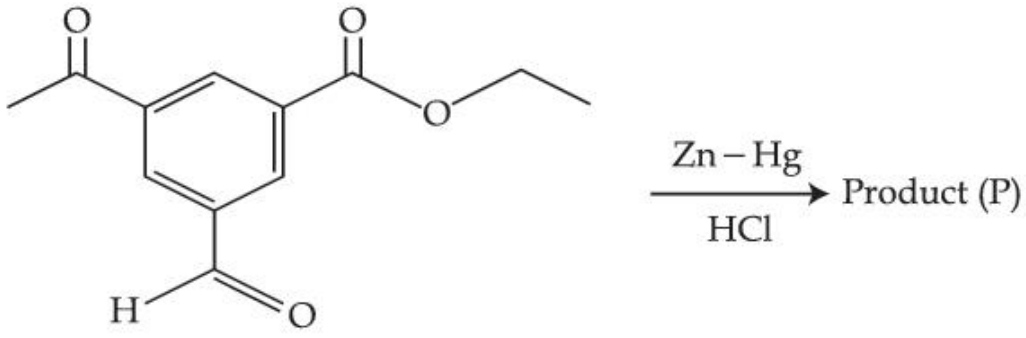
The product (P) formed in the following reaction is : ethyl 3-acetyl-5-formyl-benzoate (a benzene ring bearing an acetyl group, an ester group –C(=O)OCH₂CH₃ and a formyl group –CHO) ⟶[ Zn–Hg / HCl ] Product (P)
- AA benzene ring bearing an acetyl group (–COCH₃) reduced to a secondary alcohol (–CH(OH)CH₃), an ester group (–C(=O)OCH₂CH₃) and a formyl group (–CHO) reduced to a primary alcohol (–CH₂OH), and the ester unchanged
- BA benzene ring bearing an acetyl group (–COCH₃) reduced to a primary alcohol (–CH₂OH), an ester group (–C(=O)OCH₂CH₃) and a formyl group (–CHO) reduced to a primary alcohol (–CH₂OH), and the ester unchanged
- CA benzene ring bearing an acetyl group, an ester group and a formyl group all reduced to alcohols, and the ester reduced to an alcohol as well
- DA benzene ring bearing an acetyl group (–COCH₃) reduced to an ethyl group, a formyl group (–CHO) reduced to a methyl group, and the ester group (–C(=O)OCH₂CH₃) unchanged
View answer or solution
Answer
A benzene ring bearing an acetyl group (–COCH₃) reduced to an ethyl group, a formyl group (–CHO) reduced to a methyl group, and the ester group (–C(=O)OCH₂CH₃) unchanged
Organic Compounds Containing Oxygen
The steam volatile compounds among the following are :
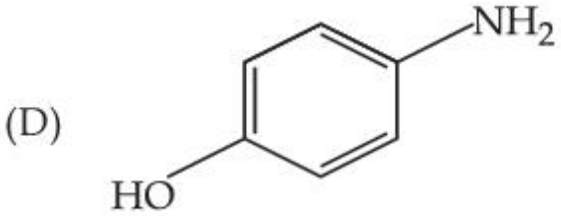
- A(A) and (B) Only
- B(A) and (C) Only
- C(B) and (D) Only
- D(A), (B) and (C) Only
View answer or solution
Answer
(A) and (B) Only
The reaction A₂ + B₂ → 2AB follows the mechanism A₂ ⇌[ k₁ / k₋₁ ] A + A (fast) A + B₂ ⟶[ k₂ ] AB + B (slow) A + B ⟶ AB (fast) The overall order of the reaction is :
- A3
- B1.5
- C2
- D2.5
View answer or solution
Answer
1.5
The correct option with order of melting points of the pairs (Mn, Fe), (Tc, Ru) and (Re, Os) is :
- AFe < Mn, Ru < Tc and Os < Re
- BMn < Fe, Tc < Ru and Os < Re
- CFe < Mn, Ru < Tc and Re < Os
- DMn < Fe, Tc < Ru and Re < Os
View answer or solution
Answer
Mn < Fe, Tc < Ru and Os < Re
Classification of Elements and Periodicity in Properties
An element ‘E’ has the ionisation enthalpy value of 374 kJ mol⁻¹. ‘E’ reacts with elements A, B, C and D with electron gain enthalpy values of −328, −349, −325 and −295 kJ mol⁻¹, respectively. The correct order of the products EA, EB, EC and ED in terms of ionic character is :
- AEA > EB > EC > ED
- BEB > EA > EC > ED
- CED > EC > EB > EA
- DED > EC > EA > EB
View answer or solution
Answer
EB > EA > EC > ED
Chemical Bonding and Molecular Structure
Match List - I with List - II. List - I (Complex) (A) [MnBr₄]²⁻ (B) [FeF₆]³⁻ (C) [Co(C₂O₄)₃]³⁻ (D) [Ni(CO)₄] List - II (Hybridisation & Magnetic characters) (I) d²sp³ & diamagnetic (II) sp³d² & paramagnetic (III) sp³ & diamagnetic (IV) sp³ & paramagnetic Choose the correct answer from the options given below :
- A(A)-(III), (B)-(II), (C)-(I), (D)-(IV)
- B(A)-(IV), (B)-(I), (C)-(II), (D)-(III)
- C(A)-(III), (B)-(I), (C)-(II), (D)-(IV)
- D(A)-(IV), (B)-(II), (C)-(I), (D)-(III)
View answer or solution
Answer
(A)-(IV), (B)-(II), (C)-(I), (D)-(III)
The correct increasing order of stability of the complexes based on Δₒ value is : I. [Mn(CN)₆]³⁻ II. [Co(CN)₆]⁴⁻ III. [Fe(CN)₆]⁴⁻ IV. [Fe(CN)₆]³⁻
- AII < III < I < IV
- BI < II < IV < III
- CIV < III < II < I
- DIII < II < IV < I
View answer or solution
Answer
I < II < IV < III
Some Basic Concepts in Chemistry
Choose the correct statements. (A) Weight of a substance is the amount of matter present in it. (B) Mass is the force exerted by gravity on an object. (C) Volume is the amount of space occupied by a substance. (D) Temperatures below 0°C are possible in Celsius scale, but in Kelvin scale negative temperature is not possible. (E) Precision refers to the closeness of various measurements for the same quantity. Choose the correct answer from the options given below :
- A(A), (B) and (C) Only
- B(B), (C) and (D) Only
- C(A), (D) and (E) Only
- D(C), (D) and (E) Only
View answer or solution
Answer
(C), (D) and (E) Only
If a₀ is denoted as the Bohr radius of hydrogen atom, then what is the de-Broglie wavelength (λ) of the electron present in the second orbit of hydrogen atom ? [n : any integer]
- A2a₀/(nπ)
- B4n/(πa₀)
- C4πa₀/n
- D8πa₀/n
View answer or solution
Answer
8πa₀/n
1.24 g of AX₂ (molar mass 124 g mol⁻¹) is dissolved in 1 kg of water to form a solution with boiling point of 100.0156°C, while 25.4 g of AY₂ (molar mass 250 g mol⁻¹) in 2 kg of water constitutes a solution with a boiling point of 100.0260°C. K_b(H₂O) = 0.52 K kg mol⁻¹ Which of the following is correct ?
- AAX₂ is completely unionised while AY₂ is fully ionised.
- BAX₂ and AY₂ (both) are completely unionised.
- CAX₂ and AY₂ (both) are fully ionised.
- DAX₂ is fully ionised while AY₂ is completely unionised.
View answer or solution
Answer
AX₂ is fully ionised while AY₂ is completely unionised.
500 J of energy is transferred as heat to 0.5 mol of Argon gas at 298 K and 1.00 atm. The final temperature and the change in internal energy respectively are : Given : R = 8.3 J K⁻¹ mol⁻¹
- A378 K and 300 J
- B368 K and 500 J
- C378 K and 500 J
- D348 K and 300 J
View answer or solution
Answer
348 K and 300 J
Redox Reactions and Electrochemistry
The standard reduction potential values of some of the p-block ions are given below. Predict the one with the strongest oxidising capacity.
- AE°(Al³⁺/Al) = −1.66 V
- BE°(Sn⁴⁺/Sn²⁺) = +1.15 V
- CE°(Tl³⁺/Tl) = +1.26 V
- DE°(Pb⁴⁺/Pb²⁺) = +1.67 V
View answer or solution
Answer
E°(Pb⁴⁺/Pb²⁺) = +1.67 V
Classification of Elements and Periodicity in Properties
Given below are two statements : Statement (I) : The radii of isoelectronic species increases in the order. Mg²⁺ < Na⁺ < F⁻ < O²⁻ Statement (II) : The magnitude of electron gain enthalpy of halogen decreases in the order. Cl > F > Br > I In the light of the above statements, choose the most appropriate answer from the options given below :
- ABoth Statement I and Statement II are correct
- BBoth Statement I and Statement II are incorrect
- CStatement I is incorrect but Statement II is correct
- DStatement I is correct but Statement II is incorrect
View answer or solution
Answer
Both Statement I and Statement II are correct
Some Basic Principles of Organic Chemistry
Total number of nucleophiles from the following is : NH₃, PhSH, (H₃C)₂S, H₂C=CH₂, OH⁻, H₃O⁺, (CH₃)₂ CO, >C=NCH₃
- A5
- B4
- C6
- D7
View answer or solution
Answer
5
Redox Reactions and Electrochemistry
For a Mg|Mg²⁺(aq) || Ag⁺(aq)|Ag the correct Nernst Equation is :
- AE_cell = E°_cell − (RT/2F) ln ([Ag⁺]/[Mg²⁺])
- BE_cell = E°_cell − (RT/2F) ln ([Ag⁺]²/[Mg²⁺])
- CE_cell = E°_cell + (RT/2F) ln ([Ag⁺]²/[Mg²⁺])
- DE_cell = E°_cell − (RT/2F) ln ([Mg²⁺]/[Ag⁺])
View answer or solution
Answer
E_cell = E°_cell + (RT/2F) ln ([Ag⁺]²/[Mg²⁺])
Chemical Bonding and Molecular Structure
The sum of sigma (σ) and pi (π) bonds in Hex-1,3-dien-5-yne is __________.
View answer or solution
Answer
15
Organic Compounds Containing Nitrogen
Given below are some nitrogen containing compounds Each of them is treated with HCl separately. 1.0 g of the most basic compound will consume ________ mg of HCl. (Given molar mass in g mol⁻¹ C : 12, H : 1, O : 16, Cl : 35.5)
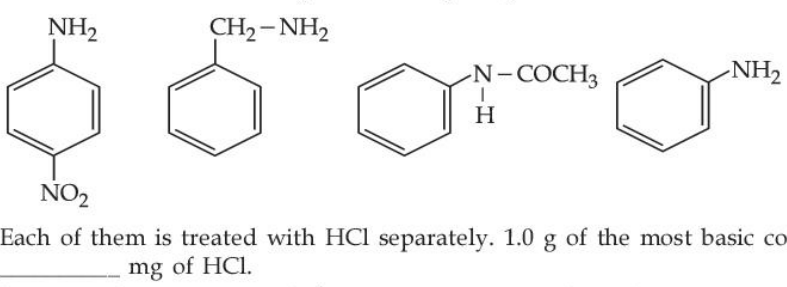
View answer or solution
Answer
341
If A₂B is 30% ionised in an aqueous solution, then the value of van't Hoff factor (i) is _________ ×10⁻¹.
View answer or solution
Answer
16
Some Basic Concepts in Chemistry
The molar mass of the water insoluble product formed from the fusion of chromite ore (FeCr₂O₄) with Na₂CO₃ in presence of O₂ is ________ g mol⁻¹.
View answer or solution
Answer
160
Some Basic Concepts in Chemistry
0.1 mole of compound 'S' will weigh _________ g. (Given molar mass in g mol⁻¹ C : 12, H : 1, O : 16)
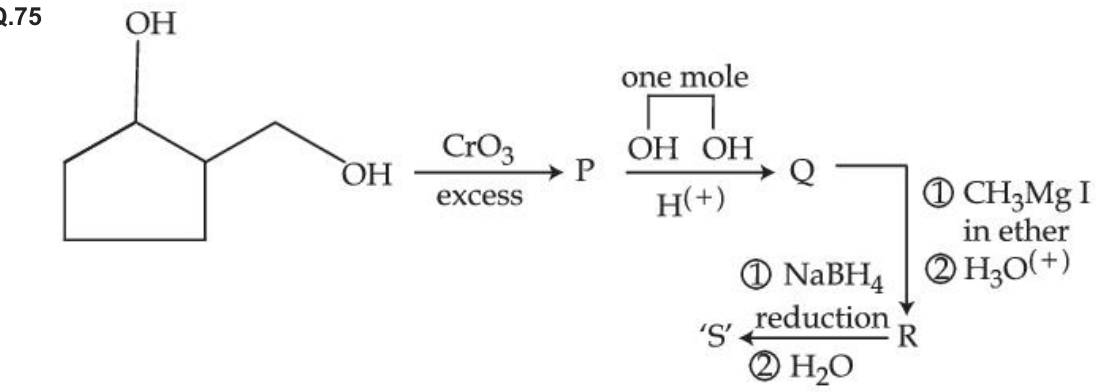
View answer or solution
Answer
13