
// JEE (Main) / 2025
JEE (Main) 2025 Session 1, 29 January 2025, Shift 1 — Paper 1 (B.E / B.Tech) Physics
Physics · B.E / B.Tech
Questions
24 + 1
Has an official figure
Withheld — the source figure is not published, so the question is stored with the paper and not served
Work through the questions
24 questions
Take a moment to try each question before opening the available answer or solution.
Consider I₁ and I₂ are the currents flowing simultaneously in two nearby coils 1 & 2, respectively. If L₁ = self inductance of coil 1, M₁₂ = mutual inductance of coil 1 with respect to coil 2, then the value of induced emf in coil 1 will be
- Aε₁ = −L₁ (dI₁/dt) + M₁₂ (dI₂/dt)
- Bε₁ = −L₁ (dI₁/dt) − M₁₂ (dI₁/dt)
- Cε₁ = −L₁ (dI₁/dt) − M₁₂ (dI₂/dt)
- Dε₁ = −L₁ (dI₂/dt) − M₁₂ (dI₁/dt)
View answer or solution
Answer
ε₁ = −L₁ (dI₁/dt) − M₁₂ (dI₂/dt)
Given below are two statements : one is labelled as Assertion (A) and the other is labelled as Reason (R). Assertion (A) : Time period of a simple pendulum is longer at the top of a mountain than that at the base of the mountain. Reason (R) : Time period of a simple pendulum decreases with increasing value of acceleration due to gravity and vice-versa. In the light of the above statements, choose the most appropriate answer from the options given below :
- ABoth (A) and (R) are true but (R) is not the correct explanation of (A)
- BBoth (A) and (R) are true and (R) is the correct explanation of (A)
- C(A) is false but (R) is true
- D(A) is true but (R) is false
View answer or solution
Answer
Both (A) and (R) are true and (R) is the correct explanation of (A)
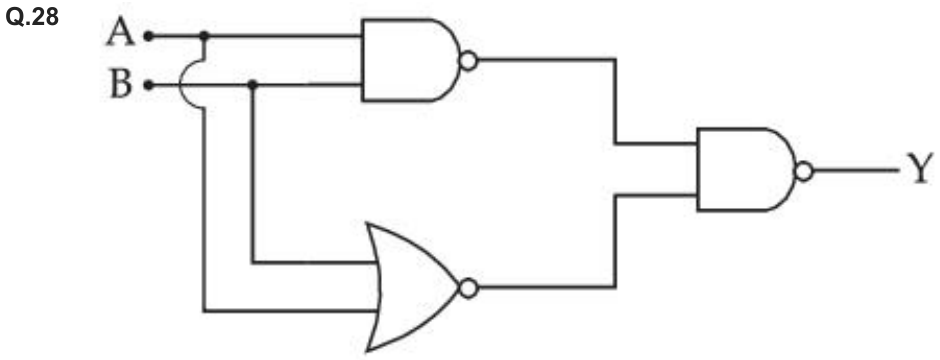
For the circuit shown above, equivalent GATE is :
- AAND gate
- BNOT gate
- COR gate
- DNAND gate
View answer or solution
Answer
OR gate
An electric dipole of mass m, charge q, and length l is placed in a uniform electric field E⃗ = E₀ î. When the dipole is rotated slightly from its equilibrium position and released, the time period of its oscillations will be :
- A2π √(ml/(2qE₀))
- B1/(2π) √(ml/(2qE₀))
- C2π √(ml/(qE₀))
- D1/(2π) √(2ml/(qE₀))
View answer or solution
Answer
2π √(ml/(2qE₀))
Match List - I with List - II. List - I (A) Electric field inside (distance r > 0 from center) of a uniformly charged spherical shell with surface charge density σ, and radius R. (B) Electric field at distance r>0 from a uniformly charged infinite plane sheet with surface charge density σ. (C) Electric field outside (distance r>0 from center) of a uniformly charged spherical shell with surface charge density σ, and radius R. (D) Electric field between 2 oppositely charged infinite plane parallel sheets with uniform surface charge density σ. List - II (I) σ/ε₀ (II) σ/2ε₀ (III) 0 (IV) σ/(ε₀r²) Choose the correct answer from the options given below :
- A(A)-(IV), (B)-(II), (C)-(III), (D)-(I)
- B(A)-(IV), (B)-(I), (C)-(III), (D)-(II)
- C(A)-(III), (B)-(II), (C)-(IV), (D)-(I)
- D(A)-(II), (B)-(I), (C)-(IV), (D)-(III)
View answer or solution
Answer
(A)-(III), (B)-(II), (C)-(IV), (D)-(I)
Properties of Solids and Liquids
The fractional compression (ΔV/V) of water at the depth of 2.5 km below the sea level is ________ %. Given, the Bulk modulus of water = 2×10⁹ N m⁻², density of water = 10³ kg m⁻³, acceleration due to gravity = g = 10 m s⁻².
- A1.5
- B1.75
- C1.25
- D1.0
View answer or solution
Answer
1.25
Let u and v be the distances of the object and the image from a lens of focal length f. The correct graphical representation of u and v for a convex lens when |u| > f, is
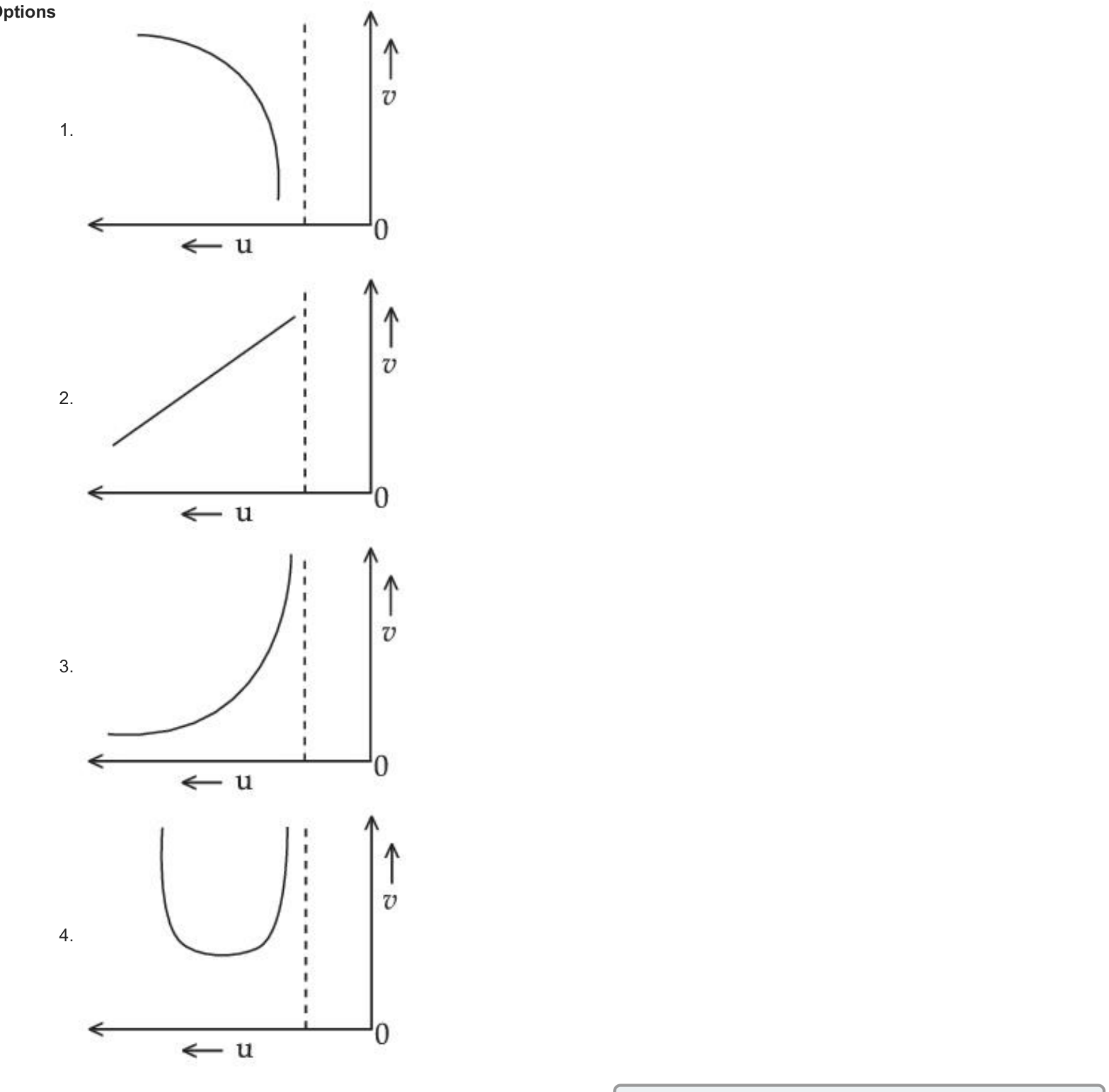
- AGraph: v on the vertical axis and u on the horizontal axis measured to the left of the origin 0, with a dashed vertical line drawn on the plot; a curve that starts high on the left (large u) and falls to the right with increasing steepness, ending above the axis just to the left of the dashed line.
- BGraph: v on the vertical axis and u on the horizontal axis measured to the left of the origin 0, with a dashed vertical line drawn on the plot; a straight line of positive slope rising from the lower left to the upper right, ending just to the left of the dashed line.
- CGraph: v on the vertical axis and u on the horizontal axis measured to the left of the origin 0, with a dashed vertical line drawn on the plot; a curve that stays nearly flat close to the horizontal axis far to the left (large u) and rises steeply as it approaches the dashed line from the left.
- DGraph: v on the vertical axis and u on the horizontal axis measured to the left of the origin 0, with a dashed vertical line drawn on the plot; a U-shaped curve with a rounded minimum lying wholly to the left of the dashed line.
View answer or solution
Answer
Graph: v on the vertical axis and u on the horizontal axis measured to the left of the origin 0, with a dashed vertical line drawn on the plot; a curve that stays nearly flat close to the horizontal axis far to the left (large u) and rises steeply as it approaches the dashed line from the left.
Dual Nature of Matter and Radiation
If λ and K are de Broglie wavelength and kinetic energy, respectively, of a particle with constant mass. The correct graphical representation for the particle will be
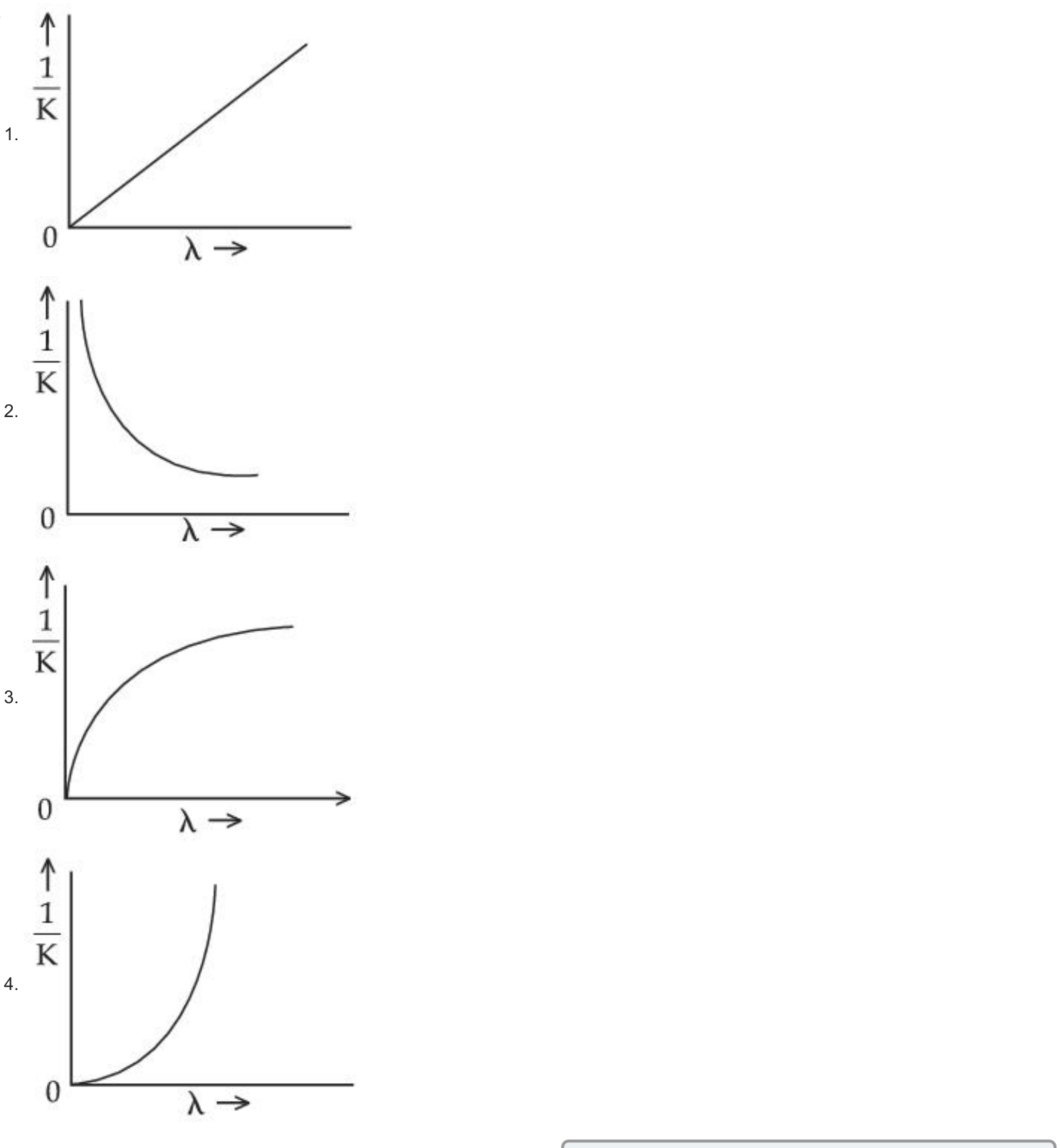
- AGraph: 1/K on the vertical axis against λ on the horizontal axis; a straight line through the origin with positive slope.
- BGraph: 1/K on the vertical axis against λ on the horizontal axis; a curve that falls from a high value near the vertical axis, decreasing steeply at first and then levelling off towards the λ-axis.
- CGraph: 1/K on the vertical axis against λ on the horizontal axis; a curve that rises from the origin, steep at first and then levelling off towards a constant value.
- DGraph: 1/K on the vertical axis against λ on the horizontal axis; a curve that rises from the origin with increasing steepness.
View answer or solution
Answer
Graph: 1/K on the vertical axis against λ on the horizontal axis; a curve that rises from the origin with increasing steepness.
Given below are two statements : one is labelled as Assertion (A) and the other is labelled as Reason (R). Assertion (A) : Electromagnetic waves carry energy but not momentum. Reason (R) : Mass of a photon is zero. In the light of the above statements, choose the most appropriate answer from the options given below :
- A(A) is true but (R) is false
- B(A) is false but (R) is true
- CBoth (A) and (R) are true but (R) is not the correct explanation of (A)
- DBoth (A) and (R) are true and (R) is the correct explanation of (A)
View answer or solution
Answer
(A) is false but (R) is true
Two projectiles are fired with same initial speed from same point on ground at angles of (45° − α) and (45° + α), respectively, with the horizontal direction. The ratio of their maximum heights attained is :
- A(1−tanα)/(1+tanα)
- B(1−sin2α)/(1+sin2α)
- C(1+sinα)/(1−sinα)
- D(1+sin2α)/(1−sin2α)
View answer or solution
Answer
(1−sin2α)/(1+sin2α)
The expression given below shows the variation of velocity (v) with time (t), v = At² + Bt/(C+t). The dimension of ABC is :
- A[M⁰L²T⁻³]
- B[M⁰L¹T⁻³]
- C[M⁰L²T⁻²]
- D[M⁰L¹T⁻²]
View answer or solution
Answer
[M⁰L²T⁻³]
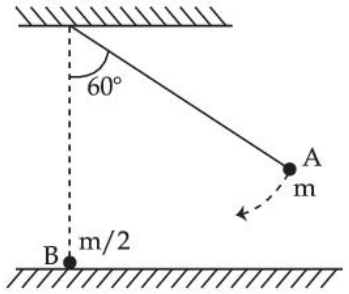
As shown below, bob A of a pendulum having massless string of length 'R' is released from 60° to the vertical. It hits another bob B of half the mass that is at rest on a friction less table in the center. Assuming elastic collision, the magnitude of the velocity of bob A after the collision will be (take g as acceleration due to gravity.)
- A(2/3)√(Rg)
- B(4/3)√(Rg)
- C√(Rg)
- D(1/3)√(Rg)
View answer or solution
Answer
(1/3)√(Rg)
A body of mass 'm' connected to a massless and unstretchable string goes in vertical circle of radius 'R'under gravity g. The other end of the string is fixed at the center of circle. If velocity at top of circular path is n√gR, where, n ≥ 1, then ratio of kinetic energy of the body at bottom to that at top of the circle is
- A(n²+4)/n²
- Bn²/(n²+4)
- C(n+4)/n
- Dn/(n+4)
View answer or solution
Answer
(n²+4)/n²
The workdone in an adiabatic change in an ideal gas depends upon only :
- Achange in its temperature
- Bchange in its specific heat
- Cchange in its pressure
- Dchange in its volume
View answer or solution
Answer
change in its temperature
Magnetic Effects of Current and Magnetism
Consider a long straight wire of a circular cross-section (radius a) carrying a steady current I. The current is uniformly distributed across this cross-section. The distances from the centre of the wire's cross-section at which the magnetic field [inside the wire, outside the wire] is half of the maximum possible magnetic field, any where due to the wire, will be
- A[a/4, 3a/2]
- B[a/4, 2a]
- C[a/2, 3a]
- D[a/2, 2a]
View answer or solution
Answer
[a/2, 2a]
Dual Nature of Matter and Radiation
Given below are two statements : one is labelled as Assertion (A) and the other is labelled as Reason (R). Assertion (A) : Emission of electrons in photoelectric effect can be suppressed by applying a sufficiently negative electron potential to the photoemissive substance. Reason (R) : A negative electric potential, which stops the emission of electrons from the surface of a photoemissive substance, varies linearly with frequency of incident radiation. In the light of the above statements, choose the most appropriate answer from the options given below :
- A(A) is false but (R) is true
- BBoth (A) and (R) are true and (R) is the correct explanation of (A)
- CBoth (A) and (R) are true but (R) is not the correct explanation of (A)
- D(A) is true but (R) is false
View answer or solution
Answer
Both (A) and (R) are true but (R) is not the correct explanation of (A)
Properties of Solids and Liquids
The pair of physical quantities not having same dimensions is :
- ASurface tension and impulse
- BTorque and energy
- CPressure and Young’s modulus
- DAngular momentum and Planck’s constant
View answer or solution
Answer
Surface tension and impulse
A coil of area A and N turns is rotating with angular velocity ω in a uniform magnetic field B⃗ about an axis perpendicular to B⃗. Magnetic flux φ and induced emf ε across it, at an instant when B⃗ is parallel to the plane of coil, are :
- Aφ = 0, ε = 0
- Bφ = AB, ε = 0
- Cφ = AB, ε = NABω
- Dφ = 0, ε = NABω
View answer or solution
Answer
φ = 0, ε = NABω
Given below are two statements : one is labelled as Assertion (A) and the other is labelled as Reason (R). Assertion (A) : Choke coil is simply a coil having a large inductance but a small resistance. Choke coils are used with fluorescent mercury-tube fittings. If household electric power is directly connected to a mercury tube, the tube will be damaged. Reason (R) : By using the choke coil, the voltage across the tube is reduced by a factor (R/√(R² + ω²L²)), where ω is frequency of the supply across resistor R and inductor L. If the choke coil were not used, the voltage across the resistor would be the same as the applied voltage. In the light of the above statements, choose the most appropriate answer from the options given below :
- A(A) is false but (R) is true
- B(A) is true but (R) is false
- CBoth (A) and (R) are true but (R) is not the correct explanation of (A)
- DBoth (A) and (R) are true and (R) is the correct explanation of (A)
View answer or solution
Answer
Both (A) and (R) are true and (R) is the correct explanation of (A)
A container of fixed volume contains a gas at 27° C. To double the pressure of the gas, the temperature of gas should be raised to ________ °C.
View answer or solution
Answer
327
The maximum speed of a boat in still water is 27 km/h. Now this boat is moving downstream in a river flowing at 9 km/h. A man in the boat throws a ball vertically upwards with speed of 10 m/s. Range of the ball as observed by an observer at rest on the river bank, is ________ cm. (Take g = 10 m/s²)
View answer or solution
Answer
2000
In a hydraulic lift, the surface area of the input piston is 6 cm² and that of the output piston is 1500 cm². If 100 N force is applied to the input piston to raise the output piston by 20 cm, then the work done is ________ kJ.
View answer or solution
Answer
5
The coordinates of a particle with respect to origin in a given reference frame is (1, 1, 1) meters. If a force of F⃗ = î − ĵ + k̂ acts on the particle, then the magnitude of torque (with respect to origin) in z-direction is ________.
View answer or solution
Answer
2
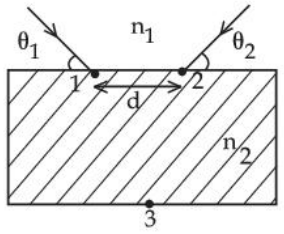
Two light beams fall on a transparent material block at point 1 and 2 with angle θ₁ and θ₂, respectively, as shown in figure. After refraction, the beams intersect at point 3 which is exactly on the interface at other end of the block. Given : the distance between 1 and 2, d = 4√3 cm and θ₁ = θ₂ = cos⁻¹(n₂/(2n₁)), where refractive index of the block n₂ > refractive index of the outside medium n₁, then the thickness of the block is ________ cm.
View answer or solution
Answer
6