
// JEE (Main) / 2025
JEE (Main) 2025 Session 1, 22 January 2025, Shift 2 — Paper 1 (B.E / B.Tech) Chemistry
Chemistry · B.E / B.Tech
Work through the questions
25 questions
Take a moment to try each question before opening the available answer or solution.
The maximum covalency of a non-metallic group 15 element ‘E’ with weakest E – E bond is :
- A5
- B4
- C3
- D6
View answer or solution
Answer
4
Classification of Elements and Periodicity in Properties
Given below are two statements : Statement (I) : An element in the extreme left of the periodic table forms acidic oxides. Statement (II) : Acid is formed during the reaction between water and oxide of a reactive element present in the extreme right of the periodic table. In the light of the above statements, choose the correct answer from the options given below :
- AStatement I is true but Statement II is false
- BBoth Statement I and Statement II are true
- CBoth Statement I and Statement II are false
- DStatement I is false but Statement II is true
View answer or solution
Answer
Statement I is false but Statement II is true
Identify the number of structure/s from the following which can be correlated to D-glyceraldehyde.
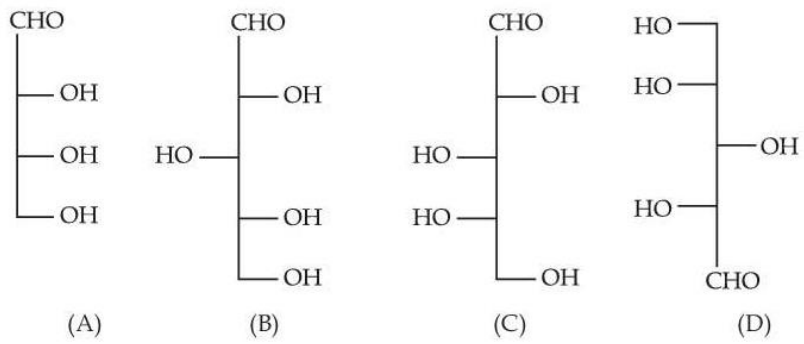
- Afour
- Btwo
- Cthree
- Done
View answer or solution
Answer
three
Organic Compounds Containing Nitrogen
Given below are two statements : Statement (I) : Nitrogen, sulphur, halogen and phosphorus present in an organic compound are detected by Lassaigne's Test. Statement (II) : The elements present in the compound are converted from covalent form into ionic form by fusing the compound with Magnesium in Lassaigne's test. In the light of the above statements, choose the correct answer from the options given below :
- AStatement I is true but Statement II is false
- BStatement I is false but Statement II is true
- CBoth Statement I and Statement II are true
- DBoth Statement I and Statement II are false
View answer or solution
Answer
Statement I is true but Statement II is false
Given below are two statements : Statement (I) : A spectral line will be observed for a 2pₓ → 2p_y transition. Statement (II) : 2pₓ and 2p_y are degenerate orbitals. In the light of the above statements, choose the correct answer from the options given below :
- AStatement I is true but Statement II is false
- BStatement I is false but Statement II is true
- CBoth Statement I and Statement II are false
- DBoth Statement I and Statement II are true
View answer or solution
Answer
Statement I is false but Statement II is true
Consider the given figure and choose the correct option :
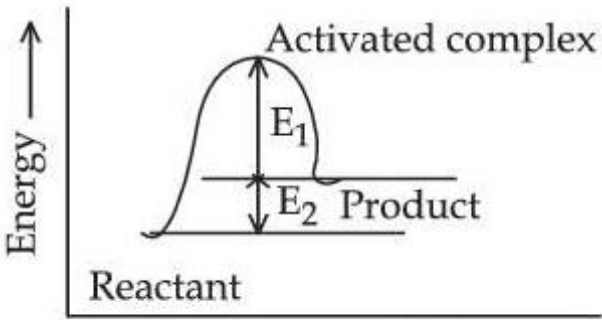
- AActivation energy of backward reaction is E₁ and product is more stable than reactant.
- BActivation energy of both forward and backward reaction is E₁ + E₂ and reactant is more stable than product.
- CActivation energy of forward reaction is E₁ + E₂ and product is more stable than reactant.
- DActivation energy of forward reaction is E₁ + E₂ and product is less stable than reactant.
View answer or solution
Answer
Activation energy of forward reaction is E₁ + E₂ and product is less stable than reactant.
Some Basic Concepts in Chemistry
The molar solubility(s) of zirconium phosphate with molecular formula (Zr⁴⁺)₃ (PO₄³⁻)₄ is given by relation :
- A(Ksp/9612)^(1/3)
- B(Ksp/8435)^(1/7)
- C(Ksp/5348)^(1/6)
- D(Ksp/6912)^(1/7)
View answer or solution
Answer
(Ksp/6912)^(1/7)
Some Basic Principles of Organic Chemistry
The most stable carbocation from the following is :
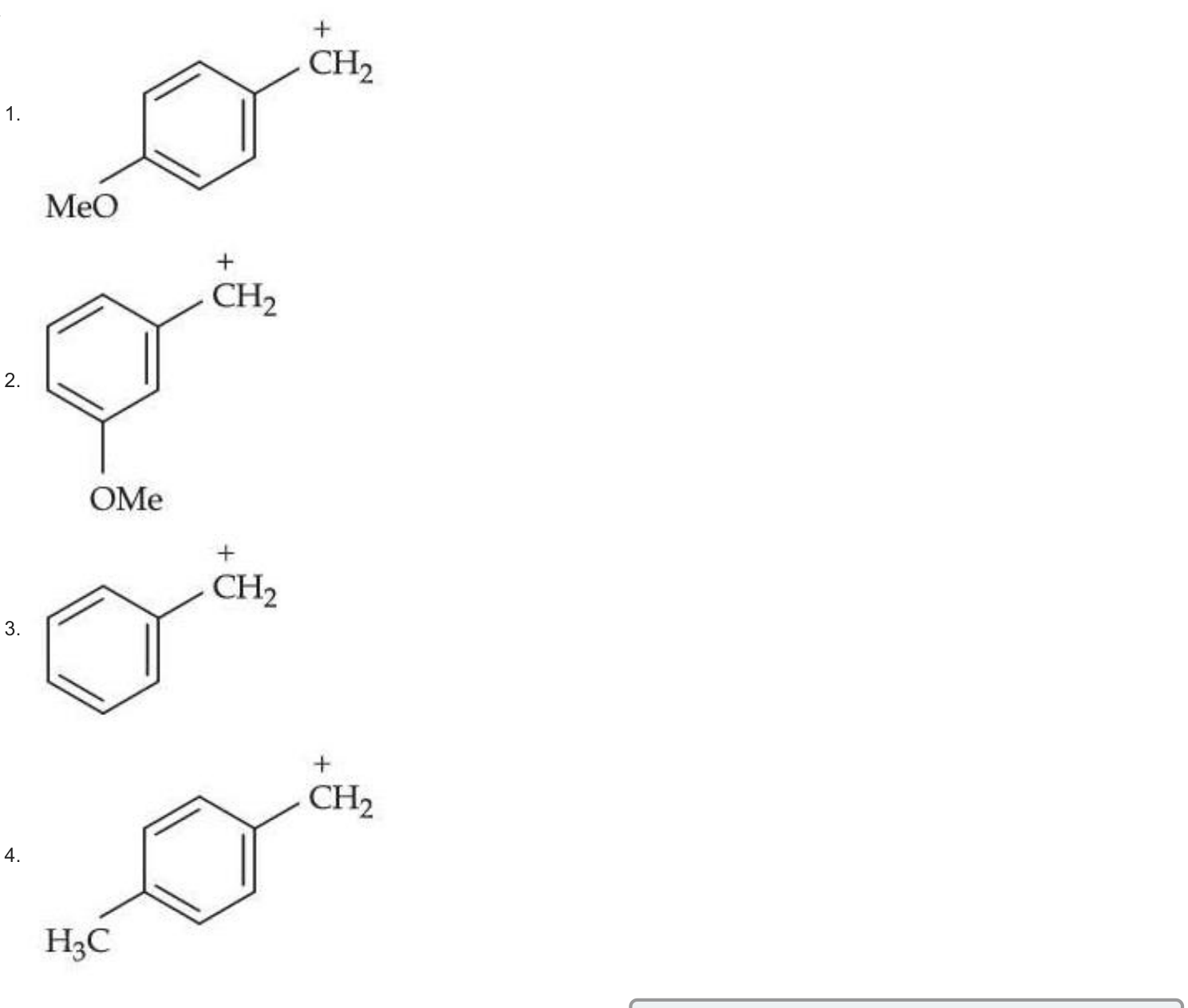
- A4-methoxymethyl carbocation: a benzene ring bearing a –CH₂⁺ group and a para –OMe group
- B3-methoxymethyl carbocation: a benzene ring bearing a –CH₂⁺ group and a meta –OMe group
- CBenzyl carbocation: a benzene ring bearing a –CH₂⁺ group
- D4-methylbenzyl carbocation: a benzene ring bearing a –CH₂⁺ group and a para –CH₃ group
View answer or solution
Answer
4-methoxymethyl carbocation: a benzene ring bearing a –CH₂⁺ group and a para –OMe group
Chemical Bonding and Molecular Structure
Arrange the following compounds in increasing order of their dipole moment : HBr, H₂S, NF₃ and CHCl₃
- AHBr < H₂S < NF₃ < CHCl₃
- BNF₃ < HBr < H₂S < CHCl₃
- CCHCl₃ < NF₃ < HBr < H₂S
- DH₂S < HBr < NF₃ < CHCl₃
View answer or solution
Answer
NF₃ < HBr < H₂S < CHCl₃
Identify the homoleptic complex(es) that is/are low spin. (A) [Fe(CN)₅NO]²⁻ (B) [CoF₆]³⁻ (C) [Fe(CN)₆]⁴⁻ (D) [Co(NH₃)₆]³⁺ (E) [Cr(H₂O)₆]²⁺ Choose the correct answer from the options given below :
- A(C) and (D) only
- B(C) only
- C(A) and (C) only
- D(B) and (E) only
View answer or solution
Answer
(C) and (D) only
The correct order of the following complexes in terms of their crystal field stabilization energies is :
- A[Co(NH₃)₄]²⁺ < [Co(NH₃)₆]²⁺ < [Co(NH₃)₆]³⁺ < [Co(en)₃]³⁺
- B[Co(NH₃)₄]²⁺ < [Co(NH₃)₆]²⁺ < [Co(en)₃]³⁺ < [Co(NH₃)₆]³⁺
- C[Co(NH₃)₆]²⁺ < [Co(NH₃)₆]³⁺ < [Co(NH₃)₄]²⁺ < [Co(en)₃]³⁺
- D[Co(en)₃]³⁺ < [Co(NH₃)₆]³⁺ < [Co(NH₃)₆]²⁺ < [Co(NH₃)₄]²⁺
View answer or solution
Answer
[Co(NH₃)₄]²⁺ < [Co(NH₃)₆]²⁺ < [Co(NH₃)₆]³⁺ < [Co(en)₃]³⁺
Match List - I with List - II. List - I (Partial Derivatives) (A) (∂G/∂T)_P (B) (∂H/∂T)_P (C) (∂G/∂P)_T (D) (∂U/∂T)_V List - II (Thermodynamic Quantity) (I) Cp (II) −S (III) Cv (IV) V Choose the correct answer from the options given below :
- A(A)-(I), (B)-(II), (C)-(IV), (D)-(III)
- B(A)-(II), (B)-(I), (C)-(IV), (D)-(III)
- C(A)-(II), (B)-(III), (C)-(I), (D)-(IV)
- D(A)-(II), (B)-(I), (C)-(III), (D)-(IV)
View answer or solution
Answer
(A)-(II), (B)-(I), (C)-(IV), (D)-(III)
Redox Reactions and Electrochemistry
Given below are two statements : Statement (I) : Corrosion is an electrochemical phenomenon in which pure metal acts as an anode and impure metal as a cathode. Statement (II) : The rate of corrosion is more in alkaline medium than in acidic medium. In the light of the above statements, choose the correct answer from the options given below :
- ABoth Statement I and Statement II are false
- BStatement I is true but Statement II is false
- CBoth Statement I and Statement II are true
- DStatement I is false but Statement II is true
View answer or solution
Answer
Statement I is true but Statement II is false
Some Basic Concepts in Chemistry
Density of 3 M NaCl solution is 1.25 g/mL. The molality of the solution is :
- A2 m
- B3 m
- C1.79 m
- D2.79 m
View answer or solution
Answer
2.79 m
Organic Compounds Containing Nitrogen
Match the Compounds (List - I) with the appropriate Catalyst/Reagents (List - II) for their reduction into corresponding amines. List - I (Compounds) (A) R–C(=O)–NH₂ (B) nitrobenzene (C) R–C≡N (D) N-R substituted phthalimide List - II (Catalyst/Reagents) (I) NaOH (aqueous) (II) H₂/Ni (III) LiAlH₄, H₂O (IV) Sn, HCl Choose the correct answer from the options given below :
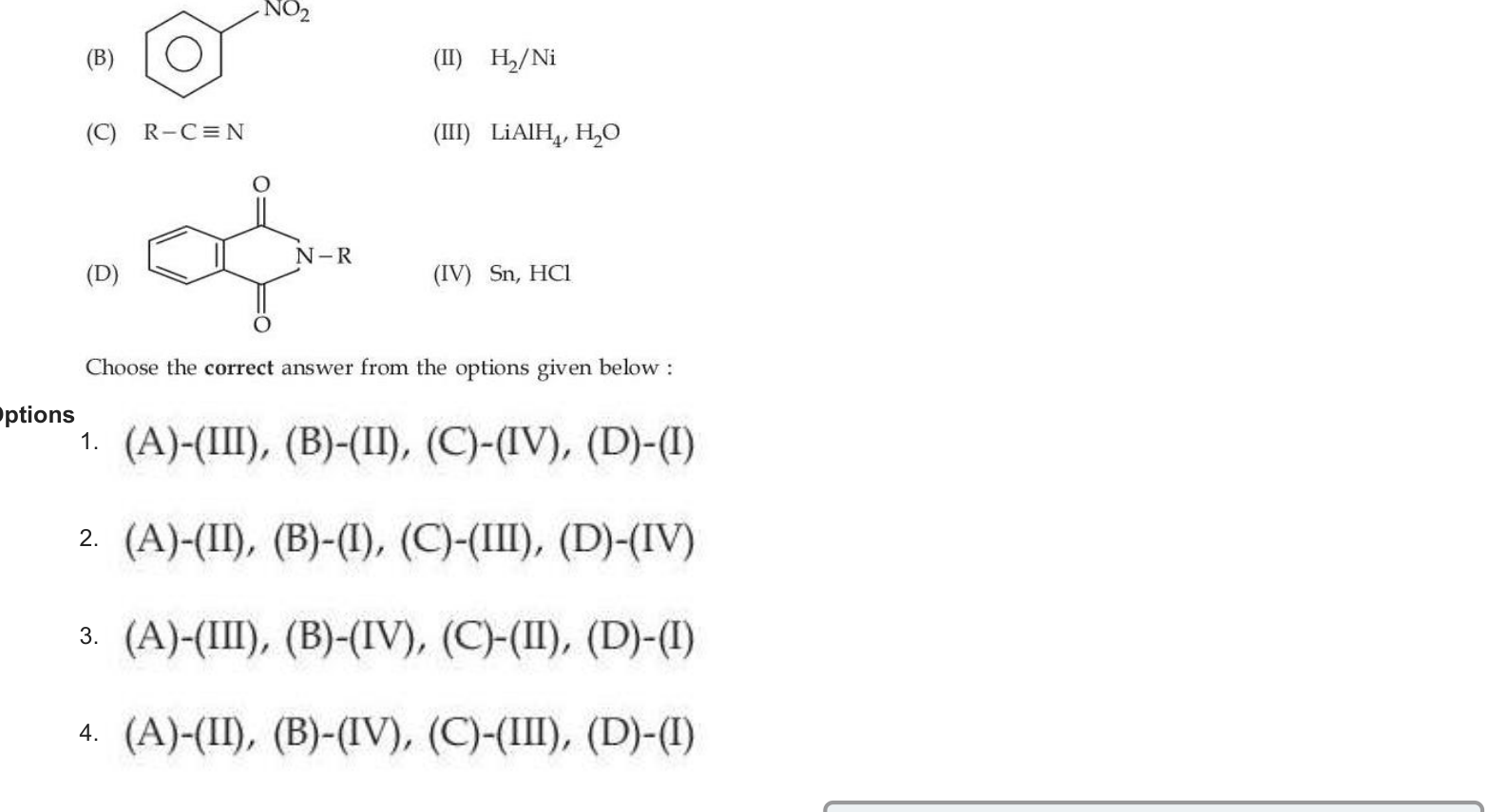
- A(A)-(III), (B)-(II), (C)-(IV), (D)-(I)
- B(A)-(II), (B)-(I), (C)-(III), (D)-(IV)
- C(A)-(III), (B)-(IV), (C)-(II), (D)-(I)
- D(A)-(II), (B)-(IV), (C)-(III), (D)-(I)
View answer or solution
Answer
(A)-(III), (B)-(IV), (C)-(II), (D)-(I)
Organic Compounds Containing Oxygen
RBr ⟶[ (i) Mg, dry ether, (ii) H₂O ] 2-Methylbutane The maximum number of RBr producing 2-methylbutane by above sequence of reactions is ________. (Consider the structural isomers only)

- A1
- B4
- C5
- D3
View answer or solution
Answer
4
Redox Reactions and Electrochemistry
The species which does not undergo disproportionation reaction is :
- AClO₂⁻
- BClO⁻
- CClO₃⁻
- DClO₄⁻
View answer or solution
Answer
ClO₄⁻
When sec-butylcyclohexane reacts with bromine in the presence of sunlight, the major product is :
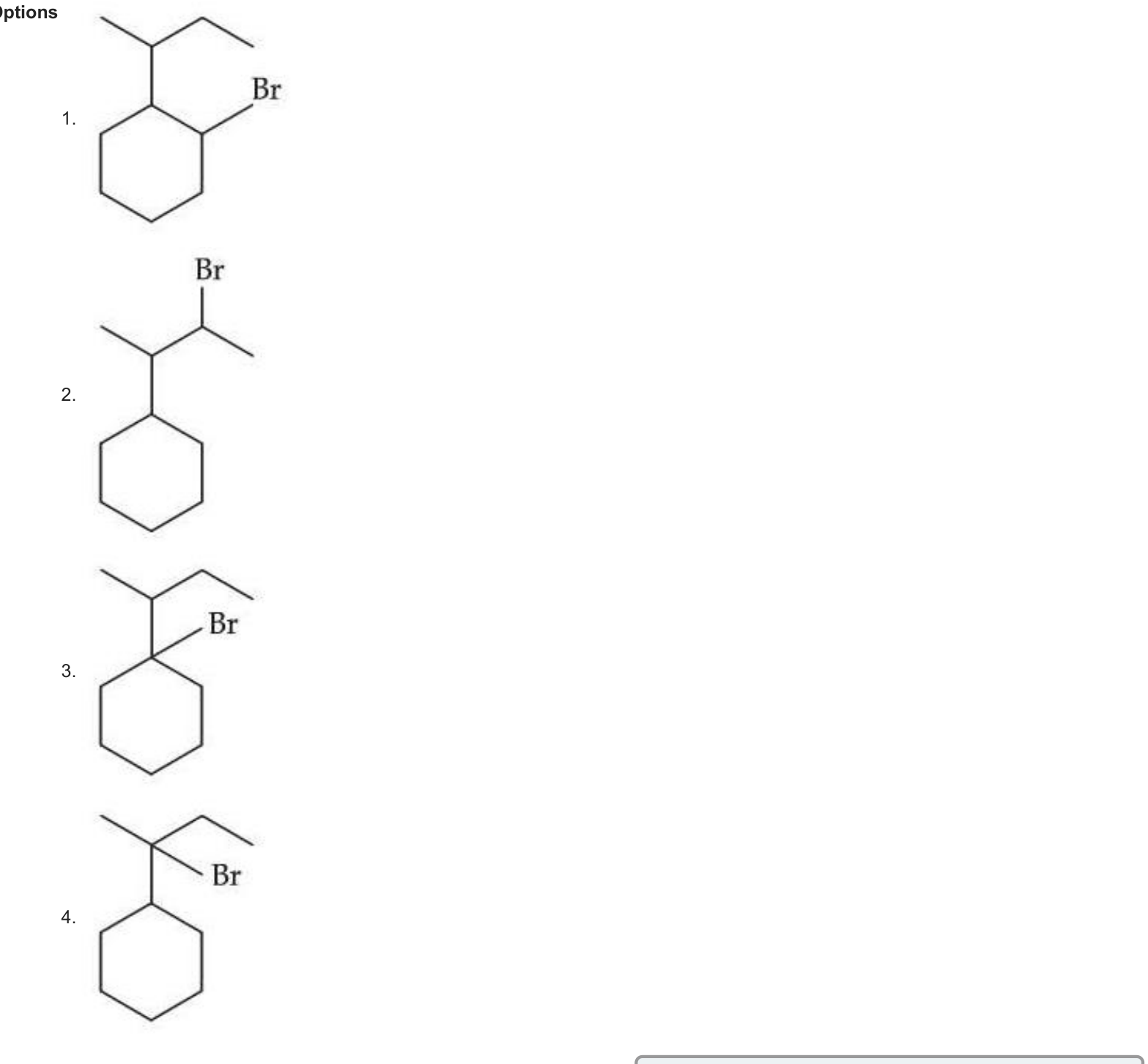
- A1-bromo-2-(sec-butyl)cyclohexane
- BCyclohexyl–CH(CH₃)–CH(Br)–CH₃ (Br on the side chain)
- C1-bromo-1-(sec-butyl)cyclohexane
- D1-bromo-1-(2-methylpropyl)cyclohexane
View answer or solution
Answer
1-bromo-1-(2-methylpropyl)cyclohexane
The alkane from below having two secondary hydrogens is :
- A2,2,4,5-Tetramethylheptane
- B4-Ethyl-3,4-dimethyloctane
- C2,2,3,3-Tetramethylpentane
- D2,2,4,4-Tetramethylhexane
View answer or solution
Answer
2,2,3,3-Tetramethylpentane
Some Basic Concepts in Chemistry
Toluene (excess) ⟶[ (i) CrO₂Cl₂, CS₂, (ii) H₃O⁺, (iii) NaHSO₃ ] Filter ⟶ Residue (A) Residue (A) + HCl(dil) → Compound (B) Structure of residue (A) and compound (B) formed respectively is :
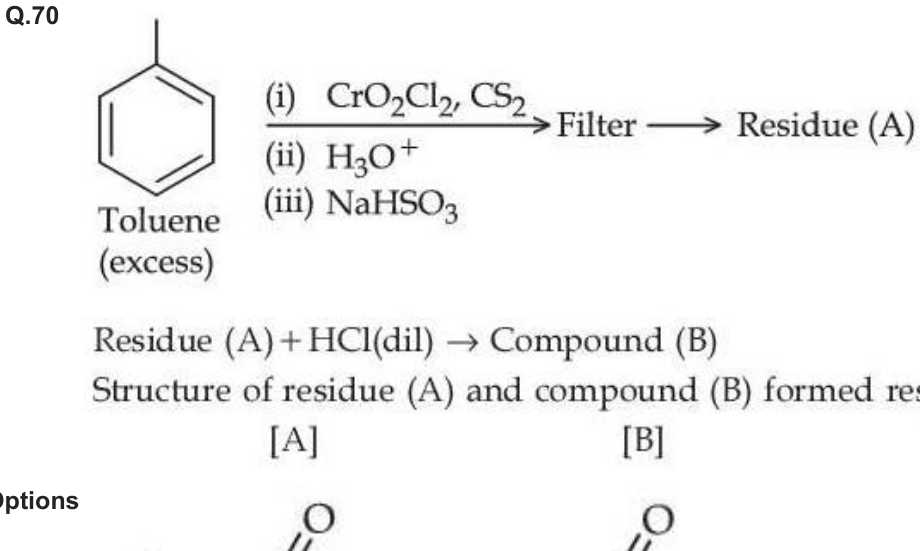
- A[A] = benzaldehyde, [B] = benzoic acid
- B[A] = benzaldehyde, [B] = sodium benzoate
- C[A] = the sodium bisulphite addition compound of benzaldehyde, [B] = benzaldehyde
- D[A] = benzaldehyde bearing a –CH(OCrOHCl₂)₂ group, [B] = benzaldehyde
View answer or solution
Answer
[A] = the sodium bisulphite addition compound of benzaldehyde, [B] = benzaldehyde
The complex of Ni²⁺ ion and dimethyl glyoxime contains ________ number of Hydrogen (H) atoms.
View answer or solution
Answer
14
Niobium (Nb) and ruthenium (Ru) have “x” and “y” number of electrons in their respective 4d orbitals. The value of x + y is ________.
View answer or solution
Answer
11
Some Basic Concepts in Chemistry
The compound with molecular formula C₆H₆, which gives only one monobromo derivative and takes up four moles of hydrogen per mole for complete hydrogenation has ________ π electrons.
View answer or solution
Answer
8
20 mL of 2 M NaOH solution is added to 400 mL of 0.5 M NaOH solution. The final concentration of the solution is ________ × 10⁻² M. (Nearest integer)
View answer or solution
Answer
57
Consider the following cases of standard enthalpy of reaction (ΔH°r in kJ mol⁻¹) C₂H₆(g) + (7/2) O₂(g) → 2CO₂(g) + 3H₂O(l) ΔH°₁ = −1550 C(graphite) + O₂(g) → CO₂(g) ΔH°₂ = −393.5 H₂(g) + (1/2) O₂(g) → H₂O(l) ΔH°₃ = −286 The magnitude of ΔH°f C₂H₆(g) is ________ kJ mol⁻¹ (Nearest integer).
View answer or solution
Answer
95