
// JEE (Main) / 2025
JEE (Main) 2025 Session 1, 22 January 2025, Shift 2 — Paper 1 (B.E / B.Tech) Physics
Physics · B.E / B.Tech
Questions
24 + 1
Has an official figure
Withheld — the source figure is not published, so the question is stored with the paper and not served
Work through the questions
24 questions
Take a moment to try each question before opening the available answer or solution.
A series LCR circuit is connected to an alternating source of emf E. The current amplitude at resonant frequency is I₀. If the value of resistance R becomes twice of its initial value then amplitude of current at resonance will be
- AI₀
- BI₀/2
- C2I₀
- DI₀/√2
View answer or solution
Answer
I₀/2
Properties of Solids and Liquids
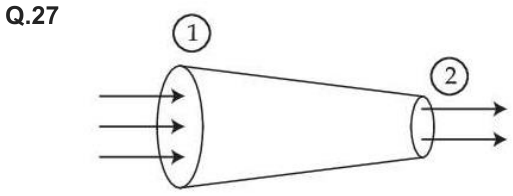
A tube of length L is shown in the figure. The radius of cross section at the point (1) is 2 cm and at the point (2) is 1 cm, respectively. If the velocity of water entering at point (1) is 2 m/s, then velocity of water leaving the point (2) will be
- A4 m/s
- B6 m/s
- C8 m/s
- D2 m/s
View answer or solution
Answer
8 m/s
Which one of the following is the correct dimensional formula for the capacitance in F ? M, L, T and C stand for unit of mass, length, time and charge,
- A[F] = [CM⁻² L⁻² T⁻²]
- B[F] = [C²M⁻¹ L⁻² T²]
- C[F] = [CM⁻¹ L⁻² T²]
- D[F] = [C²M⁻² L² T²]
View answer or solution
Answer
[F] = [C²M⁻¹ L⁻² T²]
Properties of Solids and Liquids
A small rigid spherical ball of mass M is dropped in a long vertical tube containing glycerine. The velocity of the ball becomes constant after some time. If the density of glycerine is half of the density of the ball, then the viscous force acting on the ball will be (consider g as acceleration due to gravity)
- AMg/2
- BMg
- C2 Mg
- D(3/2) Mg
View answer or solution
Answer
Mg/2
The torque due to the force (2î + ĵ + 2k̂) about the origin, acting on a particle whose position vector is (î + ĵ + k̂), would be
- Aî − ĵ + k̂
- Bĵ + k̂
- Cî + k̂
- Dî − k̂
View answer or solution
Answer
î − k̂
A transparent film of refractive index, 2.0 is coated on a glass slab of refractive index, 1.45. What is the minimum thickness of transparent film to be coated for the maximum transmission of Green light of wavelength 550 nm. [Assume that the light is incident nearly perpendicular to the glass surface.]
- A137.5 nm
- B275 nm
- C68.7 nm
- D94.8 nm
View answer or solution
Answer
137.5 nm
An electron projected perpendicular to a uniform magnetic field B moves in a circle. If Bohr's quantization is applicable, then the radius of the electronic orbit in the first excited state is :
- A√(h/(πeB))
- B√(h/(2πeB))
- C√(4h/(πeB))
- D√(2h/(πeB))
View answer or solution
Answer
√(h/(πeB))
A ball of mass 100 g is projected with velocity 20 m/s at 60° with horizontal. The decrease in kinetic energy of the ball during the motion from point of projection to highest point is
- A5 J
- Bzero
- C20 J
- D15 J
View answer or solution
Answer
15 J
A force F⃗ = 2î + bĵ + k̂ is applied on a particle and it undergoes a displacement î − 2ĵ − k̂. What will be the value of b, if work done on the particle is zero.
- A1/2
- B1/3
- C2
- D0
View answer or solution
Answer
1/2
For a diatomic gas, if γ₁ = (Cp/Cv) for rigid molecules and γ₂ = (Cp/Cv) for another diatomic molecules, but also having vibrational modes. Then, which one of the following options is correct ? (Cp and Cv are specific heats of the gas at constant pressure and volume)
- Aγ₂ < γ₁
- Bγ₂ > γ₁
- C2γ₂ = γ₁
- Dγ₂ = γ₁
View answer or solution
Answer
γ₂ < γ₁
A rectangular metallic loop is moving out of a uniform magnetic field region to a field free region with a constant speed. When the loop is partially inside the magnetic field, the plot of magnitude of induced emf (ε) with time (t) is given by
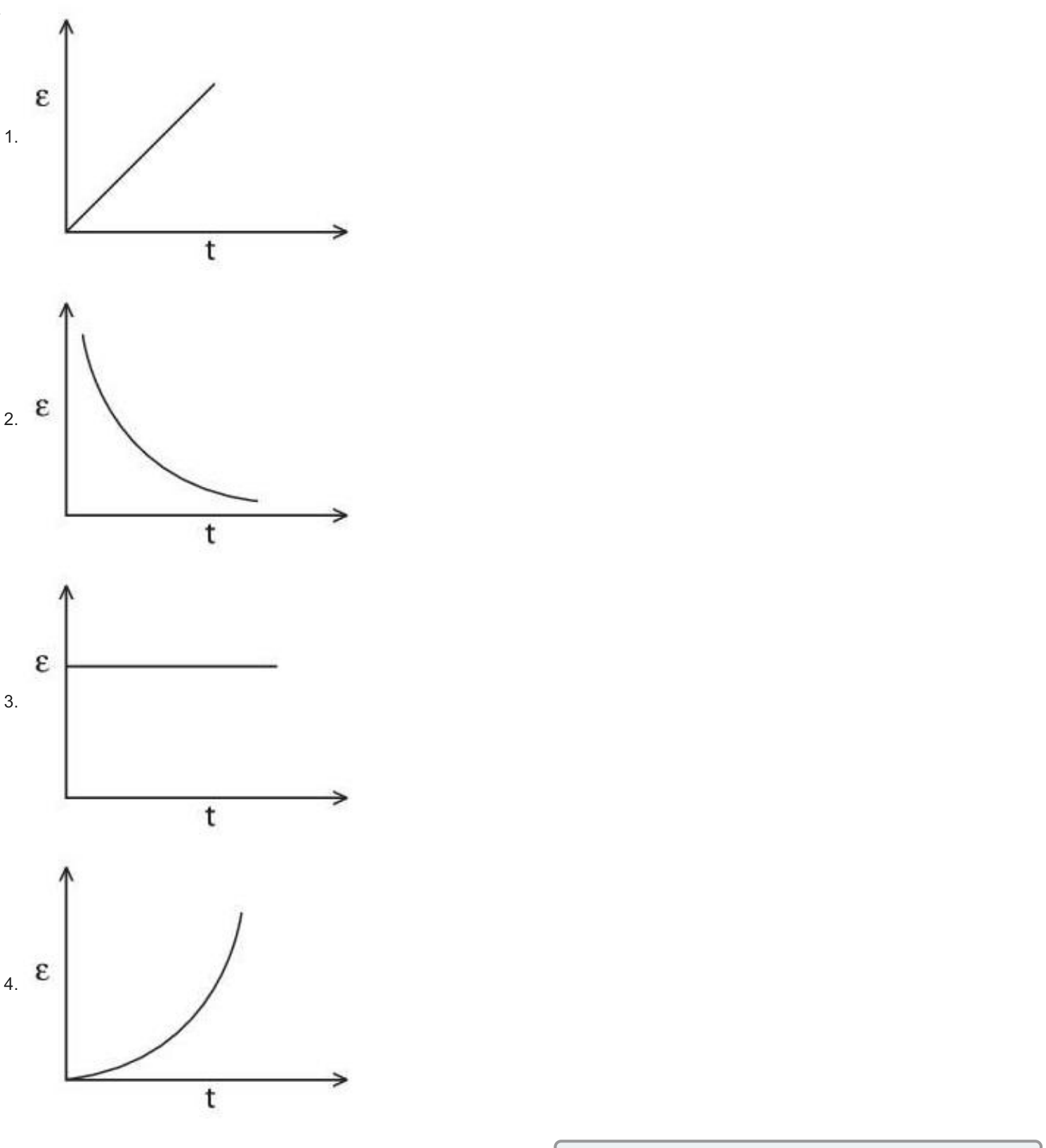
- AGraph of induced emf ε against time t: a straight line rising from the origin
- BGraph of induced emf ε against time t: a decreasing curve falling from a high value to a low value
- CGraph of induced emf ε against time t: a horizontal line at a constant value
- DGraph of induced emf ε against time t: a curve rising increasingly steeply from the origin
View answer or solution
Answer
Graph of induced emf ε against time t: a horizontal line at a constant value
Given below are two statements. One is labelled as Assertion (A) and the other is labelled as Reason (R). Assertion (A) : A simple pendulum is taken to a planet of mass and radius, 4 times and 2 times, respectively, than the Earth. The time period of the pendulum remains same on earth and the planet. Reason (R) : The mass of the pendulum remains unchanged at Earth and the other planet. In the light of the above statements, choose the correct answer from the options given below :
- ABoth (A) and (R) are true and (R) is the correct explanation of (A)
- B(A) is false but (R) is true
- CBoth (A) and (R) are true but (R) is NOT the correct explanation of (A)
- D(A) is true but (R) is false
View answer or solution
Answer
Both (A) and (R) are true but (R) is NOT the correct explanation of (A)
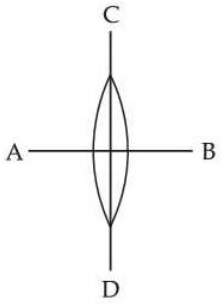
A symmetric thin biconvex lens is cut into four equal parts by two planes AB and CD as shown in figure. If the power of original lens is 4D then the power of a part of the divided lens is
- A4D
- B2D
- CD
- D8D
View answer or solution
Answer
2D
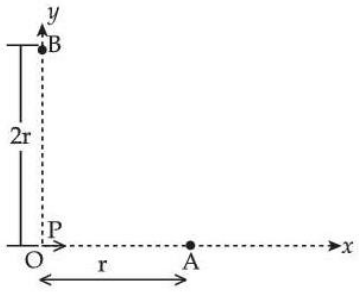
For a short dipole placed at origin O, the dipole moment P is along x-axis, as shown in the figure. If the electric potential and electric field at A are V₀ and E₀, respectively, then the correct combination of the electric potential and electric field, respectively, at point B on the y-axis is given by
- Azero and E₀/8
- BV₀/2 and E₀/16
- Czero and E₀/16
- DV₀ and E₀/4
View answer or solution
Answer
zero and E₀/16
Given are statements for certain thermodynamic variables, (A) Internal energy, volume (V) and mass (M) are extensive variables. (B) Pressure (P), temperature (T) and density (ρ) are intensive variables. (C) Volume (V), temperature (T) and density (ρ) are intensive variables. (D) Mass (M), temperature (T) and internal energy are extensive variables. Choose the correct answer from the options given below :
- A(D) and (A) Only
- B(A) and (B) Only
- C(C) and (D) Only
- D(B) and (C) Only
View answer or solution
Answer
(A) and (B) Only
Given below are two statements. One is labelled as Assertion (A) and the other is labelled as Reason (R). Assertion (A) : In Young's double slit experiment, the fringes produced by red light are closer as compared to those produced by blue light. Reason (R) : The fringe width is directly proportional to the wavelength of light. In the light of the above statements, choose the correct answer from the options given below :
- ABoth (A) and (R) are true but (R) is NOT the correct explanation of (A)
- B(A) is true but (R) is false
- CBoth (A) and (R) are true and (R) is the correct explanation of (A)
- D(A) is false but (R) is true
View answer or solution
Answer
(A) is false but (R) is true
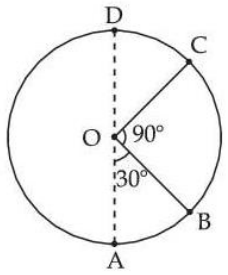
A body of mass 100 g is moving in circular path of radius 2 m on vertical plane as shown in figure. The velocity of the body at point A is 10 m/s. The ratio of its kinetic energies at point B and C is : (Take acceleration due to gravity as 10 m/s²)
- A(2 + √2)/3
- B(3 + √3)/2
- C(2 + √3)/3
- D(3 − √2)/2
View answer or solution
Answer
(3 + √3)/2
Dual Nature of Matter and Radiation
A light source of wavelength λ illuminates a metal surface and electrons are ejected with maximum kinetic energy of 2 eV. If the same surface is illuminated by a light source of wavelength λ/2, then the maximum kinetic energy of ejected electrons will be (The work function of metal is 1 eV)
- A3 eV
- B2 eV
- C5 eV
- D6 eV
View answer or solution
Answer
5 eV
The maximum percentage error in the measurement of density of a wire is [Given, mass of wire = (0.60 ± 0.003) g, radius of wire = (0.50 ± 0.01) cm, length of wire = (10.00 ± 0.05) cm]
- A7
- B4
- C8
- D5
View answer or solution
Answer
5
A tube of length 1m is filled completely with an ideal liquid of mass 2M, and closed at both ends. The tube is rotated uniformly in horizontal plane about one of its ends. If the force exerted by the liquid at the other end is F then angular velocity of the tube is √(F/(α M)) in SI unit. The value of α is ________.
View answer or solution
Answer
1
The net current flowing in the given circuit is ________ A.

View answer or solution
Answer
1
Magnetic Effects of Current and Magnetism
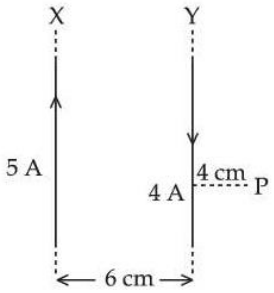
Two long parallel wires X and Y, separated by a distance of 6 cm, carry currents of 5A and 4A, respectively, in opposite directions as shown in the figure. Magnitude of the resultant magnetic field at point P at a distance of 4 cm from wire Y is x × 10⁻⁵ T. The value of x is ________. Take permeability of free space as μ₀ = 4π × 10⁻⁷ SI units.
View answer or solution
Answer
1
A parallel plate capacitor of area A = 16 cm² and separation between the plates 10 cm, is charged by a DC current. Consider a hypothetical plane surface of area A₀ = 3.2 cm² inside the capacitor and parallel to the plates. At an instant, the current through the circuit is 6A. At the same instant the displacement current through A₀ is ________ mA.
View answer or solution
Answer
1200
A proton is moving undeflected in a region of crossed electric and magnetic fields at a constant speed of 2 × 10⁵ ms⁻¹. When the electric field is switched off, the proton moves along a circular path of radius 2 cm. The magnitude of electric field is x × 10⁴ N/C. The value of x is ________. Take the mass of the proton = 1.6 × 10⁻²⁷ kg.
View answer or solution
Answer
2