
// JEE (Main) / 2025
JEE (Main) 2025 Session 2, 8 April 2025, Shift 2 — Paper 1 (B.E / B.Tech) Chemistry
Chemistry · B.E / B.Tech
Questions
24 + 1
Has an official figure
Withheld — the source figure is not published, so the question is stored with the paper and not served
Work through the questions
24 questions
Take a moment to try each question before opening the available answer or solution.
Which of the following binary mixture does not show the behaviour of minimum boiling azeotropes?
- AC₆H₅OH + C₆H₅NH₂
- BH₂O + CH₃COC₂H₅
- CCS₂ + CH₃COCH₃
- DCH₃OH + CHCl₃
View answer or solution
Answer
C₆H₅OH + C₆H₅NH₂
HA(aq) ⇌ H⁺(aq) + A⁻(aq) The freezing point depression of a 0.1 m aqueous solution of a monobasic weak acid HA is 0.20 °C. The dissociation constant for the acid is Given : K_f(H₂O) = 1.8 K kg mol⁻¹, molality ≡ molarity
- A1.1 × 10⁻²
- B1.89 × 10⁻¹
- C1.38 × 10⁻³
- D1.90 × 10⁻³
View answer or solution
Answer
1.38 × 10⁻³
Organic Compounds Containing Oxygen
Choose the correct set of reagents for the following conversion.
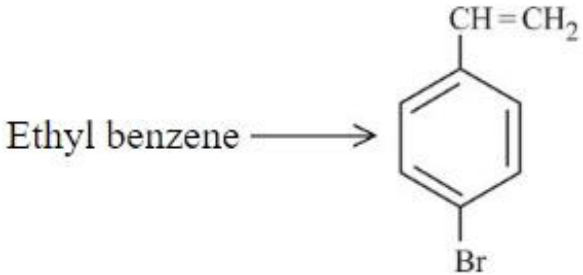
- ACl₂/Fe ; Br₂/anhy.AlCl₃ ; aq. KOH
- BBr₂/Fe ; Cl₂, Δ ; alc.KOH
- CBr₂/anhy.AlCl₃ ; Cl₂, Δ ; aq. KOH
- DCl₂/anhy.AlCl₃ ; Br₂/Fe ; alc. KOH
View answer or solution
Answer
Br₂/Fe ; Cl₂, Δ ; alc.KOH
On combustion 0.210 g of an organic compound containing C, H and O gave 0.127 g H₂O and 0.307 g CO₂. The percentages of hydrogen and oxygen in the given organic compound respectively are:
- A6.72, 39.87
- B6.72, 53.41
- C7.55, 43.85
- D53.41, 39.6
View answer or solution
Answer
6.72, 53.41
1,2-dibromocyclooctane ⟶[(i) KOH (alc.), (ii) NaNH₂, (iii) Hg²⁺ / H⁺, (iv) Zn–Hg / H⁺] P (major product) 'P' is
- Acyclooctane, drawn as a plain eight-membered ring
- Bcyclooctene, drawn as an eight-membered ring with one double bond
- Ccyclooctanol, drawn as an eight-membered ring with an –OH group on one ring carbon
- Dcyclooctanone, drawn as an eight-membered ring with a =O on one ring carbon
View answer or solution
Answer
cyclooctane, drawn as a plain eight-membered ring
Match the LIST-I with LIST-II LIST-I (Complex/ Species) A. [Ni(CO)₄] B. [Ni(CN)₄]²⁻ C. [NiCl₄]²⁻ D. [MnBr₄]²⁻ LIST-II (Shape & magnetic moment) I. Tetrahedral, 2.8 BM II. Square planar, 0 BM III. Tetrahedral, 0 BM IV. Tetrahedral, 5.9 BM Choose the correct answer from the options given below:
- AA-III, B-IV, C-II, D-I
- BA-IV, B-I, C-III, D-II
- CA-III, B-II, C-I, D-IV
- DA-I, B-II, C-III, D-IV
View answer or solution
Answer
A-III, B-II, C-I, D-IV
Classification of Elements and Periodicity in Properties
The atomic number of the element from the following with lowest 1ˢᵗ ionisation enthalpy is :
- A35
- B19
- C32
- D87
View answer or solution
Answer
87
In a first order decomposition reaction, the time taken for the decomposition of reactant to one fourth and one eighth of its initial concentration are t₁ and t₂ (s), respectively. The ratio t₁/t₂ will be:
- A4/3
- B3/2
- C2/3
- D3/4
View answer or solution
Answer
2/3
Some Basic Principles of Organic Chemistry
Match the LIST-I with LIST-II LIST-I (Reagent) A. Sodium bicarbonate solution B. Neutral ferric chloride C. ceric ammonium nitrate D. alkaline KMnO₄ LIST-II (Functional Group detected) I. double bond/ unsaturation II. carboxylic acid III. phenolic - OH IV. alcoholic - OH Choose the correct answer from the options given below:
- AA-II, B-IV, C-III, D-I
- BA-II, B-III, C-IV, D-I
- CA-II, B-III, C-I, D-IV
- DA-III, B-II, C-IV, D-I
View answer or solution
Answer
A-II, B-III, C-IV, D-I
Organic Compounds Containing Nitrogen
A ⟶[(i) NaOH (ii) H₃O⁺] B ⟶[(i) EtOH (ii) H₂SO₄, Δ] C 'A' shows positive Lassaigne's test for N and its molar mass is 121. 'B' gives effervescence with aq NaHCO₃. 'C' gives fruity smell. Identify A, B and C from the following.
- AA = a benzene ring drawn with a circle in it, bearing –NH₂ and –CHO on adjacent ring carbons; B = the same ring with –NH₂ and –CO₂H on adjacent ring carbons; C = the same ring with –NHEt and –CO₂Et on adjacent ring carbons
- BA = a benzene ring with –CHO on the top carbon and –NH₂ on the bottom carbon; B = a benzene ring with –NH₂ at the bottom carbon and a –CH(OH)–C(=O)– group at the top carbon joined to a second benzene ring carrying –NH₂; C = two benzene rings joined by a –CH(OH)–C(OH)(OEt)– bridge, each ring carrying –NH₂ on its bottom carbon
- CA = a benzene ring drawn with a circle in it, bearing –CONH₂ on the top carbon; B = the same ring with –CO₂H on the top carbon; C = the same ring with –CO₂Et on the top carbon
- DA = a benzene ring drawn with a circle in it, bearing –CH₂NHNH₂ on the top carbon; B = the same ring with –CO₂H on the top carbon; C = the same ring with –CO₂Et on the top carbon
View answer or solution
Answer
A = a benzene ring drawn with a circle in it, bearing –CONH₂ on the top carbon; B = the same ring with –CO₂H on the top carbon; C = the same ring with –CO₂Et on the top carbon
Given below are two statements: Statement I : H₂Se is more acidic than H₂Te Statement II : H₂Se has higher bond enthalpy for dissociation than H₂Te In the light of the above statements, choose the correct answer from the options given below
- ABoth Statement I and Statement II are true
- BBoth Statement I and Statement II are false
- CStatement I is false but Statement II is true
- DStatement I is true but Statement II is false
View answer or solution
Answer
Statement I is false but Statement II is true
Correct statements for an element with atomic number 9 are A. There can be 5 electrons for which m_s = +1/2 and 4 electrons for which m_s = −1/2 B. There is only one electron in p_z orbital. C. The last electron goes to orbital with n = 2 and l = 1. D. The sum of angular nodes of all the atomic orbitals is 1. Choose the correct answer from the options given below:
- AA, C and D Only
- BC and D Only
- CA and C Only
- DA and B Only
View answer or solution
Answer
A and C Only
What is the correct IUPAC name of
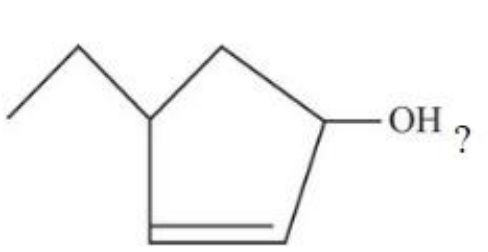
- A1-Ethylcyclopent-2-en-3-ol
- B4-Ethyl-1-hydroxycyclopent-2-ene
- C1-Ethyl-3-hydroxycyclopent-2-ene
- D4-Ethylcyclopent-2-en-1-ol
View answer or solution
Answer
4-Ethylcyclopent-2-en-1-ol
Given below are two statements: Statement I : A homoleptic octahedral complex, formed using monodentate ligands, will not show stereoisomerism Statement II : cis– and trans – platin are heteroleptic complexes of Pd. In the light of the above statements, choose the correct answer from the options given below
- ABoth Statement I and Statement II are true
- BStatement I is true but Statement II is false
- CStatement I is false but Statement II is true
- DBoth Statement I and Statement II are false
View answer or solution
Answer
Statement I is true but Statement II is false
Choose the correct option for structures of A and B, respectively
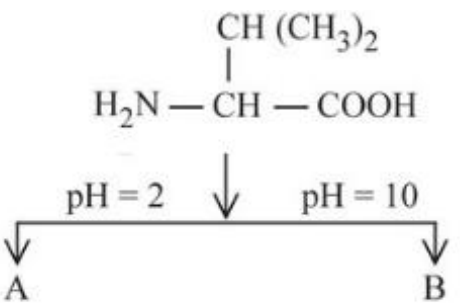
- AH₂N–CH(COO⁻)–CH(CH₃)₂ and H₃N⁺–CH(COOH)–CH(CH₃)₂
- BH₂N–CH(COO⁻)–CH(CH₃)₂ and H₃N⁺–CH(COO⁻)–CH(CH₃)₂
- CH₃N⁺–CH(COO⁻)–CH(CH₃)₂ and H₃N⁺–CH(COOH)–CH(CH₃)₂
- DH₃N⁺–CH(COOH)–CH(CH₃)₂ and H₂N–CH(COO⁻)–CH(CH₃)₂
View answer or solution
Answer
H₃N⁺–CH(COOH)–CH(CH₃)₂ and H₂N–CH(COO⁻)–CH(CH₃)₂
Organic Compounds Containing Oxygen
Which one of the following reactions will not lead to the desired ether formation in major proportion ? (iso–Bu ⇒ isobutyl, sec–Bu ⇒ sec-butyl, nPr ⇒ n–propyl, ᵗBu ⇒ tert–butyl, Et ⇒ ethyl)
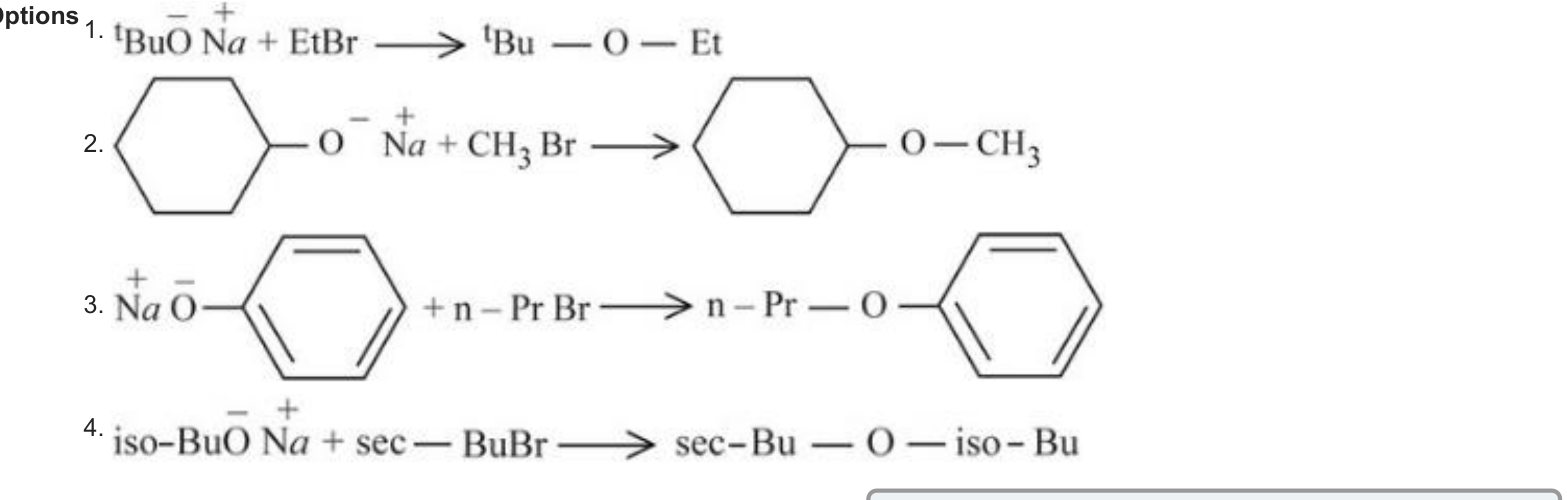
- AᵗBuO⁻Na⁺ + EtBr ⟶ ᵗBu–O–Et
- Bcyclohexyl–O⁻Na⁺ + CH₃Br ⟶ cyclohexyl–O–CH₃, both rings drawn as plain hexagons
- CC₆H₅–O⁻Na⁺ + n–PrBr ⟶ n–Pr–O–C₆H₅, both rings drawn in Kekulé style
- Diso–BuO⁻Na⁺ + sec–BuBr ⟶ sec–Bu–O–iso–Bu
View answer or solution
Answer
iso–BuO⁻Na⁺ + sec–BuBr ⟶ sec–Bu–O–iso–Bu
The correct decreasing order of spin only magnetic moment values (BM) of Cu⁺, Cu²⁺, Cr²⁺ and Cr³⁺ ions is :
- ACr²⁺ > Cr³⁺ > Cu²⁺ > Cu⁺
- BCu²⁺ > Cu⁺ > Cr²⁺ > Cr³⁺
- CCu⁺ > Cu²⁺ > Cr³⁺ > Cr²⁺
- DCr³⁺ > Cr²⁺ > Cu⁺ > Cu²⁺
View answer or solution
Answer
Cr²⁺ > Cr³⁺ > Cu²⁺ > Cu⁺
Some Basic Principles of Organic Chemistry
Match the LIST-I with LIST-II LIST-I A. Carbocation B. C-Free radical C. Nucleophile D. Electrophile LIST-II I. Species that can supply a pair of electrons. II. Species that can receive a pair of electrons. III. sp² hybridized carbon with empty p-orbital. IV. sp²/sp³ hybridized carbon with one unpaired electron. Choose the correct answer from the options given below:
- AA-IV, B-II, C-III, D-I
- BA-III, B-IV, C-II, D-I
- CA-III, B-IV, C-I, D-II
- DA-II, B-III, C-I, D-IV
View answer or solution
Answer
A-III, B-IV, C-I, D-II
Organic Compounds Containing Oxygen
When CH₃–C(=O)–CH₂–CH₂–CH₂–CH₂–C(=O)H undergoes intramolecular aldol condensation, the major product formed is :
- Aa seven-membered ring with a =O on the top carbon and one double bond in the ring
- Ba five-membered ring with a –CH₃ on one carbon, a =O on the adjacent carbon and a double bond between those two carbons
- Ca five-membered ring with one double bond, carrying an acetyl group –C(=O)CH₃ on a ring carbon
- Da five-membered ring with one double bond, carrying a –CHO on a ring carbon and a –CH₃ on an adjacent ring carbon
View answer or solution
Answer
a five-membered ring with one double bond, carrying an acetyl group –C(=O)CH₃ on a ring carbon
Some Basic Concepts in Chemistry
20 mL of sodium iodide solution gave 4.74 g silver iodide when treated with excess of silver nitrate solution. The molarity of the sodium iodide solution is ____________ M. (Nearest Integer value) (Given : Na = 23, I = 127, Ag = 108, N = 14, O = 16 g mol⁻¹)
View answer or solution
Answer
1
The equilibrium constant for decomposition of H₂O (g) H₂O(g) ⇌ H₂(g) + 1/2 O₂(g) (ΔG° = 92.34 kJ mol⁻¹) is 8.0 × 10⁻³ at 2300 K and total pressure at equilibrium is 1 bar. Under this condition, the degree of dissociation (α) of water is ____________ × 10⁻² (nearest integer value). [Assume α is negligible with respect to 1]
View answer or solution
Answer
5
The energy of an electron in first Bohr orbit of H-atom is –13.6 eV. The magnitude of energy value of electron in the first excited state of Be³⁺ is ____________ eV (nearest integer value)
View answer or solution
Answer
54
Chemical Bonding and Molecular Structure
Resonance in X₂Y can be represented as [Figure] The enthalpy of formation of X₂Y (X = X(g) + 1/2 Y = Y(g) → X₂Y(g)) is 80 kJ mol⁻¹. The magnitude of resonance energy of X₂Y is ____________ kJ mol⁻¹ (nearest integer value) Given : Bond energies of X ≡ X, X = X, Y = Y and X = Y are 940, 410, 500 and 602 kJ mol⁻¹ respectively. valence X: 3 , Y: 2

View answer or solution
Answer
98
Consider the following half cell reaction Cr₂O₇²⁻(aq) + 6e⁻ + 14H⁺(aq) ⟶ 2Cr³⁺(aq) + 7H₂O(l) The reaction was conducted with the ratio of [Cr³⁺]²/[Cr₂O₇²⁻] = 10⁻⁶. The pH value at which the EMF of the half cell will become zero is ____________. (nearest integer value) [Given : standard half cell reduction potential E°_(Cr₂O₇²⁻, H⁺/Cr³⁺) = 1.33V , 2.303RT/F = 0.059V .]
View answer or solution
Answer
10