
// JEE (Main) / 2025
JEE (Main) 2025 Session 2, 2 April 2025, Shift 2 — Paper 1 (B.E / B.Tech) Chemistry
Chemistry · B.E / B.Tech
Work through the questions
25 questions
Take a moment to try each question before opening the available answer or solution.
Chemical Bonding and Molecular Structure
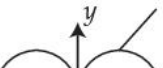
Which of the following statements are true ? (A) The subsidiary quantum number l describes the shape of the orbital occupied by the electron. (B) [Figure] is the boundary surface diagram of the 2pₓ orbital. (C) The + and − signs in the wave function of the 2pₓ orbital refer to charge. (D) The wave function of 2pₓ orbital is zero everywhere in the xy plane. Choose the correct answer from the options given below :
- A(A), (B) and (C) only
- B(A) and (B) only
- C(C) and (D) only
- D(B) and (D) only
View answer or solution
Answer
(A) and (B) only
Purification and Characterisation of Organic Compounds
Match List - I with List - II. List - I (Purification technique) (A) Distillation (simple) (B) Fractional distillation (C) Distillation under reduced pressure (D) Steam distillation List - II (Mixture of organic compounds) (I) Diesel + Petrol (II) Aniline + Water (III) Chloroform + Aniline (IV) Glycerol + Spent-lye Choose the correct answer from the options given below :
- A(A)-(II), (B)-(IV), (C)-(I), (D)-(III)
- B(A)-(III), (B)-(I), (C)-(IV), (D)-(II)
- C(A)-(III), (B)-(IV), (C)-(II), (D)-(I)
- D(A)-(II), (B)-(III), (C)-(IV), (D)-(I)
View answer or solution
Answer
(A)-(III), (B)-(I), (C)-(IV), (D)-(II)
Organic Compounds Containing Halogens
Match List - I with List - II. List - I (Reaction) (A) 2 C₆H₅–X + 2Na →[Dry Ether] C₆H₅–C₆H₅ + 2NaX (B) ArN₂⁺X⁻ →[Cu/HCl] ArCl + N₂↑ + CuX (C) C₂H₅Br + NaI →[Dry Acetone] C₂H₅I + NaBr (D) CH₃C(OH)(CH₃)CH₃ →[HCl/ZnCl₂] CH₃C(Cl)(CH₃)CH₃ List - II (Name of reaction) (I) Lucas reaction (II) Finkelstein reaction (III) Fittig reaction (IV) Gatterman reaction Choose the correct answer from the options given below :

- A(A)-(III), (B)-(II), (C)-(IV), (D)-(I)
- B(A)-(IV), (B)-(I), (C)-(II), (D)-(III)
- C(A)-(III), (B)-(IV), (C)-(II), (D)-(I)
- D(A)-(IV), (B)-(III), (C)-(I), (D)-(II)
View answer or solution
Answer
(A)-(III), (B)-(IV), (C)-(II), (D)-(I)
Redox Reactions and Electrochemistry
The nature of oxide (TeO₂) and hydride (TeH₂) formed by Te, respectively are :
- AReducing and basic
- BReducing and acidic
- COxidising and basic
- DOxidising and acidic
View answer or solution
Answer
Oxidising and acidic
Chemical Bonding and Molecular Structure
Which among the following molecules is (a) involved in sp³d hybridization, (b) has different bond lengths and (c) has lone pair of electrons on the central atom ?
- ASF₄
- BPF₅
- CXeF₂
- DXeF₄
View answer or solution
Answer
SF₄
Principles Related to Practical Chemistry
Formation of Na₄[Fe(CN)₅NOS], a purple coloured complex formed by addition of sodium nitroprusside in sodium carbonate extract of salt indicates the presence of :
- ASulphate ion
- BSodium ion
- CSulphite ion
- DSulphide ion
View answer or solution
Answer
Sulphide ion
Arrange the following in order of magnitude of work done by the system/on the system at constant temperature. (a) | w_reversible | for expansion in infinite stages. (b) | w_irreversible | for expansion in single stage. (c) | w_reversible | for compression in infinite stages. (d) | w_irreversible | for compression in single stage. Choose the correct answer from the options given below :
- Aa > c > b > d
- Ba > b > c > d
- Cd > c = a > b
- Dc = a > d > b
View answer or solution
Answer
d > c = a > b
Reactant A converts to product D through the given mechanism (with the net evolution of heat) : A → B slow; ΔH = + ve B → C fast; ΔH = − ve C → D fast; ΔH = − ve Which of the following represents the above reaction mechanism ?
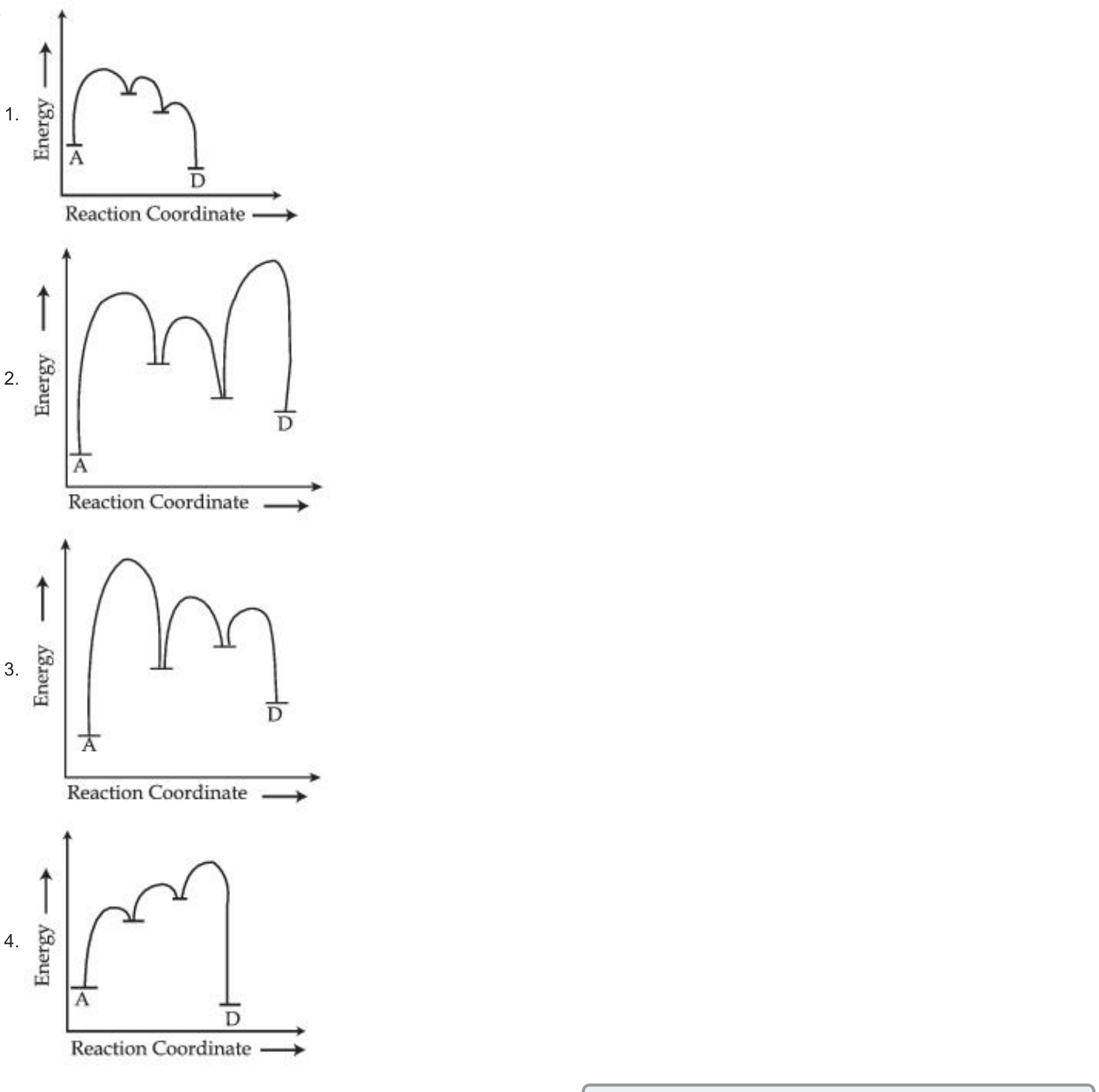
- AGraph: Energy on the vertical axis against Reaction Coordinate on the horizontal axis; the curve rises from A to the tallest first peak, falls to a valley (B) that lies above the level of A, rises to a slightly lower second peak, falls to a deeper valley (C), rises to a third, smallest peak and then falls steeply to D, which lies below the level of A.
- BGraph: Energy on the vertical axis against Reaction Coordinate on the horizontal axis; the curve rises from A to the first peak, falls to a valley (B) well above the level of A, rises to a smaller second peak, falls to a deeper valley (C), rises to the tallest third peak and then falls steeply to D, which lies above the level of A.
- CGraph: Energy on the vertical axis against Reaction Coordinate on the horizontal axis; the curve rises steeply from A to the tallest first peak, falls to a deep valley (B), rises to a second, lower peak, falls to a shallower valley (C) that still lies above B, rises to a third peak and then falls to D, which lies above the level of A.
- DGraph: Energy on the vertical axis against Reaction Coordinate on the horizontal axis; the curve rises from A to a low first peak, falls to a valley (B) above the level of A, rises to a second peak, falls to a slightly higher valley (C), rises to the tallest third peak and then falls steeply to D, which lies below the level of A.
View answer or solution
Answer
Graph: Energy on the vertical axis against Reaction Coordinate on the horizontal axis; the curve rises from A to the tallest first peak, falls to a valley (B) that lies above the level of A, rises to a slightly lower second peak, falls to a deeper valley (C), rises to a third, smallest peak and then falls steeply to D, which lies below the level of A.
Some Basic Concepts in Chemistry
'x' g of NaCl is added to water in a beaker with a lid. The temperature of the system is raised from 1°C to 25°C. Which out of the following plots, is best suited for the change in the molarity (M) of the solution with respect to temperature ? [Consider the solubility of NaCl remains unchanged over the temperature range]
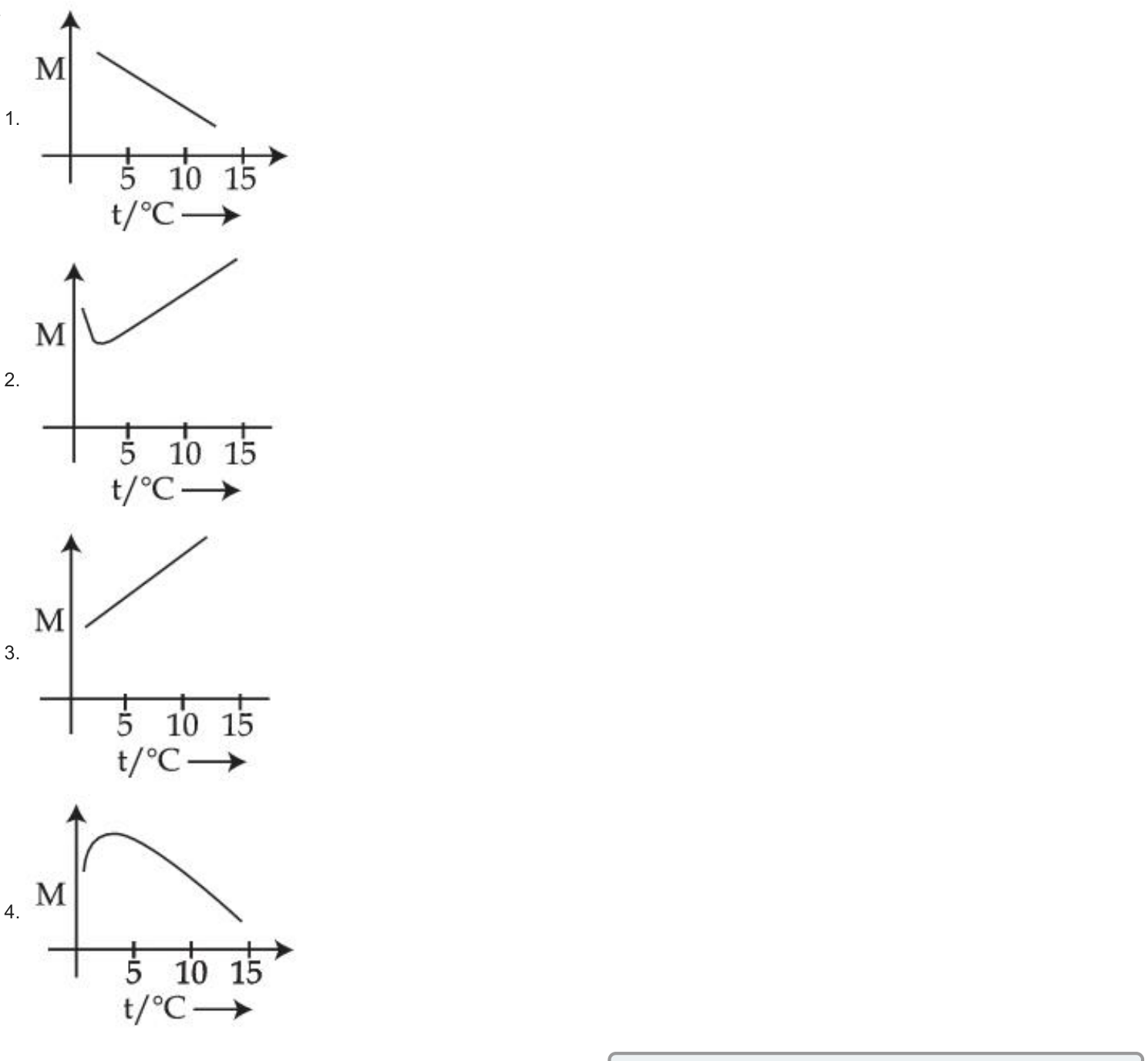
- AGraph: M on the vertical axis against t/°C on the horizontal axis, with 5, 10 and 15 marked on the t-axis; a straight line of negative slope falling from a high value of M near the vertical axis to a lower value at about 15 °C.
- BGraph: M on the vertical axis against t/°C on the horizontal axis, with 5, 10 and 15 marked on the t-axis; a curve that starts at a moderate value of M near the vertical axis, falls steeply to a minimum below 5 °C and then rises steadily with increasing slope to a high value at the right-hand end.
- CGraph: M on the vertical axis against t/°C on the horizontal axis, with 5, 10 and 15 marked on the t-axis; a straight line of positive slope rising from a value on the M axis to a higher value at the upper right.
- DGraph: M on the vertical axis against t/°C on the horizontal axis, with 5, 10 and 15 marked on the t-axis; a curve that rises steeply from a low value of M near the vertical axis to a rounded maximum at about 5 °C and then falls steadily to a lower value at about 15 °C.
View answer or solution
Answer
Graph: M on the vertical axis against t/°C on the horizontal axis, with 5, 10 and 15 marked on the t-axis; a curve that rises steeply from a low value of M near the vertical axis to a rounded maximum at about 5 °C and then falls steadily to a lower value at about 15 °C.
Some Basic Concepts in Chemistry
When a concentrated solution of sulphanilic acid and 1-naphthylamine is treated with nitrous acid (273 K) and acidified with acetic acid, the mass (g) of 0.1 mole of product formed is : (Given molar mass in g mol⁻¹ H : 1, C : 12, N : 14, O : 16, S : 32)
- A330
- B343
- C33
- D66
View answer or solution
Answer
33
Chemical Bonding and Molecular Structure
The type of hybridization and the magnetic property of [MnCl₆]³⁻ are,
- Ad²sp³, paramagnetic with two unpaired electrons.
- Bd²sp³, paramagnetic with four unpaired electrons.
- Csp³d², paramagnetic with four unpaired electrons.
- Dsp³d², paramagnetic with two unpaired electrons.
View answer or solution
Answer
sp³d², paramagnetic with four unpaired electrons.
Consider the following chemical equilibrium of the gas phase reaction at a constant temperature : A(g) ⇌ B(g) + C(g) If p being the total pressure, Kₚ is the pressure equilibrium constant and α is the degree of dissociation, then which of the following is true at equilibrium ?
- AIf Kₚ value is extremely high compared to p, α becomes much less than unity
- BWhen p increases α decreases
- CWhen p increases α increases
- DIf p value is extremely high compared to Kₚ, α ≈ 1
View answer or solution
Answer
When p increases α decreases
A tetrapeptide, “x” on complete hydrolysis produced glycine (Gly), alanine (Ala), valine (Val), leucine (Leu) in equimolar proportion each. The number of tetrapeptides (sequences) possible involving each of these amino acids is :
- A32
- B24
- C16
- D8
View answer or solution
Answer
24
Given below are two statements : Statement (I) : Neopentane forms only one monosubstituted derivative. Statement (II) : Melting point of neopentane is higher than n-pentane. In the light of the above statements, choose the most appropriate answer from the options given below :
- AStatement I is incorrect but Statement II is correct
- BBoth Statement I and Statement II are correct
- CBoth Statement I and Statement II are incorrect
- DStatement I is correct but Statement II is incorrect
View answer or solution
Answer
Both Statement I and Statement II are correct
Which of the following graphs correctly represents the variation of thermodynamic properties of Haber's process ?
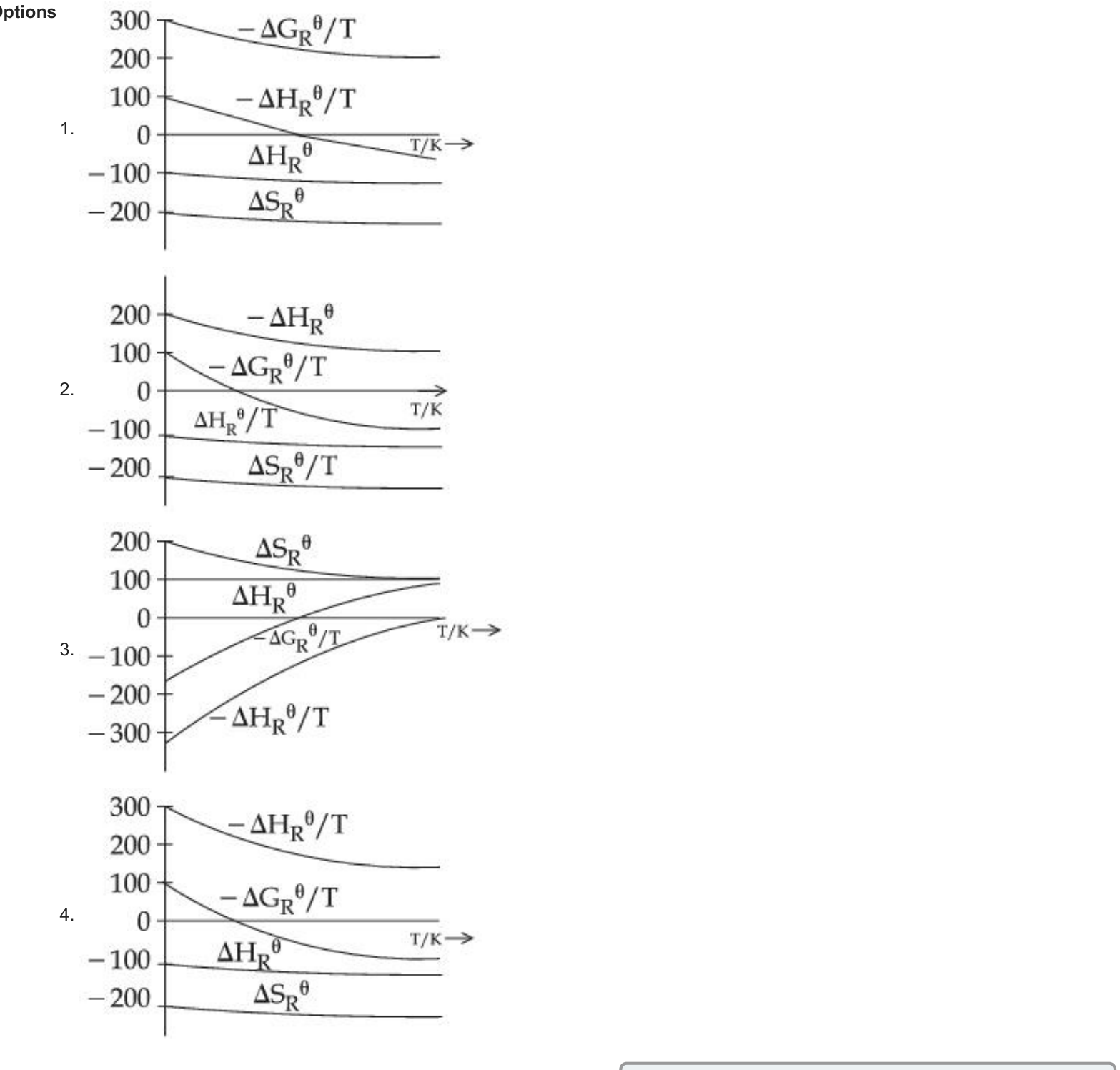
- AGraph: T/K on the horizontal axis; the vertical axis is marked 300, 200, 100, 0, −100 and −200. A curve labelled − ΔG_R^θ / T starts on the vertical axis at 300 and falls towards 200; a straight line labelled − ΔH_R^θ / T starts on the vertical axis at 100 and falls through 0 to about −50; a horizontal line at −100 is labelled ΔH_R^θ; a horizontal line at −200 is labelled ΔS_R^θ.
- BGraph: T/K on the horizontal axis; the vertical axis is marked 200, 100, 0, −100 and −200. A curve labelled − ΔH_R^θ starts on the vertical axis at 200 and falls towards 100; a curve labelled − ΔG_R^θ / T starts on the vertical axis at 100 and falls through 0 to −100; a horizontal line at −100 is labelled ΔH_R^θ / T; a horizontal line at −200 is labelled ΔS_R^θ / T.
- CGraph: T/K on the horizontal axis; the vertical axis is marked 200, 100, 0, −100, −200 and −300. A curve labelled ΔS_R^θ starts on the vertical axis at 200 and falls towards 100; a horizontal line at 100 is labelled ΔH_R^θ; a curve labelled − ΔG_R^θ / T starts at about −150 and rises through 0 towards 100; a curve labelled − ΔH_R^θ / T starts at about −300 and rises to 0.
- DGraph: T/K on the horizontal axis; the vertical axis is marked 300, 200, 100, 0, −100 and −200. A curve labelled − ΔH_R^θ / T starts on the vertical axis at 300 and falls towards 150; a curve labelled − ΔG_R^θ / T starts on the vertical axis at 100 and falls through 0 to −100; a horizontal line at −100 is labelled ΔH_R^θ; a horizontal line at −200 is labelled ΔS_R^θ.
View answer or solution
Answer
Graph: T/K on the horizontal axis; the vertical axis is marked 300, 200, 100, 0, −100 and −200. A curve labelled − ΔH_R^θ / T starts on the vertical axis at 300 and falls towards 150; a curve labelled − ΔG_R^θ / T starts on the vertical axis at 100 and falls through 0 to −100; a horizontal line at −100 is labelled ΔH_R^θ; a horizontal line at −200 is labelled ΔS_R^θ.
Chemical Bonding and Molecular Structure
Electronic configuration of four elements A, B, C and D are given below : (A) 1s²2s²2p³ (B) 1s²2s²2p⁴ (C) 1s²2s²2p⁵ (D) 1s²2s²2p² Which of the following is the correct order of increasing electronegativity (Pauling’s scale) ?
- AA < D < B < C
- BD < A < B < C
- CA < C < B < D
- DA < B < C < D
View answer or solution
Answer
D < A < B < C
Organic Compounds Containing Oxygen
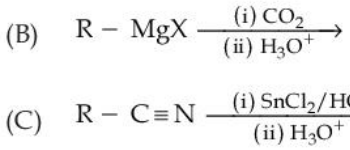
Consider the following reactions. From these reactions which reaction will give carboxylic acid as a major product ? (A) R – C ≡ N ⟶[ (i) H⁺/H₂O, mild condition ] (B) R – MgX ⟶[ (i) CO₂, (ii) H₃O⁺ ] (C) R – C ≡ N ⟶[ (i) SnCl₂/HCl, (ii) H₃O⁺ ] (D) R·CH₂·OH ⟶[ PCC ] (E) [a benzene ring drawn as a hexagon with three alternating inner double-bond lines, bonded to –COCl] ⟶[ (i) H₂|Pd-BaSO₄, (ii) Br₂ water ] Choose the correct answer from the options given below :
- AA, B and E only
- BB and E only
- CA and D only
- DB, C and E only
View answer or solution
Answer
B and E only
Some Basic Principles of Organic Chemistry
In 3,3-dimethylhex-1-en-4-yne, there are ______sp³, ______sp² and ______sp hybridised carbon atoms respectively.
- A3, 3, 2
- B4, 2, 2
- C2, 4, 2
- D2, 2, 4
View answer or solution
Answer
4, 2, 2
The d-orbital electronic configuration of the complex among [Co(en)₃]³⁺, [CoF₆]³⁻, [Mn(H₂O)₆]²⁺ and [Zn(H₂O)₆]²⁺ that has the highest CFSE is :
- At₂g³ e_g²
- Bt₂g⁶ e_g⁰
- Ct₂g⁶ e_g⁴
- Dt₂g⁴ e_g²
View answer or solution
Answer
t₂g⁶ e_g⁰
Some Basic Concepts in Chemistry
In Dumas' method for estimation of nitrogen, 0.5 gram of an organic compound gave 60 mL of nitrogen collected at 300 K temperature and 715 mm Hg pressure. The percentage composition of nitrogen in the compound (Aqueous tension at 300 K = 15 mm Hg) is ________ %.
- A1.257
- B18.67
- C20.87
- D12.57
View answer or solution
Answer
12.57
Redox Reactions and Electrochemistry
0.2% (w/v) solution of NaOH is measured to have resistivity 870.0 mΩ m. The molar conductivity of the solution will be ________ ×10² mS dm² mol⁻¹. (Nearest integer)
View answer or solution
Answer
23
The spin-only magnetic moment value of Mⁿ⁺ ion formed among Ni, Zn, Mn and Cu that has the least enthalpy of atomisation is ________. (in nearest integer) Here n is equal to the number of diamagnetic complexes among K₂[NiCl₄], [Zn(H₂O)₆]Cl₂, K₃[Mn(CN)₆] and [Cu(PPh₃)₃I]
View answer or solution
Answer
0
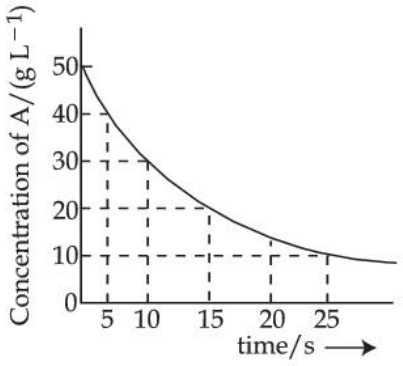
For the reaction A → B the following graph was obtained. The time required (in seconds) for the concentration of A to reduce to 2.5 g L⁻¹ (if the initial concentration of A was 50 g L⁻¹) is ________. (Nearest integer) Given : log 2 = 0.3010
View answer or solution
Answer
43
When 1 g each of compounds AB and AB₂ are dissolved in 15 g of water separately, they increased the boiling point of water by 2.7 K and 1.5 K respectively. The atomic mass of A (in amu) is ________ ×10⁻¹ (Nearest integer) (Given : Molal boiling point elevation constant is 0.5 K kg mol⁻¹)
View answer or solution
Answer
25
Some Basic Concepts in Chemistry
2-Bromopentane ⟶[ alcoholic KOH ] P Major Product ⟶[ Br₂ ] Q Consider the above sequence of reactions. 151 g of 2-bromopentane is made to react. Yield of major product P is 80% whereas Q is 100%. Mass of product Q obtained is ________ g. (Given molar mass in g mol⁻¹ H : 1, C : 12, O : 16, Br : 80)

View answer or solution
Answer
184