
// JEE (Main) / 2025
JEE (Main) 2025 Session 2, 2 April 2025, Shift 2 — Paper 1 (B.E / B.Tech) Mathematics
Mathematics · B.E / B.Tech
Work through the questions
25 questions
Take a moment to try each question before opening the available answer or solution.
Given three identical bags each containing 10 balls, whose colours are as follows : | | Red | Blue | Green | |---|---|---|---| | Bag I | 3 | 2 | 5 | | Bag II | 4 | 3 | 3 | | Bag III | 5 | 1 | 4 | A person chooses a bag at random and takes out a ball. If the ball is Red, the probability that it is from bag I is p and if the ball is Green, the probability that it is from bag III is q, then the value of (1/p + 1/q) is :
- A7
- B6
- C9
- D8
View answer or solution
Answer
7
Let (a, b) be the point of intersection of the curve x² = 2y and the straight line y − 2x − 6 = 0 in the second quadrant. Then the integral I = ∫_a^b (9x²/(1 + 5^x)) dx is equal to :
- A24
- B18
- C21
- D27
View answer or solution
Answer
24
If the image of the point P(1, 0, 3) in the line joining the points A(4, 7, 1) and B(3, 5, 3) is Q(α, β, γ), then α + β + γ is equal to :
- A46/3
- B18
- C47/3
- D13
View answer or solution
Answer
46/3
If θ ∈ [−7π/6, 4π/3], then the number of solutions of √3 cosec²θ − 2(√3 − 1) cosecθ − 4 = 0, is equal to :
- A8
- B7
- C6
- D10
View answer or solution
Answer
6
Let the point P of the focal chord PQ of the parabola y² = 16x be (1, −4). If the focus of the parabola divides the chord PQ in the ratio m : n, gcd(m, n) = 1, then m² + n² is equal to :
- A10
- B37
- C17
- D26
View answer or solution
Answer
17
If the system of equations 2x + λy + 3z = 5 3x + 2y − z = 7 4x + 5y + μz = 9 has infinitely many solutions, then (λ² + μ²) is equal to :
- A18
- B22
- C30
- D26
View answer or solution
Answer
26
If the domain of the function f(x) = 1/√(10 + 3x − x²) + 1/√(x + |x|) is (a, b), then (1 + a)² + b² is equal to :
- A25
- B30
- C26
- D29
View answer or solution
Answer
26
4 ∫_0^1 (1/(√(3 + x²) + √(1 + x²))) dx − 3 log_e(√3) is equal to :
- A2 + √2 + log_e(1 + √2)
- B2 − √2 + log_e(1 + √2)
- C2 − √2 − log_e(1 + √2)
- D2 + √2 − log_e(1 + √2)
View answer or solution
Answer
2 − √2 − log_e(1 + √2)
The line L₁ is parallel to the vector a⃗ = −3î + 2ĵ + 4k̂ and passes through the point (7, 6, 2) and the line L₂ is parallel to the vector b⃗ = 2î + ĵ + 3k̂ and passes through the point (5, 3, 4). The shortest distance between the lines L₁ and L₂ is :
- A21/√38
- B21/√57
- C23/√57
- D23/√38
View answer or solution
Answer
23/√38
The number of terms of an A.P. is even; the sum of all the odd terms is 24, the sum of all the even terms is 30 and the last term exceeds the first by 21/2. Then the number of terms which are integers in the A.P. is :
- A4
- B8
- C10
- D6
View answer or solution
Answer
4
Let a⃗ = 2î − 3ĵ + k̂, b⃗ = 3î + 2ĵ + 5k̂ and a vector c⃗ be such that (a⃗ − c⃗) × b⃗ = −18î − 3ĵ + 12k̂ and a⃗ · c⃗ = 3. If b⃗ × c⃗ = d⃗, then |a⃗ · d⃗| is equal to :
- A18
- B15
- C12
- D9
View answer or solution
Answer
15
Limit, Continuity and Differentiability
Let f : [1, ∞) → [2, ∞) be a differentiable function. If 10∫_1^x f(t) dt = 5xf(x) − x⁵ − 9 for all x ≥ 1, then the value of f(3) is :
- A18
- B26
- C32
- D22
View answer or solution
Answer
32
If the length of the minor axis of an ellipse is equal to one fourth of the distance between the foci, then the eccentricity of the ellipse is :
- A3/√19
- B√3/16
- C√5/7
- D4/√17
View answer or solution
Answer
4/√17
If the mean and the variance of 6, 4, a, 8, b, 12, 10, 13 are 9 and 9.25 respectively, then a + b + ab is equal to :
- A103
- B105
- C106
- D100
View answer or solution
Answer
103
If lim_(x→0) (cos(2x) + a cos(4x) − b)/x⁴ is finite, then (a + b) is equal to :
- A3/4
- B−1
- C0
- D1/2
View answer or solution
Answer
1/2
Let A = {1, 2, 3, ..., 100} and R be a relation on A such that R = {(a, b) : a = 2b + 1}. Let (a₁, a₂), (a₂, a₃), (a₃, a₄), ..., (a_k, a_(k+1)) be a sequence of k elements of R such that the second entry of an ordered pair is equal to the first entry of the next ordered pair. Then the largest integer k, for which such a sequence exists, is equal to :
- A6
- B7
- C8
- D5
View answer or solution
Answer
5
If ∑_(r=0)^10 ((10^(r+1) − 1)/10^r) · 11C_(r+1) = (α^11 − 11^11)/10^10, then α is equal to :
- A15
- B24
- C11
- D20
View answer or solution
Answer
20
The number of ways, in which the letters A, B, C, D, E can be placed in the 8 boxes of the figure below so that no row remains empty and at most one letter can be placed in a box, is :
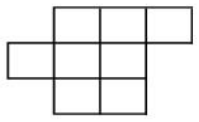
- A840
- B5880
- C5760
- D960
View answer or solution
Answer
5760
Let the area of the triangle formed by a straight line L : x + by + c = 0 with co-ordinate axes be 48 square units. If the perpendicular drawn from the origin to the line L makes an angle of 45° with the positive x-axis, then the value of b² + c² is :
- A90
- B97
- C93
- D83
View answer or solution
Answer
97
Let A be a 3×3 real matrix such that A²(A − 2I) − 4(A − I) = O, where I and O are the identity and null matrices, respectively. If A⁵ = αA² + βA + γI, where α, β, and γ are real constants, then α + β + γ is equal to :
- A20
- B76
- C12
- D4
View answer or solution
Answer
12
Complex Numbers and Quadratic Equations
If the set of all a ∈ ℝ − {1}, for which the roots of the equation (1 − a)x² + 2(a − 3)x + 9 = 0 are positive is (−∞, −α] ∪ [β, γ), then 2α + β + γ is equal to ______.
View answer or solution
Answer
7
Let A(4, −2), B(1, 1) and C(9, −3) be the vertices of a triangle ABC. Then the maximum area of the parallelogram AFDE, formed with vertices D, E and F on the sides BC, CA and AB of the triangle ABC respectively, is ______.
View answer or solution
Answer
3
Let y = y(x) be the solution of the differential equation dy/dx + 2y sec²x = 2 sec²x + 3 tan x . sec²x such that y(0) = 5/4. Then 12( y(π/4) − e⁻² ) is equal to ______.
View answer or solution
Answer
21
If the sum of the first 10 terms of the series 4·1/(1+4·1⁴) + 4·2/(1+4·2⁴) + 4·3/(1+4·3⁴) + ..... is m/n, where gcd(m, n) = 1, then m + n is equal to ______.
View answer or solution
Answer
441
If y = cos(π/3 + cos⁻¹(x/2)), then (x − y)² + 3y² is equal to ______.
View answer or solution
Answer
3