
// JEE (Main) / 2025
JEE (Main) 2025 Session 1, 28 January 2025, Shift 2 — Paper 1 (B.E / B.Tech) Chemistry
Chemistry · B.E / B.Tech
Questions
24 + 1
Has an official figure
Withheld — the source figure is not published, so the question is stored with the paper and not served
Work through the questions
24 questions
Take a moment to try each question before opening the available answer or solution.
Identify the inorganic sulphides that are yellow in colour : (A) (NH₄)₂S (B) PbS (C) CuS (D) As₂S₃ (E) As₂S₅ Choose the correct answer from the options given below :
- A(A) and (C) only
- B(D) and (E) only
- C(A), (D) and (E) only
- D(A) and (B) only
View answer or solution
Answer
(A), (D) and (E) only
Chemical Bonding and Molecular Structure
Match List - I with List - II. List - I (Complex) (A) [CoF₆]³⁻ (B) [NiCl₄]²⁻ (C) [Co(NH₃)₆]³⁺ (D) [Ni(CN)₄]²⁻ List - II (Hybridisation of central metal ion) (I) d²sp³ (II) sp³ (III) sp³d² (IV) dsp² Choose the correct answer from the options given below :
- A(A)-(III), (B)-(IV), (C)-(I), (D)-(II)
- B(A)-(I), (B)-(IV), (C)-(III), (D)-(II)
- C(A)-(III), (B)-(II), (C)-(I), (D)-(IV)
- D(A)-(I), (B)-(II), (C)-(III), (D)-(IV)
View answer or solution
Answer
(A)-(III), (B)-(II), (C)-(I), (D)-(IV)
The product B formed in the following reaction sequence is :
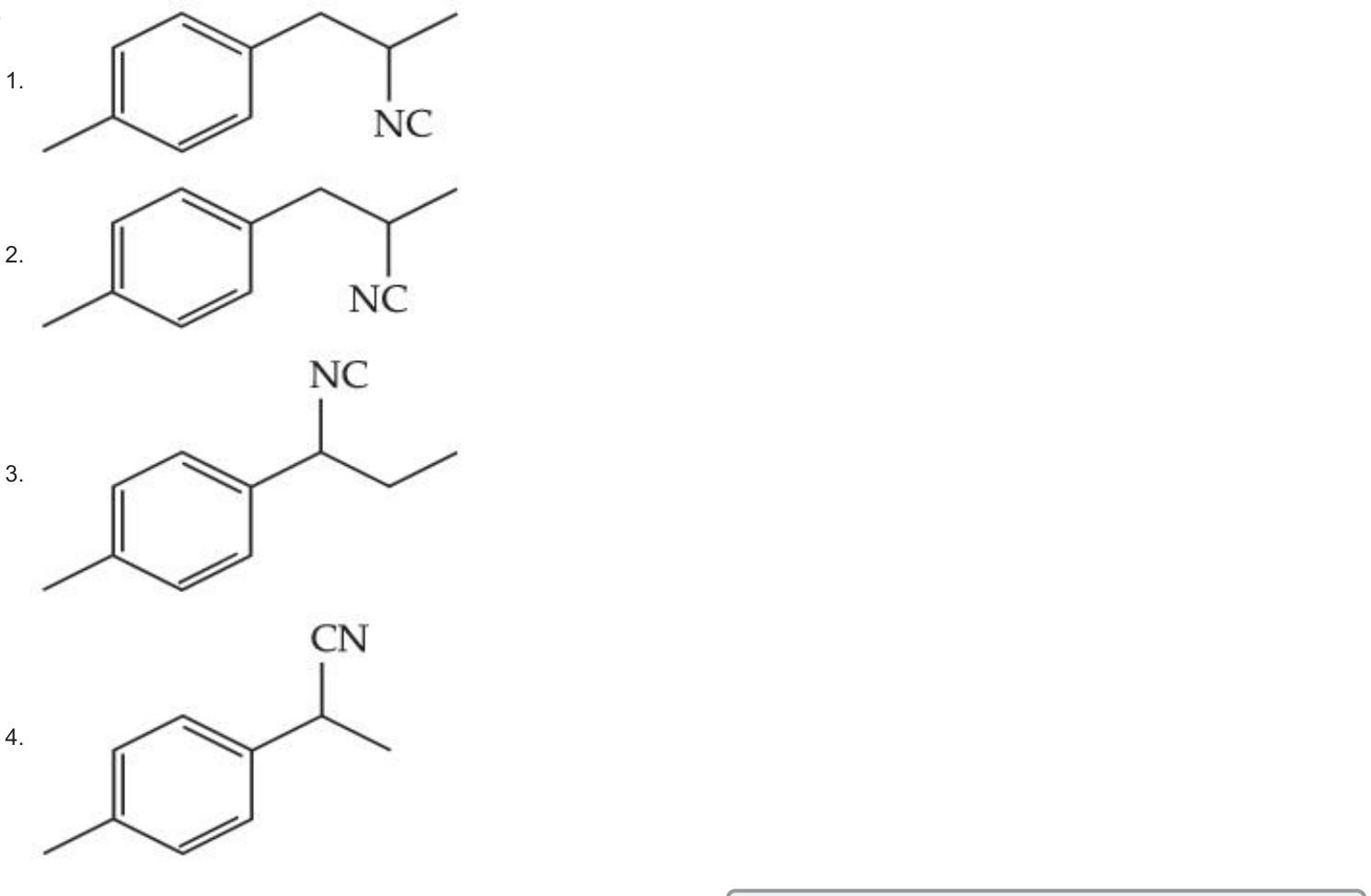
- AStructure: p-CH₃-C₆H₄-CH₂-CH(CH₃)-NC
- BStructure: p-CH₃-C₆H₄-CH₂-CH(CH₃)-NC (the printed drawing is the same as option 1)
- CStructure: p-CH₃-C₆H₄-CH(NC)-CH₂-CH₃
- DStructure: p-CH₃-C₆H₄-CH(CN)-CH₃
View answer or solution
Answer
Structure: p-CH₃-C₆H₄-CH(NC)-CH₂-CH₃
Arrange the following in increasing order of solubility product : Ca(OH)₂, AgBr, PbS, HgS
- AHgS < PbS < AgBr < Ca(OH)₂
- BHgS < AgBr < PbS < Ca(OH)₂
- CCa(OH)₂ < AgBr < HgS < PbS
- DPbS < HgS < Ca(OH)₂ < AgBr
View answer or solution
Answer
HgS < PbS < AgBr < Ca(OH)₂
For bacterial growth in a cell culture, growth law is very similar to the law of radioactive decay. Which of the following graphs is most suitable to represent bacterial colony growth ? Where N - Number of Bacteria at any time, N₀ - Initial number of Bacteria.
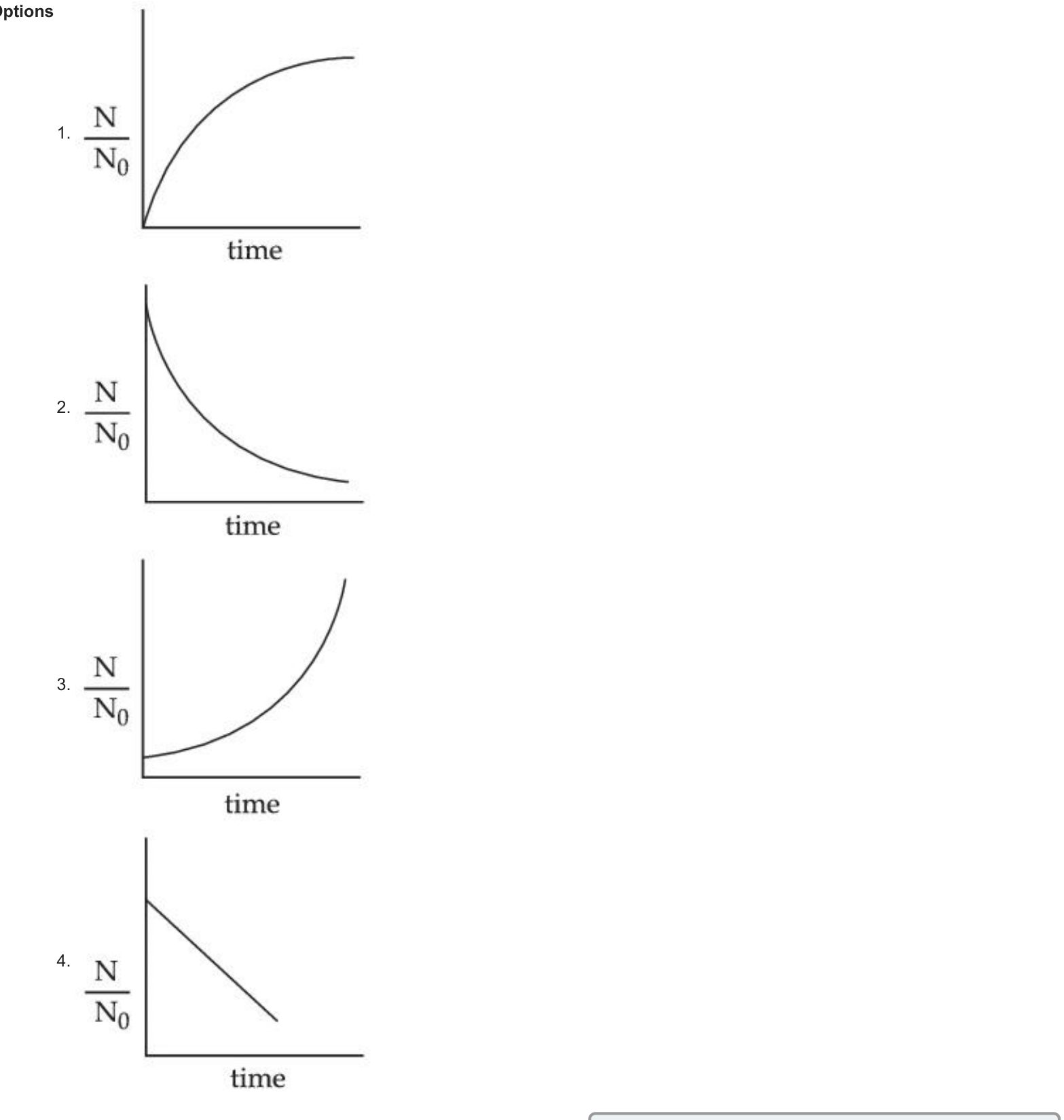
- AGraph: N/N₀ against time; a curve starting at the origin, rising steeply at first and then flattening towards a plateau.
- BGraph: N/N₀ against time; a curve starting from a high value on the N/N₀ axis, falling steeply at first and then levelling off towards the time axis.
- CGraph: N/N₀ against time; a curve starting from a small positive value on the N/N₀ axis and rising with increasing steepness.
- DGraph: N/N₀ against time; a straight line of negative slope starting from a positive value on the N/N₀ axis and falling towards the time axis.
View answer or solution
Answer
Graph: N/N₀ against time; a curve starting from a small positive value on the N/N₀ axis and rising with increasing steepness.
Identify correct conversion during acidic hydrolysis from the following : (A) starch gives galactose. (B) cane sugar gives equal amount of glucose and fructose. (C) milk sugar gives glucose and galactose. (D) amylopectin gives glucose and fructose. (E) amylose gives only glucose. Choose the correct answer from the options given below :
- A(B), (C) and (E) only
- B(C), (D) and (E) only
- C(A), (B) and (C) only
- D(B), (C) and (D) only
View answer or solution
Answer
(B), (C) and (E) only
Purification and Characterisation of Organic Compounds
The purification method based on the following physical transformation is : Solid (X) →(Heat) Vapour (X) →(Cool) Solid (X)
- ASublimation
- BDistillation
- CCrystallization
- DExtraction
View answer or solution
Answer
Sublimation
Redox Reactions and Electrochemistry
The amphoteric oxide among V₂O₃, V₂O₄ and V₂O₅, upon reaction with alkali leads to formation of an oxide anion. The oxidation state of V in the oxide anion is :
- A+5
- B+3
- C+4
- D+7
View answer or solution
Answer
+5
Consider an elementary reaction A(g) + B(g) → C(g) + D(g) If the volume of reaction mixture is suddenly reduced to 1/3 of its initial volume, the reaction rate will become 'x' times of the original reaction rate. The value of x is :
- A3
- B1/3
- C9
- D1/9
View answer or solution
Answer
9
Identify product [A], [B] and [C] in the following reaction sequence. CH₃ – C ≡ CH —(Pd/C, H₂)→ [A] —((i) O₃, (ii) Zn, H₂O)→ [B] + [C]
- A[A] : CH₂=CH₂, [B] : H₃C–C(=O)–CH₃, [C] : HCHO
- B[A] : CH₃ – CH = CH₂, [B] : CH₃CHO, [C] : HCHO
- C[A] : CH₃CH₂CH₃, [B] : CH₃CHO, [C] : HCHO
- D[A] : CH₃ – CH = CH₂, [B] : CH₃CHO, [C] : CH₃CH₂OH
View answer or solution
Answer
[A] : CH₃ – CH = CH₂, [B] : CH₃CHO, [C] : HCHO
Classification of Elements and Periodicity in Properties
Given below are two statements : Statement (I) : According to the Law of Octaves, the elements were arranged in the increasing order of their atomic number. Statement (II) : Meyer observed a periodically repeated pattern upon plotting physical properties of certain elements against their respective atomic numbers. In the light of the above statements, choose the correct answer from the options given below :
- ABoth Statement I and Statement II are false
- BStatement I is false but Statement II is true
- CStatement I is true but Statement II is false
- DBoth Statement I and Statement II are true
View answer or solution
Answer
Both Statement I and Statement II are false
The major product of the following reaction is : [Reaction scheme: C₆H₅–CH(CH₃)–CH(Br)–CH(Br)–CH₂–CH₂–CH₃ —(KOH/EtOH (excess), Δ)→ Major product]
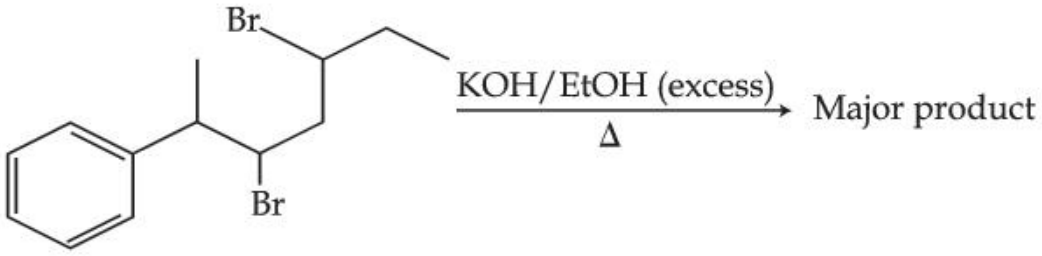
- A2-Phenylhepta-2,4-diene
- B2-Phenylhepta-2,5-diene
- C6-Phenylhepta-3,5-diene
- D6-Phenylhepta-2,4-diene
View answer or solution
Answer
2-Phenylhepta-2,4-diene
Concentrated nitric acid is labelled as 75% by mass. The volume in mL of the solution which contains 30 g of nitric acid is __________. Given : Density of nitric acid solution is 1.25 g/mL.
- A32
- B55
- C45
- D40
View answer or solution
Answer
32
An ideal gas undergoes a cyclic transformation starting from the point A and coming back to the same point by tracing the path A→B→C→D→A as shown in the three cases above. Choose the correct option regarding ΔU :
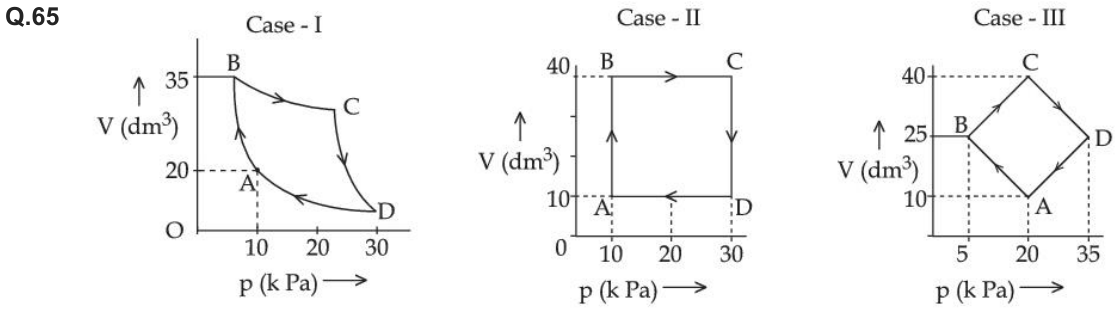
- AΔU(Case-III) > ΔU(Case-II) > ΔU(Case-I)
- BΔU(Case-I) > ΔU(Case-III) > ΔU(Case-II)
- CΔU(Case-I) > ΔU(Case-II) > ΔU(Case-III)
- DΔU(Case-I) = ΔU(Case-II) = ΔU(Case-III)
View answer or solution
Answer
ΔU(Case-I) = ΔU(Case-II) = ΔU(Case-III)
Organic Compounds Containing Oxygen
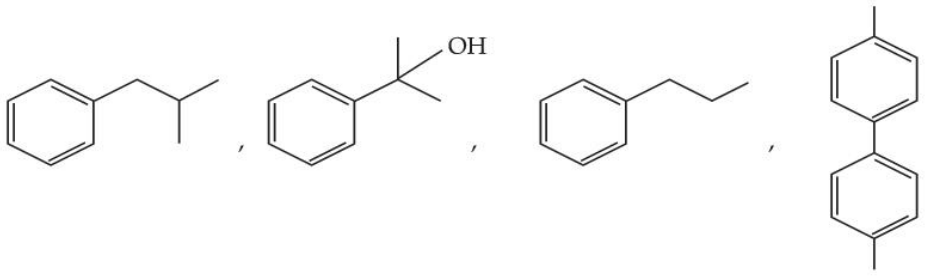
The total number of compounds from below when treated with hot KMnO₄ giving benzoic acid is : [C₆H₅CH₃, C₆H₅CH₂CH₃, C₆H₅CH(CH₃)₂, C₆H₅C(CH₃)₃, C₆H₅CH₂CH(CH₃)₂, C₆H₅C(CH₃)₂OH, C₆H₅CH₂CH₂CH₃, 4,4′-dimethylbiphenyl]
- A6
- B5
- C4
- D3
View answer or solution
Answer
5
Organic Compounds Containing Nitrogen
Identify correct statements : (A) Primary amines do not give diazonium salts when treated with NaNO₂ in acidic condition. (B) Aliphatic and aromatic primary amines on heating with CHCl₃ and ethanolic KOH form carbylamines. (C) Secondary and tertiary amines also give carbylamine test. (D) Benzenesulfonyl chloride is known as Hinsberg’s reagent. (E) Tertiary amines reacts with benzenesulfonyl chloride very easily. Choose the correct answer from the options given below :
- A(A) and (B) only
- B(B) and (D) only
- C(D) and (E) only
- D(B) and (C) only
View answer or solution
Answer
(B) and (D) only
Some Basic Principles of Organic Chemistry
Given below are two statements : Statement (I) : [methylcyclopentane (a five-membered ring bearing a methyl group) and CH₃CH₂CH=CHCH₂CH₃] are isomeric compounds. Statement (II) : [CH₃(CH₂)₄NH₂ and CH₃CH₂–NH–CH₂CH₂CH₃] are functional group isomers. In the light of the above statements, choose the correct answer from the options given below :
- ABoth Statement I and Statement II are false
- BStatement I is false but Statement II is true
- CStatement I is true but Statement II is false
- DBoth Statement I and Statement II are true
View answer or solution
Answer
Both Statement I and Statement II are true
Match List - I with List - II. List - I (Saccharides) (A) Sucrose (B) Maltose (C) Lactose (D) Amylopectin List - II (Glycosidic-linkages found) (I) α 1−4 (II) α 1−4 and α 1−6 (III) α 1−β 2 (IV) β 1−4 Choose the correct answer from the options given below :
- A(A)-(II), (B)-(IV), (C)-(III), (D)-(I)
- B(A)-(IV), (B)-(II), (C)-(I), (D)-(III)
- C(A)-(III), (B)-(I), (C)-(IV), (D)-(II)
- D(A)-(I), (B)-(II), (C)-(III), (D)-(IV)
View answer or solution
Answer
(A)-(III), (B)-(I), (C)-(IV), (D)-(II)
Which of the following is/are not correct with respect to energy of atomic orbitals of hydrogen atom ? (A) 1s < 2p < 3d < 4s (B) 1s < 2s = 2p < 3s = 3p (C) 1s < 2s < 2p < 3s < 3p (D) 1s < 2s < 4s < 3d Choose the correct answer from the options given below :
- A(A) and (C) only
- B(B) and (D) only
- C(A) and (B) only
- D(C) and (D) only
View answer or solution
Answer
(C) and (D) only
Consider the following data : Heat of formation of CO₂(g) = − 393.5 kJ mol⁻¹ Heat of formation of H₂O(l) = − 286.0 kJ mol⁻¹ Heat of combustion of benzene = − 3267.0 kJ mol⁻¹ The heat of formation of benzene is __________ kJ mol⁻¹. (Nearest integer)
View answer or solution
Answer
48
Electrolysis of 600 mL aqueous solution of NaCl for 5 min changes the pH of the solution to 12. The current in Amperes used for the given electrolysis is __________. (Nearest integer).
View answer or solution
Answer
2
A group 15 element forms dπ − dπ bond with transition metals. It also forms hydride, which is a strongest base among the hydrides of other group members that form dπ − dπ bond. The atomic number of the element is __________.
View answer or solution
Answer
15
Chemical Bonding and Molecular Structure
Total number of molecules/species from following which will be paramagnetic is __________. O₂, O₂⁺, O₂⁻, NO, NO₂, CO, K₂[NiCl₄], [Co(NH₃)₆]Cl₃, K₂[Ni(CN)₄]
View answer or solution
Answer
6
The spin only magnetic moment (μ) value (B.M.) of the compound with strongest oxidising power among Mn₂O₃, TiO and VO is __________ B.M. (Nearest integer).
View answer or solution
Answer
5