
// JEE (Main) / 2025
JEE (Main) 2025 Session 1, 24 January 2025, Shift 2 — Paper 1 (B.E / B.Tech) Chemistry
Chemistry · B.E / B.Tech
Work through the questions
25 questions
Take a moment to try each question before opening the available answer or solution.
When Ethane-1,2-diamine is added progressively to an aqueous solution of Nickel (II) chloride, the sequence of colour change observed will be :
- AGreen → Pale Blue → Blue → Violet
- BViolet → Blue → Pale Blue → Green
- CPale Blue → Blue → Green → Violet
- DPale Blue → Blue → Violet → Green
View answer or solution
Answer
Green → Pale Blue → Blue → Violet
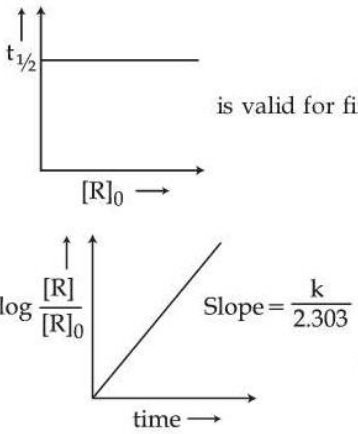
Given below are two statements : Statement (I) : [Figure] is valid for first order reaction. Statement (II) : [Figure] is valid for first order reaction. In the light of the above statements, choose the correct answer from the options given below :
- ABoth Statement I and Statement II are false
- BStatement I is false but Statement II is true
- CBoth Statement I and Statement II are true
- DStatement I is true but Statement II is false
View answer or solution
Answer
Statement I is true but Statement II is false
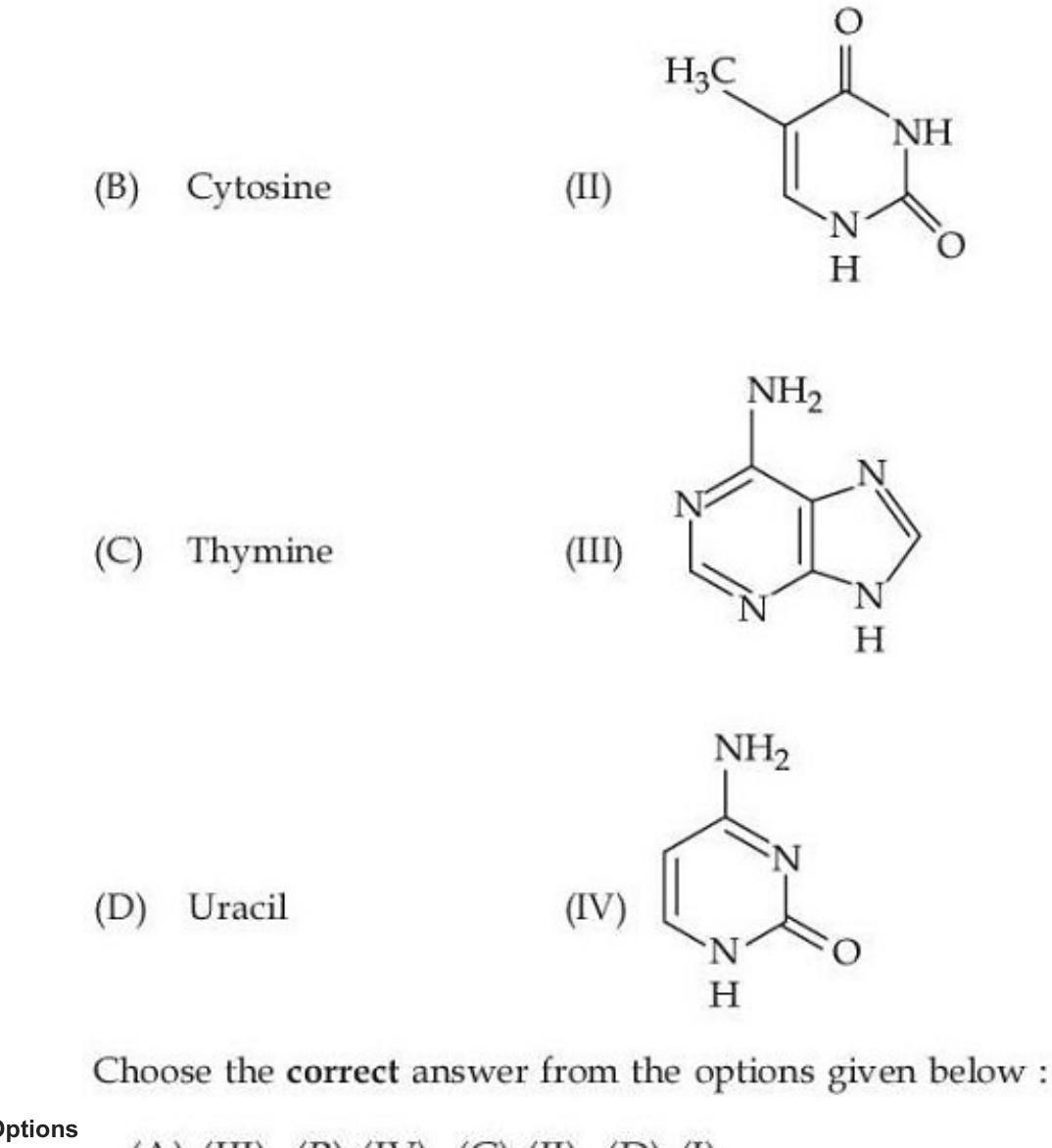
Match List - I with List - II. List - I (A) Adenine (B) Cytosine (C) Thymine (D) Uracil List - II (I) [Figure] (II) [Figure] (III) [Figure] (IV) [Figure] Choose the correct answer from the options given below :
- A(A)-(III), (B)-(IV), (C)-(II), (D)-(I)
- B(A)-(III), (B)-(I), (C)-(IV), (D)-(II)
- C(A)-(III), (B)-(IV), (C)-(I), (D)-(II)
- D(A)-(IV), (B)-(III), (C)-(II), (D)-(I)
View answer or solution
Answer
(A)-(III), (B)-(IV), (C)-(II), (D)-(I)
Given below are two statements : Statement (I) : The first ionization energy of Pb is greater than that of Sn. Statement (II) : The first ionization energy of Ge is greater than that of Si. In the light of the above statements, choose the correct answer from the options given below :
- AStatement I is true but Statement II is false
- BStatement I is false but Statement II is true
- CBoth Statement I and Statement II are false
- DBoth Statement I and Statement II are true
View answer or solution
Answer
Statement I is true but Statement II is false
For the reaction, H₂(g) + I₂(g) = 2HI(g) Attainment of equilibrium is predicted correctly by :
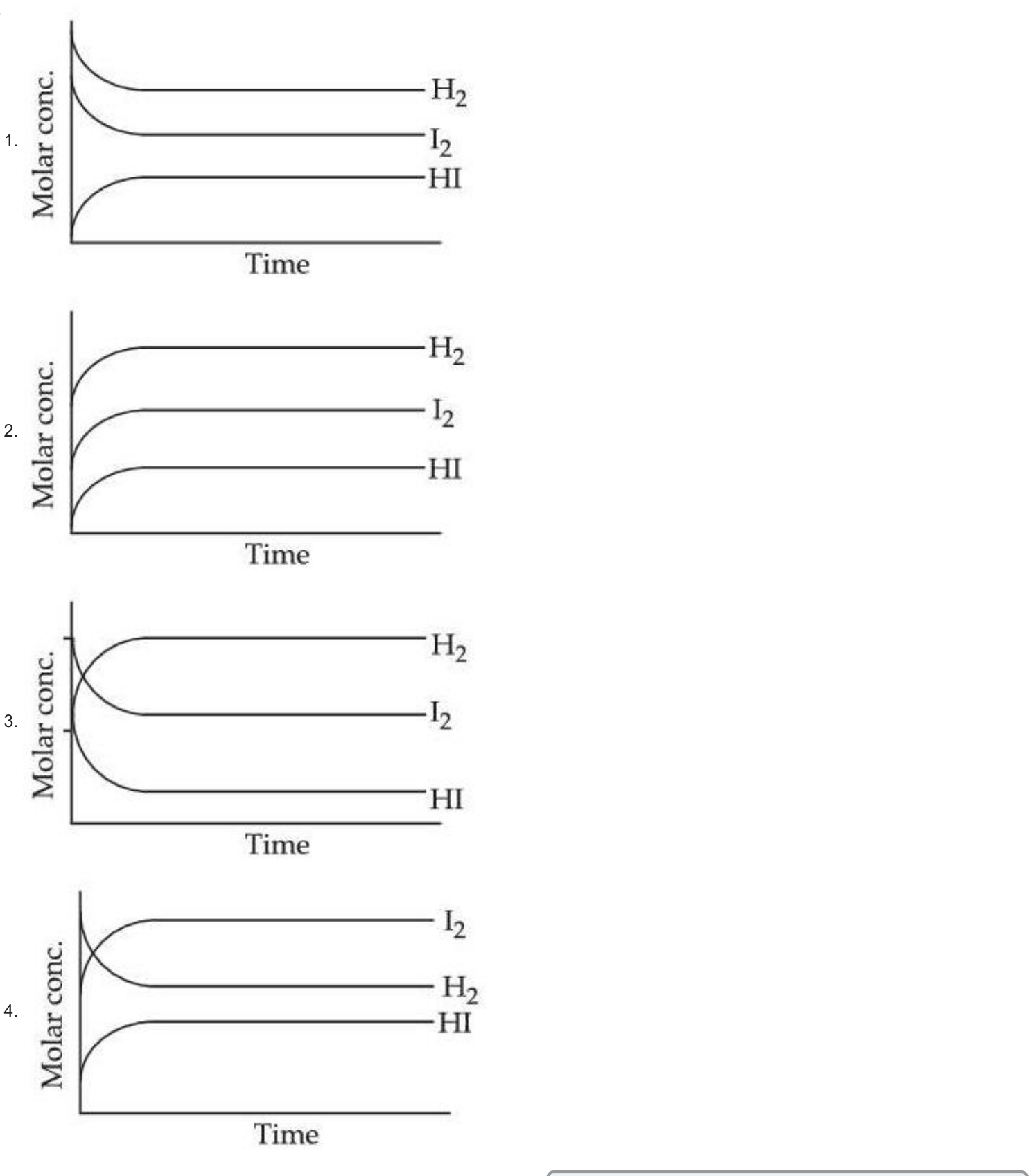
- AGraph: Molar conc. on the vertical axis against Time on the horizontal axis; the H₂ curve falls from a high value to the highest plateau, the I₂ curve falls from a lower value to the middle plateau and the HI curve rises from the origin to the lowest plateau.
- BGraph: Molar conc. on the vertical axis against Time on the horizontal axis; all three curves rise, the H₂ curve to the highest plateau, the I₂ curve to the middle plateau and the HI curve from the origin to the lowest plateau.
- CGraph: Molar conc. on the vertical axis against Time on the horizontal axis; the H₂ curve rises from a low value to the highest plateau, the I₂ curve falls from a high value to the middle plateau and the HI curve falls from a middle value to the lowest plateau, the rising and the falling curves crossing near the start.
- DGraph: Molar conc. on the vertical axis against Time on the horizontal axis; the I₂ curve rises to the highest plateau, the H₂ curve falls from a high value to the middle plateau and the HI curve rises from the origin to the lowest plateau.
View answer or solution
Answer
Graph: Molar conc. on the vertical axis against Time on the horizontal axis; the H₂ curve falls from a high value to the highest plateau, the I₂ curve falls from a lower value to the middle plateau and the HI curve rises from the origin to the lowest plateau.
Organic Compounds Containing Oxygen
In the given structure, number of sp and sp² hybridized carbon atoms present respectively are :

- A4 and 6
- B4 and 5
- C3 and 6
- D3 and 5
View answer or solution
Answer
3 and 5
Chemical Bonding and Molecular Structure
Given below are two statements : Statement (I) : Experimentally determined oxygen-oxygen bond lengths in the O₃ are found to be same and the bond length is greater than that of a O = O (double bond) but less than that of a single (O – O) bond. Statement (II) : The strong lone pair-lone pair repulsion between oxygen atoms is solely responsible for the fact that the bond length in ozone is smaller than that of a double bond (O = O) but more than that of a single bond (O – O). In the light of the above statements, choose the correct answer from the options given below :
- ABoth Statement I and Statement II are true
- BStatement I is true but Statement II is false
- CBoth Statement I and Statement II are false
- DStatement I is false but Statement II is true
View answer or solution
Answer
Statement I is true but Statement II is false
For hydrogen atom, the orbital/s with lowest energy is/are : (A) 4s (B) 3p_x (C) 3d_x²−y² (D) 3d_z² (E) 4p_z Choose the correct answer from the options given below :
- A(A) only
- B(B) only
- C(A) and (E) only
- D(B), (C) and (D) only
View answer or solution
Answer
(B), (C) and (D) only
S(g) + 3/2 O₂(g) → SO₃(g) + 2x kcal SO₂(g) + 1/2 O₂(g) → SO₃(g) + y kcal The heat of formation of SO₂(g) is given by :
- Ay − 2x kcal
- B2x/y kcal
- Cx + y kcal
- D2x + y kcal
View answer or solution
Answer
y − 2x kcal
The conditions and consequence that favours the t₂g³ eg¹ configuration in a metal complex are :
- Astrong field ligand, high spin complex
- Bstrong field ligand, low spin complex
- Cweak field ligand, low spin complex
- Dweak field ligand, high spin complex
View answer or solution
Answer
weak field ligand, high spin complex
Redox Reactions and Electrochemistry
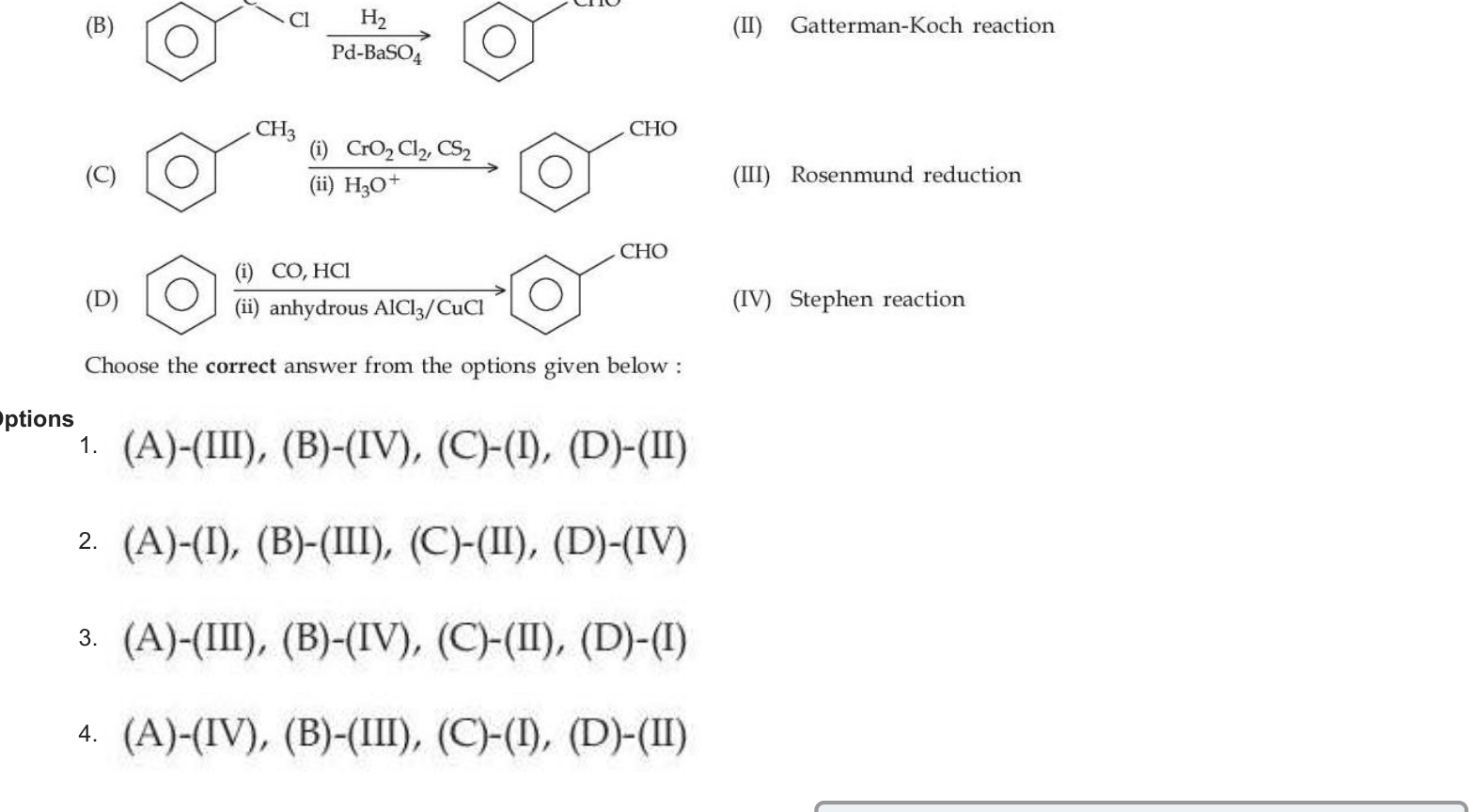
Match List - I with List - II. List - I (A) RCN →[ (i) SnCl₂, HCl, (ii) H₃O⁺ ] RCHO (B) C₆H₅COCl →[ H₂/Pd-BaSO₄ ] C₆H₅CHO (C) C₆H₅CH₃ →[ (i) CrO₂Cl₂, CS₂, (ii) H₃O⁺ ] C₆H₅CHO (D) C₆H₆ →[ (i) CO, HCl, (ii) anhydrous AlCl₃/CuCl ] C₆H₅CHO List - II (I) Etard reaction (II) Gattermann-Koch reaction (III) Rosenmund reduction (IV) Stephen reaction Choose the correct answer from the options given below :
- A(A)-(III), (B)-(IV), (C)-(I), (D)-(II)
- B(A)-(I), (B)-(III), (C)-(II), (D)-(IV)
- C(A)-(III), (B)-(IV), (C)-(II), (D)-(I)
- D(A)-(IV), (B)-(III), (C)-(I), (D)-(II)
View answer or solution
Answer
(A)-(IV), (B)-(III), (C)-(I), (D)-(II)
The structure of the major product formed in the following reaction is : C₆H₃(I)(CH₂Cl)(Br) (1,3,5-positions) →[ AgCN ] major product
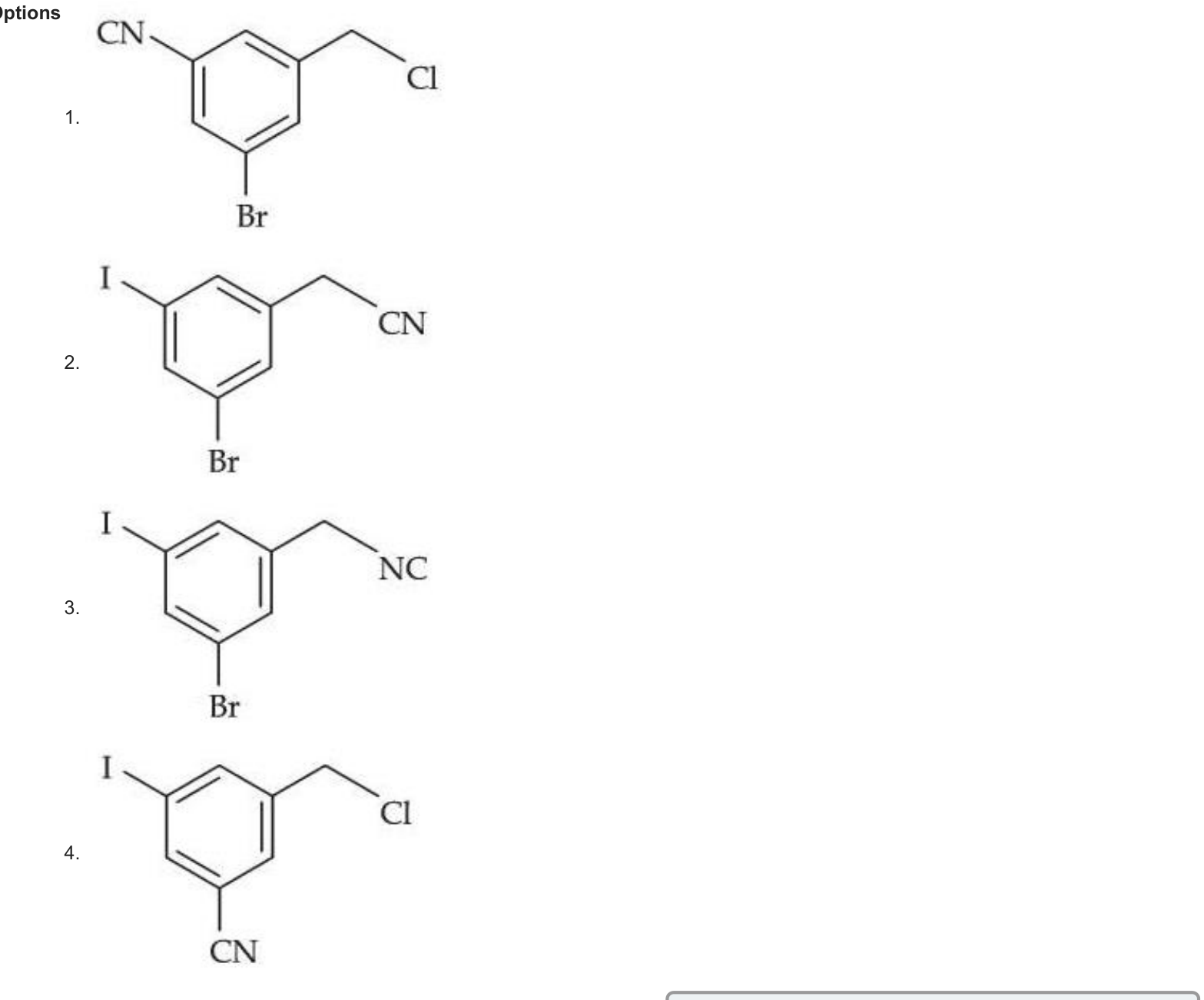
- AA benzene ring bearing –CN, –CH₂Cl and –Br groups in the 1,3,5-positions
- BA benzene ring bearing –I, –CH₂CN and –Br groups in the 1,3,5-positions
- CA benzene ring bearing –I, –CH₂NC and –Br groups in the 1,3,5-positions
- DA benzene ring bearing –I, –CH₂Cl and –CN groups in the 1,3,5-positions
View answer or solution
Answer
A benzene ring bearing –I, –CH₂NC and –Br groups in the 1,3,5-positions
Redox Reactions and Electrochemistry
Based on the data given below : E°(Cr₂O₇²⁻/Cr³⁺) = 1.33 V, E°(Cl₂/Cl⁻) = 1.36 V E°(MnO₄⁻/Mn²⁺) = 1.51 V, E°(Cr³⁺/Cr) = −0.74 V the strongest reducing agent is :
- AMnO₄⁻
- BMn²⁺
- CCl⁻
- DCr
View answer or solution
Answer
Cr
The successive 5 ionisation energies of an element are 800, 2427, 3658, 25024 and 32824 kJ/mol, respectively. By using the above values predict the group in which the above element is present :
- AGroup 13
- BGroup 4
- CGroup 2
- DGroup 14
View answer or solution
Answer
Group 13
Organic Compounds Containing Oxygen
For reaction C₆H₅NH₂ → C₆H₄(NH₂)(Br) (Major, Br ortho to NH₂) The correct order of set of reagents for the above conversion is :
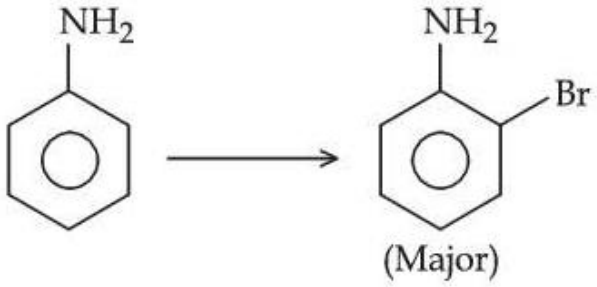
- AAc₂O, Br₂, H₂O(Δ), NaOH
- BH₂SO₄, Ac₂O, Br₂, H₂O(Δ), NaOH
- CAc₂O, H₂SO₄, Br₂, NaOH
- DBr₂ | FeBr₃, H₂O(Δ), NaOH
View answer or solution
Answer
H₂SO₄, Ac₂O, Br₂, H₂O(Δ), NaOH
Principles Related to Practical Chemistry
Find the compound 'A' from the following reaction sequences. A →[ aqua-regia ] B →[ (1) KNO₂|NH₄OH, (2) AcOH ] yellow ppt
- ANiS
- BZnS
- CMnS
- DCoS
View answer or solution
Answer
CoS
Some Basic Concepts in Chemistry
The elemental composition of a compound is 54.2% C, 9.2% H and 36.6% O. If the molar mass of the compound is 132 g mol⁻¹, the molecular formula of the compound is : [Given : The relative atomic mass of C : H : O = 12 : 1 : 16]
- AC₄H₈O₂
- BC₆H₁₂O₆
- CC₄H₉O₃
- DC₆H₁₂O₃
View answer or solution
Answer
C₆H₁₂O₃
Which of the following mixing of 1M base and 1M acid leads to the largest increase in temperature ?
- A30 mL CH₃COOH and 30 mL NaOH
- B45 mL CH₃COOH and 25 mL NaOH
- C30 mL HCl and 30 mL NaOH
- D50 mL HCl and 20 mL NaOH
View answer or solution
Answer
30 mL HCl and 30 mL NaOH
Match List - I with List - II. List - I (Transition metal ion) (A) Ti³⁺ (B) V²⁺ (C) Ni²⁺ (D) Sc³⁺ List - II (Spin only magnetic moment (B.M.)) (I) 3.87 (II) 0.00 (III) 1.73 (IV) 2.84 Choose the correct answer from the options given below :
- A(A)-(III), (B)-(I), (C)-(IV), (D)-(II)
- B(A)-(IV), (B)-(II), (C)-(III), (D)-(I)
- C(A)-(II), (B)-(IV), (C)-(I), (D)-(III)
- D(A)-(III), (B)-(I), (C)-(II), (D)-(IV)
View answer or solution
Answer
(A)-(III), (B)-(I), (C)-(IV), (D)-(II)
Organic Compounds Containing Halogens
Identify correct statement/s : (A) –OCH₃ and –NHCOCH₃ are activating group. (B) –CN and –OH are meta directing group. (C) –CN and –SO₃H are meta directing group. (D) Activating groups act as ortho - and para directing groups. (E) Halides are activating groups. Choose the correct answer from the options given below :
- A(A) only
- B(A), (C) and (D) only
- C(A), (B) and (E) only
- D(A) and (C) only
View answer or solution
Answer
(A), (C) and (D) only
Consider a complex reaction taking place in three steps with rate constants k₁, k₂ and k₃ respectively. The overall rate constant k is given by the expression k = √(k₁k₃/k₂). If the activation energies of the three steps are 60, 30 and 10 kJ mol⁻¹ respectively, then the overall energy of activation in kJ mol⁻¹ is ________. (Nearest integer)
View answer or solution
Answer
20
Some Basic Principles of Organic Chemistry
The possible number of stereoisomers for 5-phenylpent-4-en-2-ol is ________.
View answer or solution
Answer
4
Purification and Characterisation of Organic Compounds
In Carius method of estimation of halogen, 0.25 g of an organic compound gave 0.15 g of silver bromide (AgBr). The percentage of Bromine in the organic compound is ________ ×10⁻¹% (Nearest integer). (Given : Molar mass of Ag is 108 and Br is 80 g mol⁻¹)
View answer or solution
Answer
255
The hydrocarbon (X) with molar mass 80 g mol⁻¹ and 90% carbon has ________ degree of unsaturation.
View answer or solution
Answer
3
Redox Reactions and Electrochemistry
The observed and normal molar masses of compound MX₂ are 65.6 and 164 respectively. The percent degree of ionisation of MX₂ is ________%. (Nearest integer)
View answer or solution
Answer
75