
// JEE (Main) / 2025
JEE (Main) 2025 Session 1, 24 January 2025, Shift 2 — Paper 1 (B.E / B.Tech) Physics
Physics · B.E / B.Tech
Work through the questions
25 questions
Take a moment to try each question before opening the available answer or solution.
Magnetic Effects of Current and Magnetism
Given below are two statements. One is labelled as Assertion (A) and the other is labelled as Reason (R). Assertion (A) : A electron in a certain region of uniform magnetic field is moving with constant velocity in a straight line path. Reason (R) : The magnetic field in that region is along the direction of velocity of the electron. In the light of the above statements, choose the correct answer from the options given below :
- ABoth (A) and (R) are true but (R) is NOT the correct explanation of (A)
- B(A) is true but (R) is false
- CBoth (A) and (R) are true and (R) is the correct explanation of (A)
- D(A) is false but (R) is true
View answer or solution
Answer
Both (A) and (R) are true and (R) is the correct explanation of (A)
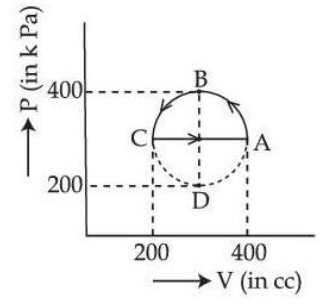
The magnitude of heat exchanged by a system for the given cyclic process ABCA (as shown in figure) is (in SI unit) :
- Azero
- B40π
- C5π
- D10π
View answer or solution
Answer
5π
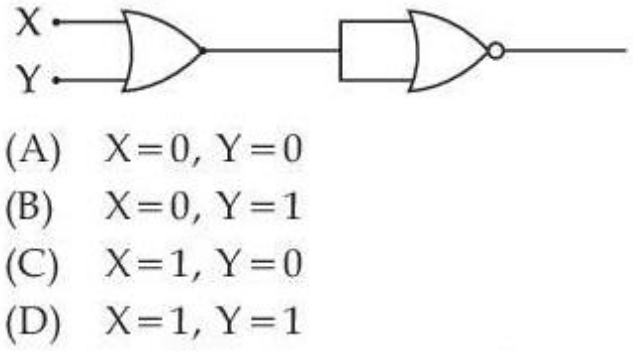
The output of the circuit is low (zero) for : (A) X=0, Y=0 (B) X=0, Y=1 (C) X=1, Y=0 (D) X=1, Y=1 Choose the correct answer from the options given below :
- A(A), (B) and (C) only
- B(B), (C) and (D) only
- C(A), (B) and (D) only
- D(A), (C) and (D) only
View answer or solution
Answer
(B), (C) and (D) only
A small uncharged conducting sphere is placed in contact with an identical sphere but having 4 × 10⁻⁸ C charge and then removed to a distance such that the force of repulsion between them is 9 × 10⁻³ N. The distance between them is (Take 1/(4πε₀) as 9 × 10⁰ in SI units)
- A4 cm
- B2 cm
- C3 cm
- D1 cm
View answer or solution
Answer
2 cm
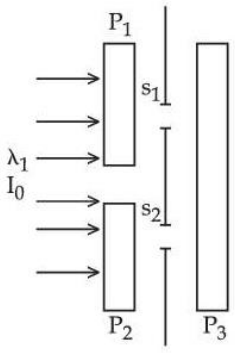
In a Young's double slit experiment, three polarizers are kept as shown in the figure. The transmission axes of P₁ and P₂ are orthogonal to each other. The polarizer P₃ covers both the slits with its transmission axis at 45° to those of P₁ and P₂. An unpolarized light of wavelength λ and intensity I₀ is incident on P₁ and P₂. The intensity at a point after P₃ where the path difference between the light waves from s₁ and s₂ is λ/3, is
- AI₀/3
- BI₀/4
- CI₀/2
- DI₀
View answer or solution
Answer
I₀/4
Properties of Solids and Liquids
The temperature of a body in air falls from 40°C to 24°C in 4 minutes. The temperature of the air is 16°C. The temperature of the body in the next 4 minutes will be :
- A56/3 °C
- B42/3 °C
- C28/3 °C
- D14/3 °C
View answer or solution
Answer
56/3 °C
Which of the following figure represents the relation between Celsius and Fahrenheit temperatures ?
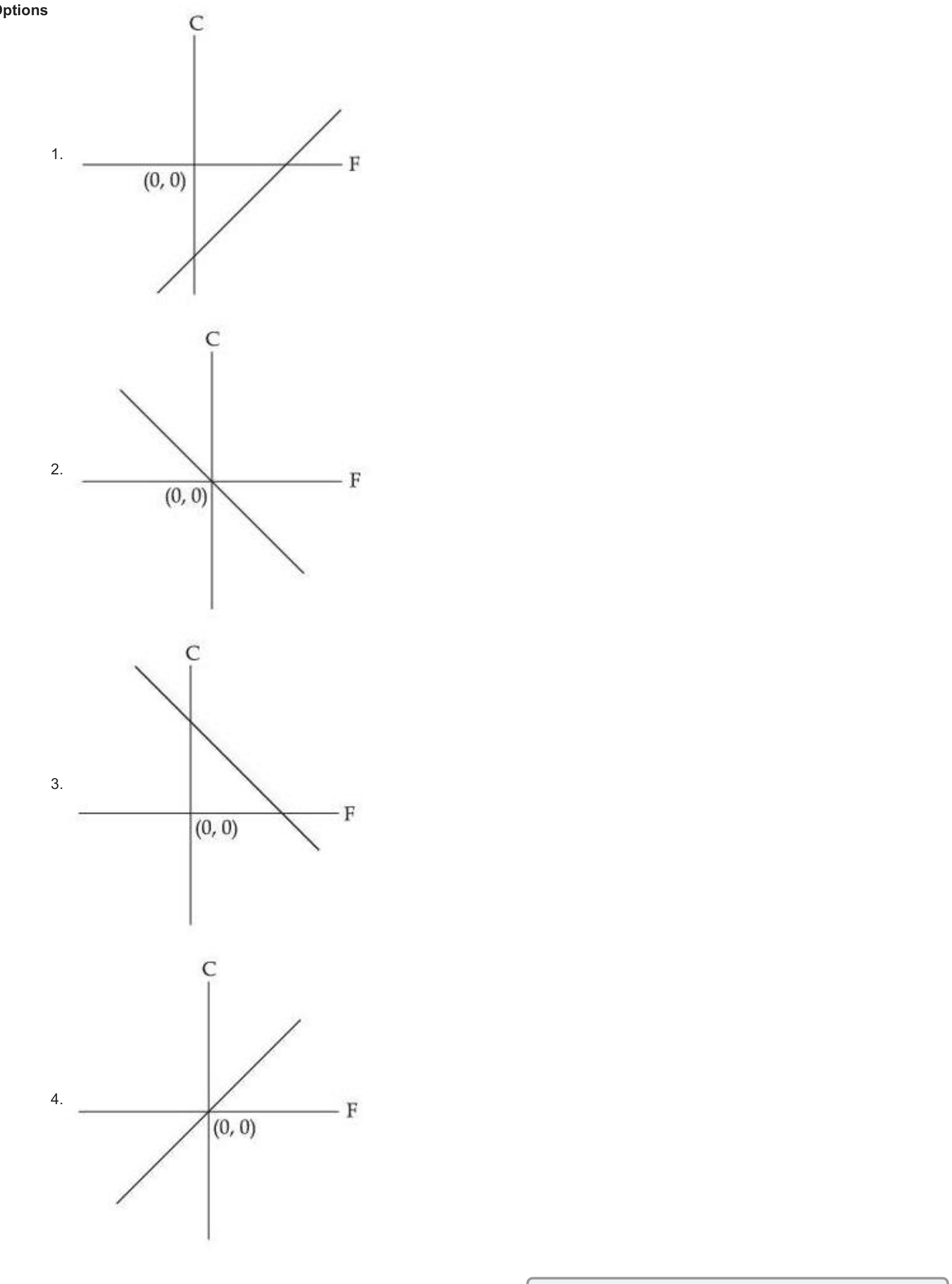
- AGraph with C on the vertical axis and F on the horizontal axis: a straight line of positive slope passing through the intersection of the two axes; the origin '(0, 0)' is printed below the horizontal axis, to the left of the vertical axis
- BGraph with C on the vertical axis and F on the horizontal axis: a straight line of negative slope passing through the intersection of the two axes; the origin '(0, 0)' is printed below the horizontal axis, to the left of the vertical axis
- CGraph with C on the vertical axis and F on the horizontal axis: a straight line of negative slope that meets the vertical axis above the horizontal axis and meets the horizontal axis to the right of the vertical axis; the origin '(0, 0)' is printed below the horizontal axis, just to the right of the vertical axis
- DGraph with C on the vertical axis and F on the horizontal axis: a straight line of positive slope passing through the intersection of the two axes; the origin '(0, 0)' is printed below the horizontal axis, to the right of the vertical axis
View answer or solution
Answer
Graph with C on the vertical axis and F on the horizontal axis: a straight line of positive slope passing through the intersection of the two axes; the origin '(0, 0)' is printed below the horizontal axis, to the left of the vertical axis
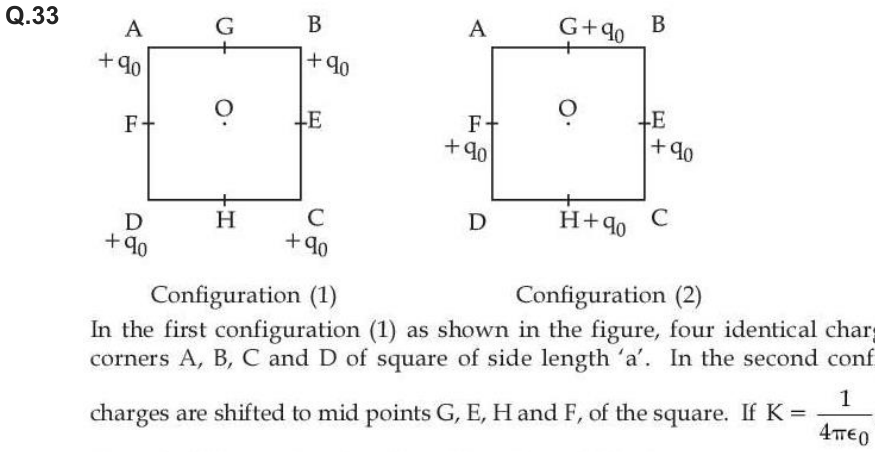
In the first configuration (1) as shown in the figure, four identical charges (q₀) are kept at the corners A, B, C and D of square of side length 'a'. In the second configuration (2), the same charges are shifted to mid points G, E, H and F, of the square. If K = 1/(4πε₀), the difference between the potential energies of configuration (2) and (1) is given by :
- AKq₀²/a (3 − √2)
- BKq₀²/a (3√2 − 2)
- CKq₀²/a (4 − 2√2)
- DKq₀²/a (4√2 − 2)
View answer or solution
Answer
Kq₀²/a (3√2 − 2)
Arrange the following in the ascending order of wavelength (λ) : (A) Microwaves (λ₁) (B) Ultraviolet rays (λ₂) (C) Infrared rays (λ₃) (D) X-rays (λ₄) Choose the most appropriate answer from the options given below :
- Aλ₄ < λ₂ < λ₃ < λ₁
- Bλ₄ < λ₃ < λ₁ < λ₂
- Cλ₃ < λ₄ < λ₂ < λ₁
- Dλ₄ < λ₃ < λ₂ < λ₁
View answer or solution
Answer
λ₄ < λ₂ < λ₃ < λ₁
Magnetic Effects of Current and Magnetism
A long straight wire of a circular cross-section with radius 'a' carries a steady current I. The current I is uniformly distributed across this cross-section. The plot of magnitude of magnetic field B with distance r from the centre of the wire is given by
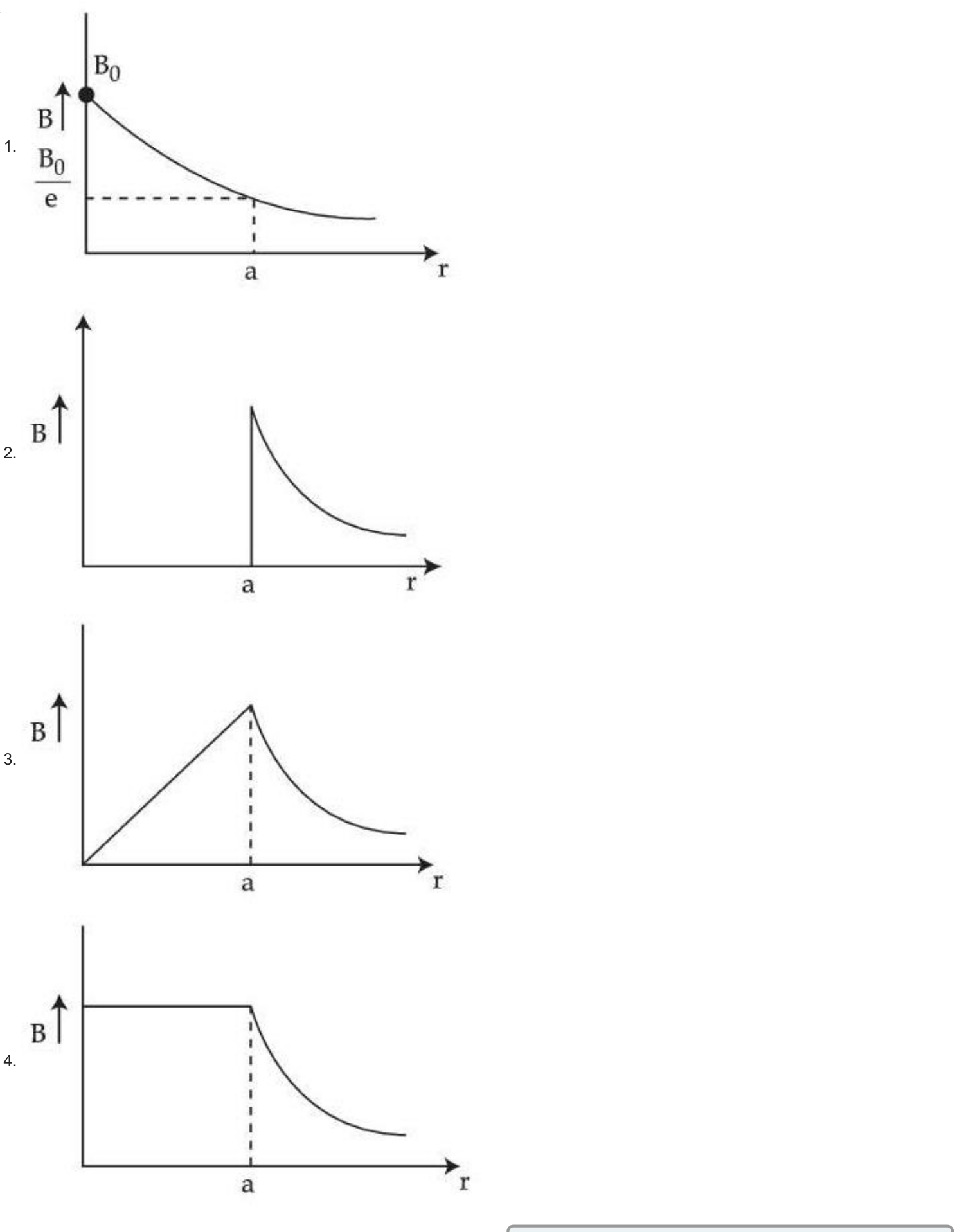
- AGraph: B on the vertical axis against r on the horizontal axis; a marked point B₀ on the B-axis, a curve falling smoothly from B₀ and approaching a lower asymptote, a dotted horizontal line at B₀/e meeting the curve at r = a, and a dashed vertical line dropped from that point to the r-axis at a.
- BGraph: B on the vertical axis against r on the horizontal axis; B stays zero along the axis from the origin up to r = a, where the curve jumps vertically to a maximum, and then falls smoothly towards the r-axis as r increases.
- CGraph: B on the vertical axis against r on the horizontal axis; a straight line rising from the origin to a peak at r = a marked by a dashed vertical line, and then a curve falling smoothly from that peak towards the r-axis.
- DGraph: B on the vertical axis against r on the horizontal axis; a horizontal constant line at a fixed value of B from the origin up to r = a marked by a dashed vertical line, and then a curve falling smoothly from that level towards the r-axis.
View answer or solution
Answer
Graph: B on the vertical axis against r on the horizontal axis; a straight line rising from the origin to a peak at r = a marked by a dashed vertical line, and then a curve falling smoothly from that peak towards the r-axis.
The energy E and momentum p of a moving body of mass m are related by some equation. Given that c represents the speed of light, identify the correct equation
- AE² = pc² + m²c²
- BE² = p²c² + m²c²
- CE² = p²c² + m²c⁴
- DE² = pc² + m²c⁴
View answer or solution
Answer
E² = p²c² + m²c⁴
A solid sphere and a hollow sphere of the same mass and of same radius are rolled on an inclined plane. Let the time taken to reach the bottom by the solid sphere and the hollow sphere be t₁ and t₂, respectively, then
- At₁ = 2t₂
- Bt₁ < t₂
- Ct₁ > t₂
- Dt₁ = t₂
View answer or solution
Answer
t₁ < t₂
Given below are two statements. One is labelled as Assertion (A) and the other is labelled as Reason (R). Assertion (A) : In an insulated container, a gas is adiabatically shrunk to half of its initial volume. The temperature of the gas decreases. Reason (R) : Free expansion of an ideal gas is an irreversible and an adiabatic process. In the light of the above statements, choose the correct answer from the options given below :
- A(A) is false but (R) is true
- BBoth (A) and (R) are true and (R) is the correct explanation of (A)
- CBoth (A) and (R) are true but (R) is NOT the correct explanation of (A)
- D(A) is true but (R) is false
View answer or solution
Answer
(A) is false but (R) is true
Dual Nature of Matter and Radiation
In photoelectric effect, the stopping potential (V₀) v/s frequency (ν) curve is plotted. (h is the Planck's constant and φ₀ is work function of metal ) (A) V₀ v/s ν is linear. (B) The slope of V₀ v/s ν curve = φ₀/h (C) h constant is related to the slope of V₀ v/s ν line. (D) The value of electric charge of electron is not required to determine h using the V₀ v/s ν curve. (E) The work function can be estimated without knowing the value of h. Choose the correct answer from the options given below :
- A(A), (B) and (C) only
- B(D) and (E) only
- C(C) and (D) only
- D(A), (C) and (E) only
View answer or solution
Answer
(A), (C) and (E) only
A solid sphere is rolling without slipping on a horizontal plane. The ratio of the linear kinetic energy of the centre of mass of the sphere and rotational kinetic energy is :
- A4/3
- B3/4
- C2/5
- D5/2
View answer or solution
Answer
5/2
Young's double slit interference apparatus is immersed in a liquid of refractive index 1.44. It has slit separation of 1.5 mm. The slits are illuminated by a parallel beam of light whose wavelength in air is 690 nm. The fringe-width on a screen placed behind the plane of slits at a distance of 0.72 m, will be :
- A0.63 mm
- B0.33 mm
- C0.46 mm
- D0.23 mm
View answer or solution
Answer
0.23 mm
A photograph of a landscape is captured by a drone camera at a height of 18 km. The size of the camera film is 2 cm × 2 cm and the area of the landscape photographed is 400 km². The focal length of the lens in the drone camera is :
- A2.5 cm
- B0.9 cm
- C1.8 cm
- D2.8 cm
View answer or solution
Answer
1.8 cm
The position vector of a moving body at any instant of time is given as r⃗ = (5t² î − 5t ĵ) m. The magnitude and direction of velocity at t = 2s is,
- A5√15 m/s, making an angle of tan⁻¹4 with −ve Y axis
- B5√15 m/s, making an angle of tan⁻¹4 with +ve X axis
- C5√17 m/s, making an angle of tan⁻¹4 with +ve X axis
- D5√17 m/s, making an angle of tan⁻¹4 with −ve Y axis
View answer or solution
Answer
5√17 m/s, making an angle of tan⁻¹4 with −ve Y axis
A particle oscillates along the x-axis according to the law, x(t) = x₀ sin²(t/2) where x₀ = 1 m. The kinetic energy (K) of the particle as a function of x is correctly represented by the graph
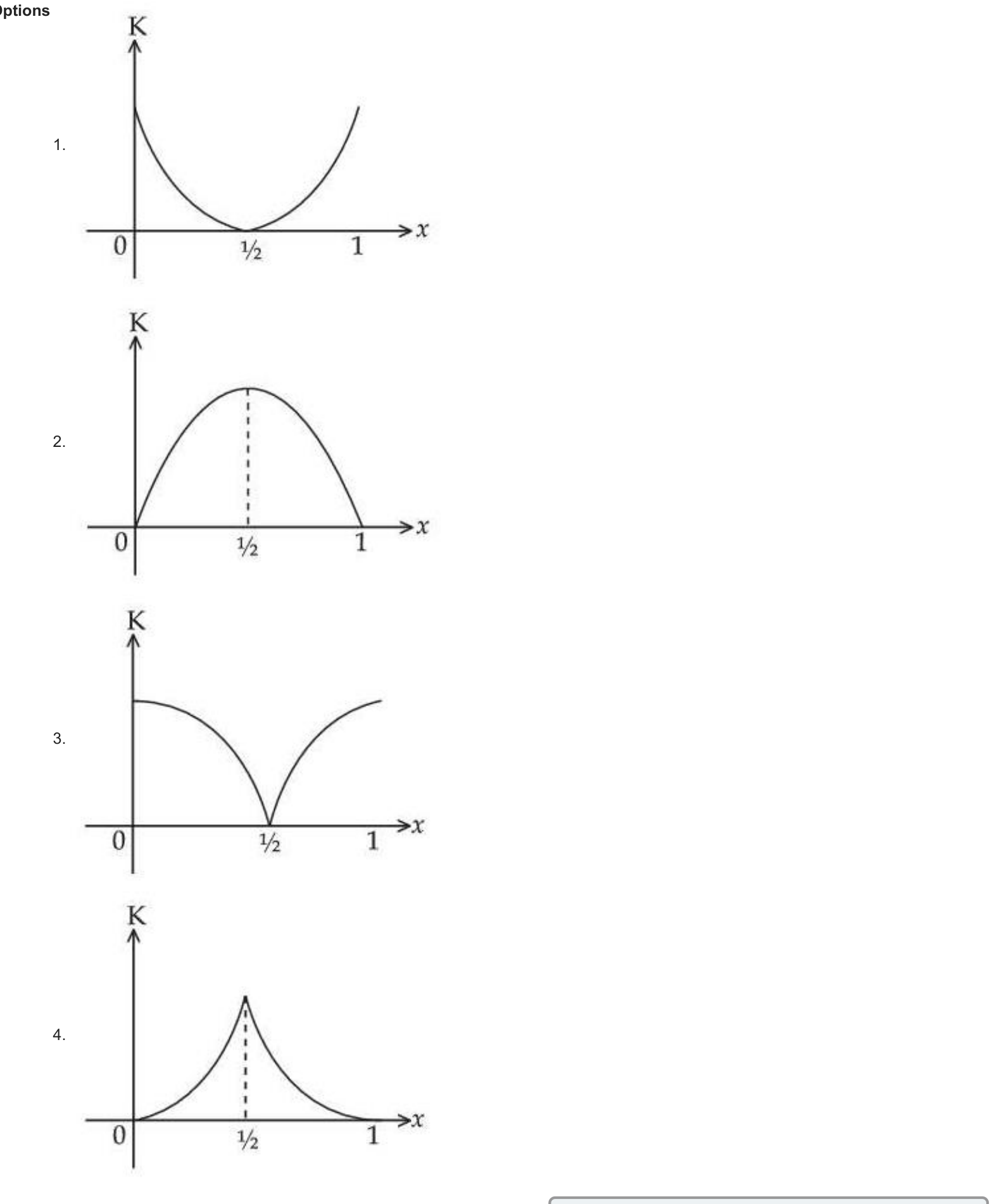
- AGraph: K on the vertical axis against x on the horizontal axis, with 0, ½ and 1 marked on the x-axis; a U-shaped (parabolic) curve starting at a positive value on the K-axis at x = 0, falling to touch the x-axis at x = ½ and rising symmetrically to a positive value at x = 1.
- BGraph: K on the vertical axis against x on the horizontal axis, with 0, ½ and 1 marked on the x-axis; a smooth arch rising from the origin at x = 0 to a rounded maximum at x = ½ (marked by a vertical dashed line) and falling back to zero at x = 1.
- CGraph: K on the vertical axis against x on the horizontal axis, with 0, ½ and 1 marked on the x-axis; a curve starting at a positive value on the K-axis at x = 0, running nearly flat and then falling steeply to a sharp cusp on the x-axis at x = ½, and rising steeply back to a positive value at x = 1.
- DGraph: K on the vertical axis against x on the horizontal axis, with 0, ½ and 1 marked on the x-axis; a curve rising from zero at x = 0 with increasing steepness to a sharp peak at x = ½ (marked by a vertical dashed line) and falling back to zero at x = 1.
View answer or solution
Answer
Graph: K on the vertical axis against x on the horizontal axis, with 0, ½ and 1 marked on the x-axis; a smooth arch rising from the origin at x = 0 to a rounded maximum at x = ½ (marked by a vertical dashed line) and falling back to zero at x = 1.
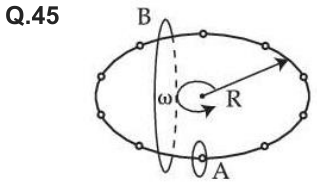
N equally spaced charges each of value q, are placed on a circle of radius R. The circle rotates about its axis with an angular velocity ω as shown in the figure. A bigger Amperian loop B encloses the whole circle where as a smaller Amperian loop A encloses a small segment. The difference between enclosed currents, I_A − I_B, for the given Amperian loops is
- AN/(2π) qω
- B(2π/N) qω
- CN/π qω
- DN²/(2π) qω
View answer or solution
Answer
N/(2π) qω
Acceleration due to gravity on the surface of earth is 'g'. If the diameter of earth is reduced to one third of its original value and mass remains unchanged, then the acceleration due to gravity on the surface of the earth is ________ g.
View answer or solution
Answer
9
Properties of Solids and Liquids
The increase in pressure required to decrease the volume of a water sample by 0.2% is P × 10⁵ Nm⁻². Bulk modulus of water is 2.15 × 10⁹ Nm⁻². The value of P is _______.
View answer or solution
Answer
43
Dual Nature of Matter and Radiation
The ratio of the power of a light source S₁ to that the light source S₂ is 2. S₁ is emitting 2 × 10¹⁵ photons per second at 600 nm. If the wavelength of the source S₂ is 300 nm, then the number of photons per second emitted by S₂ is _______ × 10¹⁴.
View answer or solution
Answer
5
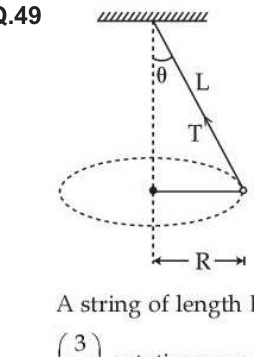
A string of length L is fixed at one end and carries a mass of M at the other end. The mass makes (3/π) rotations per second about the vertical axis passing through end of the string as shown. The tension in the string is ________ ML.
View answer or solution
Answer
36
Magnetic Effects of Current and Magnetism
A tightly wound long solenoid carries a current of 1.5 A. An electron is executing uniform circular motion inside the solenoid with a time period of 75 ns. The number of turns per metre in the solenoid is ________. [Take mass of electron mₑ = 9 × 10⁻³¹ kg, charge of electron |qₑ| = 1.6 × 10⁻¹⁹ C, μ₀ = 4π × 10⁻⁷ N/A², 1 ns = 10⁻⁹ s]
View answer or solution
Answer
250