
// JEE (Main) / 2025
JEE (Main) 2025 Session 1, 23 January 2025, Shift 1 — Paper 1 (B.E / B.Tech) Chemistry
Chemistry · B.E / B.Tech
Work through the questions
25 questions
Take a moment to try each question before opening the available answer or solution.
Organic Compounds Containing Nitrogen
Given below are two statements: Statement I: In Lassaigne's test, the covalent organic molecules are transformed into ionic compounds. Statement II: The sodium fusion extract of an organic compound having N and S gives prussian blue colour with FeSO₄ and Na₄[Fe(CN)₆] In the light of the above statements, choose the correct answer from the options given below
- AStatement I is false but Statement II is true
- BBoth Statement I and Statement II are true
- CStatement I is true but Statement II is false
- DBoth Statement I and Statement II are false
View answer or solution
Answer
Statement I is true but Statement II is false
Redox Reactions and Electrochemistry
FeO₄²⁻ —(+2.0 V)→ Fe³⁺ —(0.8 V)→ Fe²⁺ —(−0.5 V)→ Fe⁰ In the above diagram, the standard electrode potentials are given in volts (over the arrow). The value of E⊖(FeO₄²⁻/Fe²⁺) is

- A2.1 V
- B1.2 V
- C1.4 V
- D1.7 V
View answer or solution
Answer
1.7 V
Organic Compounds Containing Oxygen
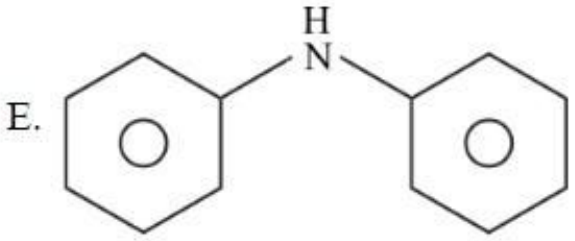
Which among the following react with Hinsberg's reagent? A. [Figure: hexagon with a circle inside it and an NH₂ group attached to the upper-right vertex] B. [Figure: hexagon with a circle inside it and an N(CH₃)₂ group attached to the upper-right vertex] C. CH₃ – NH₂ D. N(CH₃)₃ E. [Figure: two hexagons, each with a circle inside it, bonded to an N that carries an H printed directly above it] Choose the correct answer from the options given below:
- AC and D Only
- BA, B and E Only
- CB and D Only
- DA, C and E Only
View answer or solution
Answer
A, C and E Only
The incorrect statement among the following is
- APH₃ shows lower proton affinity than NH₃.
- BPF₃ exists but NF₅ does not.
- CNO₂ can dimerise easily.
- DSO₂ can act as an oxidizing agent, but not as a reducing agent.
View answer or solution
Answer
SO₂ can act as an oxidizing agent, but not as a reducing agent.
Organic Compounds Containing Oxygen
What amount of bromine will be required to convert 2 g of phenol into 2,4,6-tribromophenol? (Given molar mass in g mol⁻¹ of C, H, O, Br are 12, 1, 16, 80 respectively )
- A20.44 g
- B6.0 g
- C4.0 g
- D10.22 g
View answer or solution
Answer
10.22 g
Organic Compounds Containing Oxygen
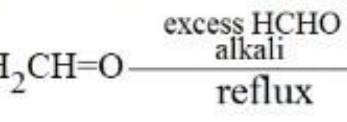
The major product of the following reaction is: CH₃CH₂CH=O —(excess HCHO and alkali above the arrow, reflux below it)→ ?
- ACH₃–C(=CH₂)–CH=O (the C carries a double bond drawn straight down to CH₂)
- BCH₃–C(CH₂–OH)(CH₂–OH)(CH₂–OH) (the C carries three CH₂–OH groups, one on a bond slanting up-right, one on a horizontal bond to the right and one on a bond slanting down-right)
- CCH₃–CH₂–CH₂–OH
- DCH₃–CH(CH₂–OH)–CH=O (the CH carries a vertical bond down to CH₂–OH)
View answer or solution
Answer
CH₃–C(CH₂–OH)(CH₂–OH)(CH₂–OH) (the C carries three CH₂–OH groups, one on a bond slanting up-right, one on a horizontal bond to the right and one on a bond slanting down-right)
Some Basic Principles of Organic Chemistry
The complex that shows Facial - Meridional isomerism is:
- A[Co(NH₃)₄Cl₂]⁺
- B[Co(en)₃]³⁺
- C[Co(NH₃)₃Cl₃]
- D[Co(en)₂Cl₂]⁺
View answer or solution
Answer
[Co(NH₃)₃Cl₃]
Chemical Bonding and Molecular Structure
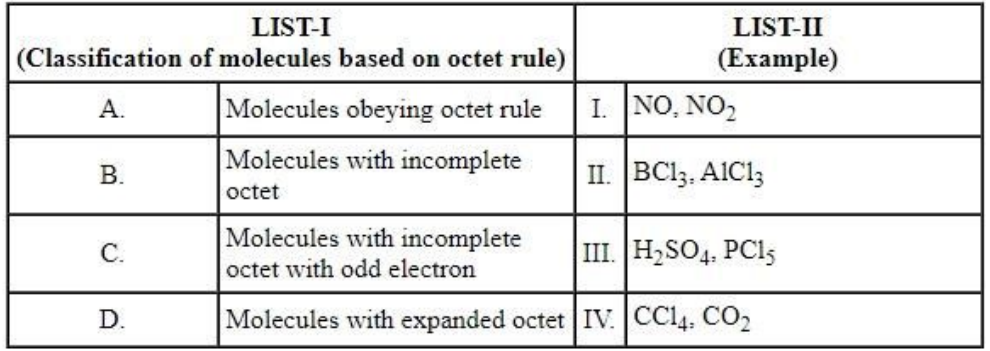
Match the LIST-I with LIST-II LIST-I (Classification of molecules based on octet rule) A. Molecules obeying octet rule B. Molecules with incomplete octet C. Molecules with incomplete octet with odd electron D. Molecules with expanded octet LIST-II (Example) I. NO, NO₂ II. BCl₃, AlCl₃ III. H₂SO₄, PCl₅ IV. CCl₄, CO₂ Choose the correct answer from the options given below:
- AA-IV, B-I, C-III, D-II
- BA-IV, B-II, C-I, D-III
- CA-III, B-II, C-I, D-IV
- DA-II, B-IV, C-III, D-I
View answer or solution
Answer
A-IV, B-II, C-I, D-III
Heat treatment of muscular pain involves radiation of wavelength of about 900 nm. Which spectral line of H atom is suitable for this? Given : Rydberg constant R_H = 10⁵ cm⁻¹ , h = 6.6 × 10⁻³⁴ J s, c = 3 × 10⁸ m/s)
- ABalmer series, ∞ → 2
- BPaschen series, 5 → 3
- CPaschen series, ∞ → 3
- DLyman series, ∞ → 1
View answer or solution
Answer
Paschen series, ∞ → 3
Some Basic Concepts in Chemistry
2.8 × 10⁻³ mol of CO₂ is left after removing 10²¹ molecules from its ‘x’ mg sample. The mass of CO₂ taken initially is Given: N_A = 6.02 × 10²³ mol⁻¹
- A196.2 mg
- B98.3 mg
- C48.2 mg
- D150.4 mg
View answer or solution
Answer
196.2 mg
The correct set of ions (aqueous solution) with same colour from the following is:
- ASc³⁺, Ti³⁺, Cr²⁺
- BV²⁺, Cr³⁺, Mn³⁺
- CTi⁴⁺, V⁴⁺, Mn²⁺
- DZn²⁺, V³⁺, Fe³⁺
View answer or solution
Answer
V²⁺, Cr³⁺, Mn³⁺
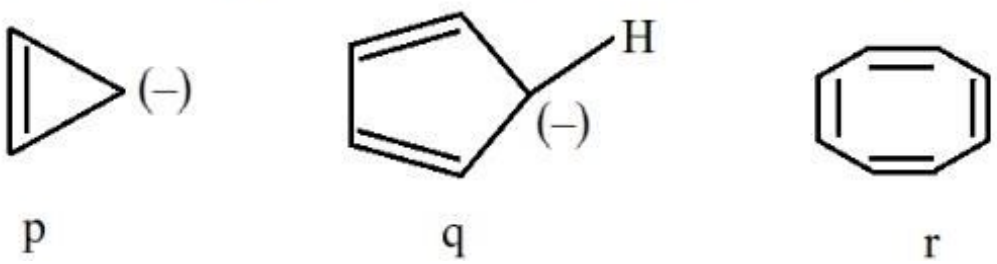
The correct stability order of the following species/molecules is:
- Ar > q > p
- Bp > q > r
- Cq > r > p
- Dq > p > r
View answer or solution
Answer
q > r > p
Organic Compounds Containing Halogens
Match the LIST-I with LIST-II | LIST-I (Name reaction) | LIST-II (Product obtainable) | |---|---| | A. Swarts reaction | I. Ethyl benzene | | B. Sandmeyer’s reaction | II. Ethyl iodide | | C. Wurtz Fittig reaction | III. Cyanobenzene | | D. Finkelstein reaction | IV. Ethyl fluoride | Choose the correct answer from the options given below:
- AA-IV, B-I, C-III, D-II
- BA-II, B-I, C-III, D-IV
- CA-II, B-III, C-I, D-IV
- DA-IV, B-III, C-I, D-II
View answer or solution
Answer
A-IV, B-III, C-I, D-II
Given below are two statements: Statement I: Fructose does not contain an aldehydic group but still reduces Tollen’s reagent Statement II: In the presence of base, fructose undergoes rearrangement to give glucose. In the light of the above statements, choose the correct answer from the options given below
- ABoth Statement I and Statement II are true
- BStatement I is true but Statement II is false
- CBoth Statement I and Statement II are false
- DStatement I is false but Statement II is true
View answer or solution
Answer
Both Statement I and Statement II are true
Classification of Elements and Periodicity in Properties
The element that does not belong to the same period of the remaining elements (modern periodic table) is:
- AOsmium
- BPalladium
- CIridium
- DPlatinum
View answer or solution
Answer
Palladium
Which of the following happens when NH₄OH is added gradually to the solution containing 1M A²⁺ and 1M B³⁺ ions? Given : K_sp[A(OH)₂] = 9 × 10⁻¹⁰ and K_sp[B(OH)₃] = 27 × 10⁻¹⁸ at 298 K.
- AA(OH)₂ will precipitate before B(OH)₃
- BA(OH)₂ and B(OH)₃ will precipitate together
- CB(OH)₃ will precipitate before A(OH)₂
- DBoth A(OH)₂ and B(OH)₃ do not show precipitation with NH₄OH
View answer or solution
Answer
B(OH)₃ will precipitate before A(OH)₂
The d– electronic configuration of an octahedral Co(II) complex having magnetic moment of 3.95 BM is:
- Ae⁴t₂³
- Bt₂g⁶ e_g¹
- Ct₂g³ e_g⁰
- Dt₂g⁵ e_g²
View answer or solution
Answer
t₂g⁵ e_g²
Ice at −5°C is heated to become vapor with temperature of 110°C at atmospheric pressure. The entropy change associated with this process can be obtained from
- A∫_268K^(273K) (C_p,m/T) dT + ΔH_m.fusion/T_f + ΔH_m.vaporisation/T_b + ∫_273K^(373K) (C_p,m dT/T) + ∫_373K^(383K) (C_p,m dT/T)
- B∫_268K^(383K) C_p dT + ΔH_melting/273 + ΔH_boiling/373
- C∫_268K^(273K) C_p,m dT + ΔH_m.fusion/T_f + ΔH_m.vaporisation/T_b + ∫_273K^(373K) C_p,m dT + ∫_373K^(383K) C_p,m dT
- D∫_268K^(383K) C_p dT + q_rev/T
View answer or solution
Answer
∫_268K^(273K) (C_p,m/T) dT + ΔH_m.fusion/T_f + ΔH_m.vaporisation/T_b + ∫_273K^(373K) (C_p,m dT/T) + ∫_373K^(383K) (C_p,m dT/T)
Some Basic Principles of Organic Chemistry
Propane molecule on chlorination under photochemical condition gives two di-chloro products, “x” and “y”. Amongst “x” and “y”, “x” is an optically active molecule. How many tri-chloro products (consider only structural isomers) will be obtained from “x” when it is further treated with chlorine under the photochemical condition?
- A3
- B4
- C2
- D5
View answer or solution
Answer
3
CrCl₃.xNH₃ can exist as a complex. 0.1 molal aqueous solution of this complex shows a depression in freezing point of 0.558°C. Assuming 100% ionisation of this complex and coordination number of Cr is 6, the complex will be (Given K_f = 1.86 K kg mol⁻¹)
- A[Cr(NH₃)₃Cl₃]
- B[Cr(NH₃)₅Cl]Cl₂
- C[Cr(NH₃)₄Cl₂]Cl
- D[Cr(NH₃)₆]Cl₃
View answer or solution
Answer
[Cr(NH₃)₅Cl]Cl₂
If 1 mM solution of ethylamine produces pH = 9, then the ionization constant (K_b) of ethylamine is 10⁻ˣ. The value of x is ______ (nearest integer). [The degree of ionization of ethylamine can be neglected with respect to unity.]
View answer or solution
Answer
7
The standard enthalpy and standard entropy of decomposition of N₂O₄ to NO₂ are 55.0 kJ mol⁻¹ and 175.0 J/K/mol respectively. The standard free energy change for this reaction at 25°C in J mol⁻¹ is ______ (Nearest integer)
View answer or solution
Answer
2850
Some Basic Concepts in Chemistry
During “S” estimation, 160 mg of an organic compound gives 466 mg of barium sulphate. The percentage of Sulphur in the given compound is ______%. (Given molar mass in g mol⁻¹ of Ba : 137, S : 32, O : 16)
View answer or solution
Answer
40
Some Basic Concepts in Chemistry
Consider the following sequence of reactions to produce major product (A) (i)Br₂, Fe (ii)Sn,HCl (iii)NaNO₂,HCl,273K (iv)H₃PO₂,H₂O → (A) Major Product Molar mass of product (A) is ______ g mol⁻¹. (Given molar mass in g mol⁻¹ of C : 12, H: 1, O :16, Br : 80, N : 14, P:31)
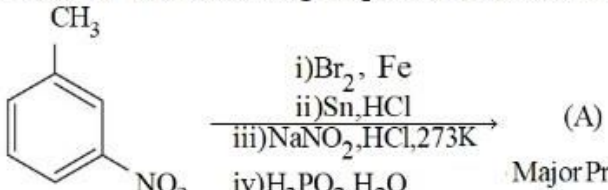
View answer or solution
Answer
171
For the thermal decomposition of N₂O₅(g) at constant volume, the following table can be formed, for the reaction mentioned below. 2N₂O₅(g) → 2N₂O₄(g) + O₂(g) | Sr.No | Time/s | Total pressure/(atm) | |---|---|---| | 1 | 0 | 0.6 | | 2 | 100 | ‘x’ | x = ______ × 10⁻³ atm [nearest integer] Given : Rate constant for the reaction is 4.606 × 10⁻² s⁻¹.
View answer or solution
Answer
897