
// JEE (Main) / 2024
JEE (Main) 2024 Session 2, 9 April 2024, Shift 1 — Paper 1 (B.E / B.Tech) Chemistry
Chemistry · B.E / B.Tech
Work through the questions
30 questions
Take a moment to try each question before opening the available answer or solution.
[Figure] ⟶[AlCl₃] A ⟶[Zn − Hg / HCl] B ⟶[Conc. H₂SO₄] C What is the structure of C ?

- ADrawn structure: a benzene ring (drawn with a circle inside) fused to a six-membered carbocycle; the second ring carries a C=O - the carbon next to the ring-fusion carbon is double bonded to 'O' drawn above it (1-tetralone).
- BDrawn structure: a benzene ring (drawn with a circle inside) fused to a six-membered carbocycle; the C=O is drawn at the carbon one step away from the ring-fusion carbon, the double bond slanting up-right to 'O' (2-tetralone).
- CDrawn structure: a benzene ring (drawn with a circle inside) bonded to a 'C' that carries a double bond up to 'O'; from that C a two-carbon zigzag chain runs to a second 'C' carrying a double bond down to 'O' and a single bond up-right to 'OH' (C₆H₅–CO–CH₂–CH₂–COOH).
- DDrawn structure: a benzene ring (drawn with a circle inside) bonded to 'CH₂'; from CH₂ a two-carbon zigzag chain runs to a 'C' carrying a double bond down to 'O' and a single bond up-right to 'OH' (C₆H₅–CH₂–CH₂–CH₂–COOH).
View answer or solution
Answer
Drawn structure: a benzene ring (drawn with a circle inside) fused to a six-membered carbocycle; the second ring carries a C=O - the carbon next to the ring-fusion carbon is double bonded to 'O' drawn above it (1-tetralone).
Chemical Bonding and Molecular Structure
Relative stability of the contributing structures is : (I) CH₂=CH–C(=O)–H ↔ (II) ⁺CH₂–CH=C(–O⁻)–H ↔ (III) ⁻CH₂–CH=C(–O⁺)–H
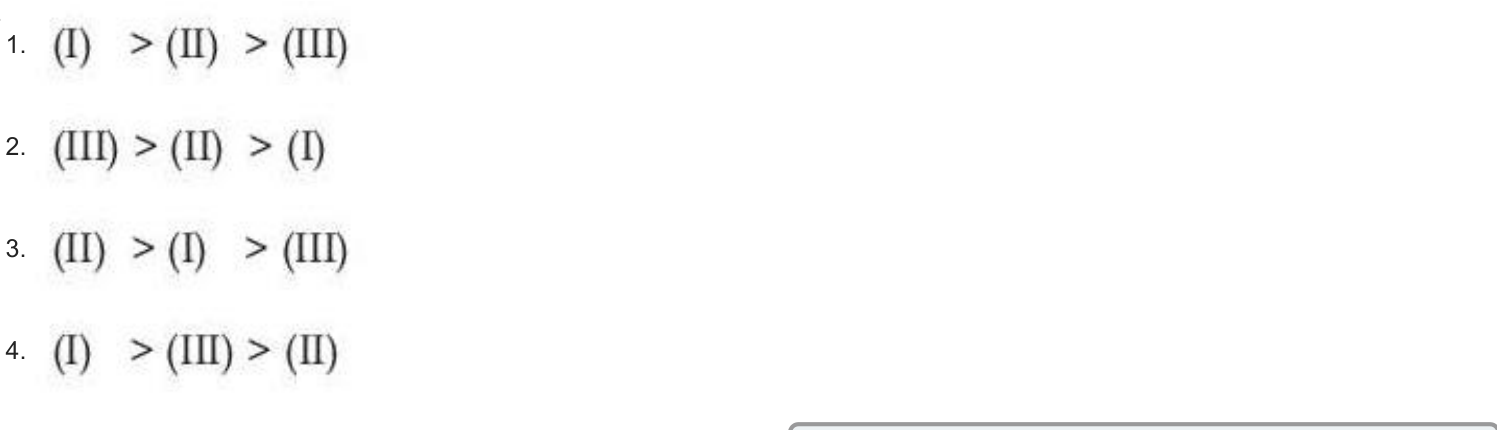
- A(I) > (II) > (III)
- B(III) > (II) > (I)
- C(II) > (I) > (III)
- D(I) > (III) > (II)
View answer or solution
Answer
(I) > (II) > (III)
Redox Reactions and Electrochemistry
The molar conductivity for electrolytes A and B are plotted against C^1/2 as shown below. Electrolytes A and B respectively are : [Figure]
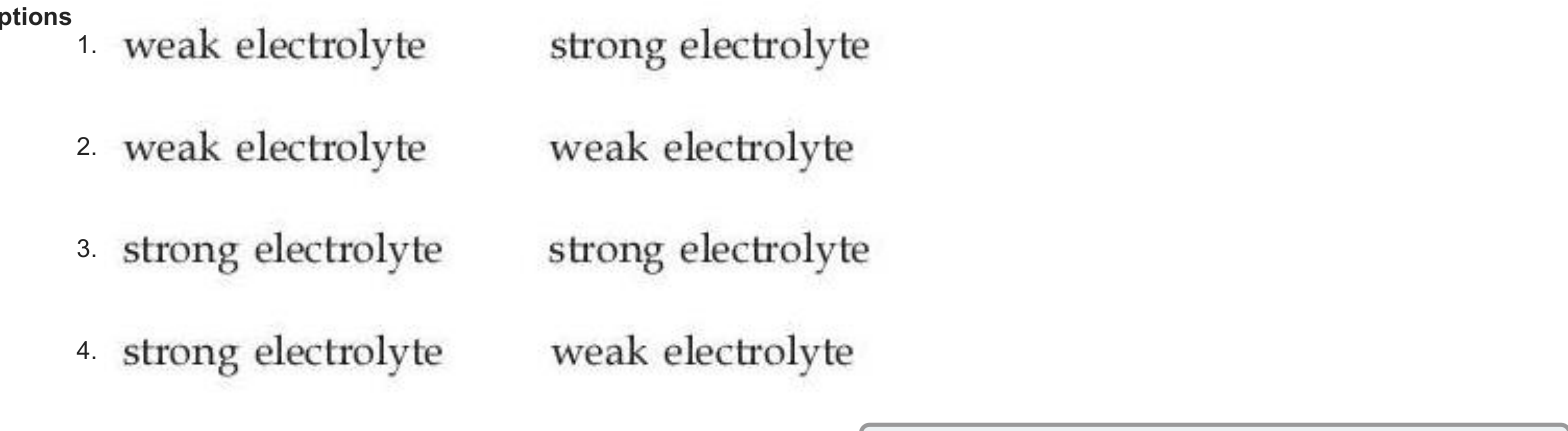
- AA: weak electrolyte; B: strong electrolyte
- BA: weak electrolyte; B: weak electrolyte
- CA: strong electrolyte; B: strong electrolyte
- DA: strong electrolyte; B: weak electrolyte
View answer or solution
Answer
A: weak electrolyte; B: strong electrolyte
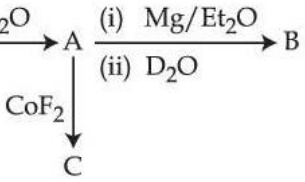
In the following sequence of reaction, the major products B and C respectively are : [Figure] ⟶[Na/Et₂O] A ⟶[(i) Mg/Et₂O, (ii) D₂O] B; A ⟶[CoF₂] C
- ADrawn structures: 'D' on each of two opposite carbons of a four-membered ring (a diamond) that is drawn with an extra vertical bond joining its top and bottom vertices; and 'F' on each of the two outer carbons of two four-membered rings (diamonds) joined to each other by a single bond.
- BDrawn structures: 'D' on the leftmost carbon of a four-membered ring (diamond) that is joined by a single bond to a second four-membered ring (diamond) carrying 'D' on its rightmost carbon; and 'F' on each of the two outer carbons of two four-membered rings (diamonds) joined by a single bond.
- CDrawn structures: 'D' on each of two opposite carbons of a single four-membered ring (diamond); and 'F' on each of two opposite carbons of a single four-membered ring (diamond).
- DDrawn structures: a four-membered ring (a diamond) drawn with an extra vertical bond joining its top and bottom vertices, with no atom printed on it; and 'F' on each of two opposite carbons of a single four-membered ring (diamond).
View answer or solution
Answer
Drawn structures: 'D' on the leftmost carbon of a four-membered ring (diamond) that is joined by a single bond to a second four-membered ring (diamond) carrying 'D' on its rightmost carbon; and 'F' on each of the two outer carbons of two four-membered rings (diamonds) joined by a single bond.
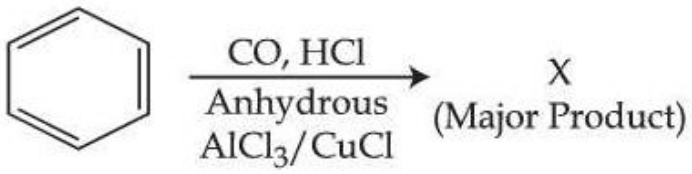
Identify major product “X” formed in the following reaction : [Figure] ⟶[CO, HCl / Anhydrous AlCl₃/CuCl] X (Major Product)
- ADrawn structure: a benzene ring (drawn with three alternating double bonds) bonded to a 'C' that carries a double bond up to 'O' and a single bond down-right to 'Cl' (C₆H₅–CO–Cl).
- BDrawn structure: a benzene ring (drawn with three alternating double bonds) bonded to 'CH₂Cl' (C₆H₅–CH₂Cl).
- CDrawn structure: a benzene ring (drawn with three alternating double bonds) bonded to 'CHO' (C₆H₅–CHO).
- DDrawn structure: a 'C' with a double bond up to 'O', bonded on the left to a benzene ring and on the right to a second benzene ring, both rings drawn with three alternating double bonds ((C₆H₅)₂CO).
View answer or solution
Answer
Drawn structure: a benzene ring (drawn with three alternating double bonds) bonded to 'CHO' (C₆H₅–CHO).
Some Basic Principles of Organic Chemistry
Given below are two statements : one is labelled as Assertion (A) and the other is labelled as Reason (R). Assertion (A) : S_N2 reaction of C₆H₅CH₂Br occurs more readily than the S_N2 reaction of CH₃CH₂Br. Reason (R) : The partially bonded unhybridized p-orbital that develops in the trigonal bipyramidal transition state is stabilized by conjugation with the phenyl ring. In the light of the above statements, choose the most appropriate answer from the options given below :
- ABoth (A) and (R) are correct and (R) is the correct explanation of (A)
- BBoth (A) and (R) are correct but (R) is not the correct explanation of (A)
- C(A) is correct but (R) is not correct
- D(A) is not correct but (R) is correct
View answer or solution
Answer
Both (A) and (R) are correct and (R) is the correct explanation of (A)
Chemical Bonding and Molecular Structure
Given below are two statements : one is labelled as Assertion (A) and the other is labelled as Reason (R). Assertion (A) : Both rhombic and monoclinic sulphur exist as S₈ while oxygen exists as O₂. Reason (R) : Oxygen forms pπ − pπ multiple bonds with itself and other elements having small size and high electronegativity like C, N, which is not possible for sulphur. In the light of the above statements, choose the most appropriate answer from the options given below :
- ABoth (A) and (R) are correct and (R) is the correct explanation of (A)
- B(A) is not correct but (R) is correct
- C(A) is correct but (R) is not correct
- DBoth (A) and (R) are correct but (R) is not the correct explanation of (A)
View answer or solution
Answer
(A) is correct but (R) is not correct
The F⁻ ions make the enamel on teeth much harder by converting hydroxyapatite (the enamel on the surface of teeth) into much harder fluoroapatite having the formula.
- A[3(Ca₃(PO₄)₃)·CaF₂]
- B[3(Ca₂(PO₄)₂)·Ca(OH)₂]
- C[3(Ca₃(PO₄)₂)·Ca(OH)₂]
- D[3(Ca₃(PO₄)₂)·CaF₂]
View answer or solution
Answer
[3(Ca₃(PO₄)₂)·CaF₂]
Classification of Elements and Periodicity in Properties
Given below are two statements : Statement (I) : The oxidation state of an element in a particular compound is the charge acquired by its atom on the basis of electron gain enthalpy consideration from other atoms in the molecule. Statement (II) : pπ − pπ bond formation is more prevalent in second period elements over other periods. In the light of the above statements, choose the most appropriate answer from the options given below :
- ABoth Statement I and Statement II are correct
- BStatement I is incorrect but Statement II is correct
- CStatement I is correct but Statement II is incorrect
- DBoth Statement I and Statement II are incorrect
View answer or solution
Answer
Statement I is incorrect but Statement II is correct
The electronic configuration of Cu(II) is 3d⁹ whereas that of Cu(I) is 3d¹⁰. Which of the following is correct ?
- ACu(I) and Cu(II) are equally stable
- BStability of Cu(I) and Cu(II) depends on nature of copper salts
- CCu(II) is more stable
- DCu(II) is less stable
View answer or solution
Answer
Cu(II) is more stable
Chemical Bonding and Molecular Structure
In which one of the following pairs the central atoms exhibit sp² hybridization ?
- ANH₂⁻ and H₂O
- BNH₂⁻ and BF₃
- CBF₃ and NO₂⁻
- DH₂O and NO₂
View answer or solution
Answer
BF₃ and NO₂⁻
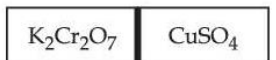
0.05M CuSO₄ when treated with 0.01M K₂Cr₂O₇ gives green colour solution of Cu₂Cr₂O₇. The two solutions are separated as shown below : [SPM : Semi Permeable Membrane] [Figure] Due to osmosis :
- AMolarity of CuSO₄ solution is lowered.
- BGreen colour formation observed on side Y.
- CGreen colour formation observed on side X.
- DMolarity of K₂Cr₂O₇ solution is lowered.
View answer or solution
Answer
Molarity of CuSO₄ solution is lowered.
Chemical Bonding and Molecular Structure
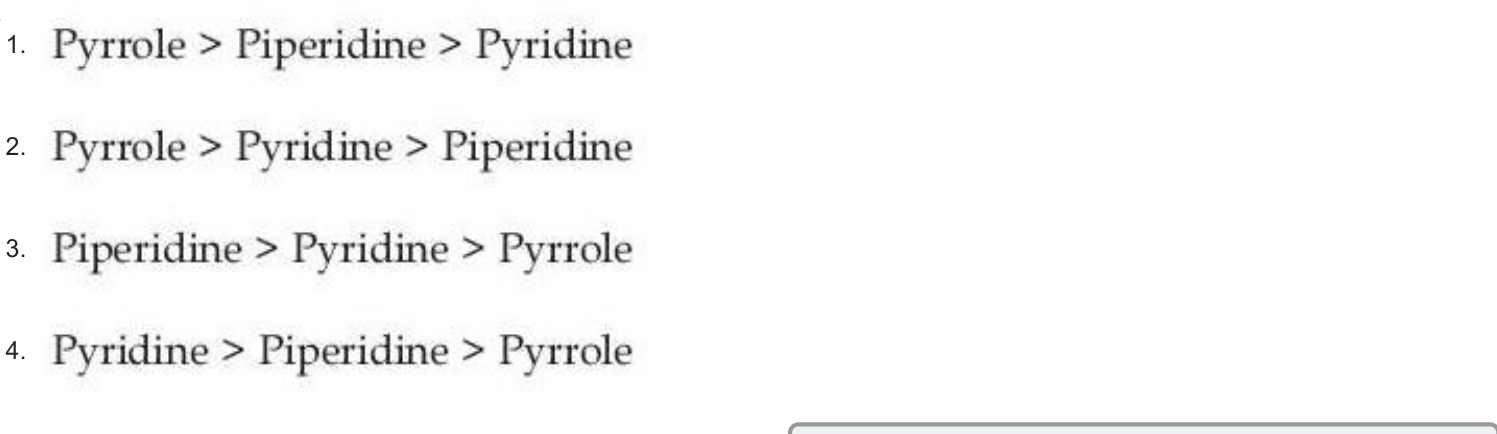
Correct order of basic strength of Pyrrole [Figure], Pyridine [Figure] and Piperidine [Figure] is :
- APyrrole > Piperidine > Pyridine
- BPyrrole > Pyridine > Piperidine
- CPiperidine > Pyridine > Pyrrole
- DPyridine > Piperidine > Pyrrole
View answer or solution
Answer
Piperidine > Pyridine > Pyrrole
On reaction of Lead Sulphide with dilute nitric acid which of the following is not formed ?
- ALead nitrate
- BNitric oxide
- CNitrous oxide
- DSulphur
View answer or solution
Answer
Nitrous oxide
Principles Related to Practical Chemistry
Identify the incorrect statements regarding primary standard of titrimetric analysis. (A) It should be purely available in dry form. (B) It should not undergo chemical change in air. (C) It should be hygroscopic and should react with another chemical instantaneously and stoichiometrically. (D) It should be readily soluble in water. (E) KMnO₄ & NaOH can be used as primary standard. Choose the correct answer from the options given below :
- A(C) and (D) only
- B(B) and (E) only
- C(C) and (E) only
- D(A) and (B) only
View answer or solution
Answer
(C) and (E) only
Given below are two statements : one is labelled as Assertion (A) and the other is labelled as Reason (R). Assertion (A) : The total number of geometrical isomers shown by [Co(en)₂Cl₂]⁺ complex ion is three. Reason (R) : [Co(en)₂Cl₂]⁺ complex ion has an octahedral geometry. In the light of the above statements, choose the most appropriate answer from the options given below :
- A(A) is not correct but (R) is correct
- BBoth (A) and (R) are correct and (R) is the correct explanation of (A)
- CBoth (A) and (R) are correct but (R) is not the correct explanation of (A)
- D(A) is correct but (R) is not correct
View answer or solution
Answer
(A) is not correct but (R) is correct
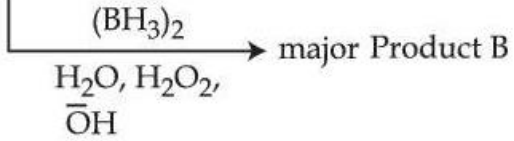
Identify the product A and product B in the following set of reactions. [Figure]
- AA - CH₃CH₂CH₃; B - CH₃CH₂CH₃
- BA - CH₃CH₂CH₂–OH; B - CH₃CH₂CH₂–OH
- CA - CH₃–CH–CH₃ with a vertical bond drawn from the middle carbon down to 'OH'; B - CH₃CH₂CH₂–OH
- DA - CH₃CH₂CH₂–OH; B - CH₃–CH–CH₃ with a vertical bond drawn from the middle carbon down to 'OH'
View answer or solution
Answer
A - CH₃–CH–CH₃ with a vertical bond drawn from the middle carbon down to 'OH'; B - CH₃CH₂CH₂–OH
Compare the energies of following sets of quantum numbers for multielectron system. (A) n = 4, l = 1 (B) n = 4, l = 2 (C) n = 3, l = 1 (D) n = 3, l = 2 (E) n = 4, l = 0 Choose the correct answer from the options given below :
- A(E) < (C) < (D) < (A) < (B)
- B(C) < (E) < (D) < (A) < (B)
- C(E) > (C) > (A) > (D) > (B)
- D(B) > (A) > (C) > (E) > (D)
View answer or solution
Answer
(C) < (E) < (D) < (A) < (B)
Purification and Characterisation of Organic Compounds
Methods used for purification of organic compounds are based on :
- Aneither on nature of compound nor on the impurity present.
- Bnature of compound and presence of impurity.
- Cpresence of impurity only.
- Dnature of compound only.
View answer or solution
Answer
nature of compound and presence of impurity.
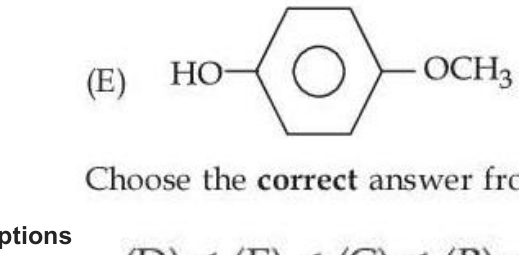
For the given compounds, the correct order of increasing pKₐ value : Choose the correct answer from the options given below :
- A(D) < (E) < (C) < (B) < (A)
- B(B) < (D) < (A) < (C) < (E)
- C(E) < (D) < (B) < (A) < (C)
- D(E) < (D) < (C) < (B) < (A)
View answer or solution
Answer
(B) < (D) < (A) < (C) < (E)
Chemical Bonding and Molecular Structure
The total number of species from the following in which one unpaired electron is present, is ________. N₂, O₂, C₂⁻, O₂⁻, O₂²⁻, H₂⁺, CN⁻, He₂⁺
View answer or solution
Answer
4
Some Basic Principles of Organic Chemistry
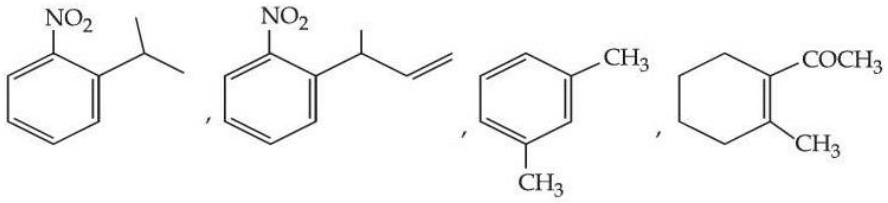
How many compounds among the following compounds show inductive, mesomeric as well as hyperconjugation effects ?
View answer or solution
Answer
4
Some Basic Concepts in Chemistry
Molarity (M) of an aqueous solution containing x g of anhyd. CuSO₄ in 500 mL solution at 32 °C is 2 × 10⁻¹ M. Its molality will be ________ × 10⁻³ m. (nearest integer). [Given density of the solution = 1.25 g/mL]
View answer or solution
Answer
164
When equal volume of 1M HCl and 1M H₂SO₄ are separately neutralised by excess volume of 1M NaOH solution. x and y kJ of heat is liberated respectively. The value of y/x is ________.
View answer or solution
Answer
2
Number of ambidentate ligands among the following is ________. NO₂⁻, SCN⁻, C₂O₄²⁻, NH₃, CN⁻, SO₄²⁻, H₂O.
View answer or solution
Answer
3
Redox Reactions and Electrochemistry
The standard reduction potentials at 298 K for the following half cells are given below : Cr₂O₇²⁻ + 14H⁺ + 6e⁻ → 2Cr³⁺ + 7H₂O, E° = 1.33V Fe³⁺(aq) + 3e⁻ → Fe E° = −0.04V Ni²⁺(aq) + 2e⁻ → Ni E° = −0.25V Ag⁺(aq) + e⁻ → Ag E° = 0.80V Au³⁺(aq) + 3e⁻ → Au E° = 1.40V Consider the given electrochemical reactions, The number of metal(s) which will be oxidized be Cr₂O₇²⁻, in aqueous solution is ________.
View answer or solution
Answer
3
Total number of essential amino acid among the given list of amino acids is ________. Arginine, Phenylalanine, Aspartic acid, Cysteine, Histidine, Valine, Proline
View answer or solution
Answer
4
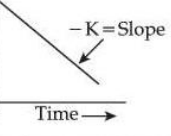
Given below are two statements : Statement I : The rate law for the reaction A + B → C is rate (r) = k [A]²[B]. When the concentration of both A and B is doubled, the reaction rate is increased "x" times. Statement II : The figure is showing "the variation in concentration against time plot" for a "y" order reaction. The Value of x + y is ________.
View answer or solution
Answer
8
Number of colourless lanthanoid ions among the following is ________. Eu³⁺, Lu³⁺, Nd³⁺, La³⁺, Sm³⁺
View answer or solution
Answer
2
The heat of solution of anhydrous CuSO₄ and CuSO₄·5H₂O are − 70 kJ mol⁻¹ and + 12 kJ mol⁻¹ respectively. The heat of hydration of CuSO₄ to CuSO₄·5H₂O is − x kJ. The value of x is ________. (nearest integer).
View answer or solution
Answer
82