
// JEE (Main) / 2024
JEE (Main) 2024 Session 2, 9 April 2024, Shift 1 — Paper 1 (B.E / B.Tech) Mathematics
Mathematics · B.E / B.Tech
Work through the questions
30 questions
Take a moment to try each question before opening the available answer or solution.
The solution of the differential equation (x² + y²)dx − 5xy dy = 0, y(1) = 0, is :
- A|x² − 2y²|⁶ = x
- B|x² − 2y²|⁵ = x²
- C|x² − 4y²|⁵ = x²
- D|x² − 4y²|⁶ = x
View answer or solution
Answer
|x² − 4y²|⁵ = x²
Let f(x) = ax³ + bx² + cx + 41 be such that f(1) = 40, f′(1) = 2 and f″(1) = 4. Then a² + b² + c² is equal to :
- A51
- B62
- C54
- D73
View answer or solution
Answer
51
Let f(x) = x² + 9, g(x) = x/(x − 9) and a = fog(10), b = gof(3). If e and l denote the eccentricity and the length of the latus rectum of the ellipse x²/a + y²/b = 1, then 8e² + l² is equal to.
- A16
- B6
- C8
- D12
View answer or solution
Answer
8
Complex Numbers and Quadratic Equations
Let α, β be the roots of the equation x² + 2√2 x − 1 = 0. The quadratic equation, whose roots are α⁴ + β⁴ and (1/10)(α⁶ + β⁶), is :
- Ax² − 195x + 9506 = 0
- Bx² − 190x + 9466 = 0
- Cx² − 195x + 9466 = 0
- Dx² − 180x + 9506 = 0
View answer or solution
Answer
x² − 195x + 9506 = 0
The parabola y² = 4x divides the area of the circle x² + y² = 5 in two parts. The area of the smaller part is equal to :
- A1/3 + √5 sin⁻¹(2/√5)
- B1/3 + 5 sin⁻¹(2/√5)
- C2/3 + √5 sin⁻¹(2/√5)
- D2/3 + 5 sin⁻¹(2/√5)
View answer or solution
Answer
2/3 + 5 sin⁻¹(2/√5)
Let the line L intersect the lines x − 2 = −y = z − 1, 2(x + 1) = 2(y − 1) = z + 1 and be parallel to the line (x − 2)/3 = (y − 1)/1 = (z − 2)/2. Then which of the following points lies on L?
- A(−1/3, 1, 1)
- B(−1/3, 1, −1)
- C(−1/3, −1, −1)
- D(−1/3, −1, 1)
View answer or solution
Answer
(−1/3, 1, −1)
Let OA⃗ = 2a⃗, OB⃗ = 6a⃗ + 5b⃗ and OC⃗ = 3b⃗, where O is the origin. If the area of the parallelogram with adjacent sides OA⃗ and OC⃗ is 15 sq. units, then the area (in sq. units) of the quadrilateral OABC is equal to :
- A35
- B40
- C32
- D38
View answer or solution
Answer
35
The solution curve, of the differential equation 2y dy/dx + 3 = 5 dy/dx, passing through the point (0, 1) is a conic, whose vertex lies on the line :
- A2x + 3y = −6
- B2x + 3y = 9
- C2x + 3y = −9
- D2x + 3y = 6
View answer or solution
Answer
2x + 3y = 9
A variable line L passes through the point (3, 5) and intersects the positive coordinate axes at the points A and B. The minimum area of the triangle OAB, where O is the origin, is :
- A30
- B25
- C40
- D35
View answer or solution
Answer
30
The shortest distance between the lines (x − 3)/4 = (y + 7)/(−11) = (z − 1)/5 and (x − 5)/3 = (y − 9)/(−6) = (z + 2)/1 is :
- A187/√563
- B185/√563
- C179/√563
- D178/√563
View answer or solution
Answer
187/√563
Binomial Theorem and Its Simple Applications
The coefficient of x⁷⁰ in x²(1 + x)⁹⁸ + x³(1 + x)⁹⁷ + x⁴(1 + x)⁹⁶ + … + x⁵⁴(1 + x)⁴⁶ is ⁹⁹C_p − ⁴⁶C_q. Then a possible value of p + q is :
- A68
- B61
- C55
- D83
View answer or solution
Answer
83
Let λ, μ ∈ ℝ. If the system of equations 3x + 5y + λz = 3 7x + 11y − 9z = 2 97x + 155y − 189z = μ has infinitely many solutions, then μ + 2λ is equal to :
- A22
- B25
- C24
- D27
View answer or solution
Answer
25
If the sum of the series 1/(1·(1 + d)) + 1/((1 + d)(1 + 2d)) + … + 1/((1 + 9d)(1 + 10d)) is equal to 5, then 50d is equal to :
- A20
- B5
- C10
- D15
View answer or solution
Answer
5
Let |cos θ cos(60 − θ) cos(60 + θ)| ≤ 1/8, θ ∈ [0, 2π]. Then, the sum of all θ ∈ [0, 2π], where cos 3θ attains its maximum value, is :
- A9π
- B6π
- C15π
- D18π
View answer or solution
Answer
6π
Let ∫ (2 − tan x)/(3 + tan x) dx = (1/2)(αx + logₑ|β sin x + γ cos x|) + C, where C is the constant of integration. Then α + γ/β is equal to :
- A3
- B7
- C4
- D1
View answer or solution
Answer
4
The frequency distribution of the age of students in a class of 40 students is given below. | Age | 15 | 16 | 17 | 18 | 19 | 20 | |---|---|---|---|---|---|---| | No of Students | 5 | 8 | 5 | 12 | x | y | If the mean deviation about the median is 1.25, then 4x + 5y is equal to :
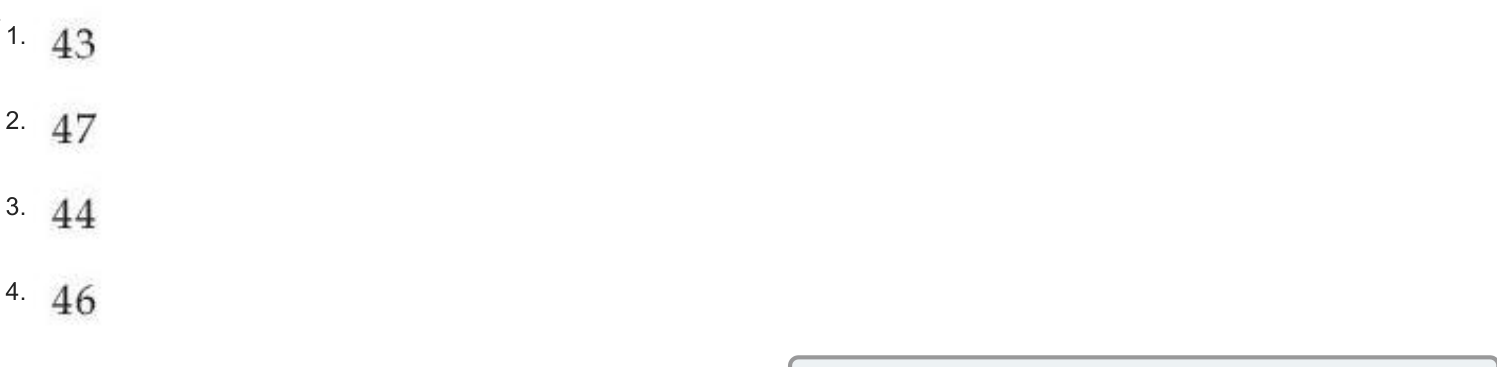
- A43
- B47
- C44
- D46
View answer or solution
Answer
44
A ray of light coming from the point P(1, 2) gets reflected from the point Q on the x-axis and then passes through the point R(4, 3). If the point S(h, k) is such that PQRS is a parallelogram, then hk² is equal to :
- A90
- B80
- C70
- D60
View answer or solution
Answer
70
If the domain of the function f(x) = sin⁻¹((x − 1)/(2x + 3)) is ℝ − (α, β), then 12αβ is equal to :
- A32
- B24
- C40
- D36
View answer or solution
Answer
32
Let three vectors a⃗ = αî + 4ĵ + 2k̂, b⃗ = 5î + 3ĵ + 4k̂, c⃗ = xî + yĵ + zk̂ form a triangle such that c⃗ = a⃗ − b⃗ and the area of the triangle is 5√6. If α is a positive real number, then |c⃗|² is equal to :
- A14
- B10
- C12
- D16
View answer or solution
Answer
14
Let a circle passing through (2, 0) have its centre at the point (h, k). Let (x_c, y_c) be the point of intersection of the lines 3x+5y=1 and (2+c)x+5c²y=1. If h = lim_(c→1) x_c and k = lim_(c→1) y_c, then the equation of the circle is :
- A25x² + 25y² − 20x + 2y − 60 = 0
- B25x² + 25y² − 2x + 2y − 60 = 0
- C5x² + 5y² − 4x − 2y − 12 = 0
- D5x² + 5y² − 4x + 2y − 12 = 0
View answer or solution
Answer
25x² + 25y² − 20x + 2y − 60 = 0
Complex Numbers and Quadratic Equations
The sum of the square of the modulus of the elements in the set {z = a + ib : a, b ∈ ℤ, z ∈ ℂ, |z − 1| ≤ 1, |z − 5| ≤ |z − 5i|} is ________.
View answer or solution
Answer
9
Let A be a non-singular matrix of order 3. If det(3adj(2adj((det A)A))) = 3⁻¹³ · 2⁻¹⁰ and det(3adj(2A)) = 2ᵐ · 3ⁿ, then |3m + 2n| is equal to ________.
View answer or solution
Answer
14
Let A = {2, 3, 6, 7} and B = {4, 5, 6, 8}. Let R be a relation defined on A × B by (a₁, b₁) R (a₂, b₂) if and only if a₁ + a₂ = b₁ + b₂. Then the number of elements in R is ________.
View answer or solution
Answer
25
If a function f satisfies f(m + n) = f(m) + f(n) for all m, n ∈ N and f(1) = 1, then the largest natural number λ such that ∑_(k=1)^2022 f(λ + k) ≤ (2022)² is equal to ________.
View answer or solution
Answer
1010
Let lim_(n→∞) (n/√(n⁴+1) − 2n/((n²+1)√(n⁴+1)) + n/√(n⁴+16) − 8n/((n²+4)√(n⁴+16)) + … + n/√(n⁴+n⁴) − 2n·n²/((n²+n²)√(n⁴+n⁴))) be π/k, using only the principal values of the inverse trigonometric functions. Then k² is equal to ________.
View answer or solution
Answer
32
Let the centre of a circle, passing through the points (0, 0), (1, 0) and touching the circle x² + y² = 9, be (h, k). Then for all possible values of the coordinates of the centre (h, k), 4(h² + k²) is equal to ________.
View answer or solution
Answer
9
Complex Numbers and Quadratic Equations
Let the set of all positive values of λ, for which the point of local minimum of the function (1 + x(λ² − x²)) satisfies (x² + x + 2)/(x² + 5x + 6) < 0, be (α, β). Then α² + β² is equal to ________.
View answer or solution
Answer
39
Let a, b and c denote the outcome of three independent rolls of a fair tetrahedral die, whose four faces are marked 1, 2, 3, 4. If the probability that ax² + bx + c = 0 has all real roots is m/n, gcd(m, n) = 1, then m+n is equal to ________.
View answer or solution
Answer
19
Limit, Continuity and Differentiability
Let f : (0, π) → ℝ be a function given by f(x) = {(8/7)^(tan8x/tan7x), 0 < x < π/2; a − 8, x = π/2; (1 + |cot x|)^(b/a)|tan x|, π/2 < x < π} where a, b ∈ ℤ. If f is continuous at x = π/2, then a² + b² is equal to ________.
View answer or solution
Answer
81
The remainder when 428²⁰²⁴ is divided by 21 is ________.
View answer or solution
Answer
1