
// JEE (Main) / 2024
JEE (Main) 2024 Session 2, 8 April 2024, Shift 1 — Paper 1 (B.E / B.Tech) Chemistry
Chemistry · B.E / B.Tech
Work through the questions
30 questions
Take a moment to try each question before opening the available answer or solution.
The incorrect statement regarding the given structure is

- Ahas 4 asymmetric carbon atom
- Bdespite the presence of –CHO does not give Schiff's test
- Ccan be oxidized to a dicarboxylic acid with Br₂ water
- Dwill coexist in equilibrium with 2 other cyclic structure
View answer or solution
Answer
can be oxidized to a dicarboxylic acid with Br₂ water
Number of Complexes with even number of electrons in t₂g orbitals is - [Fe(H₂O)₆]²⁺, [Co(H₂O)₆]²⁺, [Co(H₂O)₆]³⁺, [Cu(H₂O)₆]²⁺, [Cr(H₂O)₆]²⁺
- A2
- B1
- C5
- D3
View answer or solution
Answer
3
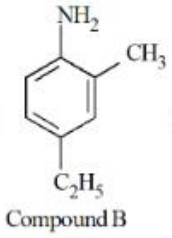
Given below are two statements: Statement I: Compound A IUPAC name of Compound A is 4-chloro-1,3-dinitrobenzene. Statement II: Compound B IUPAC name of Compound B is 4-ethyl-2-methylaniline. In the light of the above statements, choose the most appropriate answer from the options given below:
- ABoth Statement I and Statement II are correct.
- BStatement I is correct but Statement II is incorrect.
- CBoth Statement I and Statement II are incorrect.
- DStatement I is incorrect but Statement II is correct.
View answer or solution
Answer
Statement I is incorrect but Statement II is correct.
Classification of Elements and Periodicity in Properties
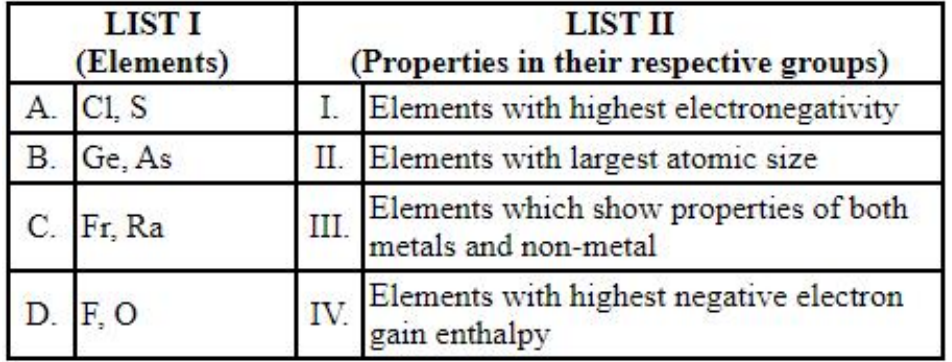
Match List I with List II | LIST I (Elements) | LIST II (Properties in their respective groups) | |---|---| | A. Cl, S | I. Elements with highest electronegativity | | B. Ge, As | II. Elements with largest atomic size | | C. Fr, Ra | III. Elements which show properties of both metals and non-metal | | D. F, O | IV. Elements with highest negative electron gain enthalpy | Choose the correct answer from the options given below:
- AA-III, B-II, C-I, D-IV
- BA-IV, B-III, C-II, D-I
- CA-II, B-I, C-IV, D-III
- DA-II, B-III, C-IV, D-I
View answer or solution
Answer
A-IV, B-III, C-II, D-I
An octahedral complex with the formula CoCl₃.nNH₃ upon reaction with excess of AgNO₃ solution gives 2 moles of AgCl. Consider the oxidation state of Co in the complex is 'x'. The value of "x + n" is ________.
- A6
- B5
- C8
- D3
View answer or solution
Answer
8
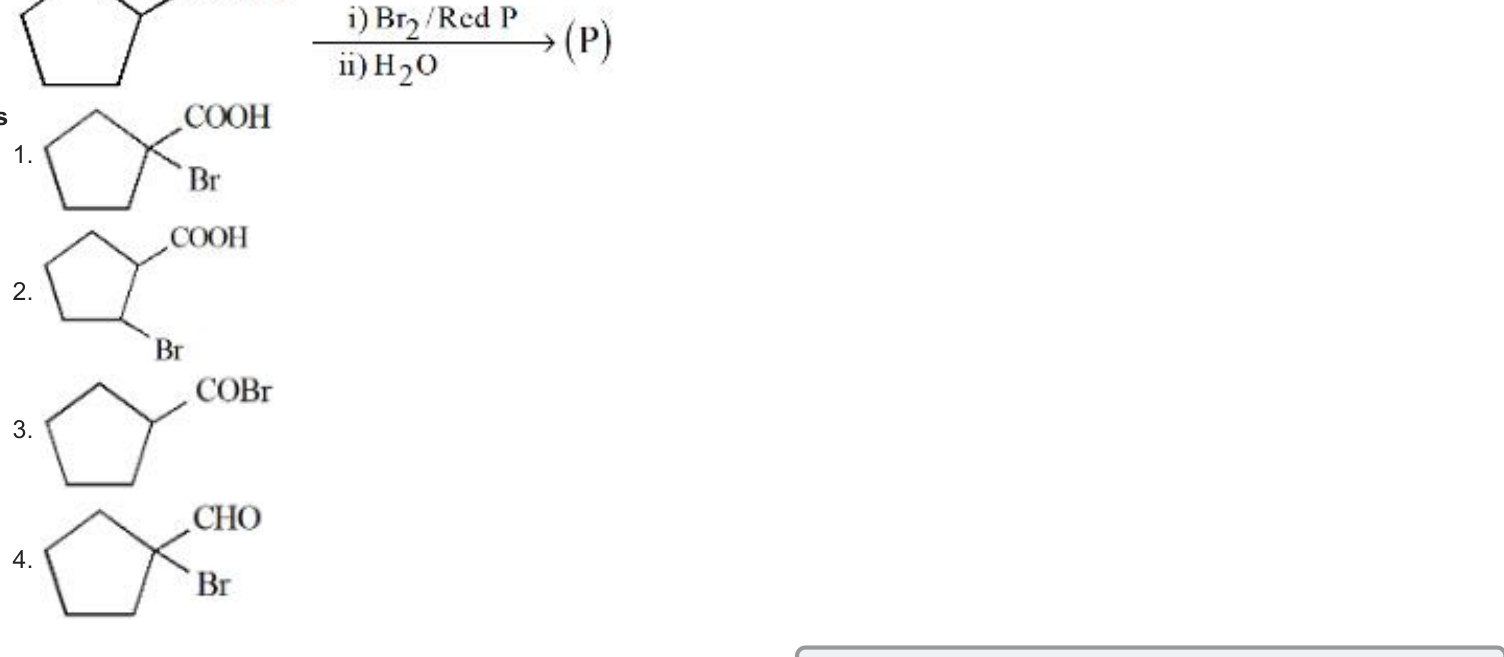
Identify the product (P) in the following reaction:
- ADrawn structure: a cyclopentane ring with 'COOH' and 'Br' both attached to the same ring carbon.
- BDrawn structure: a cyclopentane ring with 'COOH' attached to one ring carbon and 'Br' attached to the ring carbon next to it.
- CDrawn structure: a cyclopentane ring with 'COBr' attached to one ring carbon.
- DDrawn structure: a cyclopentane ring with 'CHO' and 'Br' both attached to the same ring carbon.
View answer or solution
Answer
Drawn structure: a cyclopentane ring with 'COOH' and 'Br' both attached to the same ring carbon.
Combustion of glucose (C₆H₁₂O₆) produces CO₂ and water. The amount of oxygen (in g) required for the complete combustion of 900 g of glucose is : [Molar mass of glucose in g mol⁻¹ = 180]
- A32
- B960
- C800
- D480
View answer or solution
Answer
960
Some Basic Principles of Organic Chemistry
In the given compound, the number of 2° carbon atom/s is ________. CH₃–C(CH₃)(H)–CH(H)–C(CH₃)(H)–CH₃
- ATwo
- BFour
- CThree
- DOne
View answer or solution
Answer
One
Redox Reactions and Electrochemistry
Give below are two statements: One is labelled as Assertion A and the other is labelled as Reason R: Assertion A: The stability order of +1 oxidation state of Ga, In and Tl is Ga < In < Tl. Reason R: The inert pair effect stabilizes the lower oxidation state down the group. In the light of the above statements, choose the correct answer from the options given below:
- ABoth A and R are true but R is NOT the correct explanation of A.
- BBoth A and R are true and R is the correct explanation of A.
- CA is false but R is true.
- DA is true but R is false.
View answer or solution
Answer
Both A and R are true and R is the correct explanation of A.
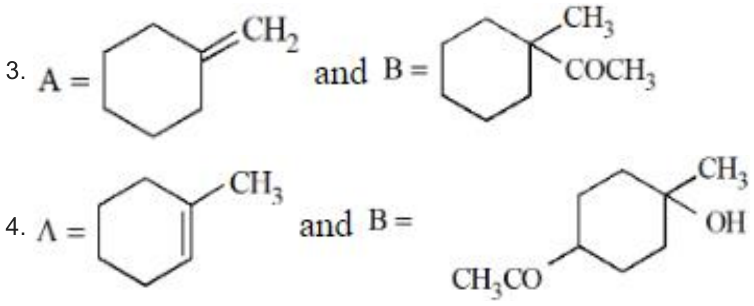
Identify the major products A and B respectively in the following set of reactions.
- AA = a cyclohexane ring drawn with an exocyclic double bond to CH₂ at the upper-right vertex and B = a cyclohexane ring whose upper-right vertex carries both a CH₃ group and an OH group, with a COCH₃ group on the adjacent lower vertex
- BA = a cyclohexane ring with a double bond on its right-hand edge and a CH₃ group on the upper-right vertex and B = a cyclohexane ring whose upper-right vertex carries both a CH₃ group and an OCOCH₃ group
- CA = a cyclohexane ring drawn with an exocyclic double bond to CH₂ at the upper-right vertex and B = a cyclohexane ring whose upper-right vertex carries both a CH₃ group and a COCH₃ group
- DA = a cyclohexane ring with a double bond on its right-hand edge and a CH₃ group on the upper-right vertex and B = a cyclohexane ring whose upper-right vertex carries a CH₃ group and an OH group, with a CH₃CO group on the lower-left vertex
View answer or solution
Answer
A = a cyclohexane ring with a double bond on its right-hand edge and a CH₃ group on the upper-right vertex and B = a cyclohexane ring whose upper-right vertex carries both a CH₃ group and an OCOCH₃ group
Some Basic Principles of Organic Chemistry
Which among the following compounds will undergo fastest S_N2 reaction.
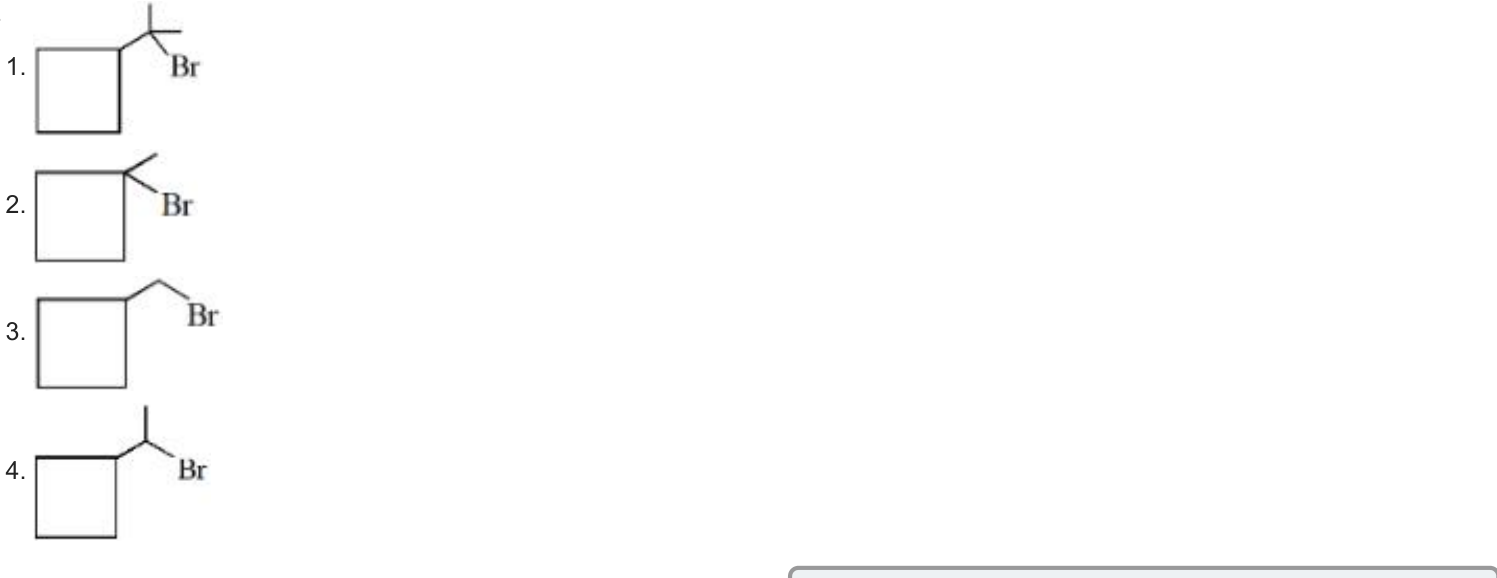
- AA cyclobutane ring drawn as a square, with a bond from its upper-right vertex to a carbon that carries a methyl drawn as a vertical line upwards, a second methyl drawn as a horizontal line to the right and 'Br' on a bond to the lower right
- BA cyclobutane ring drawn as a square, whose upper-right vertex carries a methyl on a bond to the upper right and 'Br' on a bond to the lower right
- CA cyclobutane ring drawn as a square, with a two-carbon chain running up-right and then down-right from its upper-right vertex and ending in 'Br'
- DA cyclobutane ring drawn as a square, with a bond from its upper-right vertex to a carbon that carries a methyl drawn as a vertical line upwards and 'Br' on a bond to the lower right
View answer or solution
Answer
A cyclobutane ring drawn as a square, with a two-carbon chain running up-right and then down-right from its upper-right vertex and ending in 'Br'
Chemical Bonding and Molecular Structure
Match List I with List II LIST I (Molecule) A. NH₃ B. BrF₅ C. PCl₅ D. CH₄ LIST II (Shape) I. Square pyramid II. Tetrahedral III. Trigonal pyramidal IV. Trigonal bipyramidal Choose the correct answer from the options given below:
- AA-IV, B-III, C-I, D-II
- BA-III, B-IV, C-I, D-II
- CA-III, B-I, C-IV, D-II
- DA-II, B-IV, C-I, D-III
View answer or solution
Answer
A-III, B-I, C-IV, D-II
Match List I with List II LIST I (Compound) A. Fe₄[Fe(CN)₆]₃·xH₂O B. [Fe(CN)₅NOS]⁴⁻ C. [Fe(SCN)]²⁺ D. (NH₄)₃PO₄·12MoO₃ LIST II (Colour) I. Violet II. Blood Red III. Prussian Blue IV. Yellow Choose the correct answer from the options given below:
- AA-IV, B-I, C-II, D-III
- BA-III, B-I, C-II, D-IV
- CA-II, B-III, C-IV, D-I
- DA-I, B-II, C-III, D-IV
View answer or solution
Answer
A-III, B-I, C-II, D-IV
For the given hypothetical reactions, the equilibrium constants are as follows : X ⇌ Y; K₁ = 1.0 Y ⇌ Z; K₂ = 2.0 Z ⇌ W; K₃ = 4.0 The equilibrium constant for the reaction X ⇌ W is
- A6.0
- B8.0
- C7.0
- D12.0
View answer or solution
Answer
8.0
Which of the following are aromatic?
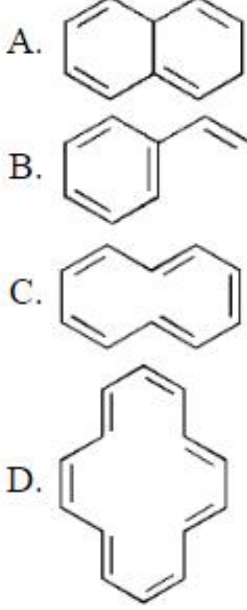
- AB and D only
- BA and C only
- CC and D only
- DA and B only
View answer or solution
Answer
B and D only
Principles Related to Practical Chemistry
Match List I with List II LIST I (Name of the test) A. Borax bead test B. Charcoal cavity test C. Cobalt nitrate test D. Flame test LIST II (Reaction sequence involved)[M is metal] I. MCO₃ → MO ⟶[Co(NO₃)₂, +Δ] CoO·MO II. MCO₃ → MCl₂ → M²⁺ III. MSO₄ ⟶[Na₂B₄O₇, Δ] M(BO₂)₂ → MBO₂ → M IV. MSO₄ ⟶[Na₂CO₃, Δ] MCO₃ → MO → M Choose the correct answer from the options given below:
- AA-III, B-I, C-IV, D-II
- BA-III, B-I, C-II, D-IV
- CA-III, B-II, C-IV, D-I
- DA-III, B-IV, C-I, D-II
View answer or solution
Answer
A-III, B-IV, C-I, D-II
Thiosulphate reacts differently with iodine and bromine in the reactions given below: 2S₂O₃²⁻ + I₂ → S₄O₆²⁻ + 2I⁻ S₂O₃²⁻ + 5Br₂ + 5H₂O → 2SO₄²⁻ + 4Br⁻ + 10H⁺ Which of the following statement justifies the above dual behaviour of thiosulphate?
- ABromine is a stronger oxidant than iodine
- BThiosulphate undergoes oxidation by bromine and reduction by iodine in these reactions
- CBromine is a weaker oxidant than iodine
- DBromine undergoes oxidation and iodine undergoes reduction in these reactions
View answer or solution
Answer
Bromine is a stronger oxidant than iodine
Given below are two statements: Statement I: N(CH₃)₃ and P(CH₃)₃ can act as ligands to form transition metal complexes. Statement II: As N and P are from same group, the nature of bonding of N(CH₃)₃ and P(CH₃)₃ is always same with transition metals. In the light of the above statements, choose the most appropriate answer from the options given below:
- ABoth Statement I and Statement II are incorrect.
- BStatement I is correct but Statement II is incorrect.
- CBoth Statement I and Statement II are correct.
- DStatement I is incorrect but Statement II is correct.
View answer or solution
Answer
Statement I is correct but Statement II is incorrect.
Redox Reactions and Electrochemistry
Iron (III) catalyses the reaction between iodide and persulphate ions, in which A. Fe³⁺ oxidises the iodide ion B. Fe³⁺ oxidises the persulphate ion C. Fe²⁺ reduces the iodide ion D. Fe²⁺ reduces the persulphate ion Choose the most appropriate answer from the options given below:
- AA and D only
- BB and C only
- CA only
- DB only
View answer or solution
Answer
A and D only
Redox Reactions and Electrochemistry
Among the following halogens F₂, Cl₂, Br₂ and I₂ Which can undergo disproportionation reactions?
- AOnly I₂
- BCl₂ , Br₂ and I₂
- CF₂, Cl₂ and Br₂
- DF₂ and Cl₂
View answer or solution
Answer
Cl₂ , Br₂ and I₂
Organic Compounds Containing Nitrogen
Number of amine compounds from the following giving solids which are soluble in NaOH upon reaction with Hinsberg's reagent is __________.
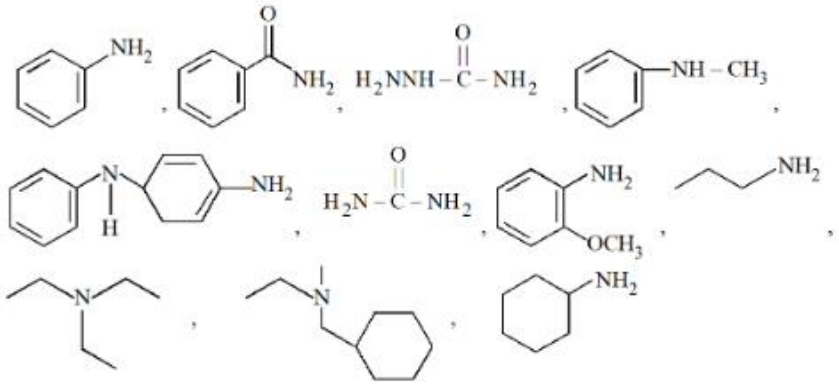
View answer or solution
Answer
5
Principles Related to Practical Chemistry
If 279 g of aniline is reacted with one equivalent of benzenediazonium chloride, the maximum amount of aniline yellow formed will be __________ g. (nearest integer) (consider complete conversion).
View answer or solution
Answer
591
The number of optical isomers in following compound is:__________
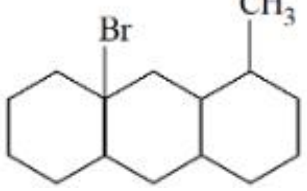
View answer or solution
Answer
32
Major product B of the following reaction has __________ π-bond.
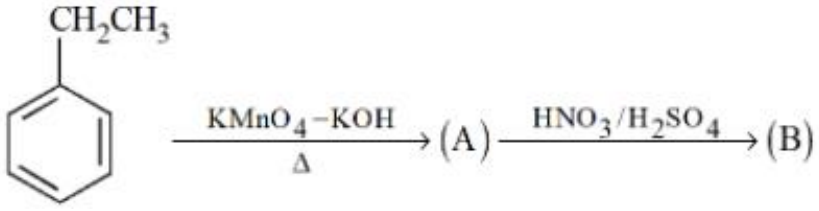
View answer or solution
Answer
5
A solution containing 10 g of an electrolyte AB₂ in 100 g of water boils at 100.52°C. The degree of ionization of the electrolyte (α) is __________ × 10⁻¹. (nearest integer) [Given : Molar mass of AB₂ = 200 g mol⁻¹, K_b (molal boiling point elevation const. of water) = 0.52 K kg mol⁻¹, boiling point of water = 100°C ; AB₂ ionises as AB₂ → A²⁺ + 2B⁻]
View answer or solution
Answer
5
Consider the following reaction A + B → C The time taken for A to become 1/4ᵗʰ of its initial concentration is twice the time taken to become 1/2 of the same. Also, when the change of concentration of B is plotted against time, the resulting graph gives a straight line with a negative slope and a positive intercept on the concentration axis. The overall order of the reaction is __________.
View answer or solution
Answer
1
The 'spin only' magnetic moment value of MO₄²⁻ is __________ BM. (Where M is a metal having least metallic radii among Sc, Ti, V, Cr, Mn and Zn). (Given atomic number: Sc = 21, Ti = 22, V = 23, Cr = 24, Mn = 25 and Zn = 30)
View answer or solution
Answer
0
A hypothetical electromagnetic wave is show below. The frequency of the wave is x × 10¹⁹ Hz. x = ________ (nearest integer)
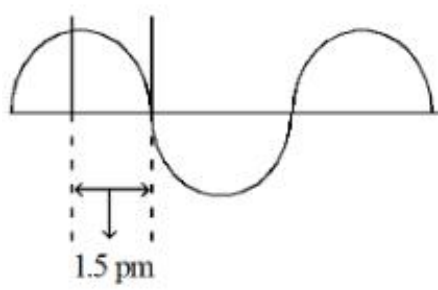
View answer or solution
Answer
5
Chemical Bonding and Molecular Structure
Number of molecules from the following which are exceptions to octet rule is ________. CO₂, NO₂, H₂SO₄, BF₃, CH₄, SiF₄, ClO₂, PCl₅, BeF₂, C₂H₆, CHCl₃, CBr₄
View answer or solution
Answer
6
Consider the figure provided. 1 mol of an ideal gas is kept in a cylinder, fitted with a piston, at the position A, at 18 °C. If the piston is moved to position B, keeping the temperature unchanged, then 'x' L atm work is done in this reversible process. x = ________ L atm. (nearest integer) [Given : Absolute temperature = °C + 273.15, R = 0.08206 L atm mol⁻¹ K⁻¹]
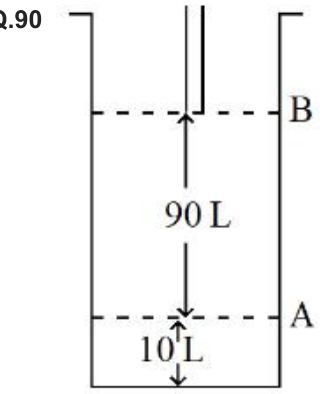
View answer or solution
Answer
55