
// JEE (Main) / 2024
JEE (Main) 2024 Session 2, 6 April 2024, Shift 2 — Paper 1 (B.E / B.Tech) Chemistry
Chemistry · B.E / B.Tech
Work through the questions
30 questions
Take a moment to try each question before opening the available answer or solution.
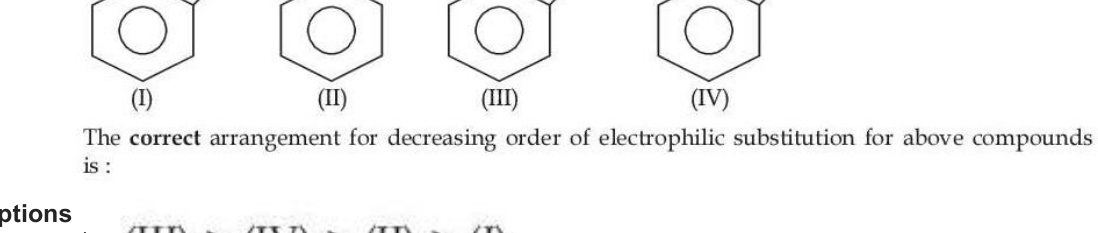
The correct arrangement for decreasing order of electrophilic substitution for above compounds is :
- A(III) > (IV) > (II) > (I)
- B(III) > (I) > (II) > (IV)
- C(II) > (IV) > (III) > (I)
- D(IV) > (I) > (II) > (III)
View answer or solution
Answer
(III) > (I) > (II) > (IV)
Chemical Bonding and Molecular Structure
The incorrect statement regarding the geometrical isomers of 2-butene is :
- Acis-2-butene has less dipole moment than trans-2-butene.
- Btrans-2-butene is more stable than cis-2-butene.
- Ccis-2-butene and trans-2-butene are not interconvertible at room temperature.
- Dcis-2-butene and trans-2-butene are stereoisomers.
View answer or solution
Answer
cis-2-butene has less dipole moment than trans-2-butene.
The ratio Kₚ/K꜀ for the reaction : CO(g) + ½ O₂(g) ⇌ CO₂(g) is :
- A(RT)^½
- BRT
- C1
- D1/√(RT)
View answer or solution
Answer
1/√(RT)
The correct IUPAC name of [PtBr₂(PMe₃)₂] is :
- Adibromodi(trimethylphosphine)platinum(II)
- Bbis[bromo(trimethylphosphine)]platinum(II)
- Cbis(trimethylphosphine)dibromoplatinum(II)
- Ddibromobis(trimethylphosphine)platinum(II)
View answer or solution
Answer
dibromobis(trimethylphosphine)platinum(II)
Some Basic Concepts in Chemistry
Molality (m) of 3 M aqueous solution of NaCl is : (Given : Density of solution = 1.25 g mL⁻¹, Molar mass in g mol⁻¹ : Na-23, Cl-35.5)
- A1.90 m
- B2.79 m
- C2.90 m
- D3.85 m
View answer or solution
Answer
2.79 m
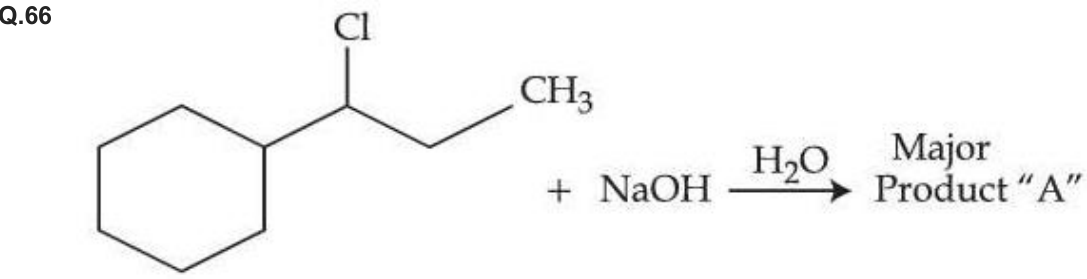
Consider the above chemical reaction. Product “A” is :
- ADrawn structure: a cyclohexane ring joined to a chain –CH₂–CH₂–CH(OH)–CH₃ with the OH on the carbon next to the terminal CH₃.
- BDrawn structure: a cyclohexane ring joined to a chain –CH(OH)–CH₂–CH₃ with the OH printed on the carbon next to the ring.
- CDrawn structure: a cyclohexane ring whose upper-right ring carbon carries an OH and a chain –CH₂–CH₂–CH₂–CH₃.
- DDrawn structure: a cyclohexane ring whose lower-right ring carbon carries an OH and a chain –CH₂–CH₂–CH₂–CH₃.
View answer or solution
Answer
Drawn structure: a cyclohexane ring whose upper-right ring carbon carries an OH and a chain –CH₂–CH₂–CH₂–CH₃.
Redox Reactions and Electrochemistry
Match List - I with List - II. List - I Reaction (A) N₂(g) + O₂(g) → 2NO(g) (B) 2Pb(NO₃)₂(s) → 2PbO(s) + 4NO₂(g) + O₂(g) (C) 2Na(s) + 2H₂O(l) → 2NaOH(aq) + H₂(g) (D) 2NO₂(g) + 2⁻OH(aq) → NO₂⁻(aq) + NO₃⁻(aq) + H₂O(l) List - II Type of redox reaction (I) Decomposition (II) Displacement (III) Disproportionation (IV) Combination Choose the correct answer from the options given below :
- A(A)-(III), (B)-(II), (C)-(I), (D)-(IV)
- B(A)-(II), (B)-(III), (C)-(IV), (D)-(I)
- C(A)-(I), (B)-(II), (C)-(III), (D)-(IV)
- D(A)-(IV), (B)-(I), (C)-(II), (D)-(III)
View answer or solution
Answer
(A)-(IV), (B)-(I), (C)-(II), (D)-(III)
Match List - I with List - II. List - I Alkali Metal (A) Li (B) Na (C) Rb (D) Cs List - II Emission Wavelength in nm (I) 589.2 (II) 455.5 (III) 670.8 (IV) 780.0 Choose the correct answer from the options given below :
- A(A)-(I), (B)-(IV), (C)-(III), (D)-(II)
- B(A)-(III), (B)-(I), (C)-(IV), (D)-(II)
- C(A)-(IV), (B)-(II), (C)-(I), (D)-(III)
- D(A)-(II), (B)-(IV), (C)-(III), (D)-(I)
View answer or solution
Answer
(A)-(III), (B)-(I), (C)-(IV), (D)-(II)
Redox Reactions and Electrochemistry
How can an electrochemical cell be converted into an electrolytic cell ?
- AReversing the flow of ions in salt bridge.
- BApplying an external opposite potential greater than E⁰cell.
- CExchanging the electrodes at anode and cathode.
- DApplying an external opposite potential lower than E⁰cell.
View answer or solution
Answer
Applying an external opposite potential greater than E⁰cell.
Chemical Bonding and Molecular Structure
Evaluate the following statements related to group 14 elements for their correctness. (A) Covalent radius decreases down the group from C to Pb in a regular manner. (B) Electronegativity decreases from C to Pb down the group gradually. (C) Maximum covalance of C is 4 whereas other elements can expand their covalance due to presence of d orbitals. (D) Heavier elements do not form pπ-pπ bonds. (E) Carbon can exhibit negative oxidation states. Choose the correct answer from the options given below :
- A(C) and (D) Only
- B(A) and (B) Only
- C(C), (D) and (E) Only
- D(A), (B) and (C) Only
View answer or solution
Answer
(C), (D) and (E) Only
The incorrect statements regarding enzymes are : (A) Enzymes are biocatalysts. (B) Enzymes are non-specific and can catalyse different kinds of reactions. (C) Most Enzymes are globular proteins. (D) Enzyme - oxidase catalyses the hydrolysis of maltose into glucose. Choose the correct answer from the option given below :
- A(A), (B) and (C)
- B(B) and (C)
- C(B) and (D)
- D(B), (C) and (D)
View answer or solution
Answer
(B) and (D)
Chemical Bonding and Molecular Structure
Given below are two statements : Statement I : PF₅ and BrF₅ both exhibit sp³d hybridisation. Statement II : Both SF₆ and [Co(NH₃)₆]³⁺ exhibit sp³d² hybridisation. In the light of the above statements, choose the correct answer from the options given below :
- AStatement I is false but Statement II is true
- BBoth Statement I and Statement II are false
- CStatement I is true but Statement II is false
- DBoth Statement I and Statement II are true
View answer or solution
Answer
Both Statement I and Statement II are false
Purification and Characterisation of Organic Compounds
The correct statement among the following, for a “chromatography” purification method is :
- ANon-polar compounds are retained at top and polar compounds come down in column chromatography.
- BR_f of a polar compound is smaller than that of a non-polar compound.
- COrganic compounds run faster than solvent in the thin layer chromatographic plate.
- DR_f is an integral value.
View answer or solution
Answer
R_f of a polar compound is smaller than that of a non-polar compound.
Organic Compounds Containing Oxygen
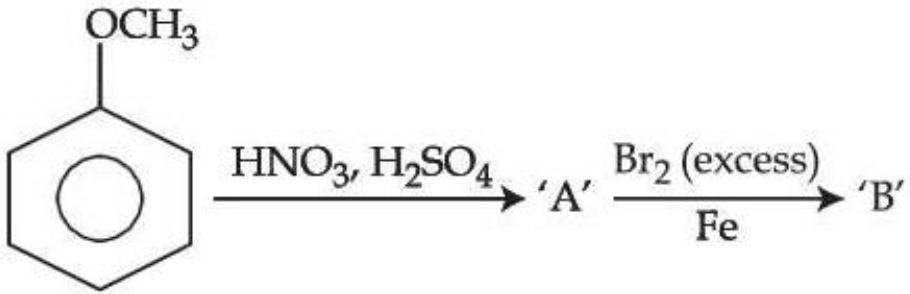
The major products formed : [Reaction scheme printed: a benzene ring drawn as a hexagon with three alternating inner double bonds and OCH₃ on the top carbon —HNO₃, H₂SO₄→ 'A' —Br₂ (excess), Fe→ 'B'] A and B respectively are :
- AA = benzene ring with OCH₃ on the top carbon and NO₂ on the upper-right carbon (ortho to OCH₃); B = benzene ring with OCH₃ on the top carbon, NO₂ on the upper-right carbon (ortho to OCH₃) and Br on the bottom carbon (para to OCH₃) - 2-bromo-4-nitroanisole
- BA = benzene ring with OCH₃ on the top carbon and NO₂ on the bottom carbon (para to OCH₃); B = benzene ring with OCH₃ on the top carbon, NO₂ on the bottom carbon (para to OCH₃) and Br on the upper-right carbon (ortho to OCH₃) - 2-bromo-4-nitroanisole
- CA = benzene ring with OCH₃ on the top carbon and NO₂ on the bottom carbon (para to OCH₃); B = benzene ring with OCH₃ on the top carbon, NO₂ on the bottom carbon (para to OCH₃), Br on the upper-left carbon and Br on the upper-right carbon (both ortho to OCH₃) - 2,6-dibromo-4-nitroanisole
- DA = benzene ring with OCH₃ on the top carbon and NO₂ on the upper-right carbon (ortho to OCH₃); B = benzene ring with OCH₃ on the top carbon, NO₂ on the upper-right carbon (ortho to OCH₃), Br on the upper-left carbon (ortho to OCH₃) and Br on the bottom carbon (para to OCH₃) - 2,6-dibromo-4-nitroanisole
View answer or solution
Answer
A = benzene ring with OCH₃ on the top carbon and NO₂ on the bottom carbon (para to OCH₃); B = benzene ring with OCH₃ on the top carbon, NO₂ on the bottom carbon (para to OCH₃), Br on the upper-left carbon and Br on the upper-right carbon (both ortho to OCH₃) - 2,6-dibromo-4-nitroanisole
Organic Compounds Containing Nitrogen
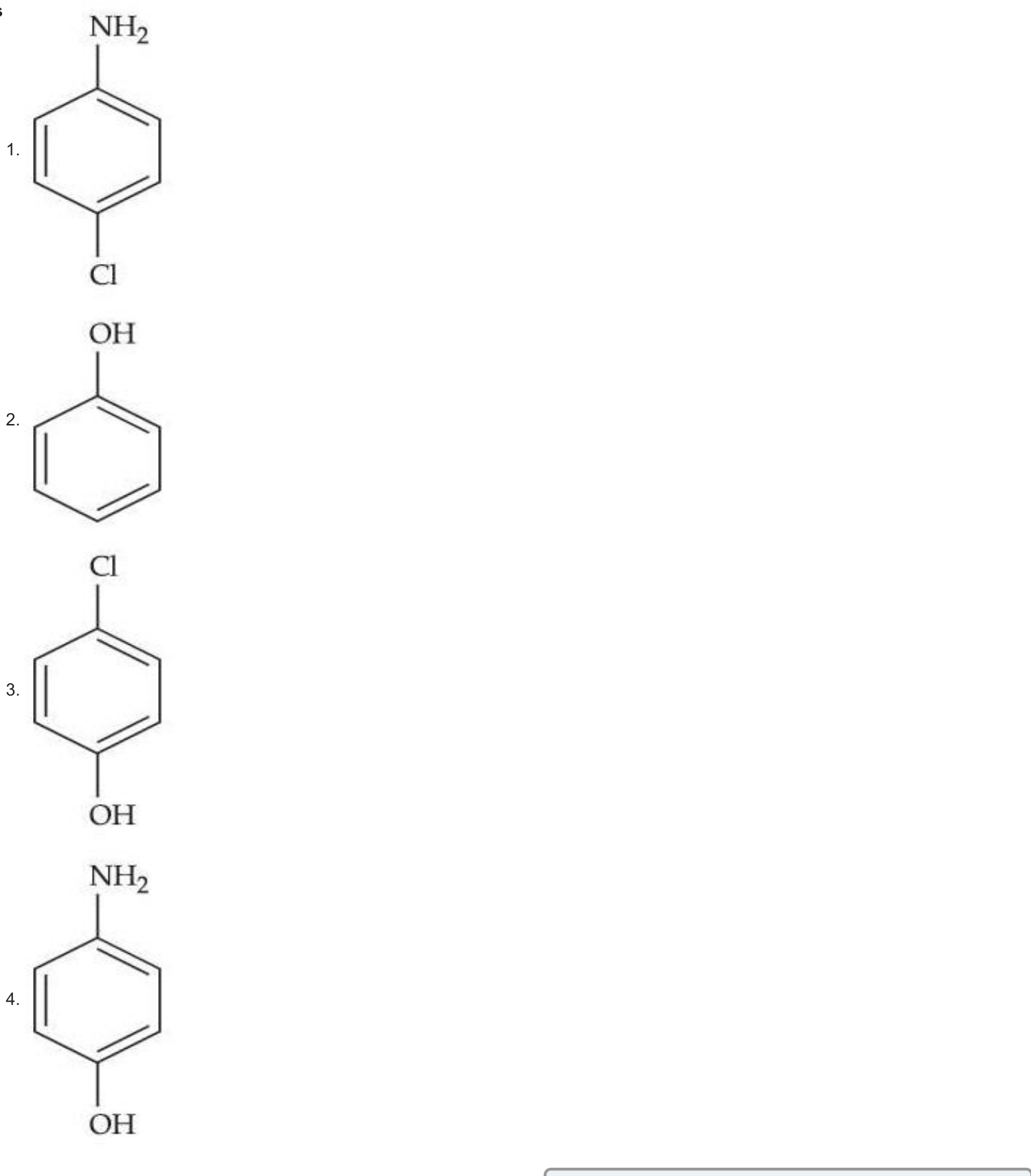
Identify the product A in the following reaction. [Reaction scheme printed: an aniline ring (a benzene ring drawn as a hexagon with three alternating inner double bonds and NH₂ on the upper-right carbon) —(i) NaNO₂ + HCl, (ii) Cu₂Cl₂, (iii) NaOH, 623 K, 300 atm, (iv) H⁺ over the arrow→ A]
- ABenzene ring with NH₂ on the top carbon and Cl on the bottom carbon (para to NH₂) - 4-chloroaniline
- BBenzene ring with OH on the top carbon - phenol
- CBenzene ring with Cl on the top carbon and OH on the bottom carbon (para to Cl) - 4-chlorophenol
- DBenzene ring with NH₂ on the top carbon and OH on the bottom carbon (para to NH₂) - 4-aminophenol
View answer or solution
Answer
Benzene ring with OH on the top carbon - phenol
Chemical Bonding and Molecular Structure
Arrange the following elements in the increasing order of number of unpaired electrons in it. (A) Sc (B) Cr (C) V (D) Ti (E) Mn Choose the correct answer from the options given below :
- A(B) < (C) < (D) < (E) < (A)
- B(A) < (D) < (C) < (B) < (E)
- C(C) < (E) < (B) < (A) < (D)
- D(A) < (D) < (C) < (E) < (B)
View answer or solution
Answer
(A) < (D) < (C) < (E) < (B)
Redox Reactions and Electrochemistry
The number of ions from the following that are expected to behave as oxidising agent is : Sn⁴⁺, Sn²⁺, Pb²⁺, Tl³⁺, Pb⁴⁺, Tl⁺
- A1
- B4
- C2
- D3
View answer or solution
Answer
2
Match List - I with List - II. List - I Tetrahedral Complex (A) TiCl₄ (B) [FeO₄]²⁻ (C) [FeCl₄]⁻ (D) [CoCl₄]²⁻ List - II Electronic configuration (I) e², t₂⁰ (II) e⁴, t₂³ (III) e⁰, t₂⁰ (IV) e², t₂³ Choose the correct answer from the options given below :
- A(A)-(IV), (B)-(III), (C)-(I), (D)-(II)
- B(A)-(III), (B)-(I), (C)-(IV), (D)-(II)
- C(A)-(I), (B)-(III), (C)-(IV), (D)-(II)
- D(A)-(III), (B)-(IV), (C)-(II), (D)-(I)
View answer or solution
Answer
(A)-(III), (B)-(I), (C)-(IV), (D)-(II)
Consider the given reaction, identify the major product P. CH₃ – COOH ⟶[(i) LiAlH₄, (ii) PCC, (iii) HCN/ŌH, (iv) H₂O/ŌH, Δ] “P”
- ACH₃ – CH₂ – CH₂ – OH
- BCH₃ – C(=O) – CH₂CH₃
- CCH₃ – CH(OH) – COOH
- DCH₃ – CH₂ – C(=O) – NH₂
View answer or solution
Answer
CH₃ – CH(OH) – COOH
Principles Related to Practical Chemistry
During the detection of acidic radical present in a salt, a student gets a pale yellow precipitate soluble with difficulty in NH₄OH solution when sodium carbonate extract was first acidified with dil. HNO₃ and then AgNO₃ solution was added. This indicates presence of :
- AI⁻
- BBr⁻
- CCl⁻
- DCO₃²⁻
View answer or solution
Answer
Br⁻
Redox Reactions and Electrochemistry
Among VO₂⁺, MnO₄⁻ and Cr₂O₇²⁻, the spin-only magnetic moment value of the species with least oxidising ability is _________ BM (Nearest integer). (Given atomic member V = 23, Mn = 25, Cr = 24)
View answer or solution
Answer
0
For the reaction at 298 K, 2A + B → C. ΔH = 400 kJ mol⁻¹ and ΔS = 0.2 kJ mol⁻¹ K⁻¹. The reaction will become spontaneous above _________ K.
View answer or solution
Answer
2000
Organic Compounds Containing Nitrogen
An amine (X) is prepared by ammonolysis of benzyl chloride. On adding p-toluenesulphonyl chloride to it the solution remains clear. Molar mass of the amine (X) formed is _________ g mol⁻¹. (Given molar mass in g mol⁻¹ C : 12, H : 1, O : 16, N : 14)
View answer or solution
Answer
287
Some Basic Principles of Organic Chemistry
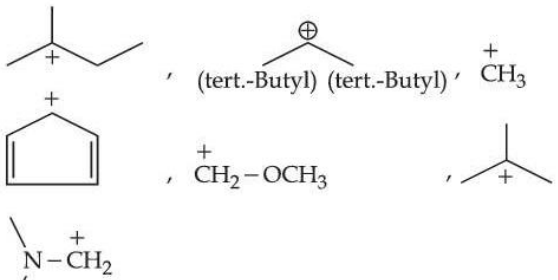
Number of carbocations from the following that are not stabilized by hyperconjugation is _________. [Figure]
View answer or solution
Answer
5
For hydrogen atom, energy of an electron in first excited state is −3.4 eV, K.E. of the same electron of hydrogen atom is x eV. Value of x is _________ ×10⁻¹ eV. (Nearest integer)
View answer or solution
Answer
34
Consider the two different first order reactions given below A + B → C (Reaction 1) P → Q (Reaction 2) The ratio of the half life of Reaction 1 : Reaction 2 is 5 : 2. If t₁ and t₂ represent the time taken to complete 2/3 ʳᵈ and 4/5 ᵗʰ of Reaction 1 and Reaction 2, respectively, then the value of the ratio t₁ : t₂ is _________ ×10⁻¹ (nearest integer). [Given : log₁₀(3) = 0.477 and log₁₀(5) = 0.699]
View answer or solution
Answer
17
Chemical Bonding and Molecular Structure
Consider the following reactions NiS + HNO₃ + HCl → A + NO + S + H₂O A + NH₄OH + H₃C–C(=N–OH)–C(=N–OH)–CH₃ → B + NH₄Cl + H₂O The number of protons that do not involve in hydrogen bonding in the product B is _________.
View answer or solution
Answer
12
Total number of species from the following with central atom utilising sp² hybrid orbitals for bonding is _________. NH₃, SO₂, SiO₂, BeCl₂, C₂H₂, C₂H₄, BCl₃, HCHO, C₆H₆, BF₃, C₂H₄Cl₂
View answer or solution
Answer
6
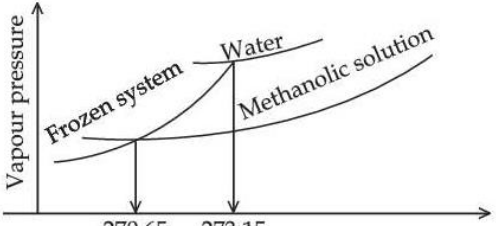
When ‘x’ × 10⁻² mL methanol (molar mass = 32 g; density = 0.792 g/cm³) is added to 100 mL water (density = 1 g/cm³), the following diagram is obtained. [Figure] x = _________ (nearest integer). [Given : Molal freezing point depression constant of water at 273.15 K is 1.86 K kg mol⁻¹]
View answer or solution
Answer
543
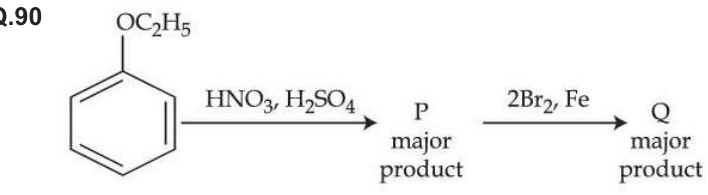
The ratio of number of oxygen atoms to bromine atoms in the product Q is ________ ×10⁻¹.
View answer or solution
Answer
15