
// JEE (Main) / 2024
JEE (Main) 2024 Session 2, 4 April 2024, Shift 1 — Paper 1 (B.E / B.Tech) Chemistry
Chemistry · B.E / B.Tech
Work through the questions
30 questions
Take a moment to try each question before opening the available answer or solution.
Chemical Bonding and Molecular Structure
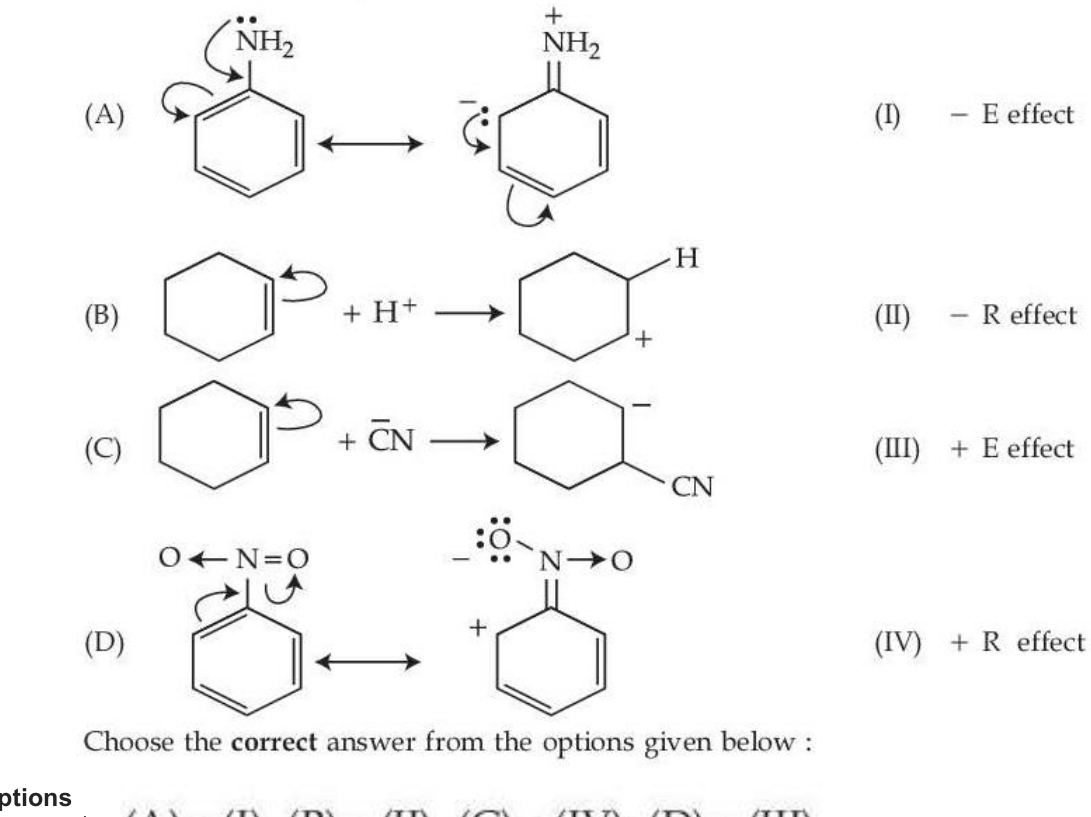
Match List I with List II : List - I Mechanism steps (A) [Figure] (B) [Figure] (C) [Figure] (D) [Figure] List - II Effect (I) − E effect (II) − R effect (III) + E effect (IV) + R effect Choose the correct answer from the options given below :
- A(A) - (I), (B) - (II), (C) - (IV), (D) - (III)
- B(A) - (II), (B) - (IV), (C) - (III), (D) - (I)
- C(A) - (III), (B) - (I), (C) - (II), (D) - (IV)
- D(A) - (IV), (B) - (III), (C) - (I), (D) - (II)
View answer or solution
Answer
(A) - (IV), (B) - (III), (C) - (I), (D) - (II)
Some Basic Concepts in Chemistry
The Molarity (M) of an aqueous solution containing 5.85 g of NaCl in 500 mL water is : (Given : Molar Mass Na : 23 and Cl : 35.5 gmol⁻¹)
- A4
- B0.2
- C20
- D2
View answer or solution
Answer
0.2
Chemical Bonding and Molecular Structure
Number of molecules/ions from the following in which the central atom is involved in sp³ hybridisation is ________. NO₃⁻, BCl₃, ClO₂⁻, ClO₃
- A2
- B4
- C1
- D3
View answer or solution
Answer
2
Redox Reactions and Electrochemistry
What pressure (bar) of H₂ would be required to make emf of hydrogen electrode zero in pure water at 25°C ?
- A0.5
- B10⁻⁷
- C10⁻¹⁴
- D1
View answer or solution
Answer
10⁻¹⁴
Some Basic Principles of Organic Chemistry
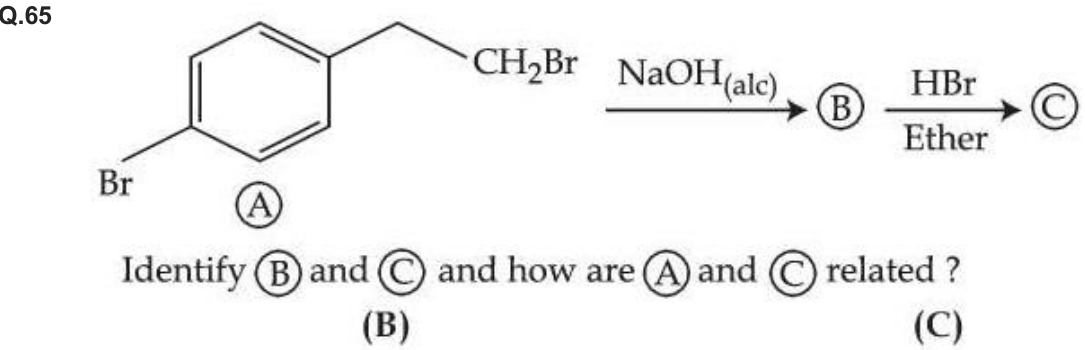
Identify B and C and how are A and C related ?
- A(B) drawn structure: a benzene ring drawn with a circle inside, 'OH' on a bond from the lower-left vertex and a –CH₂–CH₂–Br chain (two-carbon zigzag) on a bond from the upper-right vertex; (C) drawn structure: the same ring with 'OH' on the lower-left vertex and a –CH₂–CH₂–OH chain on the upper-right vertex; printed relation: functional group isomers
- B(B) drawn structure: a benzene ring drawn with a circle inside, 'Br' on a bond from the lower-left vertex and a –CH=CH₂ chain (a single bond from the ring, then a double bond to the terminal CH₂) on the upper-right vertex; (C) drawn structure: the same ring with 'Br' on the lower-left vertex and a –CH₂–CH₂–Br chain on the upper-right vertex; printed relation: chain isomers
- C(B) drawn structure: a benzene ring drawn with a circle inside, 'Br' on a bond from the lower-left vertex and a –CH=CH₂ chain (a single bond from the ring, then a double bond to the terminal CH₂) on the upper-right vertex; (C) drawn structure: the same ring with 'Br' on the lower-left vertex and a –CH(Br)–CH₃ group on the upper-right vertex, 'Br' printed above that carbon; printed relation: positon isomers
- D(B) drawn structure: a benzene ring drawn with a circle inside, 'OH' on a bond from the lower-left vertex and a –CH₂–CH₂–Br chain (two-carbon zigzag) on the upper-right vertex; (C) drawn structure: the same ring with 'OH' on the lower-left vertex and a –CH(Br)–CH₃ group on the upper-right vertex, 'Br' printed above that carbon; printed relation: Derivative
View answer or solution
Answer
(B) drawn structure: a benzene ring drawn with a circle inside, 'Br' on a bond from the lower-left vertex and a –CH=CH₂ chain (a single bond from the ring, then a double bond to the terminal CH₂) on the upper-right vertex; (C) drawn structure: the same ring with 'Br' on the lower-left vertex and a –CH(Br)–CH₃ group on the upper-right vertex, 'Br' printed above that carbon; printed relation: positon isomers
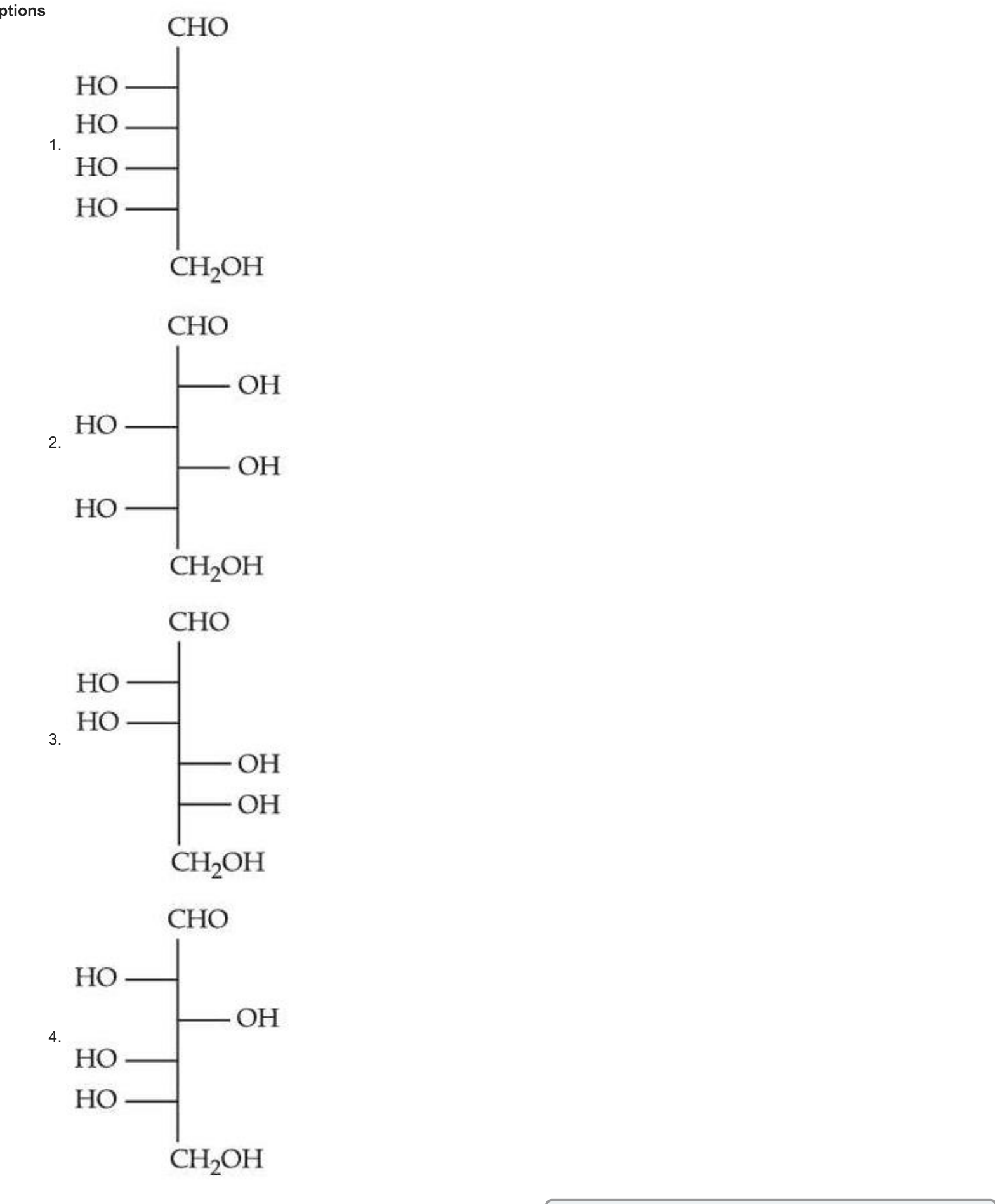
Which of the following is the correct structure of L-Glucose ?
- AFischer projection: CHO at the top; at each of the four cross-bars 'HO' is written to the left of the chain; CH₂OH at the bottom.
- BFischer projection: CHO at the top; at the uppermost cross-bar 'OH' is written to the right of the chain, at the second 'HO' to the left, at the third 'OH' to the right and at the lowest 'HO' to the left; CH₂OH at the bottom.
- CFischer projection: CHO at the top; at the upper two cross-bars 'HO' is written to the left of the chain and at the lower two 'OH' is written to the right; CH₂OH at the bottom.
- DFischer projection: CHO at the top; at the uppermost cross-bar 'HO' is written to the left of the chain, at the second 'OH' to the right and at the third and lowest 'HO' to the left; CH₂OH at the bottom.
View answer or solution
Answer
Fischer projection: CHO at the top; at the uppermost cross-bar 'HO' is written to the left of the chain, at the second 'OH' to the right and at the third and lowest 'HO' to the left; CH₂OH at the bottom.
Some Basic Principles of Organic Chemistry
Which among the following is incorrect statement ?
- AElectromeric effect dominates over inductive effect
- BThe electromeric effect is, temporary effect
- CHydrogen ion (H⁺) shows negative electromeric effect
- DThe organic compound shows electromeric effect in the presence of the reagent only.
View answer or solution
Answer
Hydrogen ion (H⁺) shows negative electromeric effect
What will be the decreasing order of basic strength of the following conjugate bases ? ⁻OH, RO⁻, CH₃COO⁻, Cl⁻
- A⁻OH > RO⁻ > CH₃COO⁻ > Cl⁻
- BCl⁻ > ⁻OH > RO⁻ > CH₃COO⁻
- CCl⁻ > RO⁻ > ⁻OH > CH₃COO⁻
- DRO⁻ > ⁻OH > CH₃COO⁻ > Cl⁻
View answer or solution
Answer
RO⁻ > ⁻OH > CH₃COO⁻ > Cl⁻
Classification of Elements and Periodicity in Properties
Number of elements from the following that CANNOT form compounds with valencies which match with their respective group valencies is ________. B, C, N, S, O, F, P, Al, Si
- A7
- B6
- C5
- D3
View answer or solution
Answer
3
Organic Compounds Containing Nitrogen
Which of the following nitrogen containing compound does not give Lassaigne’s test ?
- APhenyl hydrazine
- BGlycene
- CHydrazine
- DUrea
View answer or solution
Answer
Hydrazine
Organic Compounds Containing Oxygen
Given below are two statements : Statements I : Acidity of α-hydrogens of aldehydes and ketones is responsible for Aldol reaction. Statement II : Reaction between benzaldehyde and ethanal will NOT give Cross - Aldol product. In the light of the above statements, choose the most appropriate answer from the options given below :
- ABoth Statement I and Statement II are incorrect
- BBoth Statement I and Statement II are correct
- CStatement I is correct but Statement II is incorrect
- DStatement I is incorrect but Statement II is correct
View answer or solution
Answer
Statement I is correct but Statement II is incorrect
Number of complexes from the following with even number of unpaired “d” electrons is ______. [V(H₂O)₆]³⁺, [Cr(H₂O)₆]²⁺, [Fe(H₂O)₆]³⁺, [Ni(H₂O)₆]³⁺, [Cu(H₂O)₆]²⁺ [Given atomic numbers : V = 23, Cr = 24, Fe = 26, Ni = 28 Cu = 29]
- A4
- B1
- C2
- D5
View answer or solution
Answer
2
Purification and Characterisation of Organic Compounds
In the precipitation of the iron group (III) in qualitative analysis, ammonium chloride is added before adding ammonium hydroxide to :
- Adecrease concentration of ⁻OH ions
- Bprevent interference by phosphate ions
- Cincrease concentration of Cl⁻ ions
- Dincrease concentration of NH₄⁺ ions
View answer or solution
Answer
decrease concentration of ⁻OH ions
The correct sequence of ligands in the order of decreasing field strength is :
- A⁻OH > F⁻ > NH₃ > CN⁻
- BCO > H₂O > F⁻ > S²⁻
- CNCS⁻ > EDTA⁴⁻ > CN⁻ > CO
- DS²⁻ > ⁻OH > EDTA⁴⁻ > CO
View answer or solution
Answer
CO > H₂O > F⁻ > S²⁻
Chemical Bonding and Molecular Structure
Which one of the following molecules has maximum dipole moment ?
- ANH₃
- BPF₅
- CNF₃
- DCH₄
View answer or solution
Answer
NH₃
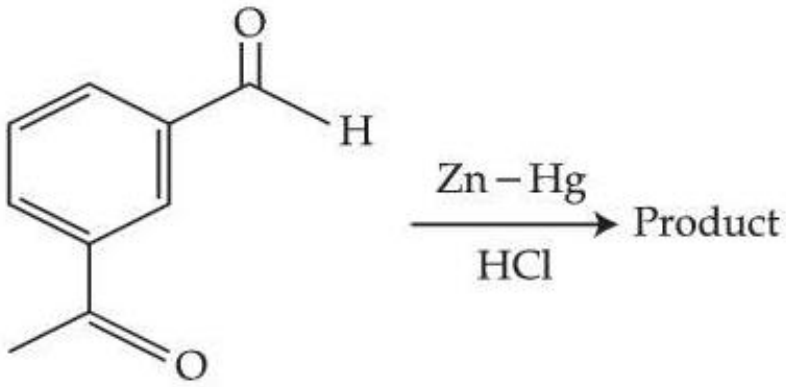
Identify the product in the following reaction : [Figure]
- ADrawn structure: a benzene ring with three alternating double bonds, a –CH₂–OH group (a one-carbon zigzag: a bond from the ring to the carbon, then a bond ending in ‘OH’) on the upper-right vertex and a –CH(OH)–CH₃ group (a carbon bearing a line to the lower left for the methyl and ‘OH’ printed to the lower right) on the bottom vertex.
- BDrawn structure: a benzene ring with three alternating double bonds, a methyl group (a single line ending) on the upper-right vertex and an acetyl group (a carbon bearing a line to the lower left for the methyl and a double bond to ‘O’) on the bottom vertex.
- CDrawn structure: a benzene ring with three alternating double bonds, a methyl group (a single line ending) on the upper-right vertex and an ethyl group (a vertical bond down to a carbon and then a line to the lower left) on the bottom vertex.
- DDrawn structure: a benzene ring with three alternating double bonds, a –CH₂–OH group (a one-carbon zigzag: a bond from the ring to the carbon, then a bond ending in ‘OH’) on the upper-right vertex and an acetyl group (a carbon bearing a line to the lower left for the methyl and a double bond to ‘O’) on the bottom vertex.
View answer or solution
Answer
Drawn structure: a benzene ring with three alternating double bonds, a methyl group (a single line ending) on the upper-right vertex and an ethyl group (a vertical bond down to a carbon and then a line to the lower left) on the bottom vertex.
Organic Compounds Containing Oxygen
Identify the correct set of reagents or reaction conditions ‘X’ and ‘Y’ in the following set of transformation. CH₃ – CH₂ – CH₂ – Br —‘X’→ Product —‘Y’→ CH₃ – CH(Br) – CH₃ (the ‘Br’ is printed on a bond below the middle CH)
- AX = conc.alc. NaOH, 80°C, Y = Br₂/CHCl₃
- BX = conc.alc. NaOH, 80°C, Y = HBr/acetic acid
- CX = dil.aq. NaOH, 20°C, Y = Br₂/CHCl₃
- DX = dil.aq. NaOH, 20°C, Y = HBr/acetic acid
View answer or solution
Answer
X = conc.alc. NaOH, 80°C, Y = HBr/acetic acid
Redox Reactions and Electrochemistry
One of the commonly used electrode is calomel electrode. Under which of the following categories, calomel electrode comes ?
- AMetal - Insoluble Salt - Anion electrodes
- BMetal ion - Metal electrodes
- COxidation - Reduction electrodes
- DGas - Ion electrodes
View answer or solution
Answer
Metal - Insoluble Salt - Anion electrodes
Classification of Elements and Periodicity in Properties
The correct order of first ionization enthalpy values of the following elements is : (A) O (B) N (C) Be (D) F (E) B Choose the correct answer from the options given below :
- AE < C < A < B < D
- BA < B < D < C < E
- CB < D < C < E < A
- DC < E < A < B < D
View answer or solution
Answer
E < C < A < B < D
Redox Reactions and Electrochemistry
The element which shows only one oxidation state other than its elemental form is :
- ATitanium
- BScandium
- CNickel
- DCobalt
View answer or solution
Answer
Scandium
The enthalpy of formation of ethane (C₂H₆) from ethylene by addition of hydrogen where the bond-energies of C – H, C – C, C=C, H – H are 414 kJ, 347 kJ, 615 kJ and 435 kJ respectively is – ________ kJ
View answer or solution
Answer
125
Some Basic Principles of Organic Chemistry
The number of different chain isomers for C₇H₁₆ is ________.
View answer or solution
Answer
9
Some Basic Concepts in Chemistry
X g of ethylamine is subjected to reaction with NaNO₂/HCl followed by water; evolved dinitrogen gas which occupied 2.24 L volume at STP. X is ________ ×10⁻¹ g.
View answer or solution
Answer
45
Only 2 mL of KMnO₄ solution of unknown molarity is required to reach the end point of a titration of 20 mL of oxalic acid (2 M) in acidic medium. The molarity of KMnO₄ solution should be ________ M.
View answer or solution
Answer
8
The de-Broglie's wavelength of an electron in the 4ᵗʰ orbit is ________ πa₀. (a₀ = Bohr's radius)
View answer or solution
Answer
8
Chemical Bonding and Molecular Structure
Number of molecules/species from the following having one unpaired electron is ________. O₂, O₂⁻¹, NO, CN⁻¹, O₂²⁻
View answer or solution
Answer
2
Consider the following transformation involving first order elementary reaction in each step at constant temperature as shown below. A + B ⇌[Step 1 / Step 3] C →[Step 2] P Some details of the above reactions are listed below. | Step | Rate constant (sec⁻¹) | Activation energy (kJ mol⁻¹) | |---|---|---| | 1 | k₁ | 300 | | 2 | k₂ | 200 | | 3 | k₃ | Ea₃ | If the overall rate constant of the above transformation (k) is given as k = (k₁ k₂)/k₃ and the overall activation energy (Eₐ) is 400 kJ mol⁻¹, then the value of Ea₃ is ________ kJ mol⁻¹ (nearest integer)

View answer or solution
Answer
100
Consider the following reaction MnO₂ + KOH + O₂ → A + H₂O. Product ‘A’ in neutral or acidic medium disproportionate to give products ‘B’ and ‘C’ along with water. The sum of spin-only magnetic moment values of B and C is ________ BM. (nearest integer) (Given atomic number of Mn is 25)
View answer or solution
Answer
4
2.5 g of a non-volatile, non-electrolyte is dissolved in 100 g of water at 25°C. The solution showed a boiling point elevation by 2°C. Assuming the solute concentration is negligible with respect to the solvent concentration, the vapor pressure of the resulting aqueous solution is ________ mm of Hg (nearest integer) [Given : Molal boiling point elevation constant of water (K_b)=0.52 K kg mol⁻¹, 1 atm pressure=760 mm of Hg, molar mass of water=18 g mol⁻¹]
View answer or solution
Answer
707
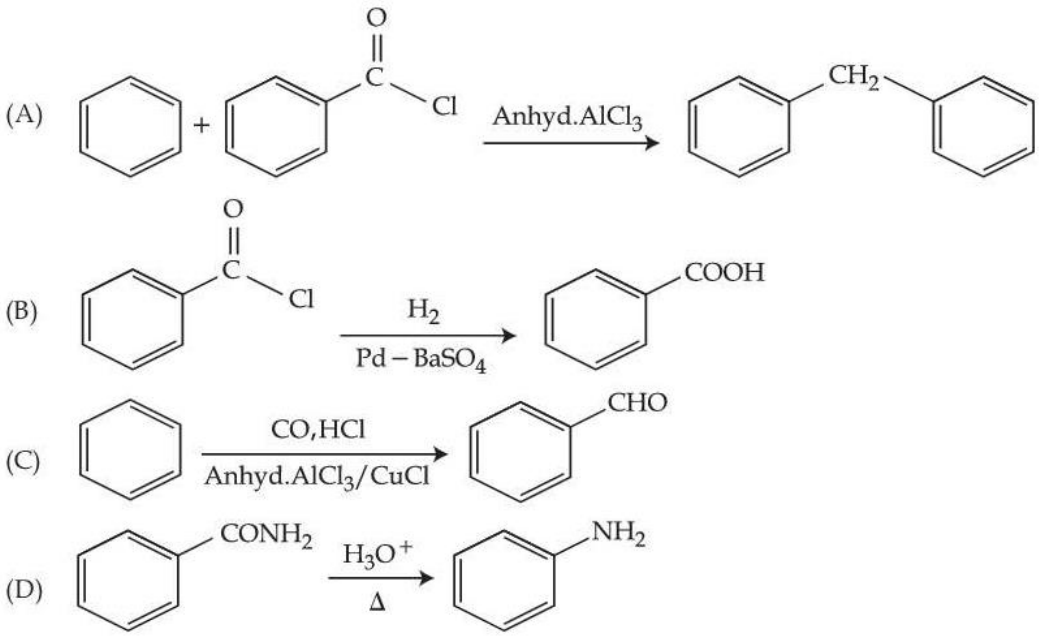
The number of the correct reaction(s) among the following is ________.
View answer or solution
Answer
1