
// JEE (Main) / 2024
JEE (Main) 2024 Session 1, 30 January 2024, Shift 2 — Paper 1 (B.E / B.Tech) Chemistry
Chemistry · B.E / B.Tech
Work through the questions
30 questions
No verified answers are available for this paper.
Given below are two statements: One is labelled as Assertion A and the other is labelled as Reason R: Assertion A: H₂Te is more acidic than H₂S. Reason R: Bond dissociation enthalpy of H₂Te is lower than H₂S. In the light of the above statements, choose the most appropriate from the options given below:
- AA is true but R is false.
- BBoth A and R are true but R is NOT the correct explanation of A.
- CA is false but R is true.
- DBoth A and R are true and R is the correct explanation of A.
No verified answer or solution is available for this question.
Some Basic Concepts in Chemistry
If a substance 'A' dissolves in solution of a mixture of 'B' and 'C' with their respective number of moles as n_A, n_B and n_C. Mole fraction of C in the solution is :
- An_C/(n_A − n_B − n_C)
- Bn_C/(n_A × n_B × n_C)
- Cn_B/(n_A + n_B)
- Dn_C/(n_A + n_B + n_C)
No verified answer or solution is available for this question.
m-chlorobenzaldehyde on treatment with 50% KOH solution yields
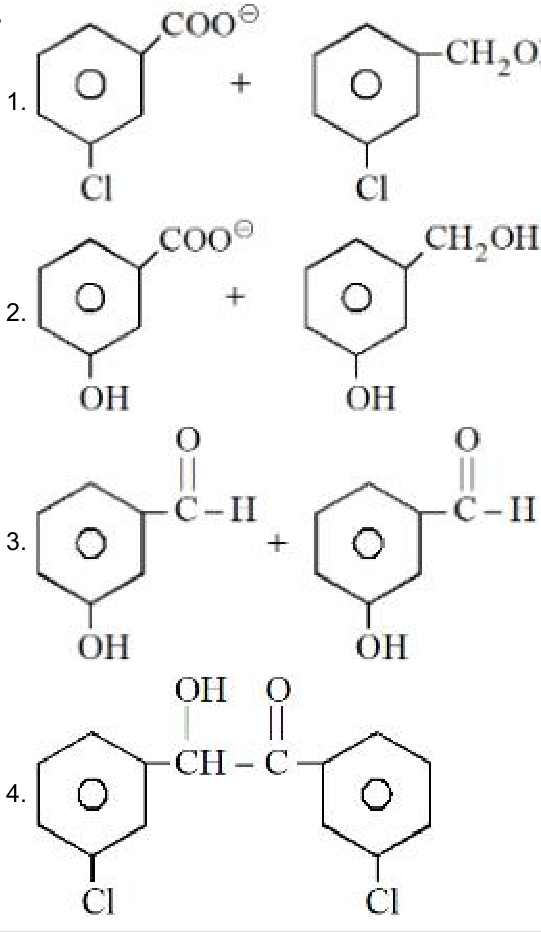
- Adrawn structure: a benzene ring drawn with a circle inside, carrying a –COO⁻ group (the circled minus sign printed beside the O) on the upper-right vertex and 'Cl' on the bottom vertex, plus a benzene ring drawn with a circle inside carrying a –CH₂OH group on the upper-right vertex and 'Cl' on the bottom vertex
- Bdrawn structure: a benzene ring drawn with a circle inside, carrying a –COO⁻ group on the upper-right vertex and 'OH' on the bottom vertex, plus a benzene ring drawn with a circle inside carrying a –CH₂OH group on the upper-right vertex and 'OH' on the bottom vertex
- Cdrawn structure: a benzene ring drawn with a circle inside, carrying a –CHO group (a carbon drawn with a double bond to 'O' above it and a single bond to 'H' on the right) on the upper-right vertex and 'OH' on the bottom vertex, plus a benzene ring drawn with a circle inside carrying a –CHO group on the upper-right vertex and 'OH' on the bottom vertex
- Ddrawn structure: two benzene rings drawn with a circle inside, joined through a –CH(OH)–C(=O)– chain (the CH carrying 'OH' above it and the carbon double bonded to 'O' above it); 'Cl' is printed on the bottom vertex of the left-hand ring and on the bottom vertex of the right-hand ring
No verified answer or solution is available for this question.
Redox Reactions and Electrochemistry
The orange colour of K₂Cr₂O₇ and purple colour of KMnO₄ is due to
- Ad → d transitions in both
- Bd → d transitions in KMnO₄ and charge transfer transitions in K₂Cr₂O₇.
- Cd → d transitions in K₂Cr₂O₇ and charge transfer transitions in KMnO₄.
- DCharge transfer transition in both.
No verified answer or solution is available for this question.
A and B formed in the following reactions are: CrO₂Cl₂ + 4NaOH → A + 2NaCl + 2H₂O A + 2HCl + 2H₂O₂ → B + 3H₂O
- AA = Na₂Cr₂O₇, B = CrO₃
- BA = Na₂CrO₄, B = CrO₅
- CA = Na₂Cr₂O₄, B = CrO₄
- DA = Na₂Cr₂O₇, B = CrO₅
No verified answer or solution is available for this question.
Redox Reactions and Electrochemistry
Reduction potential of ions are given below: ClO₄⁻ E° = 1.19 V, IO₄⁻ E° = 1.65 V, BrO₄⁻ E° = 1.74 V The correct order of their oxidising power is :
- AClO₄⁻ > IO₄⁻ > BrO₄⁻
- BBrO₄⁻ > IO₄⁻ > ClO₄⁻
- CBrO₄⁻ > ClO₄⁻ > IO₄⁻
- DIO₄⁻ > BrO₄⁻ > ClO₄⁻
No verified answer or solution is available for this question.
Chemical Bonding and Molecular Structure
Given below are two statements: Statement - I: Since Fluorine is more electronegative than nitrogen, the net dipole moment of NF₃ is greater than NH₃. Statement - II: In NH₃, the orbital dipole due to lone pair and the dipole moment of NH bonds are in opposite direction, but in NF₃ the orbital dipole due to lone pair and dipole moments of N-F bonds are in same direction. In the light of the above statements, choose the most appropriate from the options given below:
- ABoth Statement I and Statement II are false.
- BStatement I is true but Statement II is false.
- CStatement I is false but Statement II is true.
- DBoth Statement I and Statement II are true.
No verified answer or solution is available for this question.
Classification of Elements and Periodicity in Properties
Given below are two statements: Statement - I: Along the period, the chemical reactivity of the elements gradually increases from group 1 to group 18. Statement - II: The nature of oxides formed by group 1 elements is basic while that of group 17 elements is acidic. In the light of the above statements, choose the most appropriate from the options given below:
- AStatement I is False but statement I is true
- BStatement I is True But Statement II is False
- CBoth Statement I and Statement II are True
- DBoth Statement I and Statement II are False
No verified answer or solution is available for this question.
Organic Compounds Containing Halogens
Given below are two statements: Statement - I: High concentration of strong nucleophilic reagent with secondary alkyl halides which do not have bulky substituents will follow S_N² mechanism. Statement - II: A secondary alkyl halide when treated with a large excess of ethanol follows S_N¹ mechanism. In the light of the above statements, choose the most appropriate from the options given below:
- ABoth Statement I and Statement II are false.
- BBoth Statement I and Statement II are true.
- CStatement I is true but Statement II is false.
- DStatement I is false but Statement II is true.
No verified answer or solution is available for this question.
Some Basic Principles of Organic Chemistry
The correct stability order of carbocations is
- A(CH₃)₃C⁺ > CH₃–⁺CH₂ > (CH₃)₂⁺CH > ⁺CH₃
- B⁺CH₃ > CH₃–⁺CH₂ > CH₃–⁺CH(CH₃) > (CH₃)₃C⁺
- C⁺CH₃ > (CH₃)₂⁺CH > CH₃–⁺CH₂ > (CH₃)₃C⁺
- D(CH₃)₃C⁺ > (CH₃)₂⁺CH > CH₃–⁺CH₂ > ⁺CHCH₃
No verified answer or solution is available for this question.
The coordination geometry around the manganese in decacarbonylmanganese (0) is
- ATrigonal bipyramidal
- BSquare pyramidal
- COctahedral
- DSquare planar
No verified answer or solution is available for this question.
Which among the following purification methods is based on the principle of "Solubility" in two different solvents?
- ASublimation
- BDistillation
- CDifferential Extraction
- DColumn Chromatography
No verified answer or solution is available for this question.
Products A and B formed in the following set of reactions are
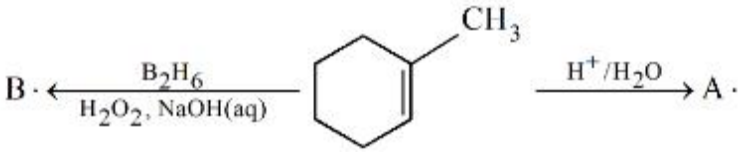
- Adrawn structure: A = a six-membered ring drawn with a double bond on the right-hand vertical edge and a –CH₂OH group on the upper-right vertex; B = a six-membered ring drawn with a double bond on the right-hand vertical edge, a –CH₃ group on the upper-right vertex and an –OH group on the lower-right vertex
- Bdrawn structure: A = a six-membered ring drawn with a double bond on the right-hand vertical edge, a –CH₃ group on the upper-right vertex and an –OH group on the lower-right vertex; B = a six-membered ring drawn with a double bond on the right-hand vertical edge carrying both a –CH₃ group and an –OH group on the same upper-right vertex
- Cdrawn structure: A = a six-membered ring drawn with a double bond on the right-hand vertical edge and a –CH₂OH group on the upper-right vertex; B = a six-membered ring drawn with a double bond on the right-hand vertical edge, a –CH₂OH group on the upper-right vertex and an –OH group on the lower-right vertex
- Ddrawn structure: A = a six-membered ring drawn with a double bond on the right-hand vertical edge carrying both a –CH₃ group and an –OH group on the same upper-right vertex; B = a six-membered ring drawn with a double bond on the right-hand vertical edge, a –CH₃ group on the upper-right vertex and an –OH group on the lower-right vertex
No verified answer or solution is available for this question.
Organic Compounds Containing Nitrogen
Choose the correct statements about the hydrides of group 15 elements. A. The stability of the hydrides decreases in the order NH₃ > PH₃ > AsH₃ > SbH₃ > BiH₃. B. The reducing ability of the hydride increases in the order NH₃ < PH₃ < AsH₃ < SbH₃ < BiH₃. C. Among the hydrides, NH₃ is strong reducing agent while BiH₃ is mild reducing agent. D. The basicity of the hydrides increases in the order NH₃ < PH₃ < AsH₃ < SbH₃ < BiH₃. Choose the most appropriate from the options given below:
- AB and C only
- BA and B only
- CA and D only
- DC and D only
No verified answer or solution is available for this question.
IUPAC name of following compound is : CH₃–CH(NH₂)–CH₂–CN
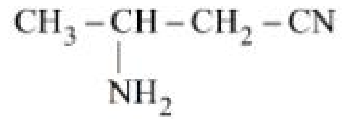
- A3-Aminobutanenitrile
- B3-Aminopropanenitrile
- C2-Aminopentanenitrile
- D2-Aminobutanenitrile
No verified answer or solution is available for this question.
Chemical Bonding and Molecular Structure
The molecule / ion with square pyramidal shape is
- APF₅
- BBrF₅
- C[Ni(CN)₄]²⁻
- DPCl₅
No verified answer or solution is available for this question.
The products A and B formed in the following reaction scheme are respectively
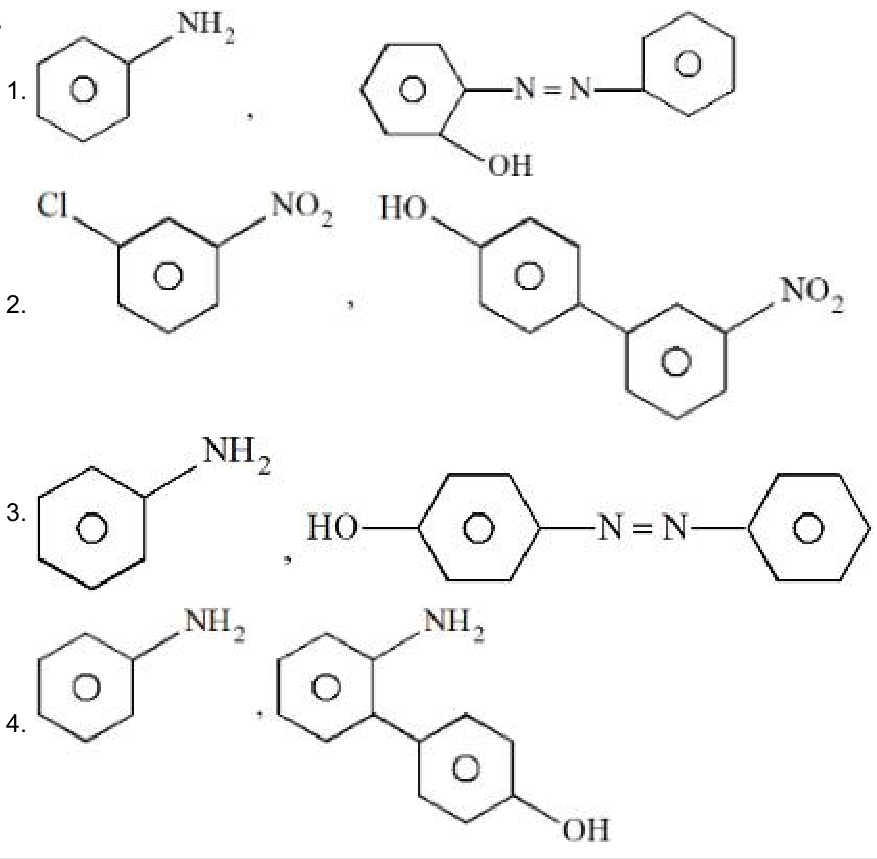
- Adrawn structure: A = a benzene ring drawn with a circle inside, with 'NH₂' attached to the upper-right vertex; B = two benzene rings, both drawn with a circle inside, joined through –N=N– (a single bond from the right-hand vertex of the left ring to N, an N=N double bond, and a single bond from the second N to the left-hand vertex of the right ring), with 'OH' attached to the lower-right vertex of the left-hand ring
- Bdrawn structure: A = a benzene ring drawn with a circle inside, with 'Cl' attached to the upper-left vertex and 'NO₂' attached to the upper-right vertex; B = two benzene rings, both drawn with a circle inside, joined by a single bond from the lower-right vertex of the left ring to the upper-left vertex of the right ring, with 'HO' attached to the upper-left vertex of the left ring and 'NO₂' attached to the upper-right vertex of the right ring
- Cdrawn structure: A = a benzene ring drawn with a circle inside, with 'NH₂' attached to the upper-right vertex; B = two benzene rings, both drawn with a circle inside and drawn with a vertex at the left and at the right, the left ring carrying 'HO' on its left-hand vertex and joined through –N=N– to the right-hand vertex of the right ring
- Ddrawn structure: A = a benzene ring drawn with a circle inside, with 'NH₂' attached to the upper-right vertex; B = two benzene rings, both drawn with a circle inside, joined by a single bond from the lower-right vertex of the left ring to the upper-left vertex of the right ring, with 'NH₂' attached to the upper-right vertex of the left ring and 'OH' attached to the lower-right vertex of the right ring
No verified answer or solution is available for this question.
Redox Reactions and Electrochemistry
Alkaline oxidative fusion of MnO₂ gives "A" which on electrolytic oxidation in alkaline solution produces B. A and B respectively are
- AMn₂O₃ and MnO₄²⁻
- BMnO₄²⁻ and Mn₂O₇
- CMn₂O₇ and MnO₄⁻
- DMnO₄²⁻ and MnO₄⁻
No verified answer or solution is available for this question.
The solution from the following with highest depression in freezing point/lowest freezing point is
- A180 g of glucose dissolved in water
- B180 g of acetic acid dissolved in water
- C180 g of acetic acid dissolved in benzene
- D180 g of benzoic acid dissolved in benzene
No verified answer or solution is available for this question.
Organic Compounds Containing Oxygen
Salicylaldehyde is synthesized from phenol, when reacted with
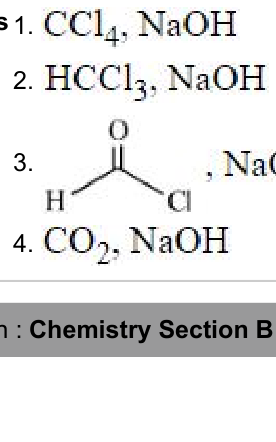
- ACCl₄, NaOH
- BHCCl₃, NaOH
- Cdrawn structure: a carbon atom drawn with a double bond running up to 'O' and single bonds running down-left to 'H' and down-right to 'Cl' (formyl chloride), , NaOH
- DCO₂, NaOH
No verified answer or solution is available for this question.
NO₂ required for a reaction is produced by decomposition of N₂O₅ in CCl₄ as by equation 2N₂O₅(g) → 4NO₂(g) + O₂(g) The initial concentration. of N₂O₅ is 3 mol L⁻¹ and it is 2.75 mol L⁻¹ after 30 minutes. The rate of formation of NO₂ is x × 10⁻³ mol L⁻¹ min⁻¹, value of x is ________. (nearest integer)
No verified answer or solution is available for this question.
Redox Reactions and Electrochemistry
Total number of species from the following which can undergo disproportionation reaction is ________. H₂O₂, ClO₃⁻, P₄, Cl₂, Ag, Cu⁺¹, F₂, NO₂, K⁺
No verified answer or solution is available for this question.
Two reactions are given below: 2Fe(s) + 3/2 O₂(g) → Fe₂O₃(s), ΔH° = −822 kJ / mol C(s) + 1/2 O₂(g) → CO(g), ΔH° = −110 kJ / mol Then enthalpy change for following reaction 3C(s) + Fe₂O₃(s) → 2Fe(s) + 3CO(g) is ________ kJ/mol.
No verified answer or solution is available for this question.
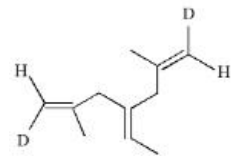
Number of geometrical isomers possible for the given structure is/are ________.
No verified answer or solution is available for this question.
The total number of correct statements, regarding the nucleic acids is ________ A. RNA is regarded as the reserve of genetic information B. DNA molecule self-duplicates during cell division C. DNA synthesizes proteins in the cell D. The message for the synthesis of particular proteins is present in DNA E. Identical DNA strands are transferred to daughter cells.
No verified answer or solution is available for this question.
Number of spectral lines obtained in He⁺ spectra, when an electron makes transition from fifth excited state to first excited state will be
No verified answer or solution is available for this question.
Principles Related to Practical Chemistry
Number of metal ions characterized by flame test among the following is ________. Sr²⁺, Ba²⁺, Ca²⁺, Cu²⁺, Zn²⁺, Co²⁺, Fe²⁺
No verified answer or solution is available for this question.
Some Basic Principles of Organic Chemistry
2-chlorobutane + Cl₂ → C₄H₈Cl₂ (isomers) Total number of optically active isomers shown by C₄H₈Cl₂, obtained in the above reaction is ________.
No verified answer or solution is available for this question.
Some Basic Principles of Organic Chemistry
Number of complexes which show optical isomerism among the following is ________. cis-[Cr(ox)₂Cl₂]³⁻, [Co(en)₃]³⁺, cis-[Pt(en)₂Cl₂]²⁺, cis-[Co(en)₂Cl₂]⁺, trans-[Pt(en)₂Cl₂]²⁺, trans-[Cr(ox)₂Cl₂]³⁻
No verified answer or solution is available for this question.
The pH of an aqueous solution containing 1M benzoic acid (pKₐ = 4.20) and 1M sodium benzoate is 4.5. The volume of benzoic acid solution in 300 mL of this buffer solution is ________ mL. (given : log 2 = 0.3)
No verified answer or solution is available for this question.