
// JEE (Main) / 2024
JEE (Main) 2024 Session 1, 1 February 2024, Shift 1 — Paper 1 (B.E / B.Tech) Chemistry
Chemistry · B.E / B.Tech
Work through the questions
30 questions
No verified answers are available for this paper.
Chemical Bonding and Molecular Structure
Arrange the bonds in order of increasing ionic character in the molecules. LiF, K₂O, N₂, SO₂ and ClF₃ :
- AN₂ < SO₂ < ClF₃ < K₂O < LiF
- BN₂ < ClF₃ < SO₂ < K₂O < LiF
- CClF₃ < N₂ < SO₂ < K₂O < LiF
- DLiF < K₂O < ClF₃ < SO₂ < N₂
No verified answer or solution is available for this question.
We have three aqueous solutions of NaCl labelled as 'A', 'B' and 'C' with concentration 0.1 M, 0.01 M and 0.001 M, respectively. The value of van 't Hoff factor(i) for these solutions will be in the order :
- Ai_A < i_B < i_C
- Bi_A < i_C < i_B
- Ci_A = i_B = i_C
- Di_A > i_B > i_C
No verified answer or solution is available for this question.
Identify A and B in the following sequence of reaction [Figure]

- ADrawn structure: A = a benzene ring drawn with three alternating double bonds, with a –CHCl₂ group on the upper-right vertex; B = a benzene ring drawn with three alternating double bonds, with a –COOH group on the upper-right vertex.
- BDrawn structure: A = a benzene ring drawn with three alternating double bonds, with a –CHCl₂ group on the upper-right vertex; B = a benzene ring drawn with three alternating double bonds, with a –CHO group on the upper-right vertex.
- CDrawn structure: A = a benzene ring drawn with three alternating double bonds, with a –COCl group on the upper-right vertex; B = a benzene ring drawn with three alternating double bonds, with a –CHO group on the upper-right vertex.
- DDrawn structure: A = a benzene ring drawn with three alternating double bonds, with a –CH₂Cl group on the upper-right vertex; B = a benzene ring drawn with three alternating double bonds, with a –CHO group on the upper-right vertex.
No verified answer or solution is available for this question.
Choose the correct option for free expansion of an ideal gas under adiabatic condition from the following :
- Aq = 0, ΔT<0, w ≠ 0
- Bq ≠ 0, ΔT = 0, w = 0
- Cq = 0, ΔT = 0, w = 0
- Dq = 0, ΔT ≠ 0, w = 0
No verified answer or solution is available for this question.
Which of the following complex is homoleptic ?
- A[Fe(NH₃)₄Cl₂]⁺
- B[Ni(NH₃)₂Cl₂]
- C[Ni(CN)₄]²⁻
- D[Co(NH₃)₄Cl₂]⁺
No verified answer or solution is available for this question.
Some Basic Principles of Organic Chemistry
Ionic reactions with organic compounds proceed through : (A) homolytic bond cleavage (B) heterolytic bond cleavage (C) free radical formation (D) primary free radical (E) secondary free radical Choose the correct answer from the options given below :
- A(C) only
- B(A) only
- C(B) only
- D(D) and (E) only
No verified answer or solution is available for this question.
Redox Reactions and Electrochemistry
In acidic medium, K₂Cr₂O₇ shows oxidising action as represented in the half reaction : Cr₂O₇²⁻ + XH⁺ + Ye⁻ → 2A + ZH₂O X, Y, Z and A are respectively are :
- A14, 7, 6 and Cr³⁺
- B8, 6, 4 and Cr₂O₃
- C8, 4, 6 and Cr₂O₃
- D14, 6, 7 and Cr³⁺
No verified answer or solution is available for this question.
According to the wave-particle duality of matter by de-Broglie, which of the following graph plot presents most appropriate relationship between wavelength of electron(λ) and momentum of electron (p) ?
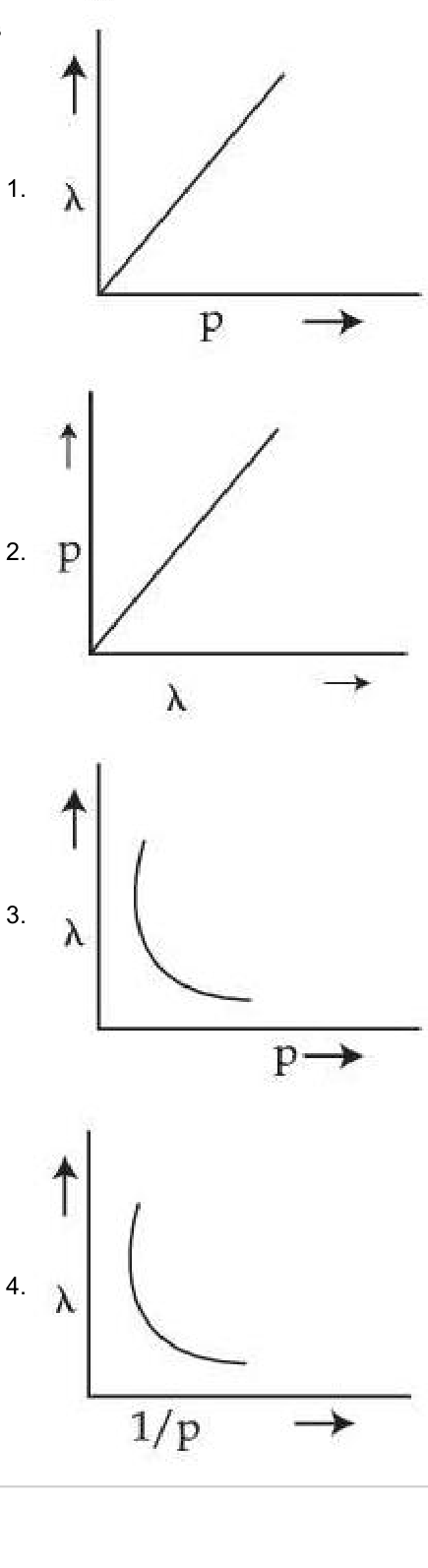
- ADrawn graph: the vertical axis is labelled λ and the horizontal axis p; a straight line rising from the origin with positive slope.
- BDrawn graph: the vertical axis is labelled p and the horizontal axis λ; a straight line rising from the origin with positive slope.
- CDrawn graph: the vertical axis is labelled λ and the horizontal axis p; a curve that starts high just to the right of the vertical axis and falls steeply, then flattens out as it approaches the horizontal axis.
- DDrawn graph: the vertical axis is labelled λ and the horizontal axis 1/p; a curve that starts high just to the right of the vertical axis and falls steeply, then flattens out as it approaches the horizontal axis.
No verified answer or solution is available for this question.
Given below are two statements : one is labelled as Assertion (A) and the other is labelled as Reason (R). Assertion (A) : PH₃ has lower boiling point than NH₃. Reason (R) : In liquid state NH₃ molecules are associated through vander Waal's forces, but PH₃ molecules are associated through hydrogen bonding. In the light of the above statements, choose the most appropriate answer from the options given below :
- A(A) is not correct but (R) is correct
- B(A) is correct but (R) is not correct
- CBoth (A) and (R) are correct but (R) is not the correct explanation of (A)
- DBoth (A) and (R) are correct and (R) is the correct explanation of (A)
No verified answer or solution is available for this question.
Organic Compounds Containing Oxygen
Match List - I with List - II. List - I (Reactions) (A) CH₃(CH₂)₅–C–OC₂H₅ → CH₃(CH₂)₅CHO (B) C₆H₅COC₆H₅ → C₆H₅CH₂C₆H₅ (C) C₆H₅CHO → C₆H₅CH(OH)CH₃ (D) CH₃COCH₂COOC₂H₅ → CH₃C(OH)CH₂COOC₂H₅ List - II (Reagents) (I) CH₃MgBr, H₂O (II) Zn(Hg) and conc. HCl (III) NaBH₄, H⁺ (IV) DIBAL-H, H₂O Choose the correct answer from the options given below :
- A(A)-(IV), (B)-(II), (C)-(I), (D)-(III)
- B(A)-(III), (B)-(IV), (C)-(II), (D)-(I)
- C(A)-(III), (B)-(IV), (C)-(I), (D)-(II)
- D(A)-(IV), (B)-(II), (C)-(III), (D)-(I)
No verified answer or solution is available for this question.
Purification and Characterisation of Organic Compounds
In Kjeldahl's method for estimation of nitrogen, CuSO₄ acts as :
- Aoxidising agent
- Bcatalytic agent
- Creducing agent
- Dhydrolysis agent
No verified answer or solution is available for this question.
Given below are two statements : Statement (I) : Potassium hydrogen phthalate is a primary standard for standardisation of sodium hydroxide solution. Statement (II) : In this titration phenolphthalein can be used as indicator. In the light of the above statements, choose the most appropriate answer from the options given below :
- ABoth Statement I and Statement II are correct
- BBoth Statement I and Statement II are incorrect
- CStatement I is correct but Statement II is incorrect
- DStatement I is incorrect but Statement II is correct
No verified answer or solution is available for this question.
In case of isoelectronic species the size of F⁻, Ne and Na⁺ is affected by :
- ANuclear charge (z)
- BNone of the factors because their size is the same
- CElectron-electron interaction in the outer orbitals
- DPrincipal quantum number (n)
No verified answer or solution is available for this question.
If one strand of a DNA has the sequence ATGCTTCA, sequence of the bases in complementary strand is :
- ATACGAAGT
- BGTACTTAC
- CCATTAGCT
- DATGCGACT
No verified answer or solution is available for this question.
Given below are two statements : Statement (I) : The NH₂ group in Aniline is ortho and para directing and a powerful activating group. Statement (II) : Aniline does not undergo Friedel-Craft's reaction (alkylation and acylation). In the light of the above statements, choose the most appropriate answer from the options given below :
- ABoth Statement I and Statement II are correct
- BBoth Statement I and Statement II are incorrect
- CStatement I is incorrect but Statement II is correct
- DStatement I is correct but Statement II is incorrect
No verified answer or solution is available for this question.
Given below are two statements : Statement (I) : A solution of [Ni(H₂O)₆]²⁺ is green in colour. Statement (II) : A solution of [Ni(CN)₄]²⁻ is colourless. In the light of the above statements, choose the most appropriate answer from the options given below :
- AStatement I is incorrect but Statement II is correct
- BBoth Statement I and Statement II are incorrect
- CBoth Statement I and Statement II are correct
- DStatement I is correct but Statement II is incorrect
No verified answer or solution is available for this question.
Organic Compounds Containing Halogens
Given below are two statements : one is labelled as Assertion (A) and the other is labelled as Reason (R). Assertion (A) : Haloalkanes react with KCN to form alkyl cyanides as a main product while with AgCN form isocyanide as the main product. Reason (R) : KCN and AgCN both are highly ionic compounds. In the light of the above statements, choose the most appropriate answer from the options given below :
- A(A) is correct but (R) is not correct
- BBoth (A) and (R) are correct but (R) is not the correct explanation of (A)
- C(A) is not correct but (R) is correct
- DBoth (A) and (R) are correct and (R) is the correct explanation of (A)
No verified answer or solution is available for this question.
Organic Compounds Containing Nitrogen
Given below are two statements : Statement (I) : Aminobenzene and aniline are same organic compounds. Statement (II) : Aminobenzene and aniline are different organic compounds. In the light of the above statements, choose the most appropriate answer from the options given below :
- AStatement I is incorrect but Statement II is correct
- BBoth Statement I and Statement II are correct
- CStatement I is correct but Statement II is incorrect
- DBoth Statement I and Statement II are incorrect
No verified answer or solution is available for this question.
Some Basic Principles of Organic Chemistry
Which of the following compound will most easily be attacked by an electrophile ?
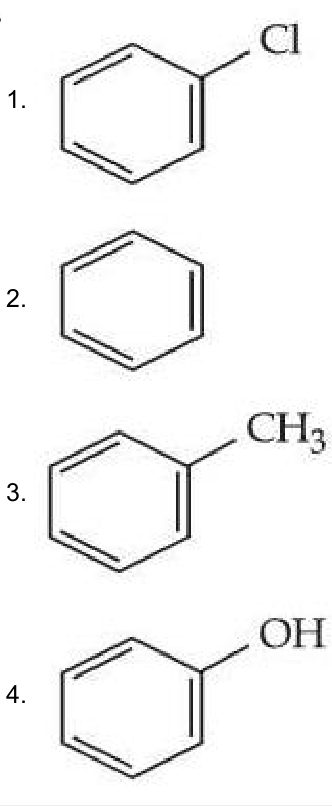
- ADrawn structure: a benzene ring drawn with three alternating double bonds with a –Cl group on the upper-right vertex.
- BDrawn structure: a benzene ring drawn with three alternating double bonds with no substituent.
- CDrawn structure: a benzene ring drawn with three alternating double bonds with a –CH₃ group on the upper-right vertex.
- DDrawn structure: a benzene ring drawn with three alternating double bonds with an –OH group on the upper-right vertex.
No verified answer or solution is available for this question.
Redox Reactions and Electrochemistry
Which of the following reactions are disproportionation reactions ? (A) Cu⁺ → Cu²⁺ + Cu (B) 3MnO₄²⁻ + 4H⁺ → 2MnO₄⁻ + MnO₂ + 2H₂O (C) 2KMnO₄ → K₂MnO₄ + MnO₂ + O₂ (D) 2MnO₄⁻ + 3Mn²⁺ + 2H₂O → 5MnO₂ + 4H⁺ Choose the correct answer from the options given below :
- A(A), (B)
- B(A), (D)
- C(B), (C), (D)
- D(A), (B), (C)
No verified answer or solution is available for this question.
Total number of deactivating groups in aromatic electrophilic substitution reaction among the following is ________. [Figure]

No verified answer or solution is available for this question.
Some Basic Principles of Organic Chemistry
Number of optical isomers possible for 2-chlorobutane ________.
No verified answer or solution is available for this question.
Principles Related to Practical Chemistry
Consider the following reaction : 3PbCl₂ + 2(NH₄)₃PO₄ → Pb₃(PO₄)₂ + 6NH₄Cl If 72 mmol of PbCl₂ is mixed with 50 mmol of (NH₄)₃PO₄ then the amount of Pb₃(PO₄)₂ formed is _________ mmol (nearest integer).
No verified answer or solution is available for this question.
Redox Reactions and Electrochemistry
The lowest oxidation number of an atom in a compound A₂B is −2. The number of electrons in its valence shell is _________.
No verified answer or solution is available for this question.
The ratio of ¹⁴C/¹²C in a piece of wood is 1/8 part that of atmosphere. If half life of ¹⁴C is 5730 years, the age of wood sample is _______ years.
No verified answer or solution is available for this question.
Redox Reactions and Electrochemistry
The potential for the given half cell at 298 K is (−) ________ ×10⁻²V. 2H⁺(aq) + 2e⁻ ⟶ H₂(g) [H⁺]=1M, P_H₂ = 2 atm (Given : 2.303RT/F = 0.06 V, log2 = 0.3)
No verified answer or solution is available for this question.
Among the following oxides of p-block elements, number of oxides having amphoteric nature is _________. Cl₂O₇, CO, PbO₂, N₂O, NO, Al₂O₃, SiO₂, N₂O₅, SnO₂
No verified answer or solution is available for this question.
The number of white coloured salts, among the following is ________. (a) SrSO₄ (b) Mg(NH₄)PO₄ (c) BaCrO₄ (d) Mn(OH)₂ (e) PbSO₄ (f) PbCrO₄ (g) AgBr (h) PbI₂ (i) CaC₂O₄ (j) [Fe(OH)₂(CH₃COO)]
No verified answer or solution is available for this question.
Chemical Bonding and Molecular Structure
The number of molecules/ion/s having trigonal bipyramidal shape is ________. PF₅, BrF₅, PCl₅, [PtCl₄]²⁻, BF₃, Fe(CO)₅
No verified answer or solution is available for this question.
Kₐ for CH₃COOH is 1.8 × 10⁻⁵ and K_b for NH₄OH is 1.8 × 10⁻⁵. The pH of ammonium acetate solution will be ________.
No verified answer or solution is available for this question.