
// JEE (Main) / 2023
JEE (Main) 2023 Session 2, 13 April 2023, Shift 2 — Paper 1 (B.E / B.Tech) Chemistry
Chemistry · B.E / B.Tech
Work through the questions
30 questions
Take a moment to try each question before opening the available answer or solution.
What happens when methane undergoes combustion in systems A and B respectively? Adiabatic system (System A) Diathermic container (System B)
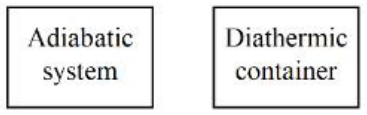
- ASystem A: Temperature rises, System B: Temperature remains same
- BSystem A: Temperature falls, System B: Temperature remains same
- CSystem A: Temperature falls, System B: Temperature rises
- DSystem A: Temperature remains same, System B: Temperature rises
View answer or solution
Answer
System A: Temperature rises, System B: Temperature remains same
Chemical Bonding and Molecular Structure
Given below are two statements : Statement I : SO₂ and H₂O both possess V-shaped structure. Statement II : The bond angle of SO₂ is less than that of H₂O. In the light of the above statements, choose the most appropriate answer from the options given below:
- ABoth Statement I and Statement II are correct
- BStatement I is correct but Statement II is incorrect
- CStatement I is incorrect but Statement II is correct
- DBoth Statement I and Statement II are incorrect
View answer or solution
Answer
Statement I is correct but Statement II is incorrect
Identify the correct order of standard enthalpy of formation of sodium halides.
- ANaCl < NaF < NaBr < NaI
- BNaI < NaBr < NaF < NaCl
- CNaF < NaCl < NaBr < NaI
- DNaI < NaBr < NaCl < NaF
View answer or solution
Answer
NaI < NaBr < NaCl < NaF
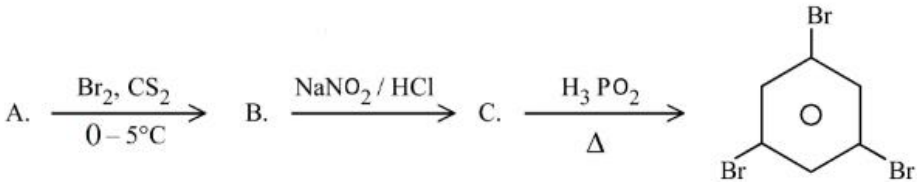
Compound A from the following reaction sequence is: A. —Br₂, CS₂ / 0 – 5°C→ B. —NaNO₂ / HCl→ C. —H₃PO₂ / Δ→ [a benzene ring drawn as a hexagon with a circle inside, with Br on the top vertex and Br on the lower-left vertex and Br on the lower-right vertex]
- APhenol
- BBenzoic Acid
- CAniline
- DSalicylic Acid
View answer or solution
Answer
Aniline
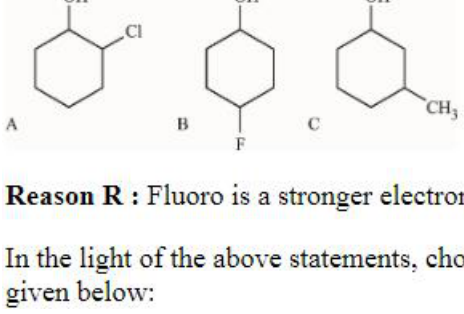
Given below are two statements, one is labelled as Assertion A and the other is labelled as Reason R. Assertion A : Order of acidic nature of the following compounds is A > B > C. [compound A: a cyclohexane ring drawn as a hexagon with OH on the top vertex and Cl on the upper-right vertex; compound B: a cyclohexane ring drawn as a hexagon with OH on the top vertex and F on the bottom vertex; compound C: a cyclohexane ring drawn as a hexagon with OH on the top vertex and CH₃ on the lower-right vertex] Reason R : Fluoro is a stronger electron withdrawing group than Chloro group. In the light of the above statements, choose the correct answer from the options given below:
- AA is false but R is true
- BBoth A and R are correct but R is NOT the correct explanation of A
- CBoth A and R are correct and R is the correct explanation of A
- DA is true but R is false
View answer or solution
Answer
Both A and R are correct but R is NOT the correct explanation of A
Principles Related to Practical Chemistry
Given below are two statements, one is labelled as Assertion A and the other is labelled as Reason R. Assertion A : The diameter of colloidal particles in solution should not be much smaller than wavelength of light to show Tyndall effect. Reason R : The light scatters in all directions when the size of particles is large enough. In the light of the above statements, choose the correct answer from the options given below:
- AA is true but R is false
- BA is false but R is true
- CBoth A and R are correct but R is NOT the correct explanation of A
- DBoth A and R are correct and R is the correct explanation of A
View answer or solution
Answer
Both A and R are correct and R is the correct explanation of A
Match List I with List II 1 - Bromopropane is reacted with reagents in List I to give product in List II LIST I - Reagent A. KOH (alc) B. KCN (alc) C. AgNO₂ D. H₃CCOOAg LIST II - Product I. Nitrile II. Ester III. Alkene IV. Nitroalkane Choose the correct answer from the options given below:
- AA-IV, B-III, C-II, D-I
- BA-I, B-III, C-IV, D-II
- CA-I, B-II, C-III, D-IV
- DA-III, B-I, C-IV, D-II
View answer or solution
Answer
A-III, B-I, C-IV, D-II
Redox Reactions and Electrochemistry
The covalency and oxidation state respectively of boron in [BF₄]⁻, are
- A4 and 4
- B3 and 5
- C4 and 3
- D3 and 4
View answer or solution
Answer
4 and 3
Redox Reactions and Electrochemistry
The correct group of halide ions which can be oxidised by oxygen in acidic medium is
- AI⁻ only
- BBr⁻ only
- CBr⁻ and I⁻ only
- DCl⁻, Br⁻ and I⁻ only
View answer or solution
Answer
I⁻ only
Classification of Elements and Periodicity in Properties
Better method for preparation of BeF₂, among the following is
- ABe + F₂ —Δ→ BeF₂
- B(NH₄)₂BeF₄ —Δ→ BeF₂
- CBeH₂ + F₂ —Δ→ BeF₂
- DBeO + C + F₂ —Δ→ BeF₂
View answer or solution
Answer
(NH₄)₂BeF₄ —Δ→ BeF₂
Organic Compounds Containing Nitrogen
The major product for the following reaction is: CH₂=CH–CN —HO–CH₂–CH₂–SH→
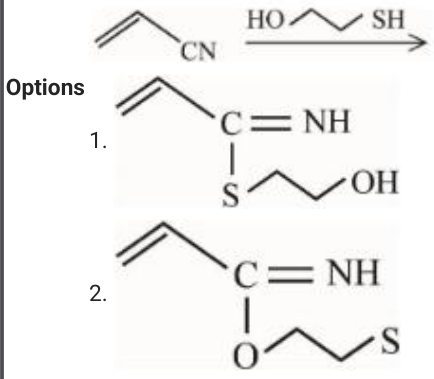
- ACH₂=CH–C(=NH)–S–CH₂–CH₂–OH
- BCH₂=CH–C(=NH)–O–CH₂–CH₂–SH
- CHS–CH₂–CH₂–O–CH₂–CH₂–CN
- DHO–CH₂–CH₂–S–CH₂–CH₂–CN
View answer or solution
Answer
HO–CH₂–CH₂–S–CH₂–CH₂–CN
Given below are two statements, one is labelled as Assertion A and the other is labelled as Reason R. Assertion A : Isotopes of hydrogen have almost same chemical properties, but difference in their rates of reaction. Reason R : Isotopes of hydrogen have different enthalpy of bond dissociation. In the light of the above statements, choose the most appropriate answer from the options given below:
- AA is not correct but R is correct
- BBoth A and R are correct and R is the correct explanation of A
- CA is correct but R is not correct
- DBoth A and R are correct but R is NOT the correct explanation of A
View answer or solution
Answer
Both A and R are correct and R is the correct explanation of A
Which of the following complexes will exhibit maximum attraction to an applied magnetic field?
- A[Zn(H₂O)₆]²⁺
- B[Co(en)₃]³⁺
- C[Co(H₂O)₆]²⁺
- D[Ni(H₂O)₆]²⁺
View answer or solution
Answer
[Co(H₂O)₆]²⁺
Some Basic Principles of Organic Chemistry
The naturally occurring amino acid that contains only one basic functional group in its chemical structure is
- Aasparagine
- Barginine
- Chistidine
- Dlysine
View answer or solution
Answer
asparagine
Organic Compounds Containing Oxygen
Match List I with List II LIST I A. Weak intermolecular forces of attraction B. Hydrogen bonding C. Heavily branched polymer D. High density polymer LIST II I. Hexamethylenediamine + adipic acid II. AlEt₃ + TiCl₄ III. 2-chloro-1, 3-butadiene IV. Phenol + formaldehyde Choose the correct answer from the options given below:
- AA-III, B-I, C-IV, D-II
- BA-IV, B-I, C-III, D-II
- CA-II, B-IV, C-I, D-III
- DA-IV, B-II, C-III, D-I
View answer or solution
Answer
A-III, B-I, C-IV, D-II
Principles Related to Practical Chemistry
Which of the following are the Green house gases? A. Water vapour B. Ozone C. I₂ D. Molecular hydrogen Choose the most appropriate answer from the options given below:
- AB and C only
- BA and B only
- CC and D only
- DA and D only
View answer or solution
Answer
A and B only
The total number of stereoisomers for the complex [Cr(ox)₂ClBr]³⁻ (where ox = oxalate) is:
- A2
- B4
- C1
- D3
View answer or solution
Answer
3
Organic Compounds Containing Halogens
Given below are two statements related to Ellingham diagram: Statement I : Ellingham diagrams can be constructed for formation of oxides, sulfides and halides of metals. Statement II : It consists of plots of ΔfH⁰ vs T for formation of oxides of elements. In the light of the above statements, choose the most appropriate answer from the options given below:
- ABoth Statement I and Statement II are correct
- BStatement I is incorrect but Statement II is correct
- CStatement I is correct but Statement II is incorrect
- DBoth Statement I and Statement II are incorrect
View answer or solution
Answer
Statement I is correct but Statement II is incorrect
Principles Related to Practical Chemistry
In the wet tests for detection of various cations by precipitation, Ba²⁺ cations are detected by obtaining precipitate of
- ABa(OAc)₂
- BBa(ox) : Barium oxalate
- CBaCO₃
- DBaSO₄
View answer or solution
Answer
BaCO₃
Some Basic Principles of Organic Chemistry
Given below are two statements : Statement I : Tropolone is an aromatic compound and has 8 π electrons. Statement II : π electrons of >C = O group in tropolone is involved in aromaticity. In the light of the above statements, choose the correct answer from the options given below:
- ABoth Statement I and Statement II are true
- BStatement I is true but Statement II is false
- CStatement I is false but Statement II is true
- DBoth Statement I and Statement II are false
View answer or solution
Answer
Statement I is true but Statement II is false
Sea water contains 29.25% NaCl and 19% MgCl₂ by weight of solution. The normal boiling point of the sea water is __________ °C (Nearest integer) Assume 100% ionization for both NaCl and MgCl₂ Given : K_b(H₂O) = 0.52 K kg mol⁻¹ Molar mass of NaCl and MgCl₂ is 58.5 and 95 g mol⁻¹ respectively.
View answer or solution
Answer
116
A(g) → 2B (g) + C (g) is a first order reaction. The initial pressure of the system was found to be 800 mm Hg which increased to 1600 mm Hg after 10 min. The total pressure of the system after 30 min will be __________ mm Hg. (Nearest integer)
View answer or solution
Answer
2200
20 mL of 0.1 M NaOH is added to 50 mL of 0.1 M acetic acid solution. The pH of the resulting solution is __________ × 10⁻² (Nearest integer) Given : pKa (CH₃ COOH) = 4.76 log 2 = 0.30 log 3 = 0.48
View answer or solution
Answer
458
Some Basic Concepts in Chemistry
1g of a carbonate (M₂CO₃) on treatment with excess HCl produces 0.01 mol of CO₂. The molar mass of M₂CO₃ is ______ g mol⁻¹. (Nearest integer)
View answer or solution
Answer
100
Chemical Bonding and Molecular Structure
Sodium metal crystallizes in a body centred cubic lattice with unit cell edge length of 4 Å. The radius of sodium atom is ______ × 10⁻¹ Å (Nearest integer)
View answer or solution
Answer
17
See the following chemical reaction: Cr₂O₇²⁻ + X H⁺ + 6Fe²⁺ → Y Cr³⁺ + 6Fe³⁺ + Z H₂O The sum of X, Y and Z is __________
View answer or solution
Answer
23
Purification and Characterisation of Organic Compounds
0.400 g of an organic compound (X) gave 0.376 g of AgBr in Carius method for estimation of bromine. % of bromine in the compound (X) is __________ . (Given: Molar mass AgBr = 188 g mol⁻¹ Br = 80 g mol⁻¹)
View answer or solution
Answer
40
At 298 K, the standard reduction potential for Cu²⁺ / Cu electrode is 0.34 V. Given : Kₛₚ Cu(OH)₂ = 1 × 10⁻²⁰ Take 2.303RT/F = 0.059V The reduction potential at pH = 14 for the above couple is (-)x × 10⁻² V. The value of x is __________
View answer or solution
Answer
25
If the formula of Borax is Na₂B₄Oₓ(OH)ᵧ · zH₂O, then x + y + z = __________
View answer or solution
Answer
17
The orbital angular momentum of an electron in 3s orbital is xh/2π. The value of x is __________ (nearest integer)
View answer or solution
Answer
0