
// THE QUESTION BANK
A little focus.
A better attempt.
Find your topic. Work through a few questions. Open the official answer when one is available.
Loading your next set of questions…
// THE QUESTION BANK
Find your topic. Work through a few questions. Open the official answer when one is available.
YOUR SELECTION
Showing 1–12 · 17 papers
Question 58
From JEE (Main) 2025 Session 1, 22 January 2025, Shift 1 — Paper 1 (B.E / B.Tech) Chemistry
From the magnetic behaviour of [NiCl₄]²⁻ (paramagnetic) and [Ni(CO)₄] (diamagnetic), choose the correct geometry and oxidation state.
Choose an option first, then open the answer.
Question from the source paper. Answer from the official final answer key (the key rows carrying this paper's Question IDs), version of 2025-02-12. Published documents are listed by the exam body at its document index.
Question 59
From JEE (Main) 2025 Session 1, 22 January 2025, Shift 1 — Paper 1 (B.E / B.Tech) Chemistry
A solution of aluminium chloride is electrolysed for 30 minutes using a current of 2A. The amount of the aluminium deposited at the cathode is ________. [Given : molar mass of aluminium and chlorine are 27 g mol⁻¹ and 35.5 g mol⁻¹ respectively. Faraday constant =96500 C mol⁻¹]
Choose an option first, then open the answer.
Question from the source paper. Answer from the official final answer key (the key rows carrying this paper's Question IDs), version of 2025-02-12. Published documents are listed by the exam body at its document index.
Question 64
From JEE (Main) 2025 Session 1, 22 January 2025, Shift 1 — Paper 1 (B.E / B.Tech) Chemistry
Which of the following electrolyte can be used to obtain H₂S₂O₈ by the process of electrolysis ?
Choose an option first, then open the answer.
Question from the source paper. Answer from the official final answer key (the key rows carrying this paper's Question IDs), version of 2025-02-12. Published documents are listed by the exam body at its document index.
Question 63
From JEE (Main) 2025 Session 1, 22 January 2025, Shift 2 — Paper 1 (B.E / B.Tech) Chemistry
Given below are two statements : Statement (I) : Corrosion is an electrochemical phenomenon in which pure metal acts as an anode and impure metal as a cathode. Statement (II) : The rate of corrosion is more in alkaline medium than in acidic medium. In the light of the above statements, choose the correct answer from the options given below :
Choose an option first, then open the answer.
Question from the source paper. Answer from the official final answer key (the key rows carrying this paper's Question IDs), version of 2025-02-12. Published documents are listed by the exam body at its document index.
Question 67
From JEE (Main) 2025 Session 1, 22 January 2025, Shift 2 — Paper 1 (B.E / B.Tech) Chemistry
The species which does not undergo disproportionation reaction is :
Choose an option first, then open the answer.
Question from the source paper. Answer from the official final answer key (the key rows carrying this paper's Question IDs), version of 2025-02-12. Published documents are listed by the exam body at its document index.
Question 52
From JEE (Main) 2025 Session 1, 23 January 2025, Shift 1 — Paper 1 (B.E / B.Tech) Chemistry
FeO₄²⁻ —(+2.0 V)→ Fe³⁺ —(0.8 V)→ Fe²⁺ —(−0.5 V)→ Fe⁰ In the above diagram, the standard electrode potentials are given in volts (over the arrow). The value of E⊖(FeO₄²⁻/Fe²⁺) is

Choose an option first, then open the answer.
Question from the source paper. Answer from the official final answer key (the key rows carrying this paper's Question IDs), version of 2025-02-12. Published documents are listed by the exam body at its document index.
Question 56
From JEE (Main) 2025 Session 1, 23 January 2025, Shift 2 — Paper 1 (B.E / B.Tech) Chemistry
Standard electrode potentials for a few half cells are mentioned below : E°_(Cu²⁺/Cu) = 0.34 V, E°_(Zn²⁺/Zn) = −0.76 V E°_(Ag⁺/Ag) = 0.80 V, E°_(Mg²⁺/Mg) = −2.37 V Which one of the following cells gives the most negative value of ΔG° ?
Choose an option first, then open the answer.
Question from the source paper. Answer from the official final answer key (the key rows carrying this paper's Question IDs), version of 2025-02-12. Published documents are listed by the exam body at its document index.
Question 58
From JEE (Main) 2025 Session 1, 23 January 2025, Shift 2 — Paper 1 (B.E / B.Tech) Chemistry
Consider the following reactions K₂Cr₂O₇ ⟶[ KOH, −H₂O ] [A] ⟶[ H₂SO₄, −H₂O ] [B] + K₂SO₄ The products [A] and [B], respectively are :
Choose an option first, then open the answer.
Question from the source paper. Answer from the official final answer key (the key rows carrying this paper's Question IDs), version of 2025-02-12. Published documents are listed by the exam body at its document index.
Question 62
From JEE (Main) 2025 Session 1, 24 January 2025, Shift 1 — Paper 1 (B.E / B.Tech) Chemistry
For the given cell Fe²⁺(aq) + Ag⁺(aq) → Fe³⁺(aq) + Ag(s) The standard cell potential of the above reaction is Given: Ag⁺ + e⁻ → Ag E^θ = x V Fe²⁺ + 2e⁻ → Fe E^θ = y V Fe³⁺ + 3e⁻ → Fe E^θ = z V
Choose an option first, then open the answer.
Question from the source paper. Answer from the official final answer key (the key rows carrying this paper's Question IDs), version of 2025-02-12. Published documents are listed by the exam body at its document index.
Question 61
From JEE (Main) 2025 Session 1, 24 January 2025, Shift 2 — Paper 1 (B.E / B.Tech) Chemistry
Match List - I with List - II. List - I (A) RCN →[ (i) SnCl₂, HCl, (ii) H₃O⁺ ] RCHO (B) C₆H₅COCl →[ H₂/Pd-BaSO₄ ] C₆H₅CHO (C) C₆H₅CH₃ →[ (i) CrO₂Cl₂, CS₂, (ii) H₃O⁺ ] C₆H₅CHO (D) C₆H₆ →[ (i) CO, HCl, (ii) anhydrous AlCl₃/CuCl ] C₆H₅CHO List - II (I) Etard reaction (II) Gattermann-Koch reaction (III) Rosenmund reduction (IV) Stephen reaction Choose the correct answer from the options given below :
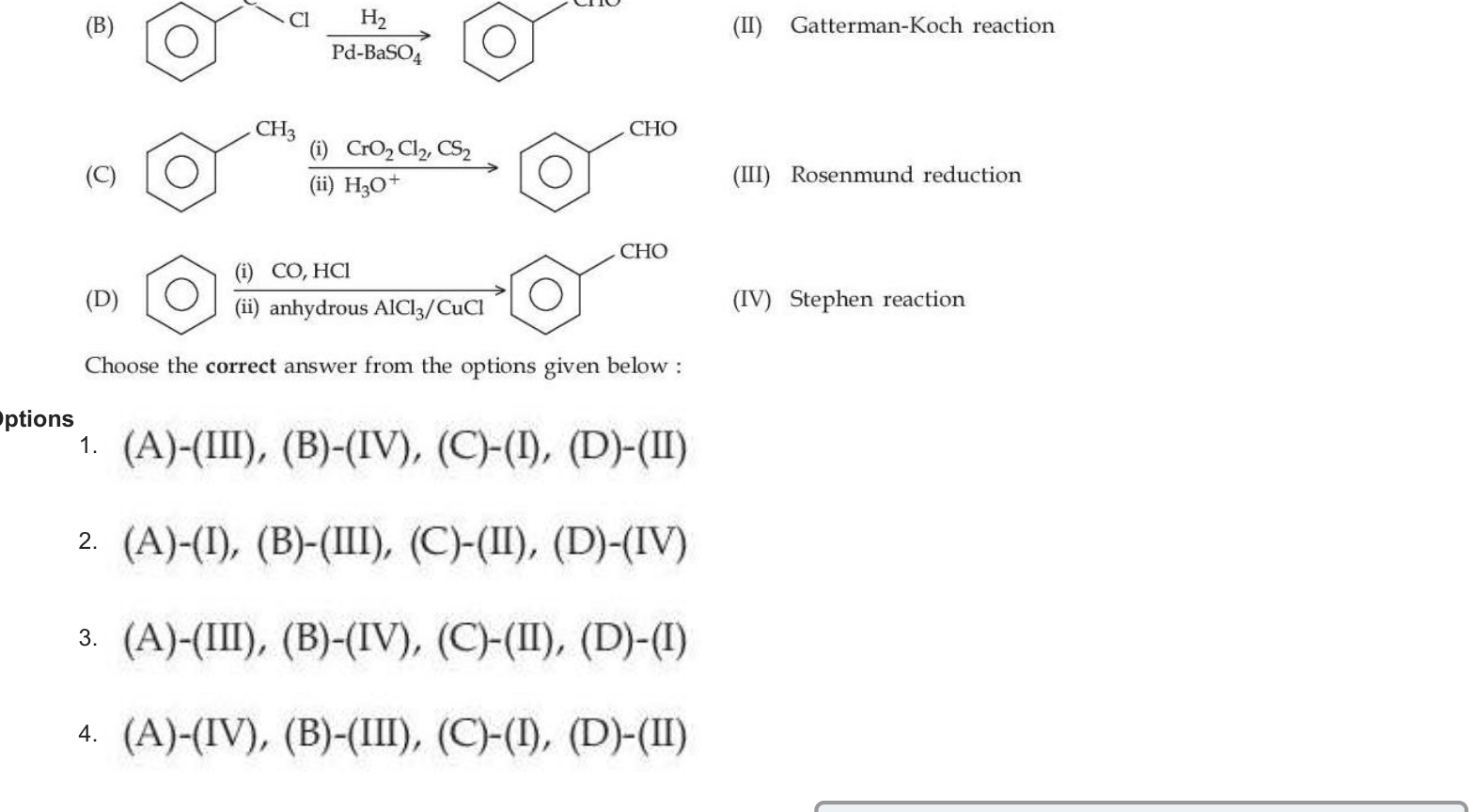
Choose an option first, then open the answer.
Question from the source paper. Answer from the official final answer key (the key rows carrying this paper's Question IDs), version of 2025-02-12. Published documents are listed by the exam body at its document index.
Question 63
From JEE (Main) 2025 Session 1, 24 January 2025, Shift 2 — Paper 1 (B.E / B.Tech) Chemistry
Based on the data given below : E°(Cr₂O₇²⁻/Cr³⁺) = 1.33 V, E°(Cl₂/Cl⁻) = 1.36 V E°(MnO₄⁻/Mn²⁺) = 1.51 V, E°(Cr³⁺/Cr) = −0.74 V the strongest reducing agent is :
Choose an option first, then open the answer.
Question from the source paper. Answer from the official final answer key (the key rows carrying this paper's Question IDs), version of 2025-02-12. Published documents are listed by the exam body at its document index.
Question 75
From JEE (Main) 2025 Session 1, 24 January 2025, Shift 2 — Paper 1 (B.E / B.Tech) Chemistry
The observed and normal molar masses of compound MX₂ are 65.6 and 164 respectively. The percent degree of ionisation of MX₂ is ________%. (Nearest integer)
This question was printed without answer options.
Open the answer when you are ready.
Question from the source paper. Answer from the official final answer key (the key rows carrying this paper's Question IDs), version of 2025-02-12. Published documents are listed by the exam body at its document index.
Questions the exam body withdrew, and questions that need unavailable source figures, are stored with their papers and withheld here. Each served question links to its source paper.
This is self-study practice. It does not issue assessment results, certificates or profile proof. Attempts on this page reset when you leave it.