
// JEE (Main) / 2025
JEE (Main) 2025 Session 1, 23 January 2025, Shift 2 — Paper 1 (B.E / B.Tech) Chemistry
Chemistry · B.E / B.Tech
Work through the questions
25 questions
Take a moment to try each question before opening the available answer or solution.
Consider the reaction X₂Y(g) ⇌ X₂(g) + ½Y₂(g) The equation representing correct relationship between the degree of dissociation (x) of X₂Y(g) with its equilibrium constant Kp is ________. Assume x to be very very small.
- Ax = ∛(Kp/p)
- Bx = ∛(2Kp²/p)
- Cx = ∛(2Kp/p)
- Dx = ∛(Kp/2p)
View answer or solution
Answer
x = ∛(2Kp²/p)
Given below are the atomic numbers of some group 14 elements. The atomic number of the element with lowest melting point is :
- A82
- B6
- C14
- D50
View answer or solution
Answer
50
Identify the coordination complexes in which the central metal ion has d⁴ configuration. (A) [FeO₄]²⁻ (B) [Mn(CN)₆]³⁻ (C) [Fe(CN)₆]³⁻ (D) Cr₂(O–C(=O)–Me)₄(H₂O)₂ (E) [NiF₆]²⁻ Choose the correct answer from the options given below :
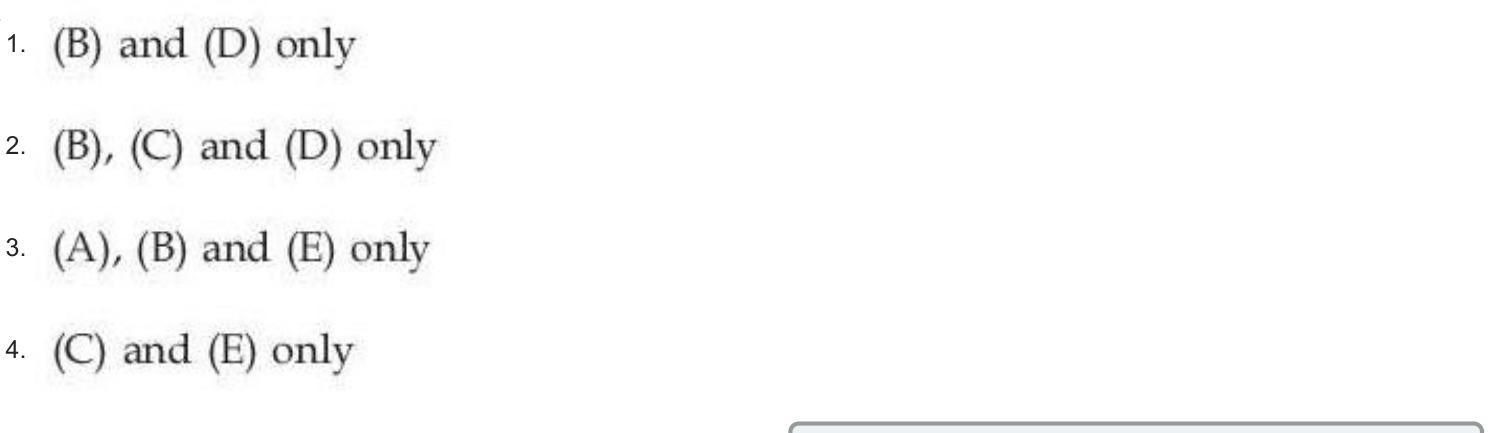
- A(B) and (D) only
- B(B), (C) and (D) only
- C(A), (B) and (E) only
- D(C) and (E) only
View answer or solution
Answer
(B) and (D) only
The α - Helix and β - Pleated sheet structures of protein are associated with its :
- Atertiary structure
- Bsecondary structure
- Cquaternary structure
- Dprimary structure
View answer or solution
Answer
secondary structure
Some Basic Concepts in Chemistry
Consider a binary solution of two volatile liquid components 1 and 2. x₁ and y₁ are the mole fractions of component 1 in liquid and vapour phase, respectively. The slope and intercept of the linear plot of 1/x₁ vs 1/y₁ are given respectively as :
- AP₁⁰/P₂⁰, (P₂⁰ − P₁⁰)/P₂⁰
- BP₂⁰/P₁⁰, (P₁⁰ − P₂⁰)/P₂⁰
- CP₁⁰/P₂⁰, (P₁⁰ − P₂⁰)/P₂⁰
- DP₂⁰/P₁⁰, (P₂⁰ − P₁⁰)/P₂⁰
View answer or solution
Answer
P₁⁰/P₂⁰, (P₂⁰ − P₁⁰)/P₂⁰
Redox Reactions and Electrochemistry
Standard electrode potentials for a few half cells are mentioned below : E°_(Cu²⁺/Cu) = 0.34 V, E°_(Zn²⁺/Zn) = −0.76 V E°_(Ag⁺/Ag) = 0.80 V, E°_(Mg²⁺/Mg) = −2.37 V Which one of the following cells gives the most negative value of ΔG° ?
- AZn | Zn²⁺ (1M)||Mg²⁺ (1M) | Mg
- BCu | Cu²⁺ (1M)||Ag⁺ (1M) | Ag
- CZn | Zn²⁺ (1M)||Ag⁺ (1M) | Ag
- DAg | Ag⁺ (1M)||Mg²⁺ (1M) | Mg
View answer or solution
Answer
Zn | Zn²⁺ (1M)||Ag⁺ (1M) | Ag
Given below are two statements : Statement (I) : The boiling points of alcohols and phenols increase with increase in the number of C-atoms. Statement (II) : The boiling points of alcohols and phenols are higher in comparison to other class of compounds such as ethers, haloalkanes. In the light of the above statements, choose the correct answer from the options given below :
- ABoth Statement I and Statement II are true
- BStatement I is false but Statement II is true
- CBoth Statement I and Statement II are false
- DStatement I is true but Statement II is false
View answer or solution
Answer
Both Statement I and Statement II are true
Redox Reactions and Electrochemistry
Consider the following reactions K₂Cr₂O₇ ⟶[ KOH, −H₂O ] [A] ⟶[ H₂SO₄, −H₂O ] [B] + K₂SO₄ The products [A] and [B], respectively are :
- AK₂CrO₄ and Cr₂O₃
- BK₂CrO₄ and K₂Cr₂O₇
- CK₂CrO₄ and CrO
- DK₂Cr(OH)₆ and Cr₂O₃
View answer or solution
Answer
K₂CrO₄ and K₂Cr₂O₇
The ascending order of relative rate of solvolysis of following compounds is :
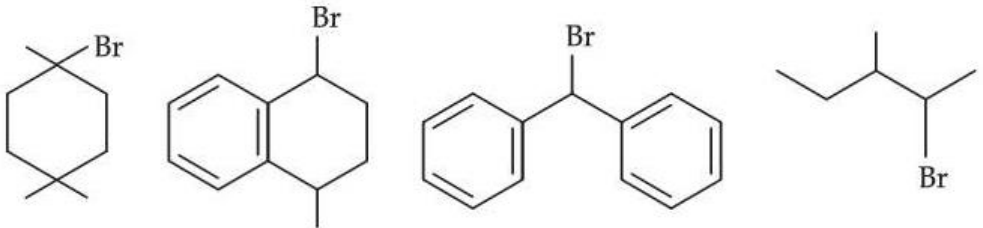
- A(D) < (A) < (B) < (C)
- B(C) < (D) < (B) < (A)
- C(C) < (B) < (A) < (D)
- D(D) < (B) < (A) < (C)
View answer or solution
Answer
(D) < (A) < (B) < (C)
Some Basic Concepts in Chemistry
Given below are two statements about X-ray spectra of elements : Statement (I) : A plot of √ν (ν = frequency of X-rays emitted) vs atomic mass is a straight line. Statement (II) : A plot of ν (ν = frequency of X-rays emitted) vs atomic number is a straight line. In the light of the above statements, choose the correct answer from the options given below :
- AStatement I is false but Statement II is true
- BBoth Statement I and Statement II are false
- CStatement I is true but Statement II is false
- DBoth Statement I and Statement II are true
View answer or solution
Answer
Both Statement I and Statement II are false
Given below are two statements : Statement (I) : For a given shell, the total number of allowed orbitals is given by n². Statement (II) : For any subshell, the spatial orientation of the orbitals is given by −l to +l values including zero. In the light of the above statements, choose the correct answer from the options given below :
- AStatement I is false but Statement II is true
- BStatement I is true but Statement II is false
- CBoth Statement I and Statement II are true
- DBoth Statement I and Statement II are false
View answer or solution
Answer
Both Statement I and Statement II are true
When a non-volatile solute is added to the solvent, the vapour pressure of the solvent decreases by 10 mm of Hg. The mole fraction of the solute in the solution is 0.2. What would be the mole fraction of the solvent if decrease in vapour pressure is 20 mm of Hg ?
- A0.6
- B0.2
- C0.8
- D0.4
View answer or solution
Answer
0.6
Match List - I with List - II. List - I (Isomers of C₁₀H₁₄) List - II (Ozonolysis product) Choose the correct answer from the options given below :
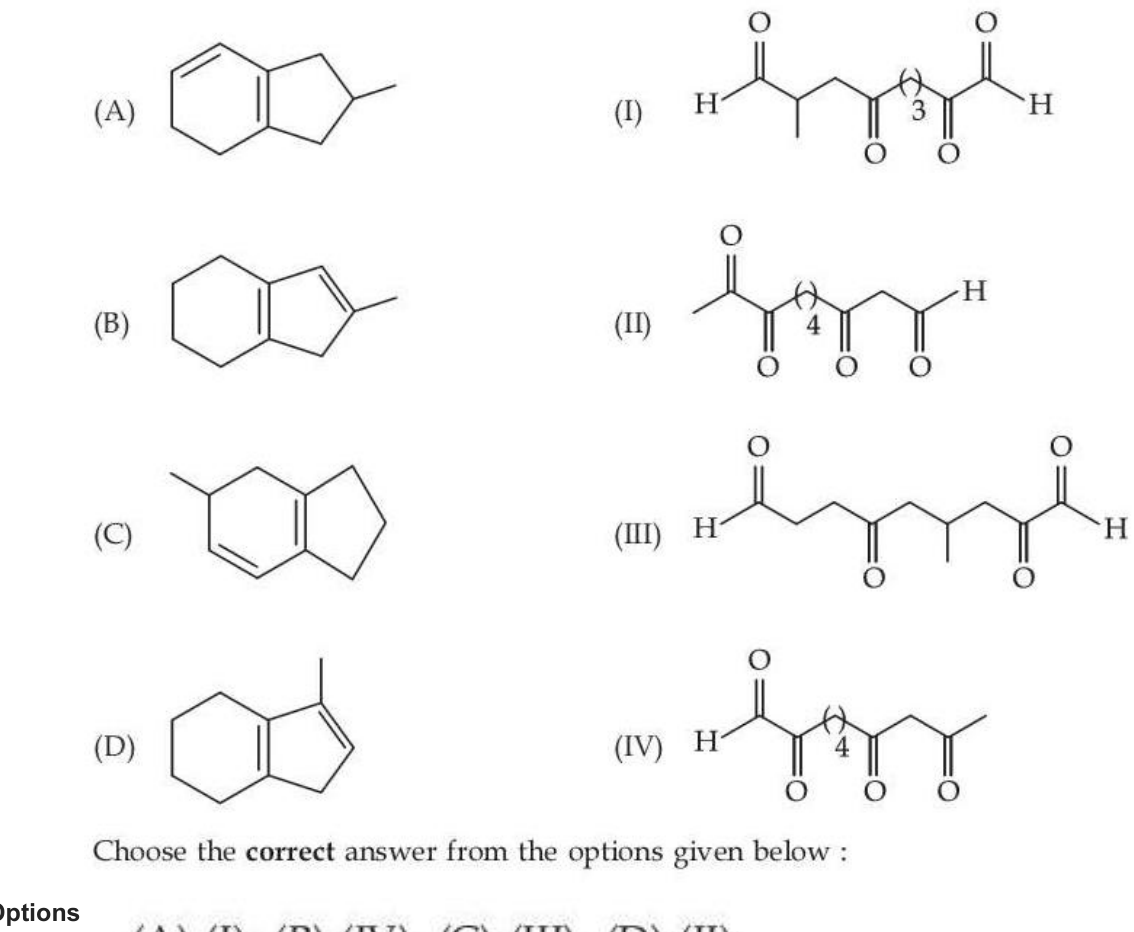
- A(A)-(I), (B)-(IV), (C)-(III), (D)-(II)
- B(A)-(III), (B)-(IV), (C)-(I), (D)-(II)
- C(A)-(II), (B)-(III), (C)-(I), (D)-(IV)
- D(A)-(III), (B)-(II), (C)-(I), (D)-(IV)
View answer or solution
Answer
(A)-(III), (B)-(IV), (C)-(I), (D)-(II)
Identify the products [A] and [B], respectively in the following reaction :
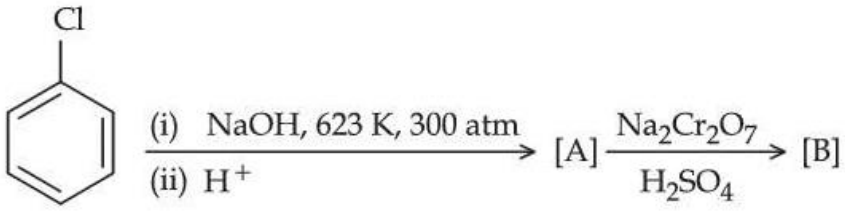
- A[A] benzene (C₆H₆), [B] cyclohexa-2,5-dien-1-one (a six-membered ring with a C=O on the top carbon and C=C bonds on the right edge and on the lower-left edge)
- B[A] benzene (C₆H₆), [B] phenol (C₆H₅–OH)
- C[A] phenol (C₆H₅–OH), [B] 1,4-benzoquinone (a six-membered ring with a C=O on the top carbon and a C=O on the bottom carbon and C=C bonds on the left edge and on the right edge)
- D[A] phenol (C₆H₅–OH), [B] sodium phenoxide (C₆H₅–O⁻ Na⁺)
View answer or solution
Answer
[A] phenol (C₆H₅–OH), [B] 1,4-benzoquinone (a six-membered ring with a C=O on the top carbon and a C=O on the bottom carbon and C=C bonds on the left edge and on the right edge)
pH of water is 7 at 25°C. If water is heated to 80°C., it's pH will :
- ARemains the same
- BH⁺ concentration increases, OH⁻ concentration decreases
- CIncrease
- DDecrease
View answer or solution
Answer
Decrease
Match List - I with List - II. List - I : (A) Bronze; (B) Brass; (C) UK silver coin; (D) Stainless steel. List - II : (I) Cu, Ni; (II) Fe, Cr, Ni, C; (III) Cu, Zn; (IV) Cu, Sn. Choose the correct answer from the options given below :
- A(A)-(IV), (B)-(II), (C)-(III), (D)-(I)
- B(A)-(III), (B)-(IV), (C)-(II), (D)-(I)
- C(A)-(III), (B)-(I), (C)-(IV), (D)-(II)
- D(A)-(IV), (B)-(III), (C)-(I), (D)-(II)
View answer or solution
Answer
(A)-(IV), (B)-(III), (C)-(I), (D)-(II)
Organic Compounds Containing Oxygen
Given below are two statements : Consider the following reaction R–C(=O)–R + H₂O ⇌(K) R–C(OH)₂–R Statement (I) : In the case of formaldehyde (H–C(=O)–H), K is about 2280, due to small substituents, hydration is faster. Statement (II) : In the case of trichloro acetaldehyde (H–C(=O)–CCl₃), K is about 2000 due to −I effect of −Cl. In the light of the above statements, choose the correct answer from the options given below :

- AStatement I is false but Statement II is true
- BStatement I is true but Statement II is false
- CBoth Statement I and Statement II are false
- DBoth Statement I and Statement II are true
View answer or solution
Answer
Both Statement I and Statement II are true
Principles Related to Practical Chemistry
Identify A, B and C in the given below reaction sequence A →(HNO₃) Pb(NO₃)₂ →(H₂SO₄) B →[(1) Ammonium acetate, (2) Acetic acid, (3) K₂CrO₄] C (Yellow ppt)
- APbCl₂, Pb(SO₄)₂, PbCrO₄
- BPbCl₂, PbSO₄, PbCrO₄
- CPbS, PbSO₄, Pb(CH₃COO)₂
- DPbS, PbSO₄, PbCrO₄
View answer or solution
Answer
PbS, PbSO₄, PbCrO₄
The effect of temperature on spontaneity of reactions are represented as : | | ΔH | ΔS | Temperature | Spontaneity | |---|---|---|---|---| | (A) | + | − | any T | Non spontaneous | | (B) | + | + | low T | spontaneous | | (C) | − | − | low T | Non spontaneous | | (D) | − | + | any T | spontaneous | The incorrect combinations are :
- A(B) and (C) only
- B(B) and (D) only
- C(A) and (C) only
- D(A) and (D) only
View answer or solution
Answer
(B) and (C) only
Which of the following graphs most appropriately represents a zero order reaction ?
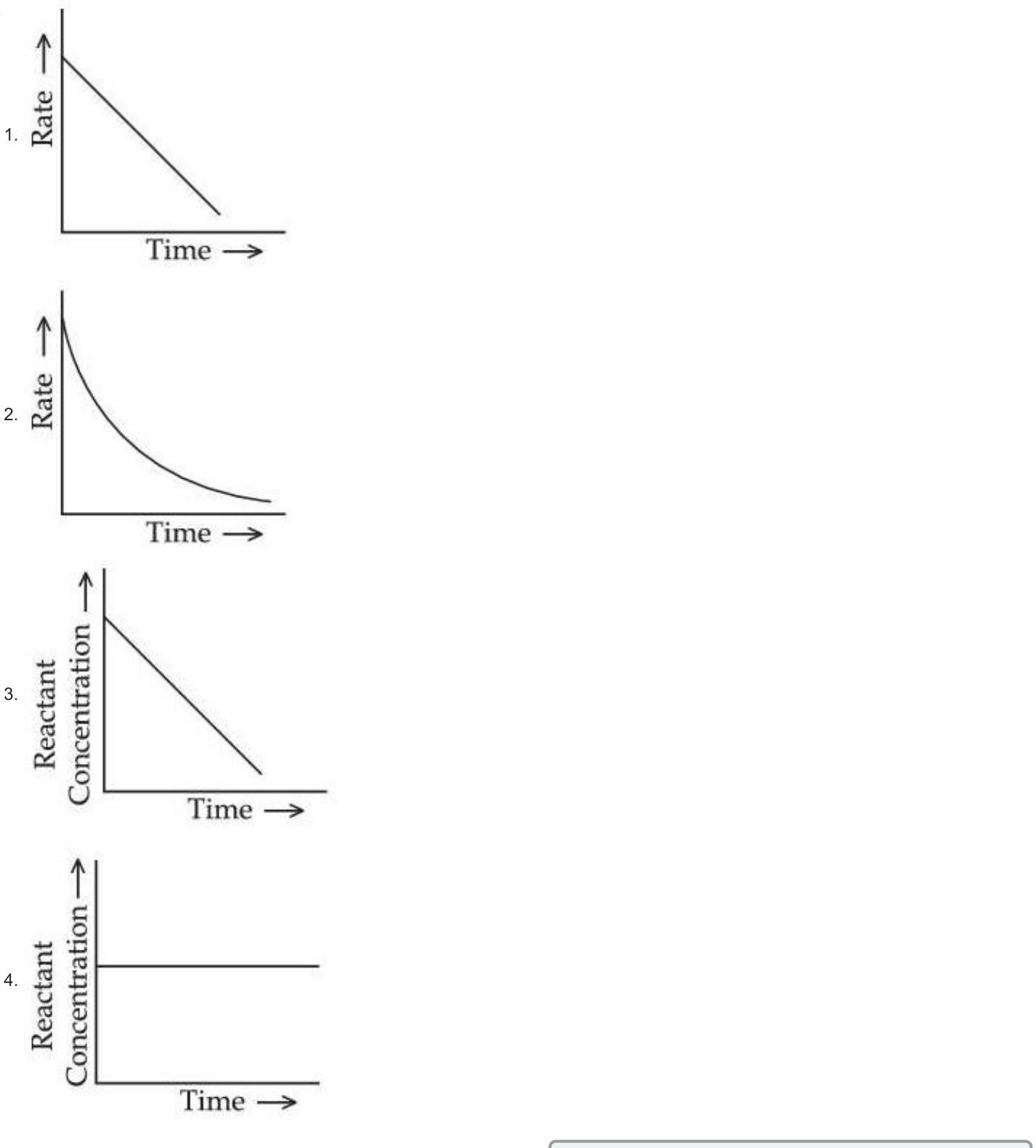
- AGraph: Rate on the vertical axis against Time on the horizontal axis; a straight line of negative slope starting from a positive value on the Rate axis and falling, ending above the Time axis.
- BGraph: Rate on the vertical axis against Time on the horizontal axis; a curve that falls steeply at first and then flattens out, approaching the Time axis asymptotically.
- CGraph: Reactant Concentration on the vertical axis against Time on the horizontal axis; a straight line of negative slope starting from a positive value on the Concentration axis and falling, ending above the Time axis.
- DGraph: Reactant Concentration on the vertical axis against Time on the horizontal axis; a horizontal straight line at a constant positive concentration.
View answer or solution
Answer
Graph: Reactant Concentration on the vertical axis against Time on the horizontal axis; a straight line of negative slope starting from a positive value on the Concentration axis and falling, ending above the Time axis.
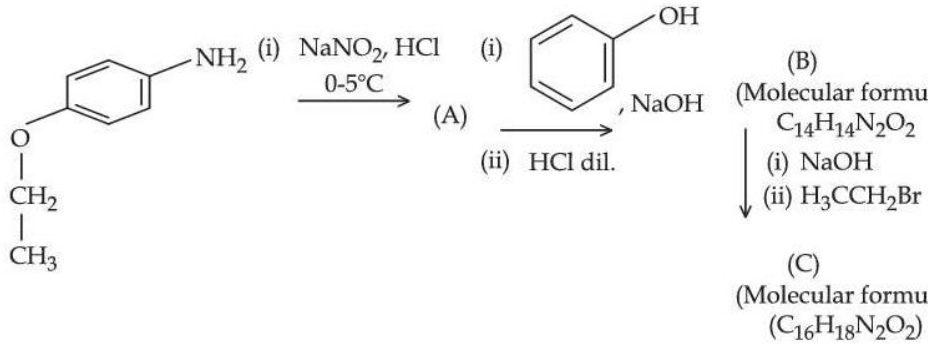
Consider the following sequence of reactions. [a benzene ring drawn in Kekulé style with NH₂ on a bond from the upper-right vertex and an O–CH₂–CH₃ group on a bond from the lower-left vertex] ⟶[ (i) NaNO₂, HCl, 0-5°C ] (A) (A) ⟶[ (i) [a benzene ring drawn in Kekulé style with OH on a bond from the upper-right vertex], NaOH; (ii) HCl dil. ] (B) (B) (Molecular formula) C₁₄H₁₄N₂O₂ ⟶[ (i) NaOH, (ii) H₃CCH₂Br ] (C) (C) (Molecular formula) (C₁₆H₁₈N₂O₂) Total number of sp³ hybridised carbon atoms in the major product C formed is _______.
View answer or solution
Answer
4
Some Basic Concepts in Chemistry
When 81.0 g of aluminium is allowed to react with 128.0 g of oxygen gas, the mass of aluminium oxide produced in grams is _______. (Nearest integer) Given : Molar mass of Al is 27.0 g mol⁻¹ Molar mass of O is 16.0 g mol⁻¹
View answer or solution
Answer
153
Some Basic Concepts in Chemistry
0.01 mole of an organic compound (X) containing 10% hydrogen, on complete combustion produced 0.9 g H₂O. Molar mass of (X) is _______ g mol⁻¹.
View answer or solution
Answer
100
The bond dissociation enthalpy of X₂ ΔH°_bond calculated from the given data is __________ kJ mol⁻¹. (Nearest integer) M⁺X⁻(s) → M⁺(g) + X⁻(g) ΔH°_lattice = 800 kJ mol⁻¹ M(s) → M(g) ΔH°_sub = 100 kJ mol⁻¹ M(g) → M⁺(g) + e⁻(g) ΔH°_i = 500 kJ mol⁻¹ X(g) + e⁻(g) → X⁻(g) ΔH°_eg = −300 kJ mol⁻¹ M(s) + (1/2)X₂(g) → M⁺X⁻(s) ΔH°_f = −400 kJ mol⁻¹ [Given : M⁺X⁻ is a pure ionic compound and X forms a diatomic molecule X₂ in gaseous state]
View answer or solution
Answer
200
Chemical Bonding and Molecular Structure
A compound 'X' absorbs 2 moles of hydrogen and 'X' upon oxidation with KMnO₄ | H⁺ gives CH₃–C(=O)–CH₃, CH₃–C(=O)–OH and CH₃–C(=O)–CH₂CH₂–C(=O)–OH. The total number of σ bonds present in the compound 'X' is _______.
View answer or solution
Answer
27