
// JEE (Main) / 2025
JEE (Main) 2025 Session 2, 7 April 2025, Shift 1 — Paper 1 (B.E / B.Tech) Chemistry
Chemistry · B.E / B.Tech
Work through the questions
25 questions
Take a moment to try each question before opening the available answer or solution.
Organic Compounds Containing Nitrogen
Which of the following amine (s) show (s) positive carbylamine test? A. C₆H₅–NH₂ B. (CH₃)₂NH C. CH₃NH₂ D. (CH₃)₃N E. C₆H₅–NH–CH₃ Choose the correct answer from the options given below:
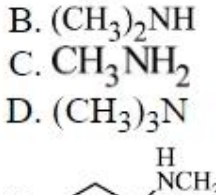
- AC Only
- BB, C and D Only
- CA and E Only
- DA and C Only
View answer or solution
Answer
A and C Only
Classification of Elements and Periodicity in Properties
The group 14 elements A and B have the first ionisation enthalpy values of 708 and 715 kJ mol⁻¹ respectively. The above values are lowest among their group members. The nature of their ions A²⁺ and B⁴⁺ respectively is
- Aoxidising and reducing
- Bboth reducing
- Cboth oxidising
- Dreducing and oxidising
View answer or solution
Answer
reducing and oxidising
Given below are two statements: Statement I: D-(+)-glucose + D-(+) fructose ⟶[−H₂O] Sucrose sucrose ⟶[hydrolysis] D-(+) glucose + D-(+) fructose Statement II: Invert sugar is formed during sucrose hydrolysis In the light of the above statements, choose the correct answer from the options given below
- AStatement I is true but Statement II is false
- BBoth Statement I and Statement II are true
- CBoth Statement I and Statement II are False
- DStatement I is false but Statement II are true
View answer or solution
Answer
Statement I is false but Statement II are true
Which of the following compounds is least likely to give effervescence of CO₂ in presence of aq. NaHCO₃ ?
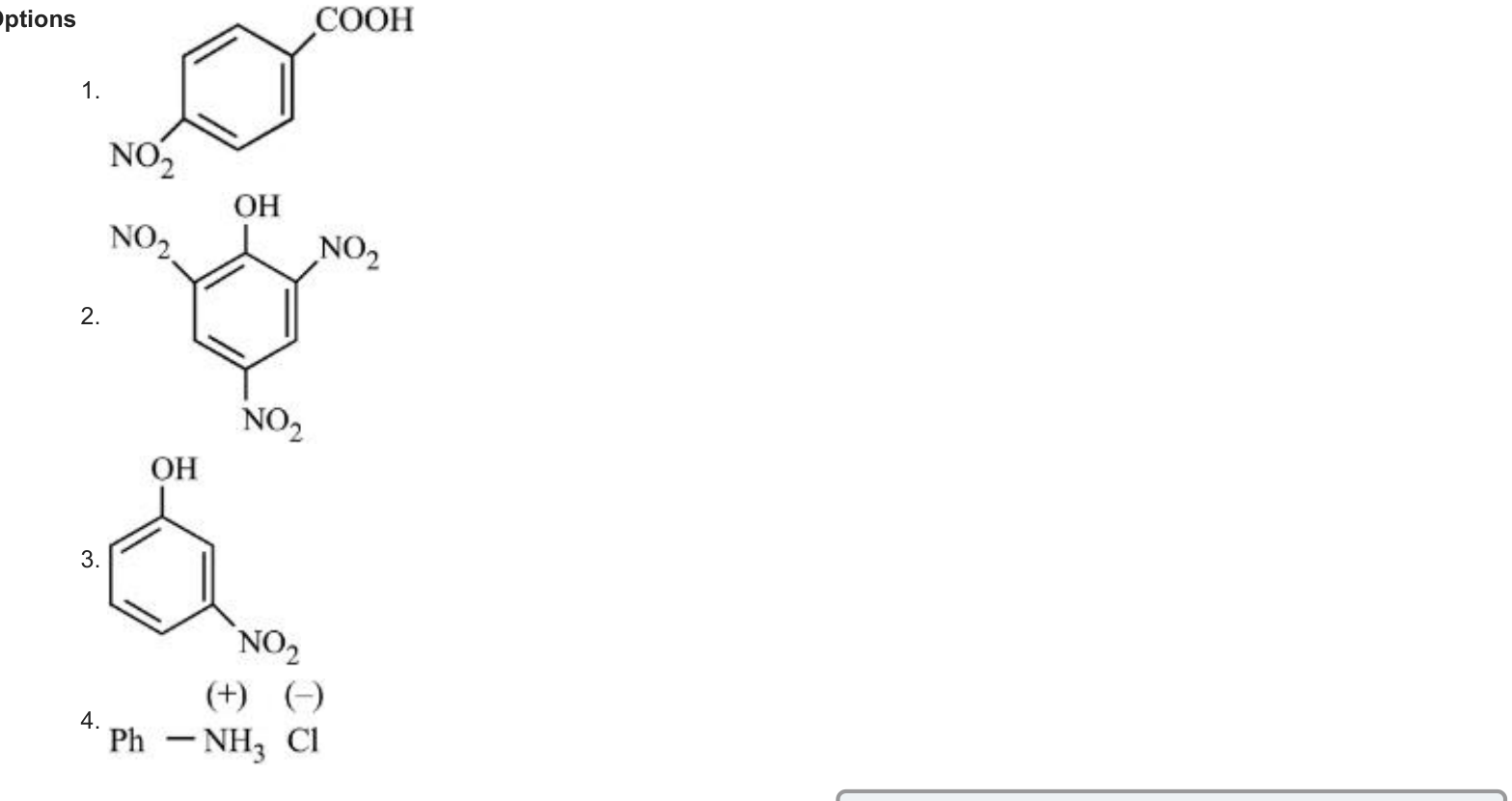
- A4-nitrobenzoic acid: a benzene ring drawn in Kekulé style with a –COOH group on one ring carbon and a –NO₂ group on the carbon opposite to it
- B2,4,6-trinitrophenol: a benzene ring drawn in Kekulé style with an –OH group on the top carbon, a –NO₂ group on each of the two carbons next to it and a –NO₂ group on the bottom carbon
- C3-nitrophenol: a benzene ring drawn in Kekulé style with an –OH group on the top carbon and a –NO₂ group on the carbon two places away from it (meta position)
- DPh–NH₃⁺ Cl⁻: anilinium chloride, printed as 'Ph – NH₃' with (+) above NH₃ and 'Cl' with (−) above it
View answer or solution
Answer
3-nitrophenol: a benzene ring drawn in Kekulé style with an –OH group on the top carbon and a –NO₂ group on the carbon two places away from it (meta position)
The reactions which cannot be applied to prepare an alkene by elimination, are A. a cyclohexane ring bearing a –CH₃ group on one ring carbon and a –Br on the adjacent ring carbon ⟶[NaOEt] B. CH₃–CH₂–CH(Br)–CH₃ ⟶[KOH (aq)] C. (CH₃)₃C–Br ⟶[NaOMe] D. C₆H₅–OH ⟶[Na₂Cr₂O₇ / H₂SO₄] E. (CH₃)₃C–OH ⟶[Cu / 573 K] Choose the correct answer from the options given below:
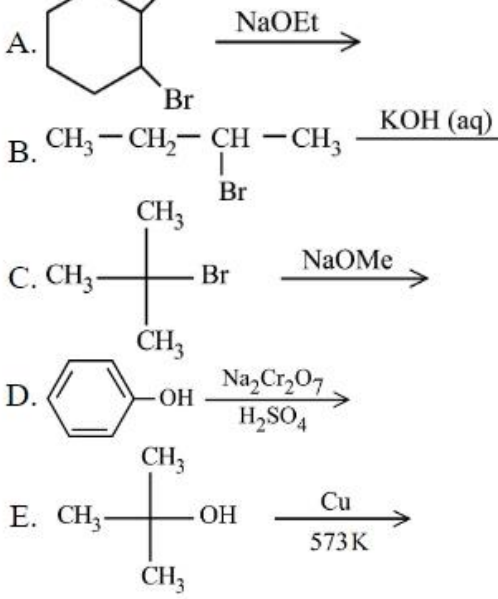
- AB & E Only
- BB, C & D Only
- CB & D Only
- DA, C & D Only
View answer or solution
Answer
B & D Only
An aqueous solution of HCl with pH 1.0 is diluted by adding equal volume of water (ignoring dissociation of water). The pH of HCl solution would (Given log 2 = 0.30)
- Areduce to 0.5
- Bremain same
- Cincrease to 1.3
- Dincrease to 2
View answer or solution
Answer
increase to 1.3
Total enthalpy change for freezing of 1 mol of water at 10°C to ice at −10°C is ____________ (Given: Δ_fusH = x kJ/mol C_p[H₂O(l)] = y J mol⁻¹ K⁻¹ C_p[H₂O(s)] = z J mol⁻¹ K⁻¹
- A10(100x + y + z)
- Bx − 10y − 10z
- C−10(100x + y + z)
- D−x − 10y − 10z
View answer or solution
Answer
−10(100x + y + z)
Organic Compounds Containing Oxygen
Given below are two statements: Statement I: Dimethyl ether is completely soluble in water. However, diethyl ether is soluble in water to a very small extent. Statement II: Sodium metal can be used to dry diethyl ether and not ethyl alcohol. In the light of given statements, choose the correct answer from the options given below
- AStatement I is false but Statement II are true
- BBoth Statement I and Statement II are true
- CBoth Statement I and Statement II are False
- DStatement I is true but Statement II is false
View answer or solution
Answer
Both Statement I and Statement II are true
Given below are two statements: Statement I: Ozonolysis followed by treatment with Zn, H₂O of cis-2-butene gives ethanal. Statement II: The product obtained by ozonolysis followed by treatment with Zn, H₂O of 3, 6-dimethyloct-4-ene has no chiral carbon atom. In the light of the above statements, choose the correct answer from the options given below
- ABoth Statement I and Statement II are true
- BStatement I is true but Statement II is false
- CBoth Statement I and Statement II are False
- DStatement I is false but Statement II are true
View answer or solution
Answer
Statement I is true but Statement II is false
Principles Related to Practical Chemistry
Given below are two statements: Statement I: Mohr's salt is composed of only three types of ions-ferrous, ammonium and sulfate. Statement II: If the molar conductance at infinite dilution for ferrous, ammonium and sulfate ions are x₁, x₂ and x₃ S cm² mol⁻¹, respectively then the molar conductance for Mohr's salt solution at infinite dilution would be given by x₁ + x₂ + 2x₃ In the light of the given statements, choose the correct answer from the options given below:
- ABoth Statements I and Statement II are false
- BStatement I is true but Statement II are false
- CStatement I is false but Statement II is true
- DBoth Statements I and Statement II are true
View answer or solution
Answer
Statement I is true but Statement II are false
Reaction A(g) → 2B(g) + C(g) is a first order reaction. It was started with pure A | t/min | Pressure of system at time t/mm Hg | |---|---| | 10 | 160 | | ∞ | 240 | Which of the following option is incorrect?
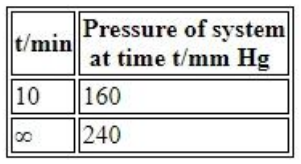
- AThe reaction never goes to completion
- BRate constant of the reaction is 1.693 min⁻¹
- CInitial pressure of A is 80 mm Hg
- DPartial pressure of A after 10 minute is 40 mm Hg
View answer or solution
Answer
Rate constant of the reaction is 1.693 min⁻¹
The number of valence electrons present in the metal among Cr, Co, Fe and Ni which has the lowest enthalpy of atomisation is
- A6
- B9
- C8
- D10
View answer or solution
Answer
6
An octahedral complex having molecular composition Co.5NH₃.Cl.SO₄ has two isomers A and B. The solution of A gives a white precipitate with AgNO₃ solution and the solution of B gives white precipitate with BaCl₂ solution. The type of isomerism exhibited by the complex is,
- AIonisation isomerism
- BCo-ordinate isomerism
- CLinkage isomerism
- DGeometrical isomerism
View answer or solution
Answer
Ionisation isomerism
Some Basic Concepts in Chemistry
At the sea level, the dry air mass percentage composition is given as nitrogen gas: 70.0, oxygen gas: 27.0 and argon gas: 3.0. If total pressure is 1.15 atm, then calculate the ratio of following respectively: (i) partial pressure of nitrogen gas to partial pressure of oxygen gas (ii) partial pressure of oxygen gas to partial pressure of argon gas (Given: Molar mass of N, O and Ar are 14, 16 and 40 g mol⁻¹ respectively.)
- A2.59, 11.85
- B5.46, 17.8
- C2.96, 11.2
- D4.26, 19.3
View answer or solution
Answer
2.96, 11.2
Which of the following is the correct IUPAC name of given organic compound (X)?
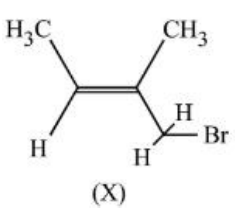
- A2-Bromo-2-methylbut-2-ene
- B3-Bromo-3-methylprop-2-ene
- C4-Bromo-3-methylbut-2-ene
- D1-Bromo-2-methylbut-2-ene
View answer or solution
Answer
1-Bromo-2-methylbut-2-ene
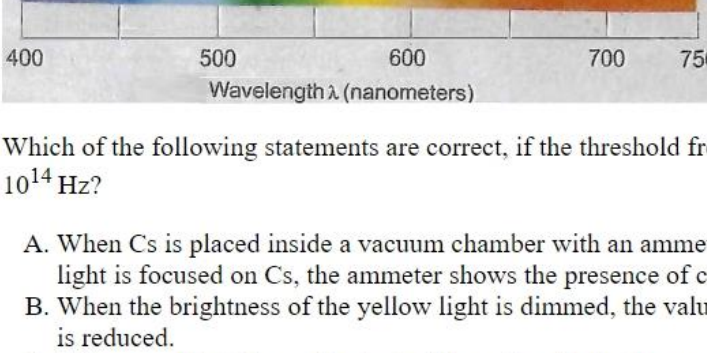
Which of the following statements are correct, if the threshold frequency of caesium is 5.16 × 10¹⁴ Hz? A. When Cs is placed inside a vacuum chamber with an ammeter connected to it and yellow light is focused on Cs, the ammeter shows the presence of current. B. When the brightness of the yellow light is dimmed, the value of the current in the ammeter is reduced. C. When a red light is used instead of the yellow light, the current produced is higher with respect to the yellow light. D. When a blue light is used, the ammeter shows the formation of current. E. When a white light is used. the ammeter shows formation of current. Choose the correct answer from the options given below:
- AA, D and E Only
- BA, C, D and E Only
- CA, B, D and E Only
- DB, C and D Only
View answer or solution
Answer
A, B, D and E Only
Organic Compounds Containing Oxygen
When a salt is treated with sodium hydroxide solution it gives gas X. On passing gas X through reagent Y a brown coloured precipitate is formed. X and Y respectively, are
- AX = NH₃ and Y = K₂HgI₄ + KOH
- BX = HCl and Y = NH₄Cl
- CX = NH₃ and Y = HgO
- DX = NH₄Cl and Y = KOH
View answer or solution
Answer
X = NH₃ and Y = K₂HgI₄ + KOH
Chemical Bonding and Molecular Structure
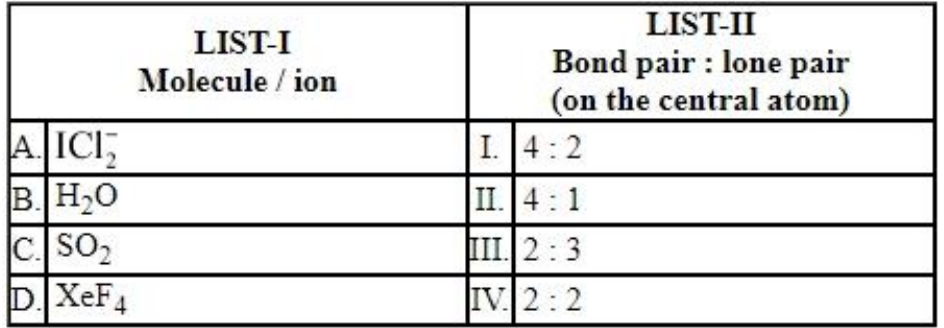
Match the LIST-I with LIST-I | LIST-I Molecule / ion | LIST-II Bond pair : lone pair (on the central atom) | |---|---| | A. ICl₂⁻ | I. 4 : 2 | | B. H₂O | II. 4 : 1 | | C. SO₂ | III. 2 : 3 | | D. XeF₄ | IV. 2 : 2 | Choose the correct answer from the options given below:
- AA-II, B-I, C-IV, D-III
- BA-III, B-IV, C-I, D-II
- CA-III, B-IV, C-II, D-I
- DA-IV, B-III, C-II, D-I
View answer or solution
Answer
A-III, B-IV, C-II, D-I
The first transition series metal ‘M’ has the highest enthalpy of atomisation in its series. One of its aquated ion (Mⁿ⁺) exists in green colour. The nature of the oxide formed by the above Mⁿ⁺ ion is:
- Abasic
- Bamphoteric
- Cneutral
- Dacidic
View answer or solution
Answer
basic
A person's wound was exposed to some bacteria and then bacterial growth started to happen at the same place. The wound was later treated with some antibacterial medicine and the rate of bacterial decay(r) was found to be proportional with the square of the existing number of bacteria at any instance. Which of the following set of graphs correctly represents the ‘before’ and ‘after’ situation of the application of the medicine? [Given: N = No. of bacteria, t = time, bacterial growth follows 1ˢᵗ order kinetics.]
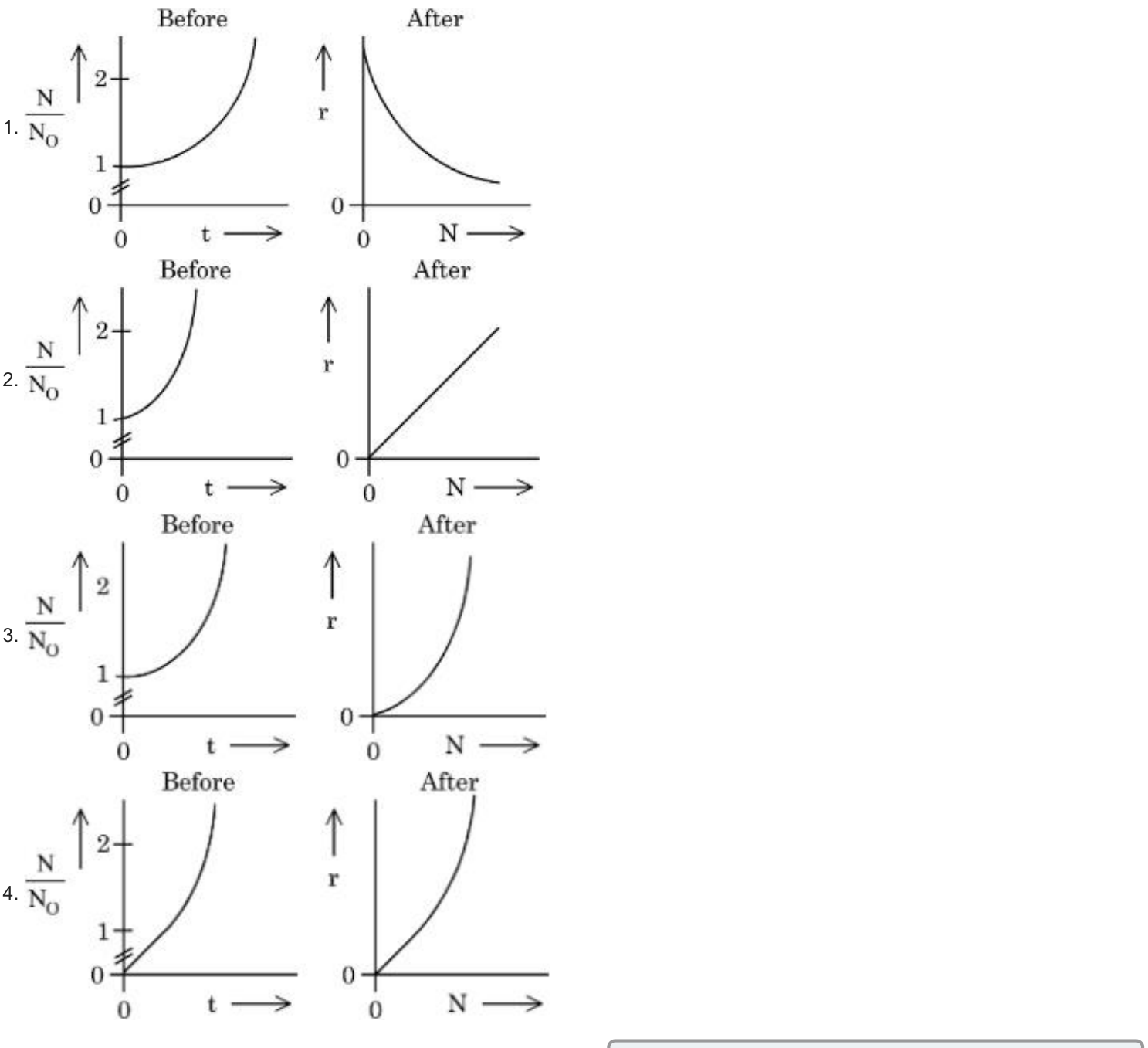
- ABefore: plot of N/N₀ (y-axis) against t (x-axis) showing an exponential rise from N/N₀ = 1; After: plot of r (y-axis) against N (x-axis) showing a decreasing curve that falls steeply from a high value at N = 0 and flattens towards the axis.
- BBefore: plot of N/N₀ against t showing an exponential rise from N/N₀ = 1; After: plot of r against N showing a straight line through the origin, increasing linearly with N.
- CBefore: plot of N/N₀ against t showing an exponential rise from N/N₀ = 1; After: plot of r against N showing a curve that starts at the origin and rises with an increasing slope.
- DBefore: plot of N/N₀ against t showing an exponential rise from the origin (N/N₀ = 0 at t = 0); After: plot of r against N showing a curve that starts at the origin and rises with an increasing slope.
View answer or solution
Answer
Before: plot of N/N₀ against t showing an exponential rise from N/N₀ = 1; After: plot of r against N showing a curve that starts at the origin and rises with an increasing slope.
Some Basic Concepts in Chemistry
An organic compound weighing 500 mg, produced 220 mg of CO₂, on complete combustion. The percentage composition of carbon in the compound is ________%. (nearest integer) (Given molar mass in g mol⁻¹ of C:12, O:16)
View answer or solution
Answer
12
Thyroxine, the hormone has given below structure The percentage of iodine in thyroxine is ________%. (nearest integer) (Given molar mass in g mol⁻¹ C:12, H:1, O:16, N:14, I:127)
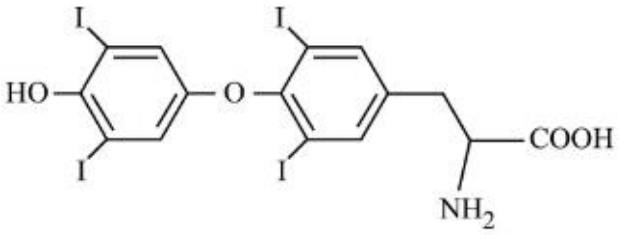
View answer or solution
Answer
65
Redox Reactions and Electrochemistry
1 Faraday electricity was passed through Cu²⁺ (1.5 M, 1 L) /Cu and 0.1 Faraday was passed through Ag⁺ (0.2 M, 1 L)/Ag electrolytic cells. After this the two cells were connected as shown below to make an electrochemical cell. The emf of the cell thus formed at 298 K is __________ mV (nearest integer) Given : E°Cu²⁺/Cu = 0·34 V E°Ag⁺/Ag = 0·8 V (2·303RT)/F = 0·06 V
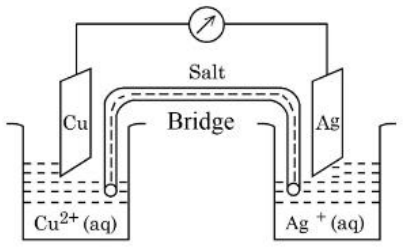
View answer or solution
Answer
400
The percentage dissociation of a salt (MX₃) solution at given temperature (van't Hoff factor i = 2) is __________ %(Nearest integer)
View answer or solution
Answer
33
Chemical Bonding and Molecular Structure
The number of paramagnetic complexes among [FeF₆]³⁻, [Fe(CN)₆]³⁻, [Mn(CN)₆]³⁻, [Co(C₂O₄)₃]³⁻, [MnCl₆]³⁻, and [CoF₆]³⁻, which involved d²sp³ hybridization is __________
View answer or solution
Answer
2