
// JEE (Main) / 2025
JEE (Main) 2025 Session 2, 2 April 2025, Shift 1 — Paper 1 (B.E / B.Tech) Chemistry
Chemistry · B.E / B.Tech
Work through the questions
25 questions
Take a moment to try each question before opening the available answer or solution.
Some Basic Concepts in Chemistry
On complete combustion 1.0 g of an organic compound (X) gave 1.46 g of CO₂ and 0.567 g of H₂O. The empirical formula mass of compound (X) is ________ g. (Given molar mass in g mol⁻¹ C : 12, H : 1, O : 16 )
- A15
- B45
- C30
- D60
View answer or solution
Answer
30
Some Basic Concepts in Chemistry
CaCO₃(s) + 2HCl(aq) → CaCl₂(aq) + CO₂(g) + H₂O(l) Consider the above reaction, what mass of CaCl₂ will be formed if 250 mL of 0.76 M HCl reacts with 1000 g of CaCO₃ ? (Given : Molar mass of Ca, C, O, H and Cl are 40, 12, 16, 1 and 35.5 g mol⁻¹, respectively)
- A2.636 g
- B5.272 g
- C3.908 g
- D10.545 g
View answer or solution
Answer
10.545 g
According to Bohr's model of hydrogen atom, which of the following statement is incorrect ?
- ARadius of 4ᵗʰ orbit is four times larger than that of 2ⁿᵈ orbit
- BRadius of 3ʳᵈ orbit is nine times larger than that of 1ˢᵗ orbit
- CRadius of 8ᵗʰ orbit is four times larger than that of 4ᵗʰ orbit
- DRadius of 6ᵗʰ orbit is three times larger than that of 4ᵗʰ orbit
View answer or solution
Answer
Radius of 6ᵗʰ orbit is three times larger than that of 4ᵗʰ orbit
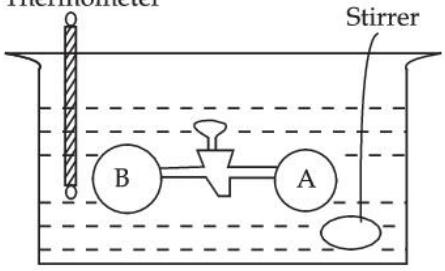
Two vessels A and B are connected via stopcock. The vessel A is filled with a gas at a certain pressure. The entire assembly is immersed in water and is allowed to come to thermal equilibrium with water. After opening the stopcock the gas from vessel A expands into vessel B and no change in temperature is observed in the thermometer. Which of the following statement is true ?
- AdU≠0
- Bdw≠0
- CThe pressure in the vessel B before opening the stopcock is zero
- Ddq≠0
View answer or solution
Answer
The pressure in the vessel B before opening the stopcock is zero
Some Basic Principles of Organic Chemistry
Consider the following compound (X) The most stable and least stable carbon radicals, respectively, produced by homolytic cleavage of corresponding C – H bond are :

- AII, I
- BII, IV
- CI, IV
- DIII, II
View answer or solution
Answer
II, I
Given below are two statements : Statement (I) : In octahedral complexes, when Δₒ < P high spin complexes are formed. When Δₒ > P low spin complexes are formed. Statement (II) : In tetrahedral complexes because of Δₜ < P, low spin complexes are rarely formed. In the light of the above statements, choose the most appropriate answer from the options given below :
- AStatement I is incorrect but Statement II is correct
- BBoth Statement I and Statement II are incorrect
- CStatement I is correct but Statement II is incorrect
- DBoth Statement I and Statement II are correct
View answer or solution
Answer
Both Statement I and Statement II are correct
Chemical Bonding and Molecular Structure
Among SO₂, NF₃, NH₃, XeF₂, ClF₃ and SF₄, the hybridization of the molecule with non-zero dipole moment and highest number of lone-pairs of electrons on the central atom is :
- Asp³d²
- Bdsp²
- Csp³d
- Dsp³
View answer or solution
Answer
sp³d
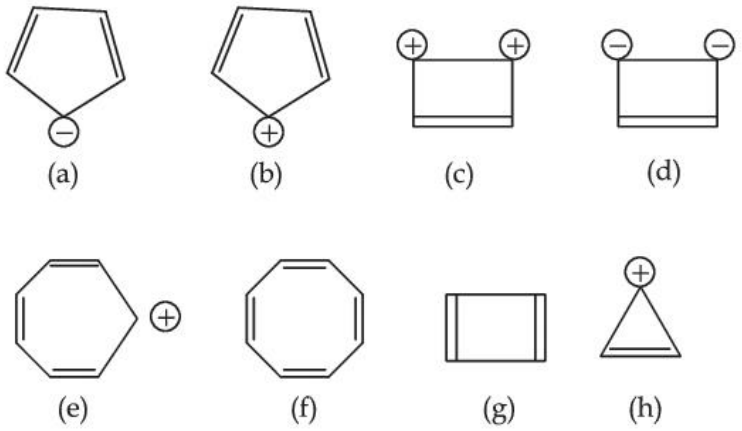
Designate whether each of the following compounds is aromatic or not aromatic.
- Aa, b, c, d aromatic and e, f, g, h not aromatic
- Bb, e, f, g aromatic and a, c, d, h not aromatic
- Ce, g aromatic and a, b, c, d, f, h not aromatic
- Da, c, d, e, h aromatic and b, f, g not aromatic
View answer or solution
Answer
a, c, d, e, h aromatic and b, f, g not aromatic
Classification of Elements and Periodicity in Properties
Given below are two statements : Statement (I) : The metallic radius of Al is less than that of Ga. Statement (II) : The ionic radius of Al³⁺ is less than that of Ga³⁺ . In the light of the above statements, choose the most appropriate answer from the options given below :
- AStatement I is incorrect but Statement II is correct
- BBoth Statement I and Statement II are incorrect
- CBoth Statement I and Statement II are correct
- DStatement I is correct but Statement II is incorrect
View answer or solution
Answer
Statement I is incorrect but Statement II is correct
Classification of Elements and Periodicity in Properties
A molecule with the formula AX₄Y has all it’s elements from p-block. Element A is rarest, monoatomic, non-radioactive from its group and has the lowest ionization enthalpy value among A, X and Y. Elements X and Y have first and second highest electronegativity values respectively among all the known elements. The shape of the molecule is :
- AOctahedral
- BPentagonal planar
- CTrigonal bipyramidal
- DSquare pyramidal
View answer or solution
Answer
Square pyramidal
Classification of Elements and Periodicity in Properties
The property/properties that show irregularity in first four elements of group-17 is/are : (A) Covalent radius (B) Electron affinity (C) Ionic radius (D) First ionization energy Choose the correct answer from the options given below :
- AA and C only
- BA, B, C and D
- CB only
- DB and D only
View answer or solution
Answer
B only
Organic Compounds Containing Oxygen
Consider the following molecules : (p) CH₃–CH₂–C(=O)–Cl (q) CH₃–CH₂–C(=O)–O–C(=O)–CH₃ (r) CH₃–CH₂–C(=O)–O–CH₂–CH₃ (s) CH₃–CH₂–C(=O)–NH₂ The correct order of rate of hydrolysis is :
- Ap > q > r > s
- Bp > r > q > s
- Cr > q > p > s
- Dq > p > r > s
View answer or solution
Answer
p > q > r > s
A solution is made by mixing one mole of volatile liquid A with 3 moles of volatile liquid B. The vapour pressure of pure A is 200 mm Hg and that of the solution is 500 mm Hg. The vapour pressure of pure B and the least volatile component of the solution, respectively, are :
- A600 mm Hg, B
- B600 mm Hg, A
- C1400 mm Hg, A
- D1400 mm Hg, B
View answer or solution
Answer
600 mm Hg, A
Which of the following graph correctly represents the plots of K_H at 1 bar for gases in water versus temperature?
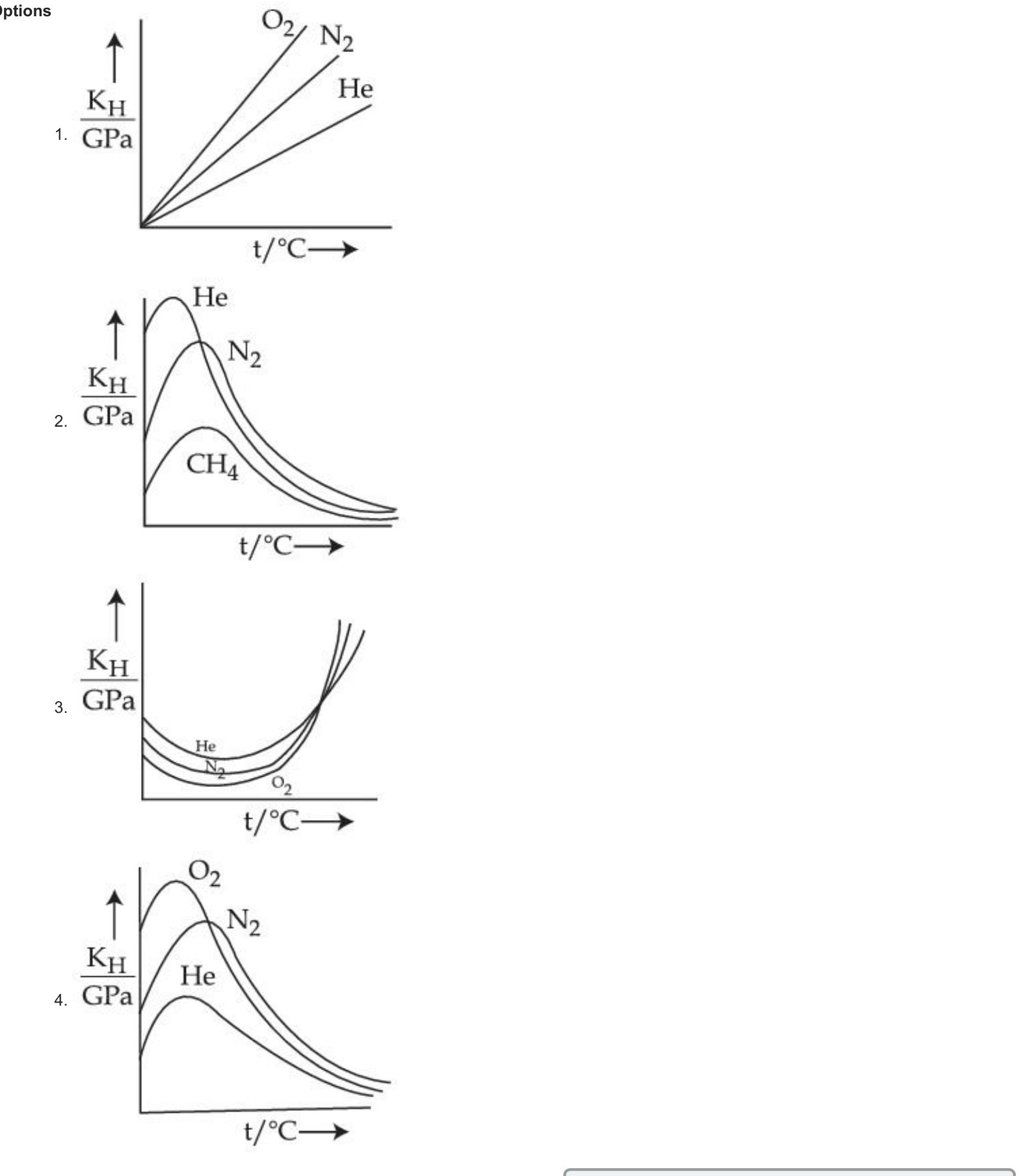
- AGraph: K_H/GPa (written as a stacked fraction) on the vertical axis against t/°C on the horizontal axis; three straight lines through the origin with positive slopes, the steepest labelled O₂, the middle one labelled N₂ and the shallowest labelled He.
- BGraph: K_H/GPa (written as a stacked fraction) on the vertical axis against t/°C on the horizontal axis; three curves that rise to a peak and then fall away towards the horizontal axis as t increases, the highest peak labelled He, the middle one labelled N₂ and the lowest labelled CH₄.
- CGraph: K_H/GPa (written as a stacked fraction) on the vertical axis against t/°C on the horizontal axis; three U-shaped curves that fall to a minimum and then rise steeply at the right-hand end, the top dip labelled He, the middle one labelled N₂ and the lowest labelled O₂.
- DGraph: K_H/GPa (written as a stacked fraction) on the vertical axis against t/°C on the horizontal axis; three curves that rise to a peak and then fall away towards the horizontal axis as t increases, the highest peak labelled O₂, the middle one labelled N₂ and the lowest labelled He.
View answer or solution
Answer
Graph: K_H/GPa (written as a stacked fraction) on the vertical axis against t/°C on the horizontal axis; three curves that rise to a peak and then fall away towards the horizontal axis as t increases, the highest peak labelled He, the middle one labelled N₂ and the lowest labelled CH₄.
Organic Compounds Containing Halogens
An optically active alkyl halide C₄H₉Br [A] reacts with hot KOH dissolved in ethanol and forms alkene [B] as major product which reacts with bromine to give dibromide [C]. The compound [C] is converted into a gas [D] upon reacting with alcoholic NaNH₂. During hydration 18 gram of water is added to 1 mole of gas [D] on warming with mercuric sulphate and dilute acid at 333 K to form compound [E]. The IUPAC name of compound [E] is :
- AButan-2-one
- BButan-2-ol
- CButan-1-al
- DBut-2-yne
View answer or solution
Answer
Butan-2-one
Organic Compounds Containing Oxygen
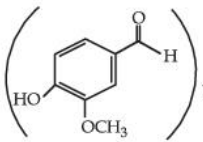
Given below are two statements : Statement (I) : Vanillin will react with NaOH and also with Tollen’s reagent. Statement (II) : Vanillin will undergo self aldol condensation very easily. In the light of the above statements, choose the most appropriate answer from the options given below :
- ABoth Statement I and Statement II are correct
- BStatement I is correct but Statement II is incorrect
- CBoth Statement I and Statement II are incorrect
- DStatement I is incorrect but Statement II is correct
View answer or solution
Answer
Statement I is correct but Statement II is incorrect
Choose the correct tests with respective observations. (A) CuSO₄ (acidified with acetic acid) + K₄[Fe(CN)₆] → Chocolate brown precipitate. (B) FeCl₃ + K₄[Fe(CN)₆] → Prussian blue precipitate. (C) ZnCl₂ + K₄[Fe(CN)₆], neutralised with NH₄OH → White or bluish white precipitate. (D) MgCl₂ + K₄[Fe(CN)₆] → Blue precipitate. (E) BaCl₂ + K₄[Fe(CN)₆], neutralised with NaOH → White precipitate. Choose the correct answer from the options given below :
- AA, D and E only
- BC, D and E only
- CB, D and E only
- DA, B and C only
View answer or solution
Answer
A, B and C only
Identify the correct statement among the following :
- AAll naturally occurring amino acids are optically active.
- BAmino acid, cysteine can easily undergo dimerisation due to the presence of free SH group.
- CAll naturally occurring amino acids except glycine contain one chiral centre.
- DGlutamic acid is the only amino acid that contains a –COOH group at the side chain.
View answer or solution
Answer
Amino acid, cysteine can easily undergo dimerisation due to the presence of free SH group.
The correct order of basic nature in aqueous solution for the bases NH₃, H₂N − NH₂, CH₃CH₂NH₂, (CH₃CH₂)₂NH and (CH₃CH₂)₃N is :
- ANH₃ < H₂N − NH₂ < (CH₃CH₂)₃N < CH₃CH₂NH₂ < (CH₃CH₂)₂NH
- BNH₂ − NH₂ < NH₃ < CH₃CH₂NH₂ < (CH₃CH₂)₃N < (CH₃CH₂)₂NH
- CNH₃ < H₂N − NH₂ < CH₃CH₂NH₂ < (CH₃CH₂)₂NH < (CH₃CH₂)₃N
- DH₂N − NH₂ < NH₃ < (CH₃CH₂)₃N < CH₃CH₂NH₂ < (CH₃CH₂)₂NH
View answer or solution
Answer
NH₂ − NH₂ < NH₃ < CH₃CH₂NH₂ < (CH₃CH₂)₃N < (CH₃CH₂)₂NH
If equal volumes of AB₂ and XY (both are salts) aqueous solutions are mixed, which of the following combination will give a precipitate of AY₂ at 300 K ? (Given K_sp (at 300 K) for AY₂ = 5.2 × 10⁻⁷)
- A3.6 × 10⁻³ M AB₂, 5.0 × 10⁻⁴ M XY
- B2.0 × 10⁻⁴ M AB₂, 0.8 × 10⁻³ M XY
- C2.0 × 10⁻² M AB₂, 2.0 × 10⁻² M XY
- D1.5 × 10⁻⁴ M AB₂, 1.5 × 10⁻³ M XY
View answer or solution
Answer
2.0 × 10⁻² M AB₂, 2.0 × 10⁻² M XY
Consider the following equilibrium, CO(g) + 2H₂(g) ⇌ CH₃OH(g) 0.1 mol of CO along with a catalyst is present in a 2 dm³ flask maintained at 500 K. Hydrogen is introduced into the flask until the pressure is 5 bar and 0.04 mol of CH₃OH is formed. The K_p^θ is _______ × 10⁻³ (nearest integer). Given : R = 0.08 dm³ bar K⁻¹ mol⁻¹ Assume only methanol is formed as the product and the system follows ideal gas behaviour.
View answer or solution
Answer
74
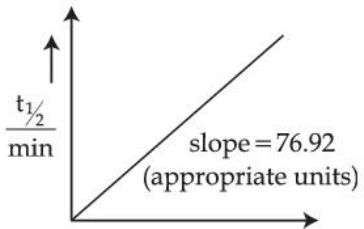
For the reaction A → products. The concentration of A at 10 minutes is _______ × 10⁻³ mol L⁻¹ (nearest integer). The reaction was started with 2.5 mol L⁻¹ of A.
View answer or solution
Answer
2435
Redox Reactions and Electrochemistry
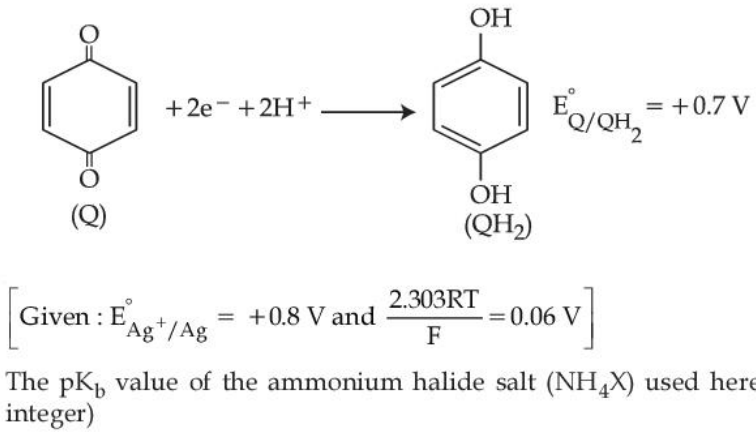
Consider the following electrochemical cell at standard condition. Au(s)|QH₂,Q|NH₄X(0.01 M) || Ag⁺ (1 M)|Ag(s) E_cell = + 0.4 V The couple QH₂/Q represents quinhydrone electrode, the half cell reaction is given below : [ Given : E°(Ag⁺/Ag) = + 0.8 V and 2.303RT/F = 0.06 V ] The pK_b value of the ammonium halide salt (NH₄X) used here is _______. (nearest integer)
View answer or solution
Answer
6
Some Basic Concepts in Chemistry
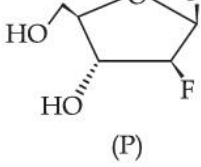
0.1 mol of the following given antiviral compound (P) will weigh _______ × 10⁻¹ g (nearest integer). (Given : molar mass in g mol⁻¹ H : 1, C : 12, N : 14, O : 16, F : 19, I : 127)
View answer or solution
Answer
372
Redox Reactions and Electrochemistry
A transition metal (M) among Mn, Cr, Co and Fe has the highest standard electrode potential (M³⁺/M²⁺). It forms a metal complex of the type [M(CN)₆]⁴⁻. The number of electrons present in the e_g orbital of the complex is _______.
View answer or solution
Answer
1