
// JEE (Main) / 2024
JEE (Main) 2024 Session 2, 8 April 2024, Shift 2 — Paper 1 (B.E / B.Tech) Chemistry
Chemistry · B.E / B.Tech
Work through the questions
30 questions
Take a moment to try each question before opening the available answer or solution.
Given below are two statements : Statement (I) : A Buffer solution is the mixture of a salt and an acid or a base mixed in any particular quantities. Statement (II) : Blood is naturally occurring buffer solution whose pH is maintained by H₂CO₃/HCO₃⁻ concentrations. In the light of the above statements, choose the correct answer from the options given below :
- ABoth Statement I and Statement II are true
- BStatement I is true but Statement II is false
- CStatement I is false but Statement II is true
- DBoth Statement I and Statement II are false
View answer or solution
Answer
Statement I is false but Statement II is true
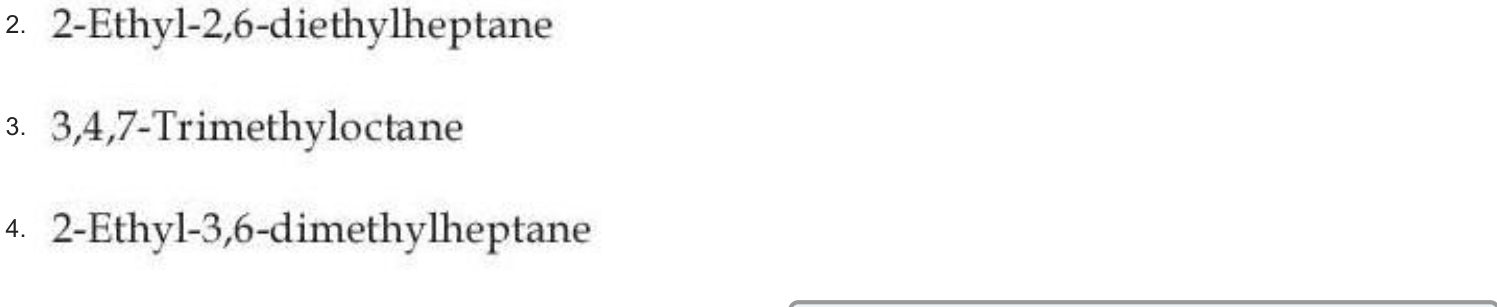
IUPAC name of following hydrocarbon(X) is : CH₃–CH(CH₃)–CH₂–CH₂–CH(CH₃)–CH(CH₃)–CH₂–CH₃ (X)
- A2,5,6-Trimethyloctane
- B2-Ethyl-2,6-diethylheptane
- C3,4,7-Trimethyloctane
- D2-Ethyl-3,6-dimethylheptane
View answer or solution
Answer
2,5,6-Trimethyloctane
Redox Reactions and Electrochemistry
Identify the incorrect statements about group 15 elements : (A) Dinitrogen is a diatomic gas which acts like an inert gas at room temperature. (B) The common oxidation states of these elements are −3, +3 and +5. (C) Nitrogen has unique ability to form pπ − pπ multiple bonds. (D) The stability of +5 oxidation states increases down the group. (E) Nitrogen shows a maximum covalency of 6. Choose the correct answer from the options given below :
- A(B), (D), (E) only
- B(D) and (E) only
- C(A), (B), (D) only
- D(A), (C), (E) only
View answer or solution
Answer
(D) and (E) only
Redox Reactions and Electrochemistry
The emf of cell Tl | Tl⁺(0.001M) || Cu²⁺(0.01M) | Cu is 0.83 V at 298 K. It could be increased by :
- Aincreasing concentration of Cu²⁺ ions
- Bincreasing concentration of Tl⁺ ions
- Cincreasing concentration of both Tl⁺ and Cu²⁺ ions
- Ddecreasing concentration of both Tl⁺ and Cu²⁺ ions
View answer or solution
Answer
increasing concentration of Cu²⁺ ions
Organic Compounds Containing Oxygen
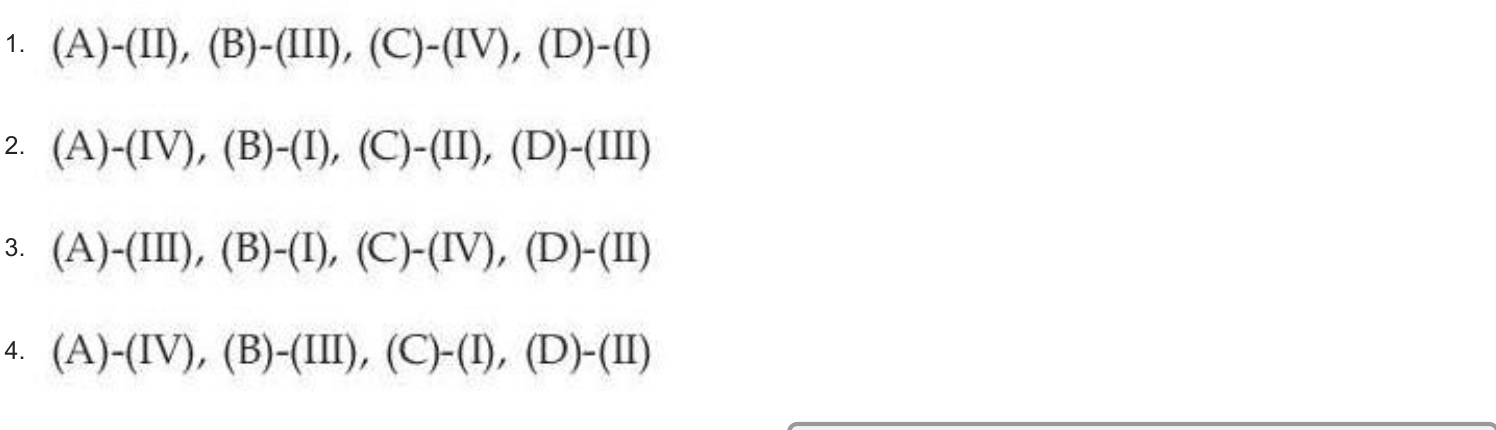
Match List - I with List - II. | List - I (Test) | List - II (Identification) | |---|---| | (A) Bayer’s test | (I) Phenol | | (B) Ceric ammonium nitrate test | (II) Aldehyde | | (C) Phthalein dye test | (III) Alcoholic-OH group | | (D) Schiff’s test | (IV) Unsaturation | Choose the correct answer from the options given below :
- A(A)-(II), (B)-(III), (C)-(IV), (D)-(I)
- B(A)-(IV), (B)-(I), (C)-(II), (D)-(III)
- C(A)-(III), (B)-(I), (C)-(IV), (D)-(II)
- D(A)-(IV), (B)-(III), (C)-(I), (D)-(II)
View answer or solution
Answer
(A)-(IV), (B)-(III), (C)-(I), (D)-(II)
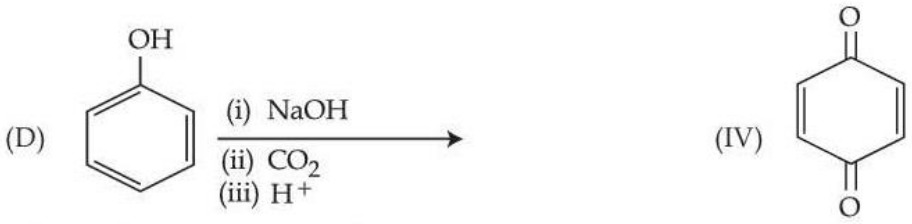
Match List - I with List - II. List - I (Reactions) (A) [Figure] ⟶[(i) NaNO₂ + HCl / (ii) H₂O, warm] (B) [Figure] ⟶[Na₂Cr₂O₇ / H₂SO₄] (C) [Figure] ⟶[(i) CHCl₃ + aq NaOH / (ii) H⁺] (D) [Figure] ⟶[(i) NaOH / (ii) CO₂ / (iii) H⁺] List - II (Products) (I) [Figure] (II) [Figure] (III) [Figure] (IV) [Figure] Choose the correct answer from the options given below :
- A(A)-(I), (B)-(IV), (C)-(II), (D)-(III)
- B(A)-(III), (B)-(II), (C)-(I), (D)-(IV)
- C(A)-(II), (B)-(IV), (C)-(I), (D)-(III)
- D(A)-(IV), (B)-(II), (C)-(III), (D)-(I)
View answer or solution
Answer
(A)-(II), (B)-(IV), (C)-(I), (D)-(III)
Organic Compounds Containing Oxygen
Which one the following compounds will readily react with dilute NaOH ?
- AC₂H₅OH
- B(CH₃)₃COH
- CC₆H₅CH₂OH
- DC₆H₅OH
View answer or solution
Answer
C₆H₅OH
Some Basic Principles of Organic Chemistry
Given below are two statements : Statement (I) : S_N2 reactions are ‘stereospecific’, indicating that they result in the formation of only one stereo-isomer as the product. Statement (II) : S_N1 reactions generally result in formation of product as racemic mixtures. In the light of the above statements, choose the correct answer from the options given below :
- ABoth Statement I and Statement II are true
- BBoth Statement I and Statement II are false
- CStatement I is true but Statement II is false
- DStatement I is false but Statement II is true
View answer or solution
Answer
Both Statement I and Statement II are true
Redox Reactions and Electrochemistry
In qualitative test for identification of presence of phosphorus, the compound is heated with an oxidising agent. Which is further treated with nitric acid and ammonium molybdate respectively. The yellow coloured precipitate obtained is :
- AMoPO₄·21NH₄NO₃
- BNa₃PO₄·12MoO₃
- C(NH₄)₃PO₄·12MoO₃
- D(NH₄)₃PO₄·12(NH₄)₂MoO₄
View answer or solution
Answer
(NH₄)₃PO₄·12MoO₃
For a reaction A ⟶[K₁] B ⟶[K₂] C If the rate of formation of B is set to be zero then the concentration of B is given by :
- A(K₁/K₂)[A]
- BK₁K₂[A]
- C(K₁ + K₂)[A]
- D(K₁ − K₂)[A]
View answer or solution
Answer
(K₁/K₂)[A]
Purification and Characterisation of Organic Compounds
Given below are two statements : Statement (I) : Kjeldahl method is applicable to estimate nitrogen in pyridine. Statement (II) : The nitrogen present in pyridine can easily be converted into ammonium sulphate in Kjeldahl method. In the light of the above statements, choose the correct answer from the options given below :
- AStatement I is false but Statement II is true
- BBoth Statement I and Statement II are false
- CBoth Statement I and Statement II are true
- DStatement I is true but Statement II is false
View answer or solution
Answer
Both Statement I and Statement II are false
When ψ_A and ψ_B are the wave functions of atomic orbitals, then σ* is represented by :
- Aψ_A − 2ψ_B
- Bψ_A − ψ_B
- Cψ_A + 2ψ_B
- Dψ_A + ψ_B
View answer or solution
Answer
ψ_A − ψ_B
Redox Reactions and Electrochemistry
Given below are two statements : Statement (I) : Fusion of MnO₂ with KOH and an oxidising agent gives dark green K₂MnO₄. Statement (II) : Manganate ion on electrolytic oxidation in alkaline medium gives permanganate ion. In the light of the above statements, choose the correct answer from the options given below :
- AStatement I is false but Statement II is true
- BBoth Statement I and Statement II are false
- CBoth Statement I and Statement II are true
- DStatement I is true but Statement II is false
View answer or solution
Answer
Both Statement I and Statement II are true
Match List - I with List - II. | List - I (Complex ion) | List - II (Spin only magnetic moment in B.M.) | |---|---| | (A) [Cr(NH₃)₆]³⁺ | (I) 4.90 | | (B) [NiCl₄]²⁻ | (II) 3.87 | | (C) [CoF₆]³⁻ | (III) 0.0 | | (D) [Ni(CN)₄]²⁻ | (IV) 2.83 | Choose the correct answer from the options given below :
- A(A)-(II), (B)-(IV), (C)-(I), (D)-(III)
- B(A)-(I), (B)-(IV), (C)-(II), (D)-(III)
- C(A)-(II), (B)-(III), (C)-(I), (D)-(IV)
- D(A)-(IV), (B)-(III), (C)-(I), (D)-(II)
View answer or solution
Answer
(A)-(II), (B)-(IV), (C)-(I), (D)-(III)
Organic Compounds Containing Oxygen
The correct sequence of acidic strength of the following aliphatic acids in their decreasing order is : CH₃CH₂COOH, CH₃COOH, CH₃CH₂CH₂COOH, HCOOH
- AHCOOH > CH₃COOH > CH₃CH₂COOH > CH₃CH₂CH₂COOH
- BHCOOH > CH₃CH₂CH₂COOH > CH₃CH₂COOH > CH₃COOH
- CCH₃CH₂CH₂COOH > CH₃CH₂COOH > CH₃COOH > HCOOH
- DCH₃COOH > CH₃CH₂COOH > CH₃CH₂CH₂COOH > HCOOH
View answer or solution
Answer
HCOOH > CH₃COOH > CH₃CH₂COOH > CH₃CH₂CH₂COOH
Organic Compounds Containing Oxygen
Given below are two statements : Statement (I) : All the following compounds react with p-toluenesulfonyl chloride. C₆H₅NH₂ (C₆H₅)₂NH (C₆H₅)₃N Statement (II) : Their products in the above reaction are soluble is aqueous NaOH. In the light of the above statements, choose the correct answer from the options given below :
- AStatement I is false but Statement II is true
- BBoth Statement I and Statement II are true
- CBoth Statement I and Statement II are false
- DStatement I is true but Statement II is false
View answer or solution
Answer
Both Statement I and Statement II are false
The equilibrium Cr₂O₇²⁻ ⇌ 2CrO₄²⁻ is shifted to the right in :
- Aa basic medium
- Ba weakly acidic medium
- Ca neutral medium
- Dan acidic medium
View answer or solution
Answer
a basic medium
Redox Reactions and Electrochemistry
The reaction ; (1/2)H₂(g) + AgCl(s) → H⁺(aq) + Cl⁻(aq) + Ag(s) occurs in which of the following galvanic cell :
- APt|H₂(g)|KCl(soln.)|AgCl(s)|Ag
- BPt|H₂(g)|HCl(soln.)|AgNO₃(aq)|Ag
- CPt|H₂(g)|HCl(soln.)|AgCl(s)|Ag
- DAg|AgCl(s)|KCl(soln.)|AgNO₃(aq.)|Ag
View answer or solution
Answer
Pt|H₂(g)|HCl(soln.)|AgCl(s)|Ag
Classification of Elements and Periodicity in Properties
Identify the correct statements about p-block elements and their compounds. (A) Non metals have higher electronegativity than metals. (B) Non metals have lower ionisation enthalpy than metals. (C) Compounds formed between highly reactive nonmetals and highly reactive metals are generally ionic. (D) The non-metal oxides are generally basic in nature. (E) The metal oxides are generally acidic or neutral in nature. Choose the correct answer from the options given below :
- A(D) and (E) only
- B(B) and (E) only
- C(A) and (C) only
- D(B) and (D) only
View answer or solution
Answer
(A) and (C) only
Some Basic Principles of Organic Chemistry
The shape of carbocation is :
- Atetrahedral
- Bdiagonal pyramidal
- Ctrigonal planar
- Ddiagonal
View answer or solution
Answer
trigonal planar
Organic Compounds Containing Halogens
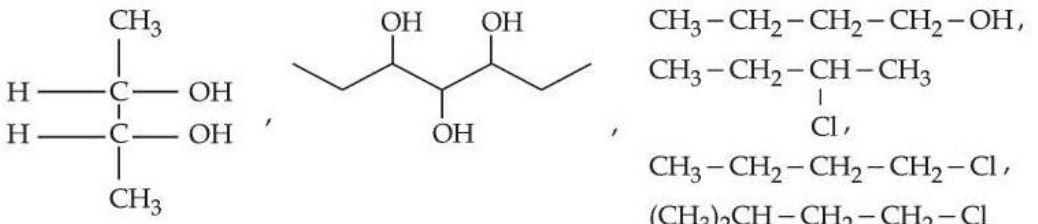
Total number of optically active compounds from the following is __________. CH₃–CH₂–CH₂–CH₂–OH, CH₃–CH₂–CH(Cl)–CH₃, CH₃–CH₂–CH₂–CH₂–Cl, (CH₃)₂CH–CH₂–CH₂–Cl
View answer or solution
Answer
1
The total number of carbon atoms present in tyrosine, an amino acid, is __________.
View answer or solution
Answer
9
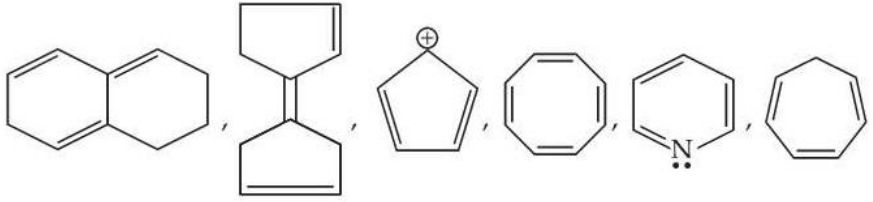
Total number of aromatic compounds among the following compounds is ______.
View answer or solution
Answer
1
Chemical Bonding and Molecular Structure
Total number of unpaired electrons in the complex ions [Co(NH₃)₆]³⁺ and [NiCl₄]²⁻ is ______.
View answer or solution
Answer
2
Organic Compounds Containing Oxygen
A solution is prepared by adding 1 mole ethyl alcohol in 9 mole water. The mass percent of solute in the solution is _______ (Integer answer) (Given : Molar mass in g mol⁻¹ Ethyl alcohol : 46 water : 18)
View answer or solution
Answer
22
Organic Compounds Containing Oxygen
Two moles of benzaldehyde and one mole of acetone under alkaline conditions using aqueous NaOH after heating gives x as the major product. The number of π bonds in the product x is _________.
View answer or solution
Answer
9
Some Basic Concepts in Chemistry
Molality of an aqueous solution of urea is 4.44 m. Mole fraction of urea in solution is x × 10⁻³. Value of x is ________. (Integer answer)
View answer or solution
Answer
74
Chemical Bonding and Molecular Structure
Number of molecules having bond order 2 from the following molecules is ________. C₂, O₂, Be₂, Li₂, Ne₂, N₂, He₂
View answer or solution
Answer
2
Δ_vap H^⊖ for water is +40.79 kJ mol⁻¹ at 1 bar and 100 °C. Change in internal energy for this vapourisation under same condition is ________ kJ mol⁻¹. (Integer answer) (Given R = 8.3 JK⁻¹ mol⁻¹)
View answer or solution
Answer
38
Wavenumber for a radiation having 5800 Å wavelength is x × 10 cm⁻¹. The value of x is ________. (Integer answer)
View answer or solution
Answer
1724