
// JEE (Main) / 2024
JEE (Main) 2024 Session 1, 31 January 2024, Shift 2 — Paper 1 (B.E / B.Tech) Chemistry
Chemistry · B.E / B.Tech
Work through the questions
30 questions
No verified answers are available for this paper.
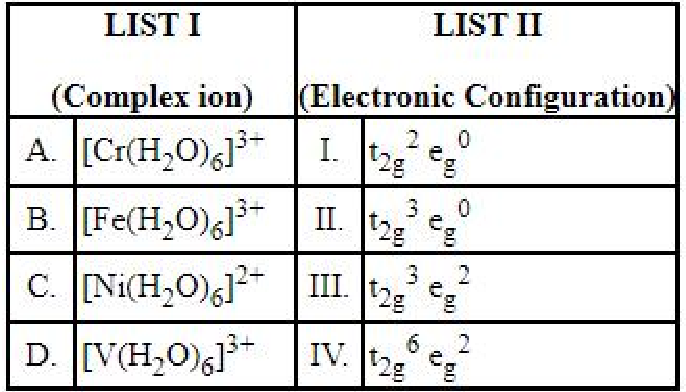
Match List I with List II | LIST I (Complex ion) | LIST II (Electronic Configuration) | |---|---| | A. [Cr(H₂O)₆]³⁺ | I. t₂g² e_g⁰ | | B. [Fe(H₂O)₆]³⁺ | II. t₂g³ e_g⁰ | | C. [Ni(H₂O)₆]²⁺ | III. t₂g³ e_g² | | D. [V(H₂O)₆]³⁺ | IV. t₂g⁶ e_g² | Choose the correct answer from the options given below:
- AA-IV, B-III, C-I, D-II
- BA-IV, B-I, C-II, D-III
- CA-II, B-III, C-IV, D-I
- DA-III, B-II, C-IV, D-I
No verified answer or solution is available for this question.
Purification and Characterisation of Organic Compounds
The fragrance of flowers is due to the presence of some steam volatile organic compounds called essential oils. These are generally insoluble in water at room temperature but are miscible with water vapour in vapour phase. A suitable method for the extraction of these oils from the flowers is -
- Acrystallisation
- Bdistillation
- Cdistillation under reduced pressure
- Dsteam distillation
No verified answer or solution is available for this question.
Identify major product 'P' formed in the following reaction. [C₆H₆ + C₆H₅COCl ⟶[Anhydrous AlCl₃] 'P' (Major Product)]
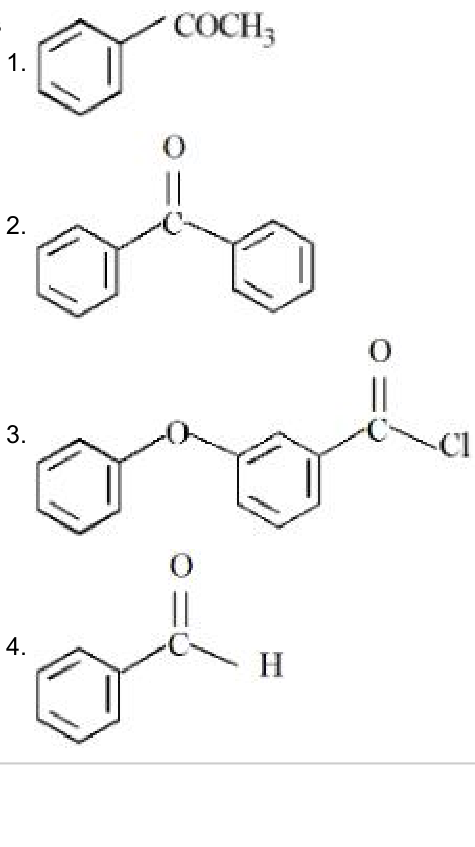
- ADrawn structure: a benzene ring drawn with three alternating double bonds bearing a group written as 'COCH₃' on its upper-right carbon (C₆H₅–CO–CH₃).
- BDrawn structure: a 'C' with a double bond up to 'O', bonded on the left to a benzene ring and on the right to a second benzene ring, both rings drawn with three alternating double bonds (C₆H₅–CO–C₆H₅).
- CDrawn structure: a benzene ring drawn with three alternating double bonds joined through an 'O' to a second benzene ring drawn with three alternating double bonds; the second ring carries on its upper-right carbon a 'C' with a double bond up to 'O' and a single bond down-right to 'Cl' (the –O– and the –C(=O)Cl groups on the second ring are in the meta position to each other).
- DDrawn structure: a benzene ring drawn with three alternating double bonds bonded to a 'C' with a double bond up to 'O' and a single bond down-right to 'H' (C₆H₅–CHO).
No verified answer or solution is available for this question.
Organic Compounds Containing Nitrogen
Given below are two statements : Statement I : Aniline reacts with con. H₂SO₄, followed by heating at 453 - 473 K gives p-aminobenzene sulphonic acid, which gives blood red colour in the 'Lassaigne's test'. Statement II : In Friedel - Craft's alkylation and acylation reactions, aniline forms salt with the AlCl₃ catalyst. Due to this, nitrogen of aniline acquires a positive charge and acts as deactivating group. In the light of the above statements, choose the correct answer from the options given below :
- ABoth statement I and statement II are false
- BStatement I is true but statement II is false
- CStatement I is false but statement II is true
- DBoth statement I and statement II are true
No verified answer or solution is available for this question.
Identify structure of 2,3–dibromo–1–phenylpentane.
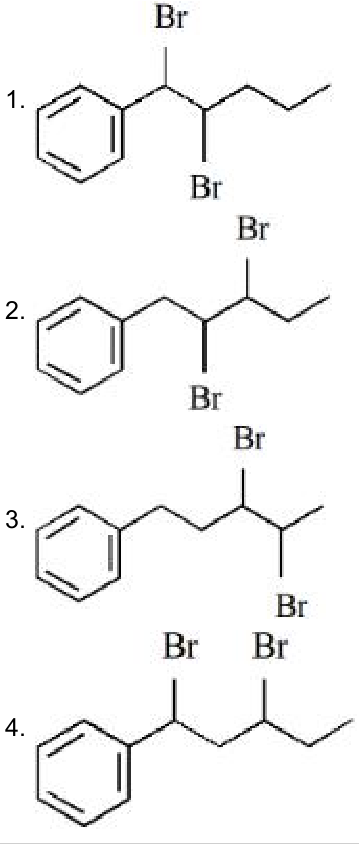
- ADrawn structure: a benzene ring drawn with three alternating double bonds joined to a five-carbon chain –CH(Br)–CH(Br)–CH₂–CH₂–CH₃, the first 'Br' printed above the first chain carbon and the second 'Br' printed below the second chain carbon.
- BDrawn structure: a benzene ring drawn with three alternating double bonds joined to a five-carbon chain –CH₂–CH(Br)–CH(Br)–CH₂–CH₃, the first 'Br' printed below the second chain carbon and the second 'Br' printed above the third chain carbon.
- CDrawn structure: a benzene ring drawn with three alternating double bonds joined to a five-carbon chain –CH₂–CH₂–CH(Br)–CH(Br)–CH₃, the first 'Br' printed above the third chain carbon and the second 'Br' printed below the fourth chain carbon.
- DDrawn structure: a benzene ring drawn with three alternating double bonds joined to a five-carbon chain –CH(Br)–CH₂–CH(Br)–CH₂–CH₃, the first 'Br' printed above the first chain carbon and the second 'Br' printed above the third chain carbon.
No verified answer or solution is available for this question.
Some Basic Concepts in Chemistry
A sample of CaCO₃ and MgCO₃ weighed 2.21 g is ignited to constant weight of 1.152 g. The composition of mixture is : (Given molar mass in g mol⁻¹ CaCO₃ : 100, MgCO₃ : 84)
- A1.187 g CaCO₃ + 1.023 g MgCO₃
- B1.023 g CaCO₃ + 1.187 g MgCO₃
- C1.023 g CaCO₃ + 1.023 g MgCO₃
- D1.187 g CaCO₃ + 1.187 g MgCO₃
No verified answer or solution is available for this question.
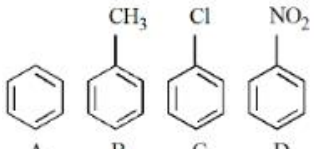
The correct order of reactivity in electrophilic substitution reaction of the following compounds is : [A = benzene ring drawn with three alternating double bonds; B = benzene ring drawn with three alternating double bonds with 'CH₃' printed above the top carbon; C = benzene ring drawn with three alternating double bonds with 'Cl' printed above the top carbon; D = benzene ring drawn with three alternating double bonds with 'NO₂' printed above the top carbon]
- AA > B > C > D
- BB > A > C > D
- CD > C > B > A
- DB > C > A > D
No verified answer or solution is available for this question.
Which of the following is least ionic?
- ACoCl₂
- BKCl
- CBaCl₂
- DAgCl
No verified answer or solution is available for this question.
Identify the name reaction. [benzene ring drawn with three alternating double bonds ⟶[CO, HCl printed above the arrow; Anhyd. AlCl₃/CuCl printed below it] benzene ring drawn with three alternating double bonds bearing a 'CHO' group on its upper-right carbon]
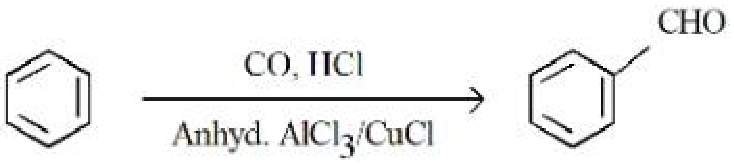
- AEtard Reaction
- BGattermann - Koch Reaction
- CRosenmund Reduction
- DStephen Reaction
No verified answer or solution is available for this question.
The four quantum numbers for the electron in the outer most orbital of potassium (atomic no. 19) are
- An = 3, l = 0, m = 1, s = +1/2
- Bn = 4, l = 2, m = −1, s = +1/2
- Cn = 2, l = 0, m = 0, s = +1/2
- Dn = 4, l = 0, m = 0, s = +1/2
No verified answer or solution is available for this question.
Identify A and B in the following reaction sequence. [benzene ring drawn in Kekulé form with 'Br' on the top vertex ⟶[Conc HNO₃] A ⟶[(i) NaOH, (ii) HCl] B]
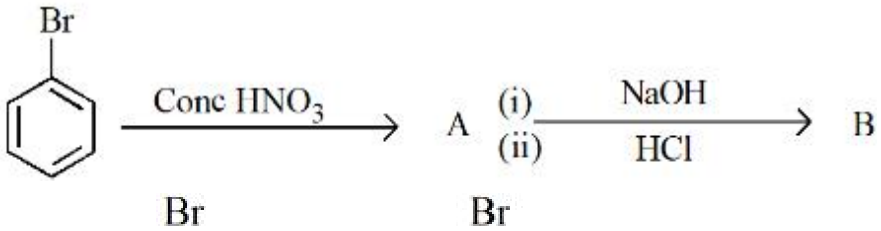
- ADrawn structures: A = a benzene ring drawn in Kekulé form with 'Br' on the top vertex, 'NO₂' on the upper-right vertex and 'NO₂' on the bottom vertex; B = a benzene ring drawn in Kekulé form with 'Br' on the top vertex, 'OH' on the upper-right vertex and 'OH' on the bottom vertex.
- BDrawn structures: A = a benzene ring drawn in Kekulé form with 'NO₂' on the top vertex; B = a benzene ring drawn in Kekulé form with 'NO₂' on the top vertex and 'OH' on the lower-right vertex.
- CDrawn structures: A = a benzene ring drawn in Kekulé form with 'Br' on the top vertex and 'NO₂' on the bottom vertex; B = a benzene ring drawn in Kekulé form with 'Br' on the top vertex, 'OH' on the upper-right vertex and 'NO₂' on the bottom vertex.
- DDrawn structures: A = a benzene ring drawn in Kekulé form with 'Br' on the top vertex, 'NO₂' on the upper-left vertex, 'NO₂' on the upper-right vertex and 'NO₂' on the bottom vertex; B = a benzene ring drawn in Kekulé form with 'OH' on the top vertex, 'NO₂' on the upper-left vertex, 'NO₂' on the upper-right vertex and 'NO₂' on the bottom vertex.
No verified answer or solution is available for this question.
Classification of Elements and Periodicity in Properties
Consider the following elements. [schematic: the word 'Group' with a downward arrow beneath it on the left; to the right of the arrow, the symbols A' B' on the upper row followed by a right-pointing arrow leading to the word 'Period', with the symbols C' D' on the row below, C' directly under A' and D' directly under B'] Which of the following is/are true about A', B', C' and D'? A. Order of atomic radii: B' < A' < D' < C' B. Order of metallic character: B' < A' < D' < C' C. Size of the element: D' < C' < B' < A' D. Order of ionic radii: B⁺ < A⁺ < D⁺ < C⁺ Choose the correct answer from the options given below :
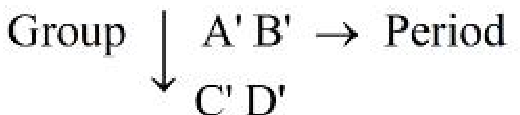
- AA, B and D only
- BB, C and D only
- CA and B only
- DA only
No verified answer or solution is available for this question.
The azo-dye (Y) formed in the following reactions is Sulphanilic acid + NaNO₂ + CH₃COOH → X. [X + naphthalene drawn as two fused hexagons side by side, each hexagon with a circle inside, carrying 'NH₂' on a vertical bond from the bottom vertex of the left-hand hexagon ⟶ Y]
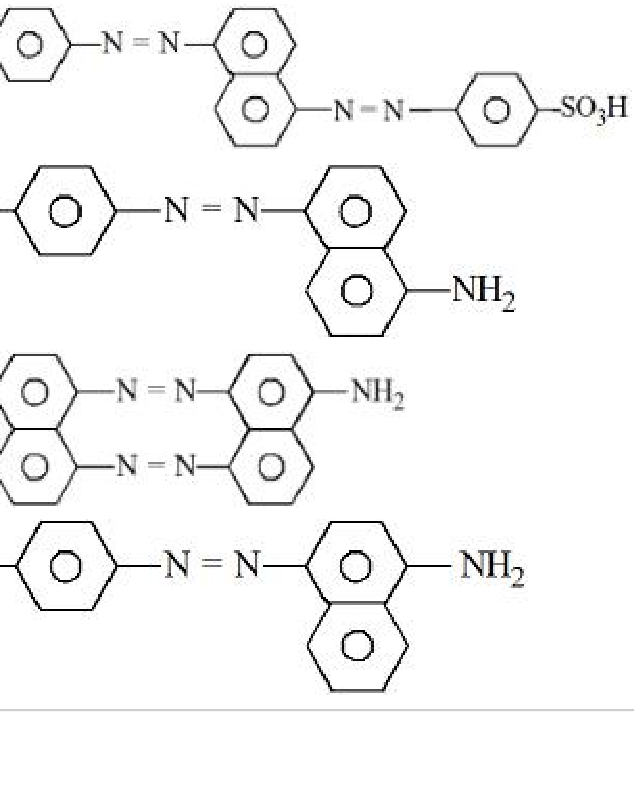
- ADrawn structure: 'HSO₃'—benzene ring drawn with a circle inside—'N=N'—naphthalene drawn as two hexagons stacked vertically, each with a circle inside, the azo group bonded to the left vertex of the upper hexagon and, from the right vertex of the lower hexagon, a bond running to 'N—N' and then to a benzene ring drawn with a circle inside carrying 'SO₃H' on its right vertex.
- BDrawn structure: 'HSO₃'—benzene ring drawn with a circle inside—'N=N'—naphthalene drawn as two hexagons stacked vertically, each with a circle inside, the azo group bonded to the left vertex of the upper hexagon and 'NH₂' bonded to the right vertex of the lower hexagon.
- CDrawn structures printed on two lines: first line, 'HO₃S'—naphthalene drawn as two hexagons stacked vertically, each with a circle inside, carrying 'HO₃S' on the left vertex and 'N=N' on the right vertex of the upper hexagon—'N=N'—naphthalene drawn as two hexagons stacked vertically, each with a circle inside, with 'N=N' on the left vertex and 'NH₂' on the right vertex of the upper hexagon; second line, 'HO₃S'—on the left vertex of the lower hexagon of the first naphthalene—'N=N'—on the left vertex of the lower hexagon of the second naphthalene.
- DDrawn structure: 'HSO₃'—benzene ring drawn with a circle inside—'N=N'—naphthalene drawn as two hexagons stacked vertically, each with a circle inside, the azo group bonded to the left vertex of the upper hexagon and 'NH₂' bonded to the right vertex of the same upper hexagon.
No verified answer or solution is available for this question.
Chemical Bonding and Molecular Structure
Choose the correct statements from the following A. All group 16 elements form oxides of general formula EO₂ and EO₃, where E = S, Se, Te and Po. Both the types of oxides are acidic in nature. B. TeO₂ is an oxidising agent while SO₂ is reducing in nature. C. The reducing property decreases from H₂S to H₂Te down the group. D. The ozone molecule contains five lone pairs of electrons. Choose the correct answer from the options given below:
- AB and C only
- BC and D only
- CA and D only
- DA and B only
No verified answer or solution is available for this question.
A(g) ⇌ B(g) + C/2(g) The correct relationship between Kp, α and equilibrium pressure P is
- AKp = (α^(3/2) p^(1/2))/((2 + α)^(1/2)(1 − α))
- BKp = (α^(1/2) p^(1/2))/((2 + α)^(1/2))
- CKp = (α^(1/2) p^(3/2))/((2 + α)^(3/2))
- DKp = (α^(1/2) p^(1/2))/((2 + α)^(3/2))
No verified answer or solution is available for this question.
Given below are two statements : Statement I : Group 13 trivalent halides get easily hydrolyzed by water due to their covalent nature. Statement II : AlCl₃ upon hydrolysis in acidified aqueous solution forms octahedral [Al(H₂O)₆]³⁺ ion. In the light of the above statements, choose the correct answer from the options given below :
- AStatement I is true but statement II is false
- BBoth statement I and statement II are true
- CStatement I is false but statement II is true
- DBoth statement I and statement II are false
No verified answer or solution is available for this question.
Select the option with correct property -
- A[NiCl₄]²⁻ Diamagnetic, [Ni(CO)₄] Paramagnetic
- B[Ni(CO)₄] and [NiCl₄]²⁻ both Paramagnetic
- C[Ni(CO)₄] Diamagnetic, [NiCl₄]²⁻ Paramagnetic
- D[Ni(CO)₄] and [NiCl₄]²⁻ both Diamagnetic
No verified answer or solution is available for this question.
Redox Reactions and Electrochemistry
Given below are two statements : Statement I : S₈ solid undergoes disproportionation reaction under alkaline conditions to form S²⁻ and S₂O₃²⁻. Statement II : ClO₄⁻ can undergo disproportionation reaction under acidic condition. In the light of the above statements, choose the most appropriate answer from the options given below :
- ABoth statement I and statement II are incorrect
- BStatement I is incorrect but statement II is correct
- CBoth statement I and statement II are correct
- DStatement I is correct but statement II is incorrect
No verified answer or solution is available for this question.
Major product of the following reaction is - [cyclopentene ring drawn as a pentagon with the double bond along the bottom edge and a 'CH₃' group on the lower-right carbon ⟶[D – Cl] ?]
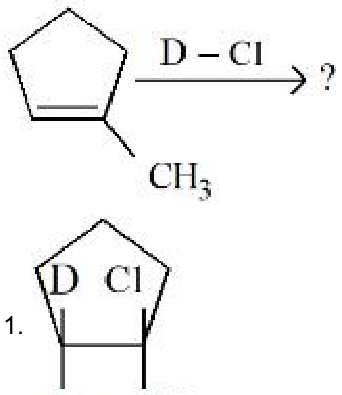
- ADrawn structure: a five-membered ring drawn as a pentagon with a vertex at the top; a vertical bond rises from the lower-left ring carbon to a 'D' written inside the ring and a vertical bond descends from the same carbon to an 'H'; a vertical bond rises from the lower-right ring carbon to a 'Cl' written inside the ring and a vertical bond descends from the same carbon to a 'CH₃'.
- BDrawn structure: a five-membered ring drawn as a pentagon with a vertex at the top; a vertical bond rises from the lower-left ring carbon to a 'D' written inside the ring and a vertical bond descends from the same carbon to an 'H'; a vertical bond rises from the lower-right ring carbon to a 'CH₃' written inside the ring and a vertical bond descends from the same carbon to a 'Cl'.
- CDrawn structure: a five-membered ring drawn as a pentagon with a vertex at the top; a vertical bond rises from the lower-left ring carbon to a 'Cl' written inside the ring and a vertical bond descends from the same carbon to an 'H'; a vertical bond rises from the lower-right ring carbon to a 'D' written inside the ring and a vertical bond descends from the same carbon to a 'CH₃'.
- DDrawn structure: a five-membered ring drawn as a pentagon with a vertex at the top; a vertical bond rises from the lower-left ring carbon to an 'H' written inside the ring and a vertical bond descends from the same carbon to a 'Cl'; a vertical bond rises from the lower-right ring carbon to a 'D' written inside the ring and a vertical bond descends from the same carbon to a 'CH₃'.
No verified answer or solution is available for this question.
Choose the correct statements from the following A. Mn₂O₇ is an oil at room temperature B. V₂O₄ reacts with acid to give VO₂²⁺ C. CrO is a basic oxide D. V₂O₅ does not react with acid Choose the correct answer from the options given below :
- AA and C only
- BA, B and C only
- CB and C only
- DA, B and D only
No verified answer or solution is available for this question.
Redox Reactions and Electrochemistry
The values of conductivity of some materials at 298.15 K in Sm⁻¹ are 2.1 × 10³, 1.0 × 10⁻¹⁶, 1.2 × 10, 3.91, 1.5 × 10⁻², 1 × 10⁻⁷, 1.0 × 10³. The number of conductors among the materials is ______.
No verified answer or solution is available for this question.
Some Basic Concepts in Chemistry
Number of moles of H⁺ ions required by 1 mole of MnO₄⁻ to oxidise oxalate ion to CO₂ is ______.
No verified answer or solution is available for this question.
Chemical Bonding and Molecular Structure
A diatomic molecule has a dipole moment of 1.2 D. If the bond distance is 1A°, then fractional charge on each atom is ______ × 10⁻¹ esu. (Given 1 D = 10⁻¹⁸ esu cm)
No verified answer or solution is available for this question.
From the vitamins A, B₁, B₆, B₁₂, C, D, E and K, the number of vitamins that can be stored in our body is ______.
No verified answer or solution is available for this question.
Redox Reactions and Electrochemistry
In the reaction of potassium dichromate, potassium chloride and sulfuric acid (conc.), the oxidation state of the chromium in the product is (+)______.
No verified answer or solution is available for this question.
If 5 moles of an ideal gas expands from 10 L to a volume of 100 L at 300 K under isothermal and reversible condition then work, w, is − x J. The value of x is ______. (Given R = 8.314 J K⁻¹ mol⁻¹)
No verified answer or solution is available for this question.
Some Basic Concepts in Chemistry
The molarity of 1 L orthophosphoric acid (H₃PO₄) having 70% purity by weight (specific gravity 1.54 g cm⁻³) is ______ M. (Molar mass of H₃PO₄ = 98 g mol⁻¹)
No verified answer or solution is available for this question.
Number of isomeric products formed by monochlorination of 2-methylbutane in presence of sunlight is ______.
No verified answer or solution is available for this question.
r = k [A] for a reaction. 50% of A is decomposed in 120 minutes. The time taken for 90% decomposition of A is ______ minutes.
No verified answer or solution is available for this question.
Principles Related to Practical Chemistry
A compound (x) with molar mass 108 g mol⁻¹ undergoes acetylation to give product with molar mass 192 g mol⁻¹. The number of amino groups in the compound (x) is ______.
No verified answer or solution is available for this question.