
// JEE (Main) / 2024
JEE (Main) 2024 Session 1, 29 January 2024, Shift 2 — Paper 1 (B.E / B.Tech) Chemistry
Chemistry · B.E / B.Tech
Work through the questions
30 questions
No verified answers are available for this paper.
Organic Compounds Containing Halogens
Alkyl halide is converted into alkyl isocyanide by reaction with
- AKCN
- BAgCN
- CNH₄CN
- DNaCN
No verified answer or solution is available for this question.
Organic Compounds Containing Halogens
Phenol treated with chloroform in presence of sodium hydroxide, which further hydrolyzed in presence of an acid results
- ABenzene-1,3-diol
- BSalicylic acid
- C2-Hydroxybenzaldehyde
- DBenzene-1,2-diol
No verified answer or solution is available for this question.
Purification and Characterisation of Organic Compounds
Chromatographic technique/s based on the principle of differential adsorption is / are A. Column chromatography B. Thin layer chromatography C. Paper chromatography Choose the most appropriate answer from the options given below:
- AA only
- BB only
- CA & B only
- DC only
No verified answer or solution is available for this question.
The product A formed in the following reaction is
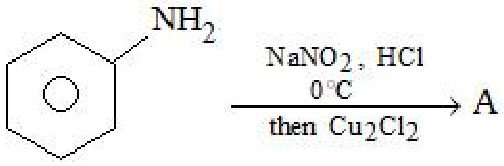
- Abenzene ring (circle inside) with –NH₂ on the upper-right carbon and –Cl on the lower-right carbon (the two substituted carbons are adjacent)
- Bbenzene ring (circle inside) with –NH₃⁺Cl⁻ on the upper-right carbon
- Cbenzene ring (circle inside) with –Cl on the upper-right carbon and –Cl on the lower-right carbon (the two substituted carbons are adjacent)
- Dbenzene ring (circle inside) with a single –Cl on the upper-right carbon
No verified answer or solution is available for this question.
Some Basic Principles of Organic Chemistry
Which one of the following will show geometrical isomerism?
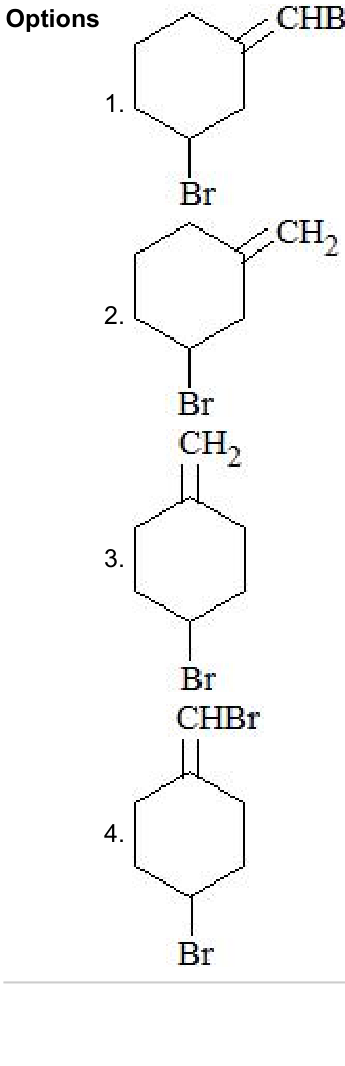
- Acyclohexane ring with an exocyclic =CHBr double bond on the upper-right carbon and –Br on the bottom carbon
- Bcyclohexane ring with an exocyclic =CH₂ double bond on the upper-right carbon and –Br on the bottom carbon
- Ccyclohexane ring with an exocyclic =CH₂ double bond on the top carbon and –Br on the bottom carbon
- Dcyclohexane ring with an exocyclic =CHBr double bond on the top carbon and –Br on the bottom carbon
No verified answer or solution is available for this question.
Which of the following reaction is correct?
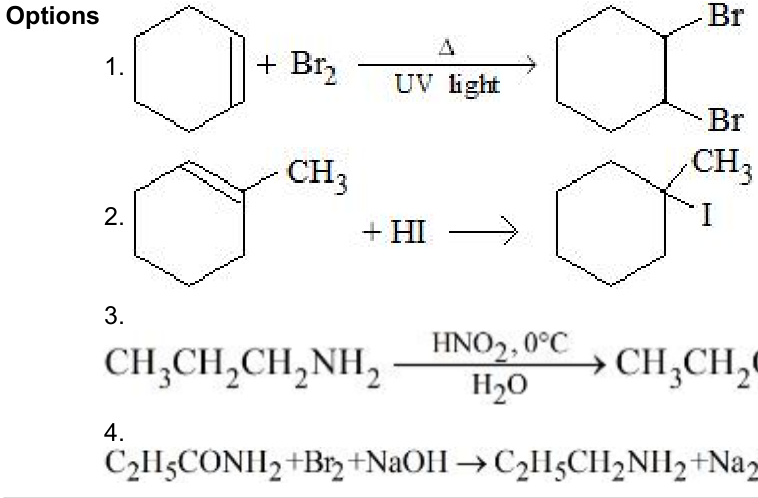
- Aa six-membered ring with a double bond on its right-hand vertical edge + Br₂ —(Δ above the arrow, UV light below the arrow)→ a six-membered ring with Br on the upper-right carbon and Br on the lower-right carbon
- Ba six-membered ring with a double bond between its top carbon and its upper-right carbon (CH₃ on the upper-right carbon) + HI → a six-membered ring with CH₃ and I both on the upper-right carbon
- CCH₃CH₂CH₂NH₂ —(HNO₂, 0 °C above the arrow, H₂O below the arrow)→ CH₃CH₂OH + N₂ + HCl
- DC₂H₅CONH₂ + Br₂ + NaOH → C₂H₅CH₂NH₂ + Na₂CO₃ + NaBr + H₂O
No verified answer or solution is available for this question.
Organic Compounds Containing Oxygen
Match List I with List II LIST I (Compound) — LIST II (pKₐ value) A. Ethanol — I. 10.0 B. Phenol — II. 15.9 C. m-Nitrophenol — III. 7.1 D. p-Nitrophenol — IV. 8.3 Choose the correct answer from the options given below:
- AA-I, B-II, C-III, D-IV
- BA-IV, B-I, C-II, D-III
- CA-II, B-I, C-IV, D-III
- DA-III, B-IV, C-I, D-II
No verified answer or solution is available for this question.
Classification of Elements and Periodicity in Properties
The element having the highest first ionization enthalpy is
- AN
- BC
- CAl
- DSi
No verified answer or solution is available for this question.
Organic Compounds Containing Oxygen
Identify the reagents used for the following conversion
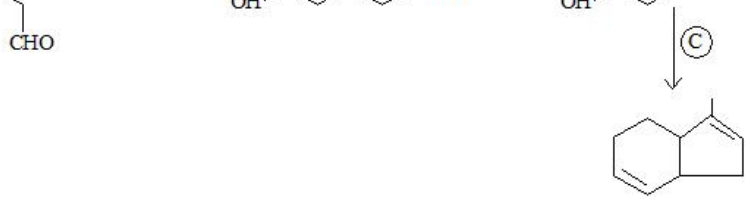
- AA = DIBAL-H, B = NaOH(aq), C = NH₂-NH₂/KOH, ethylene glycol
- BA = DIBAL-H, B = NaOH(alc), C = Zn/HCl
- CA = LiAlH₄, B = NaOH(aq), C = NH₂-NH₂/KOH, ethylene glycol
- DA = LiAlH₄, B = NaOH(alc), C = Zn/HCl
No verified answer or solution is available for this question.
Organic Compounds Containing Oxygen
On passing a gas, 'X', through Nessler's reagent, a brown precipitate is obtained. The gas 'X' is
- ACl₂
- BNH₃
- CH₂S
- DCO₂
No verified answer or solution is available for this question.
Match List I with List II LIST I (Bio Polymer) — LIST II (Monomer) A. Starch — I. nucleotide B. Cellulose — II. α-glucose C. Nucleic acid — III. β-glucose D. Protein — IV. α-amino acid Choose the correct answer from the options given below:
- AA-IV, B-II, C-I, D-III
- BA-II, B-III, C-I, D-IV
- CA-II, B-I, C-III, D-IV
- DA-I, B-III, C-IV, D-II
No verified answer or solution is available for this question.
Chemical Bonding and Molecular Structure
Anomalous behavior of oxygen is due to its
- Alarge size and high electronegativity
- Blarge size and low electronegativity
- Csmall size and high electronegativity
- Dsmall size and low electronegativity
No verified answer or solution is available for this question.
Match List I with List II LIST I (Spectral Series for Hydrogen) — LIST II (Spectral Region / Higher Energy State) A. Lyman — I. Infrared region B. Balmer — II. UV region C. Paschen — III. Infrared region D. Pfund — IV. Visible region Choose the correct answer from the options given below:
- AA-II, B-III, C-I, D-IV
- BA-I, B-II, C-III, D-IV
- CA-I, B-III, C-II, D-IV
- DA-II, B-IV, C-III, D-I
No verified answer or solution is available for this question.
Some Basic Principles of Organic Chemistry
According to IUPAC system, the compound is named as

- ACyclohex-2-en-1-ol
- BCyclohex-1-en-2-ol
- CCyclohex-1-en-3-ol
- D1-Hydroxyhex-2-ene
No verified answer or solution is available for this question.
Redox Reactions and Electrochemistry
Which of the following statements are correct about Zn, Cd and Hg? A. They exhibit high enthalpy of atomization as the d-subshell is full. B. Zn and Cd do not show variable oxidation state while Hg shows +I and +II. C. Compounds of Zn, Cd and Hg are paramagnetic in nature. D. Zn, Cd and Hg are called soft metals. Choose the most appropriate from the options given below:
- AB, C only
- BC, D only
- CA, D only
- DB, D only
No verified answer or solution is available for this question.
The correct IUPAC name of K₂MnO₄ is
- APotassium tetraoxomanganese (VI)
- BPotassium tetraoxomanganate (VI)
- CDipotassium tetraoxomanganate (VII)
- DPotassium tetraoxopermanganate (VI)
No verified answer or solution is available for this question.
Classification of Elements and Periodicity in Properties
Given below are two statements: Statement I : Fluorine has most negative electron gain enthalpy in its group. Statement II : Oxygen has least negative electron gain enthalpy in its group. In the light of the above statements, choose the most appropriate from the options given below
- ABoth Statement I and Statement II are false
- BStatement I is false but Statement II is true
- CBoth Statement I and Statement II are true
- DStatement I is true but Statement II is false
No verified answer or solution is available for this question.
Which of the following acts as a strong reducing agent? (Atomic number : Ce=58, Eu=63, Gd=64, Lu=71)
- ALu³⁺
- BCe⁴⁺
- CGd³⁺
- DEu²⁺
No verified answer or solution is available for this question.
Organic Compounds Containing Oxygen
A reagent which gives brilliant red precipitate with Nickel ions in basic medium is
- Adimethyl glyoxime
- Bmeta-dinitrobenzene
- Csodium nitroprusside
- Dneutral FeCl₃
No verified answer or solution is available for this question.
Organic Compounds Containing Oxygen
The ascending acidity order of the following H atoms is
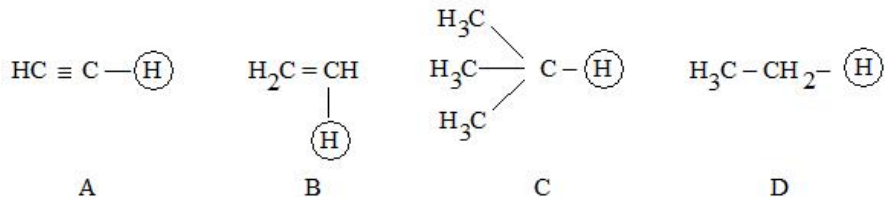
- AA < B < D < C
- BC < D < B < A
- CD < C < B < A
- DA < B < C < D
No verified answer or solution is available for this question.
Some Basic Concepts in Chemistry
A constant current was passed through a solution of AuCl₄⁻ ion between gold electrodes. After a period of 10.0 minutes, the increase in mass of cathode was 1.314g. The total charge passed through the solution is ______×10⁻² F. (Given atomic mass of Au = 197)
No verified answer or solution is available for this question.
The half-life of radioisotope bromine - 82 is 36 hours. The fraction which remains after one day is ______×10⁻². (Given antilog 0.2006 = 1.587)
No verified answer or solution is available for this question.
Standard enthalpy of vaporisation for CCl₄ is 30.5 kJ mol⁻¹. Heat required for vaporisation of 284g of CCl₄ at constant temperature is ______ kJ. (Given molar mass in g mol⁻¹; C=12, Cl=35.5)
No verified answer or solution is available for this question.
If 50 mL of 0.5M oxalic acid is required to neutralise 25 mL of NaOH solution, the amount of NaOH in 50 mL of given NaOH solution is ______ g.
No verified answer or solution is available for this question.
Chemical Bonding and Molecular Structure
The total number of molecules with zero dipole moment among CH₄, BF₃, H₂O, HF, NH₃, CO₂ and SO₂ is ______.
No verified answer or solution is available for this question.
Some Basic Concepts in Chemistry
Molality of 0.8 M H₂SO₄ solution (density 1.06 g cm⁻³) is ______×10⁻³ m.
No verified answer or solution is available for this question.
Chemical Bonding and Molecular Structure
The total number of anti bonding molecular orbitals, formed from 2s and 2p atomic orbitals in a diatomic molecule is ______.
No verified answer or solution is available for this question.
Redox Reactions and Electrochemistry
The oxidation number of iron in the compound formed during brown ring test for NO₃⁻ ion is ______.
No verified answer or solution is available for this question.
The following concentrations were observed at 500K for the formation of NH₃ from N₂ and H₂. At equilibrium ; [N₂] = 2×10⁻² M, [H₂] = 3×10⁻² M and [NH₃] = 1.5×10⁻² M. Equilibrium constant for the reaction is ______.
No verified answer or solution is available for this question.
Chemical Bonding and Molecular Structure
The total number of 'Sigma' and 'Pi' bonds in 2-formylhex-4-enoic acid is ______.
No verified answer or solution is available for this question.