
// JEE (Main) / 2024
JEE (Main) 2024 Session 1, 29 January 2024, Shift 1 — Paper 1 (B.E / B.Tech) Chemistry
Chemistry · B.E / B.Tech
Work through the questions
30 questions
No verified answers are available for this paper.
The final product A formed in the following multistep reaction sequence is
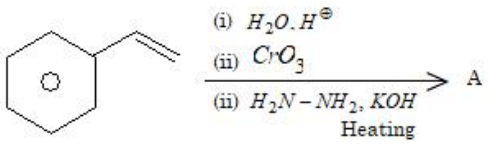
- Abenzene ring (circle inside) with a –CH₂–CH=N–NH₂ chain on the upper-right carbon
- Bbenzene ring (circle inside) with an ethyl group –CH₂–CH₃ on the upper-right carbon
- Cbenzene ring (circle inside) with a –CH₂–CH₂–COOH chain on the upper-right carbon
- Dbenzene ring (circle inside) with a –C(=N–NH₂)–CH₃ group on the upper-right carbon
No verified answer or solution is available for this question.
Chemical Bonding and Molecular Structure
The interaction between π bond and lone pair of electrons present on an adjacent atom is responsible for
- AResonance effect
- BHyperconjugation
- CInductive effect
- DElectromeric effect
No verified answer or solution is available for this question.
Organic Compounds Containing Nitrogen
The arenium ion which is not involved in the bromination of Aniline is ________.
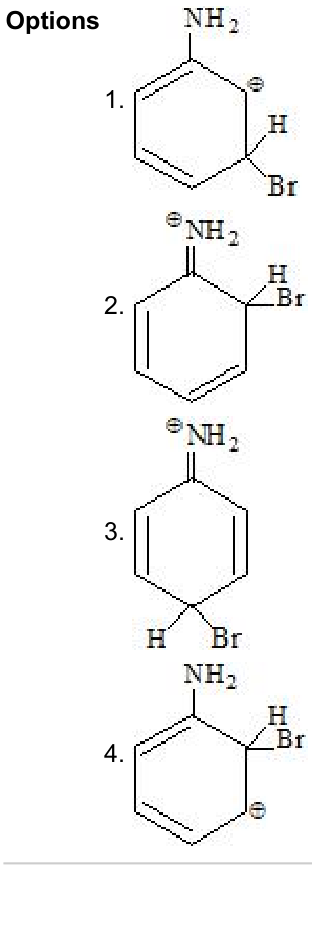
- Aa six-membered ring in Kekulé form with –NH₂ on the top carbon, a circled negative charge (⊖) beside the upper-right carbon and H and Br on the lower-right carbon (ring double bonds on the upper-left edge and on the lower-left edge)
- Ba six-membered ring in Kekulé form with ⊕NH₂ double-bonded to the top carbon and H and Br on the upper-right carbon (ring double bonds on the left-hand vertical edge and on the lower-right edge)
- Ca six-membered ring in Kekulé form with ⊕NH₂ double-bonded to the top carbon and H and Br on the bottom carbon (ring double bonds on the left-hand vertical edge and on the right-hand vertical edge)
- Da six-membered ring in Kekulé form with –NH₂ on the top carbon, H and Br on the upper-right carbon and a circled negative charge (⊖) beside the lower-right carbon (ring double bonds on the upper-left edge and on the lower-left edge)
No verified answer or solution is available for this question.
Organic Compounds Containing Nitrogen
Appearance of blood red colour, on treatment of the sodium fusion extract of an organic compound with FeSO₄ in presence of concentrated H₂SO₄ indicates the presence of element/s
- AS
- BN and S
- CBr
- DN
No verified answer or solution is available for this question.
Redox Reactions and Electrochemistry
Chlorine undergoes disproportionation in alkaline medium as shown below : a Cl₂(g) + b OH⁻(aq) → c ClO⁻(aq) + d Cl⁻(aq) + e H₂O(l) The values of a, b, c and d in a balanced redox reaction are respectively :
- A2, 4, 1 and 3
- B1, 2, 1 and 1
- C3, 4, 4 and 2
- D2, 2, 1 and 3
No verified answer or solution is available for this question.
Redox Reactions and Electrochemistry
In alkaline medium, MnO₄⁻ oxidises I⁻ to
- AIO₄⁻
- BIO⁻
- CIO₃⁻
- DI₂
No verified answer or solution is available for this question.
Classification of Elements and Periodicity in Properties
Given below are two statements : one is labelled as Assertion A and the other is labelled as Reason R : Assertion A : The first ionisation enthalpy decreases across a period. Reason R : The increasing nuclear charge outweighs the shielding across the period. In the light of the above statements, choose the most appropriate from the options given below :
- ABoth A and R are true but R is NOT the correct explanation of A
- BA is true but R is false
- CA is false but R is true
- DBoth A and R are true and R is the correct explanation of A
No verified answer or solution is available for this question.
Redox Reactions and Electrochemistry
In chromyl chloride test for confirmation of Cl⁻ ion, a yellow solution is obtained. Acidification of the solution and addition of amyl alcohol and 10% H₂O₂ turns organic layer blue indicating formation of chromium pentoxide. The oxidation state of chromium in that is
- A+5
- B+10
- C+6
- D+3
No verified answer or solution is available for this question.
Which of the following is not correct?
- AΔG is zero for a reversible reaction
- BΔG is positive for a non-spontaneous reaction
- CΔG is positive for a spontaneous reaction
- DΔG is negative for a spontaneous reaction
No verified answer or solution is available for this question.
KMnO₄ decomposes on heating at 513K to form O₂ along with
- AMn & KO₂
- BMnO₂ & K₂O₂
- CK₂MnO₄ & Mn
- DK₂MnO₄ & MnO₂
No verified answer or solution is available for this question.
Type of amino acids obtained by hydrolysis of proteins is :
- Aδ
- Bβ
- Cα
- Dγ
No verified answer or solution is available for this question.
Match List I with List II LIST I (Substances) — LIST II (Element Present) A. Ziegler catalyst — I. Rhodium B. Blood Pigment — II. Cobalt C. Wilkinson catalyst — III. Iron D. Vitamin B₁₂ — IV. Titanium Choose the correct answer from the options given below:
- AA-IV, B-III, C-I, D-II
- BA-II, B-IV, C-I, D-III
- CA-II, B-III, C-IV, D-I
- DA-III, B-II, C-IV, D-I
No verified answer or solution is available for this question.
Chemical Bonding and Molecular Structure
The difference in energy between the actual structure and the lowest energy resonance structure for the given compound is
- Aresonance energy
- Bhyperconjugation energy
- Celectromeric energy
- Dionization energy
No verified answer or solution is available for this question.
Organic Compounds Containing Halogens
Identify product A and product B :
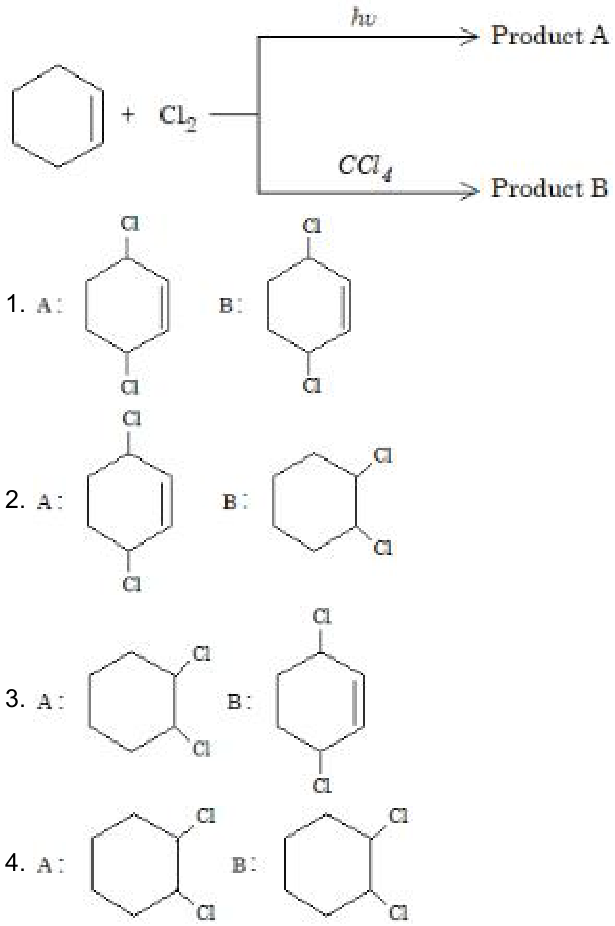
- AA: a six-membered ring with a double bond on its right-hand vertical edge, with Cl on the top carbon and Cl on the bottom carbon; B: a six-membered ring with a double bond on its right-hand vertical edge, with Cl on the top carbon and Cl on the bottom carbon
- BA: a six-membered ring with a double bond on its right-hand vertical edge, with Cl on the top carbon and Cl on the bottom carbon; B: a six-membered ring with no double bond, with Cl on the upper-right carbon and Cl on the lower-right carbon (the two substituted carbons are adjacent)
- CA: a six-membered ring with no double bond, with Cl on the upper-right carbon and Cl on the lower-right carbon (the two substituted carbons are adjacent); B: a six-membered ring with a double bond on its right-hand vertical edge, with Cl on the top carbon and Cl on the bottom carbon
- DA: a six-membered ring with no double bond, with Cl on the upper-right carbon and Cl on the lower-right carbon (the two substituted carbons are adjacent); B: a six-membered ring with no double bond, with Cl on the upper-right carbon and Cl on the lower-right carbon (the two substituted carbons are adjacent)
No verified answer or solution is available for this question.
The major product(P) in the following reaction is
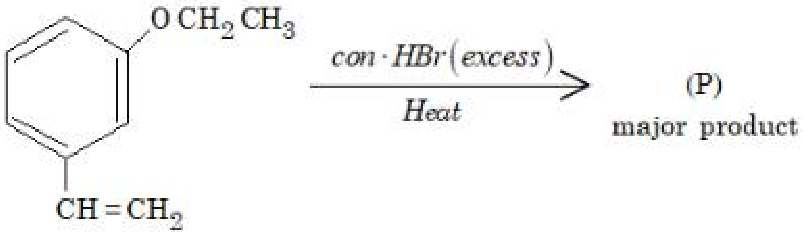
- Abenzene ring with –OH on the upper-right carbon and –CH(Br)–CH₃ on the bottom carbon
- Bbenzene ring with –OH on the upper-right carbon and –CH₂CH₂Br on the bottom carbon
- Cbenzene ring with –Br on the upper-right carbon and –CH(Br)–CH₃ on the bottom carbon
- Dbenzene ring with –Br on the upper-right carbon and –CH₂CH₂Br on the bottom carbon
No verified answer or solution is available for this question.
Identify the incorrect pair from the following :
- ACryolite – Na₃AlF₆
- BFluoroapatite – 3 Ca₃(PO₄)₂·CaF₂
- CCarnallite – KCl·MgCl₂·6H₂O
- DFluorspar – BF₃
No verified answer or solution is available for this question.
The correct set of four quantum numbers for the valence electron of rubidium atom (Z = 37) is :
- A5, 0, 0, +1/2
- B5, 1, 1, +1/2
- C5, 0, 1, +1/2
- D5, 1, 0, +1/2
No verified answer or solution is available for this question.
In which one of the following metal carbonyls, CO forms a bridge between metal atoms?
- A[Co₂(CO)₈]
- B[Os₃(CO)₁₂]
- C[Ru₃(CO)₁₂]
- D[Mn₂(CO)₁₀]
No verified answer or solution is available for this question.
Chemical Bonding and Molecular Structure
Given below are two statements : Statement I : The electronegativity of group 14 elements from Si to Pb, gradually decreases. Statement II : Group 14 contains non-metallic, metallic, as well as metalloid elements. In the light of the above statements, choose the most appropriate from the options given below :
- AStatement I is false but Statement II is true
- BBoth Statement I and Statement II are false
- CStatement I is true but Statement II is false
- DBoth Statement I and Statement II are true
No verified answer or solution is available for this question.
Organic Compounds Containing Halogens
Given below are two statements : one is labelled as Assertion A and the other is labelled as Reason R : Assertion A : Aryl halides cannot be prepared by replacement of hydroxyl group of phenol by halogen atom. Reason R : Phenols react with halogen acids violently. In the light of the above statements, choose the most appropriate from the options given below :
- ABoth A and R are true and R is the correct explanation of A
- BBoth A and R are true but R is NOT the correct explanation of A
- CA is false but R is true
- DA is true but R is false
No verified answer or solution is available for this question.
The osmotic pressure of a dilute solution is 7×10⁵ Pa at 273K. Osmotic pressure of the same solution at 283K is ______×10⁴ Nm⁻².
No verified answer or solution is available for this question.
Number of compounds among the following which contain sulphur as heteroatom is ________. Furan, Thiophene, Pyridine, Pyrrole, Cysteine, Tyrosine
No verified answer or solution is available for this question.
Organic Compounds Containing Oxygen
From the compounds given below, number of compounds which give positive Fehling's test is ________. Benzaldehyde, Acetaldehyde, Acetone, Acetophenone, Methanal, 4-nitrobenzaldehyde, cyclohexane carbaldehyde.
No verified answer or solution is available for this question.
Chemical Bonding and Molecular Structure
Number of compounds with one lone pair of electrons on central atom amongst following is ________ O₃, H₂O, SF₄, ClF₃, NH₃, BrF₅, XeF₄
No verified answer or solution is available for this question.
Chemical Bonding and Molecular Structure
The number of species from the following which are paramagnetic and with bond order equal to one is ________. H₂, He₂⁺, O₂⁺, N₂²⁻, O₂²⁻, F₂, Ne₂⁺, B₂
No verified answer or solution is available for this question.
Consider the given reaction. The total number of oxygen atom/s present per molecule of the product (P) is ________.

No verified answer or solution is available for this question.
For the reaction N₂O₄(g) ⇌ 2NO₂(g) , Kₚ = 0.492 atm at 300K. K꜀ for the reaction at same temperature is ______×10⁻². (Given : R = 0.082 L atm mol⁻¹ K⁻¹)
No verified answer or solution is available for this question.
Some Basic Concepts in Chemistry
A solution of H₂SO₄ is 31.4% H₂SO₄ by mass and has a density of 1.25g/mL. The molarity of the H₂SO₄ solution is ______ M (nearest integer) [Given molar mass of H₂SO₄ = 98g mol⁻¹]
No verified answer or solution is available for this question.
Redox Reactions and Electrochemistry
The mass of zinc produced by the electrolysis of zinc sulphate solution with a steady current of 0.015 A for 15 minutes is ______×10⁻⁴ g. (Atomic mass of zinc = 65.4 amu)
No verified answer or solution is available for this question.
For a reaction taking place in three steps at same temperature, overall rate constant K = K₁K₂/K₃. If Ea₁, Ea₂ and Ea₃ are 40, 50 and 60 kJ/mol respectively, the overall Ea is ______ kJ/mol.
No verified answer or solution is available for this question.