
// JEE (Main) / 2024
JEE (Main) 2024 Session 1, 27 January 2024, Shift 2 — Paper 1 (B.E / B.Tech) Chemistry
Chemistry · B.E / B.Tech
Work through the questions
30 questions
No verified answers are available for this paper.
Identify B formed in the reaction. Cl – (CH₂)₄ – Cl ⟶[excess NH₃] A ⟶[NaOH] B + H₂O + NaCl
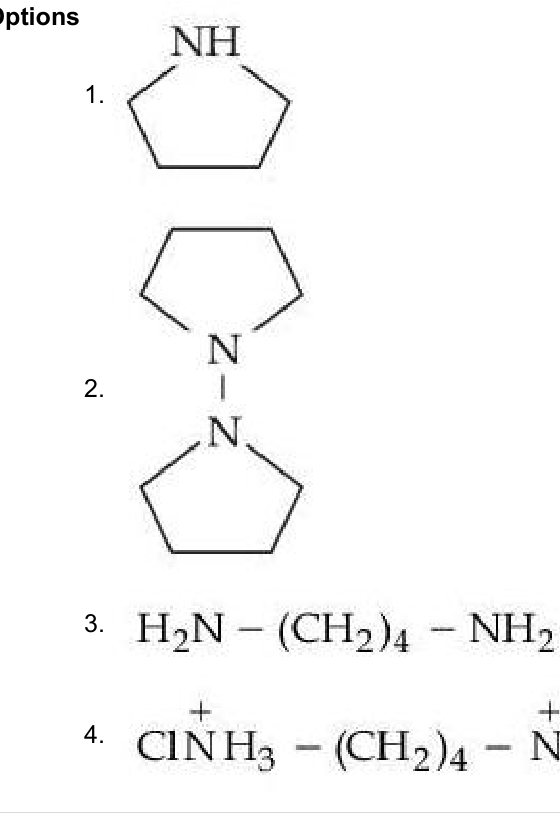
- Aa five-membered ring (pentagon) drawn in skeletal notation with –NH– written at the top vertex
- Btwo five-membered rings (pentagons) drawn in skeletal notation and facing each other across the N–N bond, the upper pentagon with its –N– at its lower vertex and the lower pentagon with its –N– at its upper vertex, the two nitrogen atoms joined by a single vertical bond
- CH₂N – (CH₂)₄ – NH₂
- D⁺ClNH₃ – (CH₂)₄ – ⁺NH₃Cl⁻
No verified answer or solution is available for this question.
Which of the following statements is not correct about rusting of iron ?
- ARusting of iron is envisaged as setting up of electrochemical cell on the surface of iron object.
- BCoating of iron surface by tin prevents rusting, even if the tin coating is peeling off.
- CWhen pH lies above 9 or 10, rusting of iron does not take place.
- DDissolved acidic oxides SO₂, NO₂ in water act as catalyst in the process of rusting.
No verified answer or solution is available for this question.
Chemical Bonding and Molecular Structure
Identify from the following species in which d²sp³ hybridisation is shown by central atom :
- ASF₆
- B[Pt(Cl₄)]²⁻
- C[Co(NH₃)₆]³⁺
- DBrF₅
No verified answer or solution is available for this question.
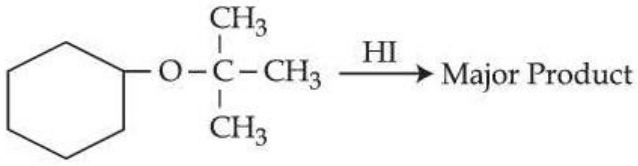
Major product formed in the following reaction is a mixture of : [a cyclohexane ring drawn as a hexagon joined through an –O– to a carbon carrying CH₃ above it, CH₃ below it and CH₃ to its right ⟶[HI] Major Product]
- Aa cyclohexane ring drawn as a hexagon with –OH on the top vertex and (CH₃)₃COH
- Ba cyclohexane ring drawn as a hexagon with –I on the top vertex and (CH₃)₃COH
- Ca cyclohexane ring drawn as a hexagon with –OH on the top vertex and CH₃ – C – I, the carbon carrying CH₃ above it, CH₃ below it and I to its right
- Da cyclohexane ring drawn as a hexagon with –I on the top vertex and (CH₃)₃Cl
No verified answer or solution is available for this question.
Some Basic Concepts in Chemistry
The quantity which changes with temperature is :
- AMole fraction
- BMolality
- CMolarity
- DMass percentage
No verified answer or solution is available for this question.
Organic Compounds Containing Oxygen
Phenolic group can be identified by a positive :
- ACarbylamine test
- BTollen’s test
- CLucas test
- DPhthalein dye test
No verified answer or solution is available for this question.
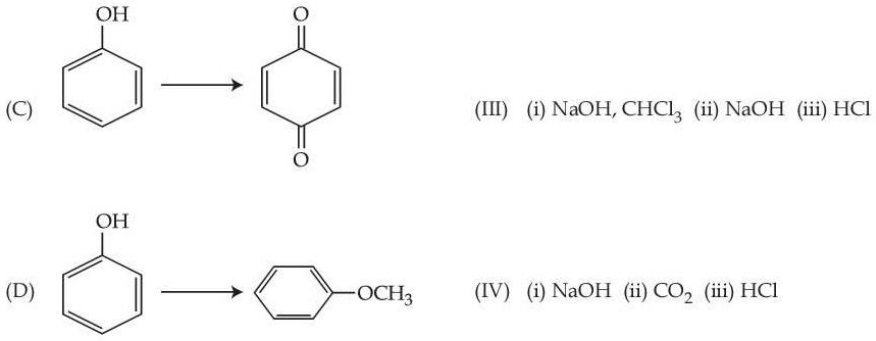
Match List - I with List - II. List - I (Reaction) (A) [phenol (a benzene ring drawn as a hexagon in Kekulé form with –OH on the top vertex) ⟶ a benzene ring drawn as a hexagon in Kekulé form with –OH on the top vertex and –COOH on the upper-right vertex] (B) [phenol (a benzene ring drawn as a hexagon in Kekulé form with –OH on the top vertex) ⟶ a benzene ring drawn as a hexagon in Kekulé form with –OH on the top vertex and –CHO on the upper-right vertex] (C) [phenol (a benzene ring drawn as a hexagon in Kekulé form with –OH on the top vertex) ⟶ a six-membered ring drawn with double bonds on its left and right vertical edges and with =O on the top vertex and =O on the bottom vertex] (D) [phenol (a benzene ring drawn as a hexagon in Kekulé form with –OH on the top vertex) ⟶ a benzene ring drawn as a hexagon with –OCH₃ on the right-hand vertex] List - II (Reagent(s)) (I) Na₂Cr₂O₇, H₂SO₄ (II) (i) NaOH (ii) CH₃Cl (III) (i) NaOH, CHCl₃ (ii) NaOH (iii) HCl (IV) (i) NaOH (ii) CO₂ (iii) HCl Choose the correct answer from the options given below :
- A(A)-(IV), (B)-(III), (C)-(I), (D)-(II)
- B(A)-(II), (B)-(I), (C)-(III), (D)-(IV)
- C(A)-(II), (B)-(III), (C)-(I), (D)-(IV)
- D(A)-(IV), (B)-(I), (C)-(III), (D)-(II)
No verified answer or solution is available for this question.
Choose the correct option having all the elements with d¹⁰ electronic configuration from the following :
- A²⁹Cu, ³⁰Zn, ⁴⁸Cd, ⁴⁷Ag
- B⁴⁶Pd, ²⁸Ni, ²⁶Fe, ²⁴Cr
- C²⁷Co, ²⁸Ni, ²⁶Fe, ²⁴Cr
- D²⁸Ni, ²⁴Cr, ²⁶Fe, ²⁹Cu
No verified answer or solution is available for this question.
Identify the incorrect pair from the following :
- AHaber process - Iron
- BPolythene preparation - TiCl₄, Al(CH₃)₃
- CPhotography - AgBr
- DWacker process - Pt Cl₂
No verified answer or solution is available for this question.
Chemical Bonding and Molecular Structure
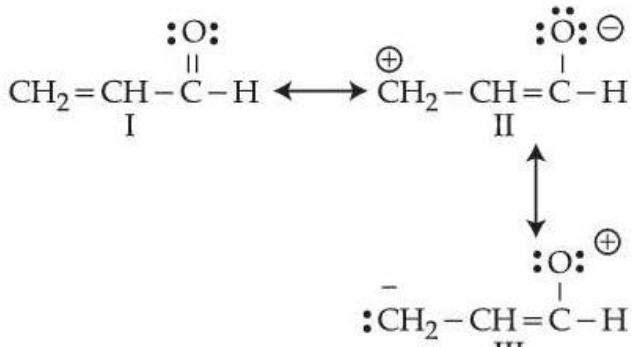
The order of relative stability of the contributing structure is : (I) CH₂ = CH – C – H with the oxygen drawn above the third carbon as a double bond and two lone pairs shown on the O atom (II) ⊕CH₂ – CH = C – H with the ⊕ printed above the left CH₂ carbon, the oxygen drawn above the third carbon as a single bond and three lone pairs with a ⊖ printed beside the O atom (III) ⁻CH₂ – CH = C – H with the ⊖ printed above the left CH₂ carbon, the oxygen drawn above the third carbon as a single bond and three lone pairs with a ⊕ printed beside the O atom Structure I and structure II are joined by a horizontal double-headed arrow (↔) and structure II and structure III are joined by a vertical double-headed arrow (⇕). Choose the correct answer from the options given below :
- AI > II > III
- BIII > II > I
- CII > I > III
- DI = II = III
No verified answer or solution is available for this question.
Which structure of protein remains intact after coagulation of egg white on boiling ?
- AQuaternary
- BPrimary
- CSecondary
- DTertiary
No verified answer or solution is available for this question.
Some Basic Principles of Organic Chemistry
Bond line formula of HOCH(CN)₂ is :
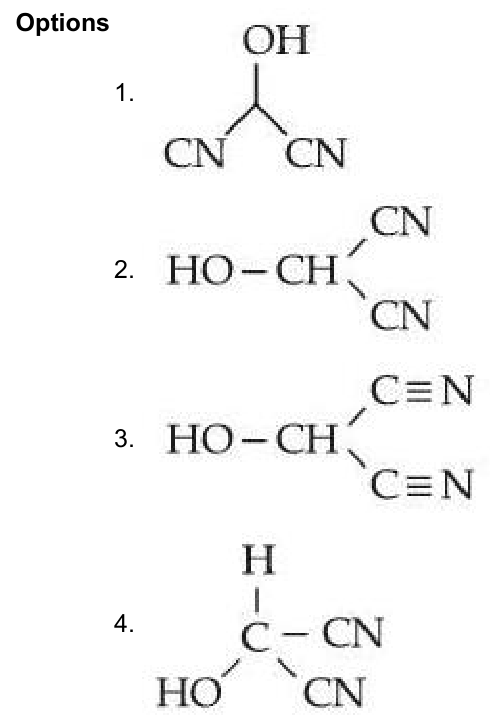
- Aa bond-line drawing with an unlabelled central carbon vertex carrying –OH on a vertical bond above it, –CN on a bond to the lower left and –CN on a bond to the lower right
- BHO – CH with –CN on a bond to the upper right and –CN on a bond to the lower right
- CHO – CH with –C≡N on a bond to the upper right and –C≡N on a bond to the lower right
- Da drawing with a central C carrying –H on a vertical bond above it, –CN to its right, –HO on a bond to the lower left and –CN on a bond to the lower right
No verified answer or solution is available for this question.
Some Basic Principles of Organic Chemistry
The incorrect statement regarding conformations of ethane is :
- AThe conformations of ethane are inter-convertible to one-another.
- BThe dihedral angle in staggered conformation is 60°.
- CEclipsed conformation is the most stable conformation.
- DEthane has infinite number of conformations.
No verified answer or solution is available for this question.
Redox Reactions and Electrochemistry
Which of the following cannot function as an oxidising agent ?
- ABrO₃⁻
- BMnO₄⁻
- CSO₄²⁻
- DN³⁻
No verified answer or solution is available for this question.
Purification and Characterisation of Organic Compounds
The technique used for purification of steam volatile water immiscible substances is :
- Asteam distillation
- Bfractional distillation
- Cfractional distillation under reduced pressure
- Ddistillation
No verified answer or solution is available for this question.
Some Basic Principles of Organic Chemistry
The molecular formula of second homologue in the homologous series of mono carboxylic acids is ______.
- AC₃H₆O₂
- BC₂H₄O₂
- CC₂H₂O₂
- DCH₂O
No verified answer or solution is available for this question.
Organic Compounds Containing Oxygen
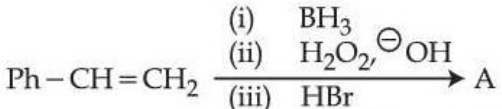
The final product A, formed in the following reaction sequence is : Ph – CH = CH₂ ⟶[(i) BH₃, (ii) H₂O₂/OH⁻ above the arrow and (iii) HBr, (iv) Mg, ether, then HCHO/H₃O⁺ below it] A
- APh – CH – CH₃ with a vertical bond from the CH carbon down to CH₂OH
- BPh – CH – CH₃ with a vertical bond from the CH carbon down to CH₃
- CPh – CH₂ – CH₂ – CH₂ – OH
- DPh – CH₂ – CH₂ – CH₃
No verified answer or solution is available for this question.
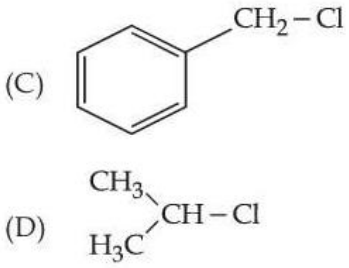
Which among the following halide/s will not show S_N1 reaction : (A) H₂C = CH – CH₂Cl (B) CH₃ – CH = CH – Cl (C) [a benzene ring drawn as a hexagon in Kekulé form with a –CH₂ – Cl group on the upper-right vertex] (D) [a carbon written as CH with –Cl to its right, –CH₃ on a bond to the upper left and –H₃C on a bond to the lower left] Choose the most appropriate answer from the options given below :
- A(A), (B) and (D) only
- B(B) and (C) only
- C(A) and (B) only
- D(B) only
No verified answer or solution is available for this question.
Given below are two statements : Statement (I) : In the Lanthanoids, the formation Ce⁴⁺ is favoured by its noble gas configuration. Statement (II) : Ce⁴⁺ is a strong oxidant reverting to the common +3 state. In the light of the above statements, choose the most appropriate answer from the options given below :
- AStatement I is false but Statement II is true
- BStatement I is true but Statement II is false
- CBoth Statement I and Statement II are false
- DBoth Statement I and Statement II are true
No verified answer or solution is available for this question.
Redox Reactions and Electrochemistry
Given below are two statements : Statement (I) : Oxygen being the first member of group 16 exhibits only –2 oxidation state. Statement (II) : Down the group 16 stability of +4 oxidation state decreases and +6 oxidation state increases. In the light of the above statements, choose the most appropriate answer from the options given below :
- AStatement I is correct but Statement II is incorrect
- BBoth Statement I and Statement II are incorrect
- CStatement I is incorrect but Statement II is correct
- DBoth Statement I and Statement II are correct
No verified answer or solution is available for this question.
For a certain thermochemical reaction M → N at T = 400 K, ΔH⊖ = 77.2 kJ mol⁻¹, ΔS = 122 JK⁻¹, log equilibrium constant (logK) is – ______×10⁻¹.
No verified answer or solution is available for this question.
Some Basic Concepts in Chemistry
Volume of 3 M NaOH (formula weight 40 g mol⁻¹) which can be prepared from 84 g of NaOH is ______×10⁻¹ dm³.
No verified answer or solution is available for this question.
Principles Related to Practical Chemistry
9.3 g of aniline is subjected to reaction with excess of acetic anhydride to prepare acetanilide. The mass of acetanilide produced if the reaction is 100% completed is ______×10⁻¹ g. (Given molar mass in g mol⁻¹ N : 14, O : 16, C : 12, H : 1)
No verified answer or solution is available for this question.
The Spin only magnetic moment value of square planar complex [Pt(NH₃)₂Cl(NH₂CH₃)]Cl is ______ B.M. (Nearest integer) (Given atomic number for Pt = 78)
No verified answer or solution is available for this question.
Some Basic Principles of Organic Chemistry
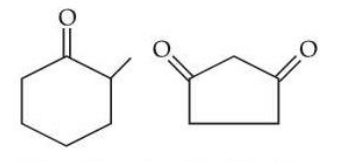
Total number of compounds with Chiral carbon atoms from following is ______. [a six-membered ring drawn as a hexagon with an exocyclic C=O on the top vertex and a methyl group on the adjacent upper-right vertex] [a five-membered ring drawn as a pentagon with exocyclic C=O groups on the upper-left and upper-right vertices] CH₃ – CH₂ – CH(NO₂) – COOH CH₃ – CH₂ – CHBr – CH₂ – CH₃ CH₃ – CH(I) – CH₂ – NO₂ CH₃ – CH₂ – CH(OH) – CH₂OH CH₃ – CH(I) – C₂H₅ (with a vertical bond running from the CH carbon down to the I atom)
No verified answer or solution is available for this question.
Total number of ions from the following with noble gas configuration is ______. Sr²⁺ (z = 38), Cs⁺ (z = 55), La²⁺ (z = 57), Pb²⁺ (z = 82), Yb²⁺ (z = 70) and Fe²⁺ (z = 26)
No verified answer or solution is available for this question.
Time required for completion of 99.9% of a First order reaction is ______ times of half life (t₁/₂) of the reaction.
No verified answer or solution is available for this question.
Some Basic Concepts in Chemistry
1 mole of PbS is oxidised by “X” moles of O₃ to get “Y” moles of O₂. X + Y = ______.
No verified answer or solution is available for this question.
The number of non-polar molecules from the following is ______. HF, H₂O, SO₂, H₂, CO₂, CH₄, NH₃, HCl, CHCl₃, BF₃
No verified answer or solution is available for this question.
The hydrogen electrode is dipped in a solution of pH = 3 at 25°C. The potential of the electrode will be – ______×10⁻² V. (2.303 RT/F = 0.059 V)
No verified answer or solution is available for this question.