
// JEE (Main) / 2023
JEE (Main) 2023 Session 2, 13 April 2023, Shift 1 — Paper 1 (B.E / B.Tech) Chemistry
Chemistry · B.E / B.Tech
Work through the questions
30 questions
Take a moment to try each question before opening the available answer or solution.
Some Basic Concepts in Chemistry
Given below are two statements : Statement I: Permutit process is more efficient compared to the synthetic resin method for the softening of water. Statement II: Synthetic resin method results in the formation of soluble sodium salts. In the light of the above statements, choose the most appropriate answer from the options given below:
- ABoth the Statements I and II are correct
- BStatement I is correct but Statement II is incorrect
- CBoth the Statements I and II are incorrect
- DStatement I is incorrect but Statement II is correct
View answer or solution
Answer
Both the Statements I and II are incorrect
Classification of Elements and Periodicity in Properties
Which of the following statements are not correct ? A. The electron gain enthalpy of F is more negative than that of Cl. B. Ionization enthalpy decreases in a group of periodic table. C. The electronegativity of an atom depends upon the atoms bonded to it. D. Al₂O₃ and NO are examples of amphoteric oxides. Choose the most appropriate answer from the options given below :
- AA, B, C and D
- BA, B and D Only
- CA, C and D Only
- DB and D Only
View answer or solution
Answer
A, C and D Only
Redox Reactions and Electrochemistry
Which one of the following is most likely a mismatch ?
- ATitanium - van Arkel Method
- BZinc - Liquation
- CCopper - Electrolysis
- DNickel - Mond process
View answer or solution
Answer
Zinc - Liquation
Chemical Bonding and Molecular Structure
In which of the following processes, the bond order increases and paramagnetic character changes to diamagnetic one ?
- ANO → NO⁺
- BO₂ → O₂²⁻
- CN₂ → N₂⁺
- DO₂ → O₂⁺
View answer or solution
Answer
NO → NO⁺
Principles Related to Practical Chemistry
What happens when a lyophilic sol is added to a lyophobic sol?
- AFilm of lyophilic sol is formed over lyophobic sol.
- BFilm of lyophobic sol is formed over lyophilic sol.
- CLyophilic sol is dispersed in lyophobic sol.
- DLyophobic sol is coagulated
View answer or solution
Answer
Film of lyophilic sol is formed over lyophobic sol.
The mismatched combinations are A. Chlorophyll - Co B. Water hardness - EDTA C. Photography - [Ag(CN)₂]⁻ D. Wilkinson catalyst - [(Ph₃P)₃RhCl] E. Chelating ligand - D-Penicillamine Choose the correct answer from the options given below :
- AD and E Only
- BA and C Only
- CA and E Only
- DA, C, and E Only
View answer or solution
Answer
A and C Only
Organic Compounds Containing Oxygen
2-Methyl propyl bromide reacts with C₂H₅O⁻ and gives 'A' whereas on reaction with C₂H₅OH it gives 'B'. The mechanism followed in these reactions and the products 'A' and 'B' respectively are :
- ASₙ2, A = 2-butyl ethyl ether; Sₙ2, B = iso-butyl ethyl ether
- BSₙ1, A = tert-butyl ethyl ether; Sₙ1, B = 2-butyl ethyl ether
- CSₙ1, A = tert-butyl ethyl ether; Sₙ2, B = iso-butyl ethyl ether
- DSₙ2, A = iso-butyl ethyl ether; Sₙ1, B = tert-butyl ethyl ether
View answer or solution
Answer
Sₙ2, A = iso-butyl ethyl ether; Sₙ1, B = tert-butyl ethyl ether
Chemical Bonding and Molecular Structure
Among the following compounds, the one which shows highest dipole moment is
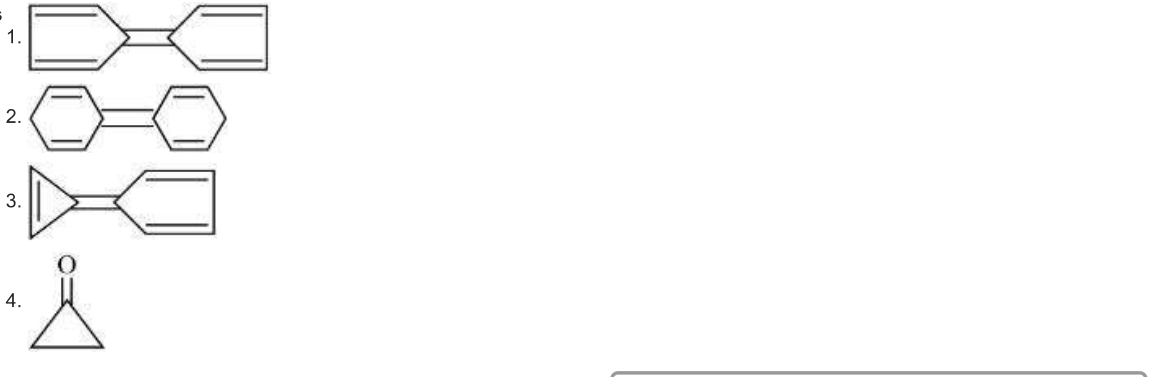
- ACompound structure 1 (see Figure in transcription_notes)
- BCompound structure 2 (see Figure in transcription_notes)
- CCompound structure 3 (see Figure in transcription_notes)
- DCompound structure 4 (see Figure in transcription_notes)
View answer or solution
Answer
Compound structure 3 (see Figure in transcription_notes)
In the reaction given below 'A' is
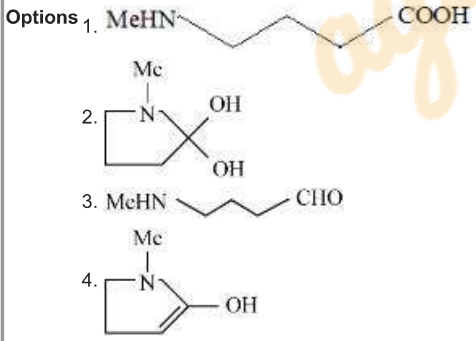
- AMeHN-(CH₂)₃-COOH (open-chain amino acid)
- BCyclic gem-diol with N-Me (see Figure in transcription_notes)
- CMeHN-(CH₂)₃-CHO (open-chain amino aldehyde)
- DCyclic enol with N-Me and OH (see Figure in transcription_notes)
View answer or solution
Answer
MeHN-(CH₂)₃-COOH (open-chain amino acid)
Match the following Column-A / Column-B: a) Nylon 6 / I. Natural Rubber; b) Vulcanized Rubber / II. Cross Linked; c) cis-1,4-polyisoprene / III. Caprolactam; d) Polychloroprene / IV. Neoprene. Choose the correct answer from options given below :
- Aa→III, b→II, c→I, d→IV
- Ba→II, b→III, c→IV, d→I
- Ca→III, b→IV, c→I, d→II
- Da→IV, b→III, c→II, d→I
View answer or solution
Answer
a→III, b→II, c→I, d→IV
The energy of an electron in the first Bohr orbit of hydrogen atom is -2.18×10⁻¹⁸ J. Its energy in the third Bohr orbit is ________.
- A1/27 of this value
- BThree times of this value
- C1/9 th of this value
- DOne third of this value
View answer or solution
Answer
1/9 th of this value
Some Basic Principles of Organic Chemistry
In the above reaction, left hand side and right hand side rings are named as 'A' and 'B' respectively. They undergo ring expansion. The correct statement for this process is:
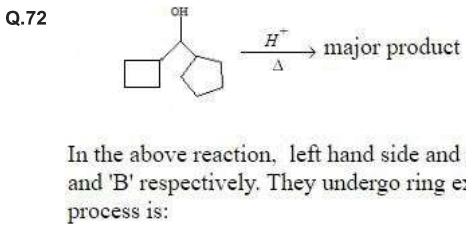
- AFinally both rings will become six membered each.
- BOnly A will become 6 membered.
- CRing expansion can go upto seven membered rings
- DFinally both rings will become five membered each.
View answer or solution
Answer
Finally both rings will become six membered each.
D -(+)- Glyceraldehyde i) HCN / ii) H₂O / H⁺ / iii) HNO₃ The products formed in the above reaction are
- ATwo optically active products
- BTwo optically inactive products
- COne optically active and one meso product
- DOne optically inactive and one meso product.
View answer or solution
Answer
One optically active and one meso product
The radical which mainly causes ozone depletion in the presence of UV radiations is :
- AȮH
- BCH₃•
- CNO•
- DCl•
View answer or solution
Answer
Cl•
Be(OH)₂ reacts with Sr(OH)₂ to yield an ionic salt. Choose the incorrect option related to this reaction from the following :
- ABoth Sr and Be elements are present in the ionic salt.
- BThe reaction is an example of acid - base neutralization reaction.
- CThe element Be is present in the cationic part of the ionic salt.
- DBe is tetrahedrally coordinated in the ionic salt.
View answer or solution
Answer
The element Be is present in the cationic part of the ionic salt.
In the following reaction 'X' is CH₃(CH₂)₄CH₃ Anhy. AlCl₃ / HCl / Δ → 'X' major product
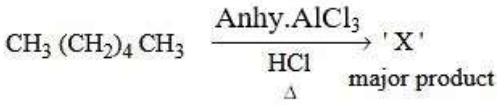
- ACH₃(CH₂)₄CH₂Cl
- BCl-CH₂-(CH₂)₄-CH₂-Cl
- CCH₃CH-(CH₂)₂CH₃ with CH₃ below CH (2-methylpentane)
- DMethylcyclohexane ring (six CH₂ groups in a ring; see Figure in transcription_notes)
View answer or solution
Answer
CH₃CH-(CH₂)₂CH₃ with CH₃ below CH (2-methylpentane)
In the reaction given below 'B' is :
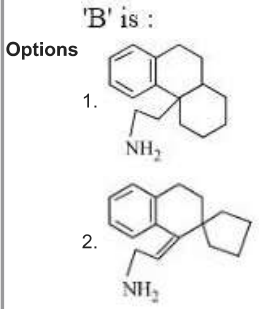
- ADrawn structure: a benzene ring fused to a six-membered ring, with a spiro-fused six-membered saturated ring on the right and a –CH₂–CH₂NH₂ chain at the bottom left labelled NH₂.
- BDrawn structure: a benzene ring fused to a six-membered ring with a double bond in the lower part of the fused system, a spiro-fused five-membered ring on the right and a –CH₂–CH₂NH₂ chain at the bottom left labelled NH₂.
- CDrawn structure: a benzene ring fused to a six-membered ring, with a spiro centre on the right carrying a spiro-fused five-membered ring and a five-membered nitrogen-containing ring below it whose NH is at the bottom right.
- DDrawn structure: a benzene ring fused to a six-membered ring with a double bond in the upper right part of the fused system, a spiro-fused six-membered saturated ring on the right and a –CH₂–CH₂NH₂ chain at the bottom left labelled NH₂.
View answer or solution
Answer
Drawn structure: a benzene ring fused to a six-membered ring with a double bond in the upper right part of the fused system, a spiro-fused six-membered saturated ring on the right and a –CH₂–CH₂NH₂ chain at the bottom left labelled NH₂.
The incorrect statement from the following for borazine is:
- AIt is a cyclic compound.
- BIt contains banana bonds.
- CIt has electronic delocalization.
- DIt can react with water.
View answer or solution
Answer
It contains banana bonds.
Chemical Bonding and Molecular Structure
ClF₅ at room temperature is a:
- AColourless liquid with trigonal bipyramidal geometry
- BColourless liquid with square pyramidal geometry
- CColourless gas with square pyramidal geometry
- DColourless gas with trigonal bipyramidal geometry.
View answer or solution
Answer
Colourless liquid with square pyramidal geometry
The pair of lanthanides in which both elements have high third - ionization energy is:
- AEu, Gd
- BEu, Yb
- CLu, Yb
- DDy, Gd
View answer or solution
Answer
Eu, Yb
Some Basic Principles of Organic Chemistry
For the given reaction CH₃–C(CH₃)(CH₃)–CH(OH)–CH(CH₃)–CH₃ 'A' —H⁺/Δ→ The total number of possible products formed by tertiary carbocation of A is ___________.
View answer or solution
Answer
5
20 mL of calcium hydroxide was consumed when it was reacted with 10 mL of unknown solution of H₂SO₄. Also 20 mL standard solution of 0.5 M HCl containing 2 drops of phenolphthalein was titrated with calcium hydroxide, the mixture showed pink colour when burette displayed the value of 35.5 mL whereas the burette showed 25.5 mL initially. The concentration of H₂SO₄ is __________ M.(Nearest integer)
View answer or solution
Answer
1
25.0 mL of 0.050 M Ba(NO₃)₂ is mixed with 25.0 mL of 0.020 M NaF. Kₛₚ of BaF₂ is 0.5×10⁻⁶ at 298 K. The ratio of [Ba²⁺][F⁻]² and Kₛₚ is __________. (Nearest integer)
View answer or solution
Answer
5
Some Basic Concepts in Chemistry
A metal surface of 100 cm² area has to be coated with nickel layer of thickness 0.001 mm. A current of 2A was passed through a solution of Ni(NO₃)₂ for 'x' seconds to coat the desired layer. The value of x is __________. (Nearest integer) (ρNi (density of Nickel) is 10 g mL⁻¹, Molar mass of Nickel is 60 g mol⁻¹ F=96500 C mol⁻¹)
View answer or solution
Answer
161
A₂+B₂→2AB. ΔH_f⁰ = −200 kJ mol⁻¹ AB, A₂ and B₂ are diatomic molecules. If the bond enthalpies of A₂, B₂ and AB are in the ratio 1:0.5:1, then the bond enthalpy of A₂ is __________ kJ mol⁻¹ (Nearest integer)
View answer or solution
Answer
800
t₈₇.₅ is the time required for the reaction to undergo 87.5% completion and t₅₀ is the time required for the reaction to undergo 50% completion. The relation between t₈₇.₅ and t₅₀ for a first order reaction is t₈₇.₅ = x × t₅₀ The value of x is __________. (Nearest integer)
View answer or solution
Answer
3
Solution of 12 g of non-electrolyte (A) prepared by dissolving it in 1000 mL of water exerts the same osmotic pressure as that of 0.05 M glucose solution at the same temperature. The empirical formula of A is CH₂O. The molecular mass of A is __________ g. (Nearest integer)
View answer or solution
Answer
240
Some Basic Concepts in Chemistry
An organic compound gives 0.220 g of CO₂ and 0.126 g of H₂O on complete combustion. If the % of carbon is 24 then the % of hydrogen is __________ ×10⁻¹. ( Nearest integer )
View answer or solution
Answer
56
Some Basic Concepts in Chemistry
A certain quantity of real gas occupies a volume of 0.15 dm³ at 100 atm and 500 K when its compressibility factor is 1.07. Its volume at 300 atm and 300 K (When its compressibility factor is 1.4) is __________ × 10⁻⁴ dm³ (Nearest integer)
View answer or solution
Answer
392
Some Basic Concepts in Chemistry
KMnO₄ is titrated with ferrous ammonium sulphate hexahydrate in presence of dilute H₂SO₄. Number of water molecules produced for 2 molecules of KMnO₄ is __________
View answer or solution
Answer
68