
// JEE (Main) / 2023
JEE (Main) 2023 Session 2, 8 April 2023, Shift 2 — Paper 1 (B.E / B.Tech) Chemistry
Chemistry · B.E / B.Tech
Work through the questions
30 questions
Take a moment to try each question before opening the available answer or solution.
Some Basic Concepts in Chemistry
Which of the following have same number of significant figures? A. 0.00253 B. 1.0003 C. 15.0 D. 163 Choose the correct answer from the options given below
- AC and D only
- BA, C and D only
- CB and C only
- DA, B and C only
View answer or solution
Answer
A, C and D only
A compound 'X' when treated with phthalic anhydride in presence of concentrated H₂SO₄ yields 'Y'. 'Y' is used as an acid/base indicator. 'X' and 'Y' are respectively
- AAnisole, methyl orange
- BCarbolic acid, Phenolphthalein
- CSalicylaldehyde, Phenolphthalein
- DToludine, Phenolphthalein
View answer or solution
Answer
Carbolic acid, Phenolphthalein
In Hall - Heroult process, the following is used for reducing Al₂O₃ :-
- AMagnesium
- BGraphite
- CCaF₂
- DNa₃AlF₆
View answer or solution
Answer
Graphite
Chemical Bonding and Molecular Structure
Match List I with List II LIST I Coordination Complex LIST II Number of unpaired electrons A. [Cr(CN)₆]³⁻ B. [Fe(H₂O)₆]²⁺ C. [Co(NH₃)₆]³⁺ D. [Ni(NH₃)₆]²⁺ I. 0 II. 3 III. 2 IV. 4 Choose the correct answer from the options given below:
- AA-II, B-IV, C-I, D-III
- BA-IV, B-III, C-II, D-I
- CA-II, B-I, C-IV, D-III
- DA-III, B-IV, C-I, D-II
View answer or solution
Answer
A-II, B-IV, C-I, D-III
Which of these reactions is not a part of breakdown of ozone in stratosphere?
- ACF₂Cl₂ (g) —uv→ Cl̇ (g) + ĊF₂Cl (g)
- BClȮ (g) + O (g) → Cl̇ (g) + O₂ (g)
- CCl̇ (g) + O₃ (g) → ClȮ (g) + O₂ (g)
- D2 ClȮ → ClO₂ (g) + Cl̇ (g)
View answer or solution
Answer
2 ClȮ → ClO₂ (g) + Cl̇ (g)
Given below are two statements: Statement I : Methyl orange is a weak acid. Statement II : The benzenoid form of methyl orange is more intense/deeply coloured than the quinonoid form. In the light of the above statement, choose the most appropriate answer from the options given below:
- ABoth Statement I and Statement II are incorrect
- BBoth statement I and Statement II are correct
- CStatement I is correct but Statement II is incorrect
- DStatement I is incorrect but Statement II is correct
View answer or solution
Answer
Both Statement I and Statement II are incorrect
Which of the following can reduce decomposition of H₂O₂ on exposure to light
- AAlkali
- BDust
- CGlass containers
- DUrea
View answer or solution
Answer
Urea
The statement/s which are true about antagonists from the following is/are: A. They bind to the receptor site. B. Get transferred inside the cell for their action. C. Inhibit the natural communication of the body. D. Mimic the natural messenger. Choose the correct answer from the options given below:
- AA, C and D
- BA and B
- CA and C
- DB only
View answer or solution
Answer
A and C
Some Basic Principles of Organic Chemistry
The correct IUPAC nomenclature for the following compound is:
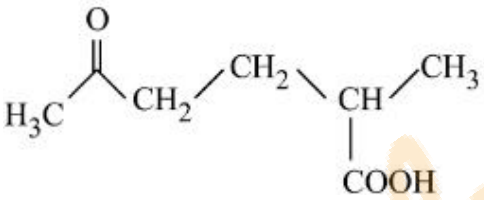
- A5-Formyl -2-methylhexanoic acid
- B2 - Formyl -5-methylhexan-6-oic acid
- C2-Methyl-5-oxohexanoic acid
- D5-Methyl-2-oxohexan-6-oic acid
View answer or solution
Answer
2-Methyl-5-oxohexanoic acid
The correct reaction profile diagram for a positive catalyst reaction.
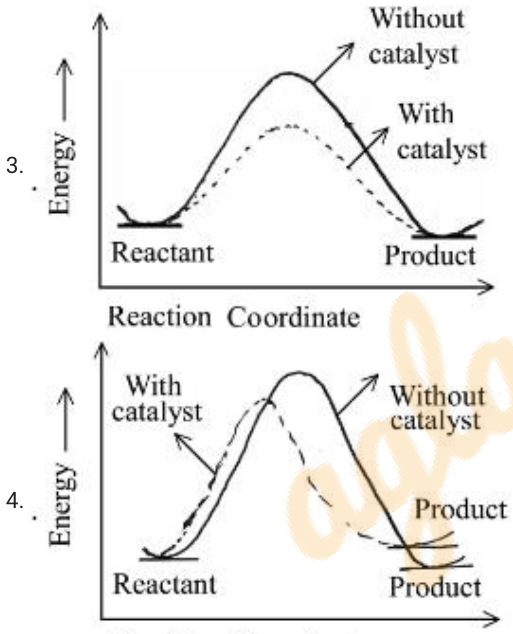
- AEnergy (vertical) vs Reaction Coordinate (horizontal) plot: Reactant on the left at low energy, Product on the right at low energy; a dashed curve labelled 'With catalyst' with the higher peak and a solid curve labelled 'Without catalyst' with the lower peak
- BEnergy (vertical) vs Reaction Coordinate (horizontal) plot: Reactant on the left at low energy, a solid curve labelled 'Without catalyst' peaking lower on the left and falling to Product, and a separate dashed curve labelled 'With catalyst' peaking higher to the right and falling to a second Product point on the right
- CEnergy (vertical) vs Reaction Coordinate (horizontal) plot: Reactant on the left at low energy, Product on the right at low energy; a solid curve labelled 'Without catalyst' with the higher peak and a dashed curve labelled 'With catalyst' with the lower peak
- DEnergy (vertical) vs Reaction Coordinate (horizontal) plot: Reactant on the left at low energy, Product on the right at low energy with two close levels; a dashed curve labelled 'With catalyst' peaking lower on the left and a solid curve labelled 'Without catalyst' peaking higher on the right
View answer or solution
Answer
Energy (vertical) vs Reaction Coordinate (horizontal) plot: Reactant on the left at low energy, Product on the right at low energy; a solid curve labelled 'Without catalyst' with the higher peak and a dashed curve labelled 'With catalyst' with the lower peak
Henry Moseley studied characteristic X-ray spectra of elements. The graph which represents his observation correctly is Given ν = frequency of X-ray emitted Z = atomic number
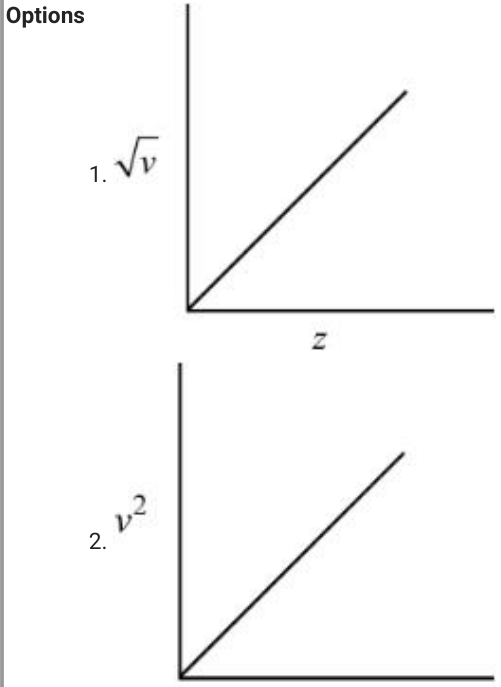
- AGraph with vertical axis √ν and horizontal axis z: a single straight line rising from the origin to the upper right
- BGraph with vertical axis ν² and horizontal axis z: a single straight line rising from the origin to the upper right
- CGraph with vertical axis ν and horizontal axis z: a single straight line rising from the origin to the upper right
- DGraph with vertical axis √z and horizontal axis ν: a single straight line rising from the origin to the upper right
View answer or solution
Answer
Graph with vertical axis √ν and horizontal axis z: a single straight line rising from the origin to the upper right
The product (P) formed from the following multistep reaction is: [benzene ring (hexagon with a circle inside) with NO₂ at the upper-right vertex and H₃C at the lower-left vertex] — (i) Br₂; (ii) H₂ / Pd; (iii) NaNO₂, HCl, 0°C; (iv) H₃PO₂ → (P) Product
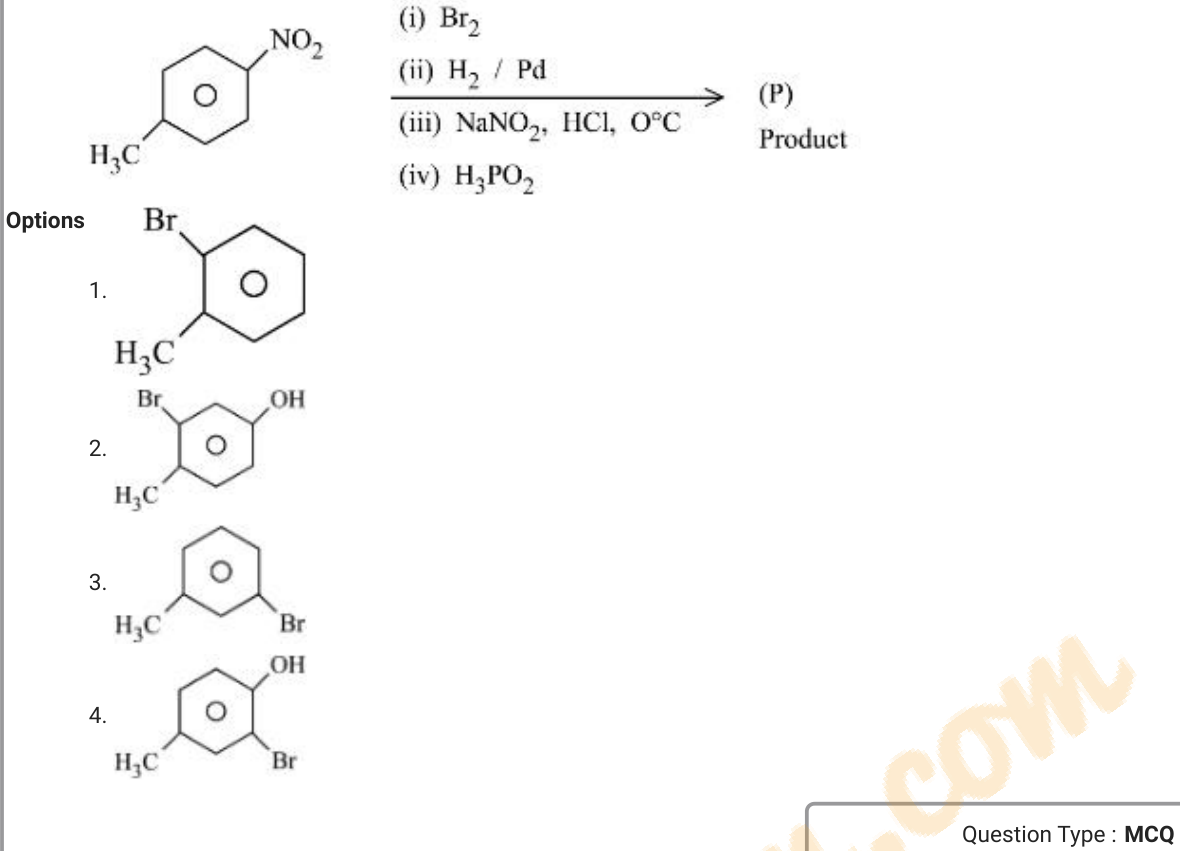
- ADrawn structure: a benzene ring (hexagon with a circle inside) with Br at the upper-left vertex and H₃C at the lower-left vertex, ortho to each other
- BDrawn structure: a benzene ring (hexagon with a circle inside) with Br at the upper-left vertex, OH at the upper-right vertex and H₃C at the lower-left vertex
- CDrawn structure: a benzene ring (hexagon with a circle inside) with H₃C at the lower-left vertex and Br at the lower-right vertex
- DDrawn structure: a benzene ring (hexagon with a circle inside) with OH at the upper-right vertex, H₃C at the lower-left vertex and Br at the lower-right vertex
View answer or solution
Answer
Drawn structure: a benzene ring (hexagon with a circle inside) with Br at the upper-left vertex and H₃C at the lower-left vertex, ortho to each other
Organic Compounds Containing Oxygen
The descending order of acidity for the following carboxylic acid is- A. CH₃COOH B. F₃C–COOH C. ClCH₂–COOH D. FCH₂–COOH E. BrCH₂–COOH Choose the correct answer from the options given below:
- AB > D > C > E > A
- BB > C > D > E > A
- CD > B > A > E > C
- DE > D > B > A > C
View answer or solution
Answer
B > D > C > E > A
Principles Related to Practical Chemistry
For a good quality cement, the ratio of lime to the total of the oxides of Si, Al and Fe should be as close as to
- A2
- B3
- C4
- D1
View answer or solution
Answer
2
Arrange the following gases in increasing order of van der Waals constant 'a' A. Ar B. CH₄ C. H₂O D. C₆H₆ Choose the correct option from the following.
- AC, D, B and A
- BA, B, C and D
- CD, C, B and A
- DB, C, D and A
View answer or solution
Answer
A, B, C and D
Given below are two statements: Statement I : In redox titration, the indicators used are sensitive to change in pH of the solution. Statement II : In acid-base titration, the indicators used are sensitive to change in oxidation potential. In the light of the above statements, choose the most appropriate answer from the options given below
- ABoth Statement I and Statement II are incorrect
- BStatement I is correct but Statement II is incorrect
- CBoth Statement I and Statement II are correct
- DStatement I is incorrect but Statement II is correct
View answer or solution
Answer
Both Statement I and Statement II are incorrect
Classification of Elements and Periodicity in Properties
Given below are two statements: One is labelled as Assertion A and the other is labelled as Reason R Assertion A : Sodium is about 30 times as abundant as potassium in the oceans. Reason R : Potassium is bigger in size than sodium. In the light of the above statements, choose the correct answer from the options given below
- ABoth A and R are true but R is NOT the correct explanation of A
- BA is true but R is false
- CA is false but R is true
- DBoth A and R are true and R is the correct explanation of A
View answer or solution
Answer
Both A and R are true and R is the correct explanation of A
Organic Compounds Containing Oxygen
Major product 'P' formed in the following reaction is: [an alkene chain terminating in a carboxylic acid: CH₂=CH–CH₂–CH₂–CH₂–COOH drawn as a zigzag with the C=O below and OH above at the right] — Br₂ / NaHCO₃ → P Major product
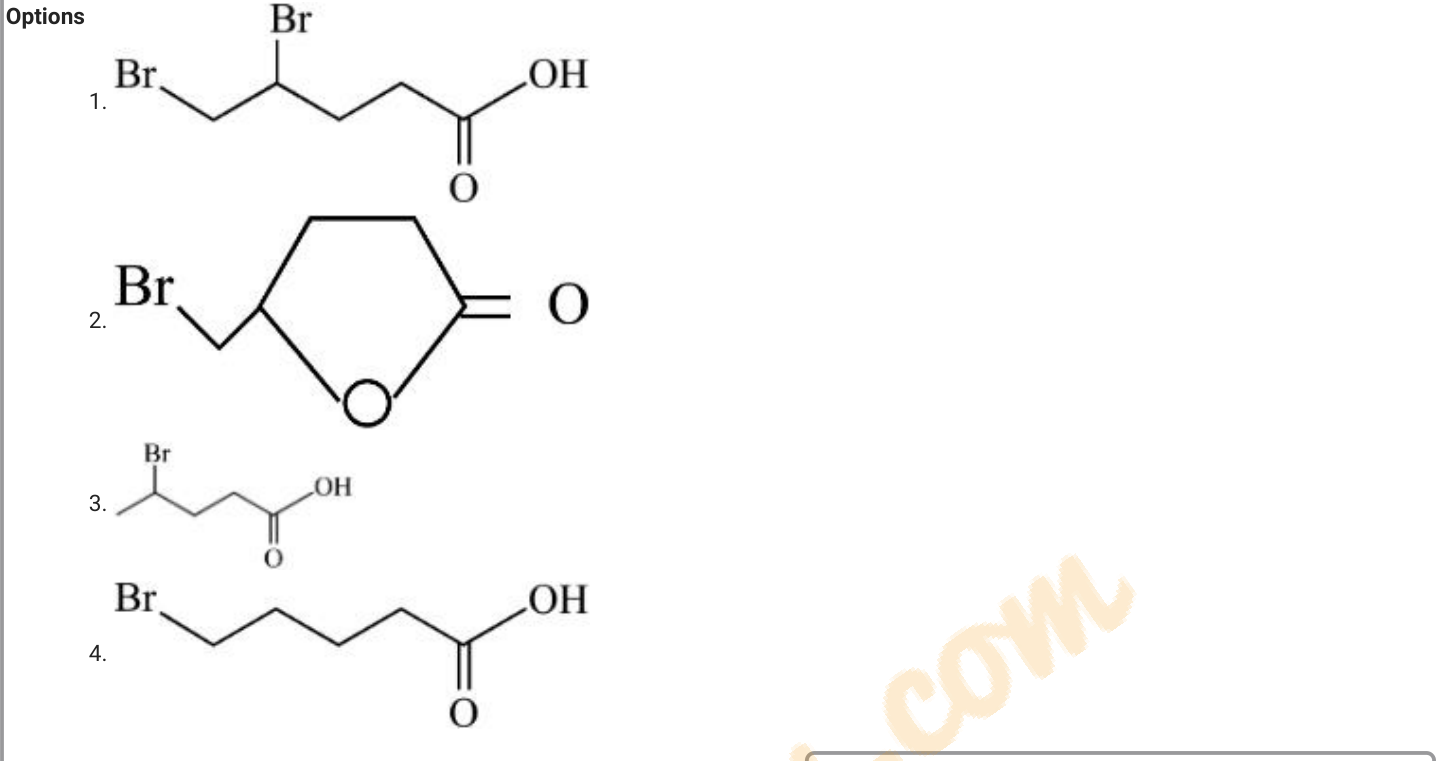
- ADrawn structure: BrCH₂–CH(Br)–CH₂–CH₂–COOH, i.e. a straight chain with Br–CH₂– at the left end, a Br attached to the next carbon, and COOH (OH above, C=O below) at the right end
- BDrawn structure: a six-membered lactone ring with ring oxygen at the bottom, C=O to the right, and a CH₂Br group at the left carbon
- CDrawn structure: CH₃–CH(Br)–CH₂–COOH, i.e. a short chain with CH₃ at the left, Br above the next carbon, and COOH (OH above, C=O below) at the right end
- DDrawn structure: BrCH₂–CH₂–CH₂–CH₂–COOH, i.e. a straight chain with Br– at the left end and COOH (OH above, C=O below) at the right end
View answer or solution
Answer
Drawn structure: a six-membered lactone ring with ring oxygen at the bottom, C=O to the right, and a CH₂Br group at the left carbon
Match List I with List II LIST I Natural amino acid | LIST II One letter code A. Glutamic acid | I. Q B. Glutamine | II. W C. Tyrosine | III. E D. Tryptophan | IV. Y Choose the correct answer from the options given below:
- AA-II, B-I, C-IV, D-III
- BA-III, B-I, C-IV, D-II
- CA-IV, B-III, C-I, D-II
- DA-III, B-IV, C-I, D-II
View answer or solution
Answer
A-III, B-I, C-IV, D-II
Organic Compounds Containing Oxygen
Th correct order of reactivity of following haloarenes towards nucleophilic substitution with aqueous NaOH is : A. B. C. D. Choose the correct answer from the options given below:
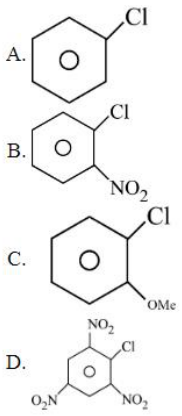
- AC > A > D > B
- BA > B > D > C
- CD > B > A > C
- DD > C > B > A
View answer or solution
Answer
D > B > A > C
The observed magnetic moment of the complex [Mn(NCS)₆]ˣ⁻ is 6.06 BM. The numerical value of x is ___________.
View answer or solution
Answer
4
Chemical Bonding and Molecular Structure
The number of species from the following carrying a single lone pair on central atom Xenon is __________. XeF₅⁺, XeO₃, XeO₂F₂, XeF₅⁻, XeO₃F₂, XeOF₄, XeF₄
View answer or solution
Answer
4
Chemical Bonding and Molecular Structure
The ratio of sigma and π bonds present in pyrophosphoric acid is ___________.
View answer or solution
Answer
6
Redox Reactions and Electrochemistry
The sum of oxidation state of the metals in Fe(CO)₅, VO²⁺ and WO₃ is ___________.
View answer or solution
Answer
10
Some Basic Concepts in Chemistry
For complete combustion of ethene, C₂H₄(g) + 3O₂(g) → 2CO₂(g) + 2H₂O (l) the amount of heat produced as measured in bomb calorimeter is 1406 kJ mol⁻¹ at 300K. The minimum value of TΔS needed to reach equilibrium is (-) __________ kJ.(Nearest integer) Given : R=8.3 J K⁻¹ mol⁻¹
View answer or solution
Answer
1411
If the boiling points of two solvents X and Y (having same molecular weights) are in the ratio 2:1 and their enthalpy of vaporizations are in the ratio 1:2, then the boiling point elevation constant of X is m times the boiling point elevation constant of Y. The value of m is __________ (nearest integer).
View answer or solution
Answer
8
The solubility product of BaSO₄ is 1×10⁻¹⁰ at 298K. The solubility of BaSO₄ in 0.1 M K₂SO₄ (aq) solution is __________ × 10⁻⁹ g L⁻¹ (nearest integer). Given: Molar mass of BaSO₄ is 233 g mol⁻¹
View answer or solution
Answer
233
The number of atomic orbitals from the following having 5 radial nodes is __________. 7s, 7p, 6s, 8p, 8d
View answer or solution
Answer
3
The number of incorrect statements from the following is __________ A. The electrical work that a reaction can perform at constant pressure and temperature is equal to the reaction Gibbs energy. B. E°cell is dependent on the pressure. C. dE°cell/dT = ΔᵣS°/nF D. A cell is operating reversibly if the cell potential is exactly balanced by an opposing source of potential difference.
View answer or solution
Answer
1
Coagulating value of the electrolytes AlCl₃ and NaCl for As₂S₃ are 0.09 and 50.04 respectively. The coagulating power of AlCl₃ is x times the coagulating power of NaCl. The value of x is __________.
View answer or solution
Answer
556