
// JEE (Main) / 2023
JEE (Main) 2023 Session 1, 30 January 2023, Shift 2 — Paper 1 (B.E / B.Tech) Chemistry
Chemistry · B.E / B.Tech
Work through the questions
30 questions
Take a moment to try each question before opening the available answer or solution.
Decreasing order towards SN 1 reaction for the following compounds is:
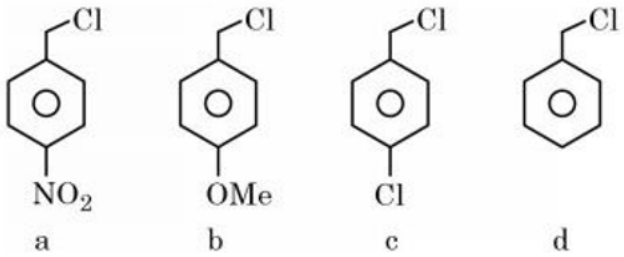
- Aa > b > c > d
- Ba > c > d > b
- Cb > d > c > a
- Dd > b > c > a
View answer or solution
Answer
b > d > c > a
Redox Reactions and Electrochemistry
Given below are two statements: Statement I: During Electrolytic refining, the pure metal is made to act as anode and its impure metallic form is used as cathode. Statement II: During the Hall-Heroult electrolysis process, purified Al₂O₃ is mixed with Na₃AlF₆ to lower the melting point of the mixture. In the light of the above statements, choose the most appropriate answer from the options given below:
- AStatement I is incorrect but Statement II is correct
- BBoth Statement I and Statement II are correct
- CStatement I is correct but Statement II is incorrect
- DBoth Statement I and Statement II are incorrect
View answer or solution
Answer
Statement I is incorrect but Statement II is correct
Principles Related to Practical Chemistry
The water quality of a pond was analysed and its BOD was found to be 4. The pond has
- AHighly polluted water
- BWater has high amount of fluoride compounds
- CSlightly polluted water
- DVery clean water
View answer or solution
Answer
Very clean water
Chemical Bonding and Molecular Structure
The Cl – Co – Cl bond angle values in a fac–[Co(NH₃)₃Cl₃] complex is/are:
- A90°
- B90° & 180°
- C180°
- D90° & 120°
View answer or solution
Answer
90°
Some Basic Concepts in Chemistry
1 L, 0.02 M solution of [Co(NH₃)₅SO₄]Br is mixed with 1 L, 0.02 M solution of [Co(NH₃)₅Br]SO₄. The resulting solution is divided into two equal parts (X) and treated with excess of AgNO₃ solution and BaCl₂ solution respectively as shown below: 1 L Solution (X) + AgNO₃ solution (excess) ⟶ Y 1 L Solution (X) + BaCl₂ solution (excess) ⟶ Z The number of moles of Y and Z respectively are
- A0.01, 0.02
- B0.01, 0.01
- C0.02, 0.01
- D0.02, 0.02
View answer or solution
Answer
0.01, 0.01
Some Basic Principles of Organic Chemistry
The most stable carbocation for the following is:
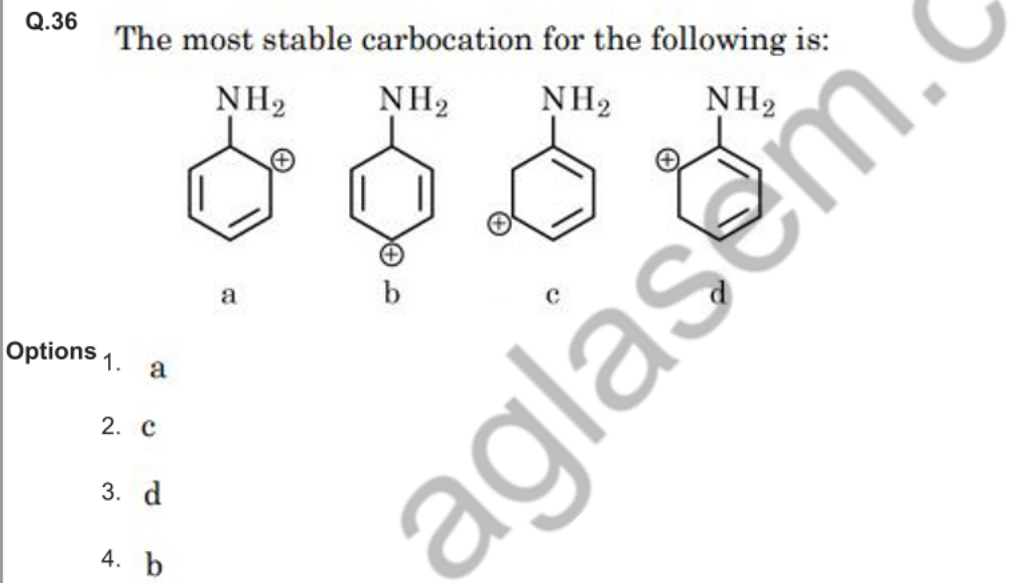
- Aa
- Bc
- Cd
- Db
View answer or solution
Answer
c
Organic Compounds Containing Oxygen
Formulae for Nessler's reagent is:
- AHgI₂
- BKHgI₃
- CK₂HgI₄
- DKHg₂I₂
View answer or solution
Answer
K₂HgI₄
Chlorides of which metal are soluble in organic solvents:
- ABe
- BMg
- CK
- DCa
View answer or solution
Answer
Be
Chemical Bonding and Molecular Structure
Boric acid is solid, whereas BF₃ is gas at room temperature because of
- AStrong van der Waal's interaction in Boric acid
- BStrong hydrogen bond in Boric acid
- CStrong ionic bond in Boric acid
- DStrong covalent bond in BF₃
View answer or solution
Answer
Strong hydrogen bond in Boric acid
The wave function (Ψ) of 2s is given by Ψ₂ₛ = 1/(2√2π) (1/a₀)^{1/2} (2 − r/a₀) e^{-r/2a₀} At r = r₀, radial node is formed. Thus, r₀ in terms of a₀
- Ar₀ = a₀/2
- Br₀ = 2a₀
- Cr₀ = 4a₀
- Dr₀ = a₀
View answer or solution
Answer
r₀ = 2a₀
Purification and Characterisation of Organic Compounds
Match List I with List II: List I (Mixture) | List II (Separation Technique) A. CHCl₃ + C₆H₅NH₂ | I. Steam distillation B. C₆H₁₄ + C₅H₁₂ | II. Differential extraction C. C₆H₅NH₂ + H₂O | III. Distillation D. Organic compound in H₂O | IV. Fractional distillation
- AA-II, B-I, C-III, D-IV
- BA-IV, B-I, C-III, D-II
- CA-III, B-IV, C-I, D-II
- DA-III, B-I, C-IV, D-II
View answer or solution
Answer
A-III, B-IV, C-I, D-II
Redox Reactions and Electrochemistry
KMnO₄ oxidises I⁻ in acidic and neutral/faintly alkaline solution, respectively, to
- AIO₃⁻ & I₂
- BI₂ & IO₃⁻
- CIO₃⁻ & IO₃⁻
- DI₂ & I₂
View answer or solution
Answer
I₂ & IO₃⁻
Bond dissociation energy of “E-H” bond of the “H₂E” hydrides of group 16 elements (given below), follows order. A. O B. S C. Se D. Te Choose the correct from the options given below:
- AA > B > D > C
- BD > C > B > A
- CB > A > C > D
- DA > B > C > D
View answer or solution
Answer
A > B > C > D
Maximum number of electrons that can be accommodated in shell with n = 4 are:
- A16
- B32
- C72
- D50
View answer or solution
Answer
32
Organic Compounds Containing Oxygen
Given below are two statements: One is labelled as Assertion A and the other is labelled as Reason R. Assertion A: [skeletal structure with a central carbon bearing OH below and two methyl groups, bonded to –CH₂–C(=O)–CH₃] can be easily reduced using Zn-Hg/HCl to [skeletal structure with a central carbon bearing OH below and two methyl groups, bonded to –CH₂–CH₂–CH₃]. Reason R: Zn-Hg/HCl is used to reduce carbonyl group to –CH₂ – group. In the light of the above statements, choose the correct answer from the options given below:

- ABoth A and R are true and R is the correct explanation of A
- BBoth A and R are true but R is not the correct explanation of A
- CA is true but R is false
- DA is false but R is true
View answer or solution
Answer
A is false but R is true
Given below are two statements: One is labelled as Assertion A and the other is labelled as Reason R. Assertion A: Antihistamines do not affect the secretion of acid in stomach. Reason R: Antiallergic and antacid drugs work on different receptors. In the light of the above statements, choose the correct answer from the options given below:
- AA is true but R is false
- BBoth A and R are true and R is the correct explanation of A
- CA is false but R is true
- DBoth A and R are true but R is not the correct explanation of A
View answer or solution
Answer
Both A and R are true and R is the correct explanation of A
[compound (X): a benzene ring with CH₃ at the top vertex and NO₂ at the bottom (para) vertex] ⟶ ⟶ [compound (Y): a benzene ring with CH₃ at the top vertex, Br at the lower-left vertex and Br at the lower-right vertex] In the above conversion of compound (X) to product (Y), the sequence of reagents to be used will be:
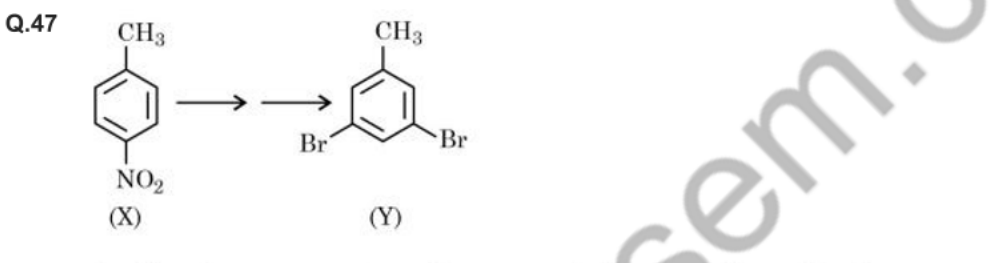
- A(i) Fe, H⁺ (ii) Br₂(aq) (iii) HNO₂ (iv) H₃PO₂
- B(i) Br₂, Fe (ii) Fe, H⁺ (iii) LiAlH₄
- C(i) Fe, H⁺ (ii) Br₂(aq) (iii) HNO₂ (iv) CuBr
- D(i) Br₂(aq) (ii) LiAlH₄ (iii) H₃O⁺
View answer or solution
Answer
(i) Fe, H⁺ (ii) Br₂(aq) (iii) HNO₂ (iv) H₃PO₂
Some Basic Concepts in Chemistry
Which of the following reaction is correct?
- A4 LiNO₃ —Δ→ 2Li₂O + 4NO₂+O₂
- B2 LiNO₃ —Δ→ 2NaNO₂ + O₂
- C2 LiNO₃ ⟶ 2Li + 2NO₂ + O₂
- D4 LiNO₃ —Δ→ 2Li₂O + 2N₂O₄+O₂
View answer or solution
Answer
4 LiNO₃ —Δ→ 2Li₂O + 4NO₂+O₂
The correct order of pKₐ values for the following compounds is: [a: phenol (benzene ring drawn as a hexagon with a circle inside, with OH on the top vertex); b: benzene ring with OH on the top vertex and N(CH₃)₂ on the bottom vertex; c: benzene ring with OH on the top vertex and NO₂ on the bottom vertex; d: benzene ring with OH on the top vertex and CH(CH₃)₂ on the bottom vertex]
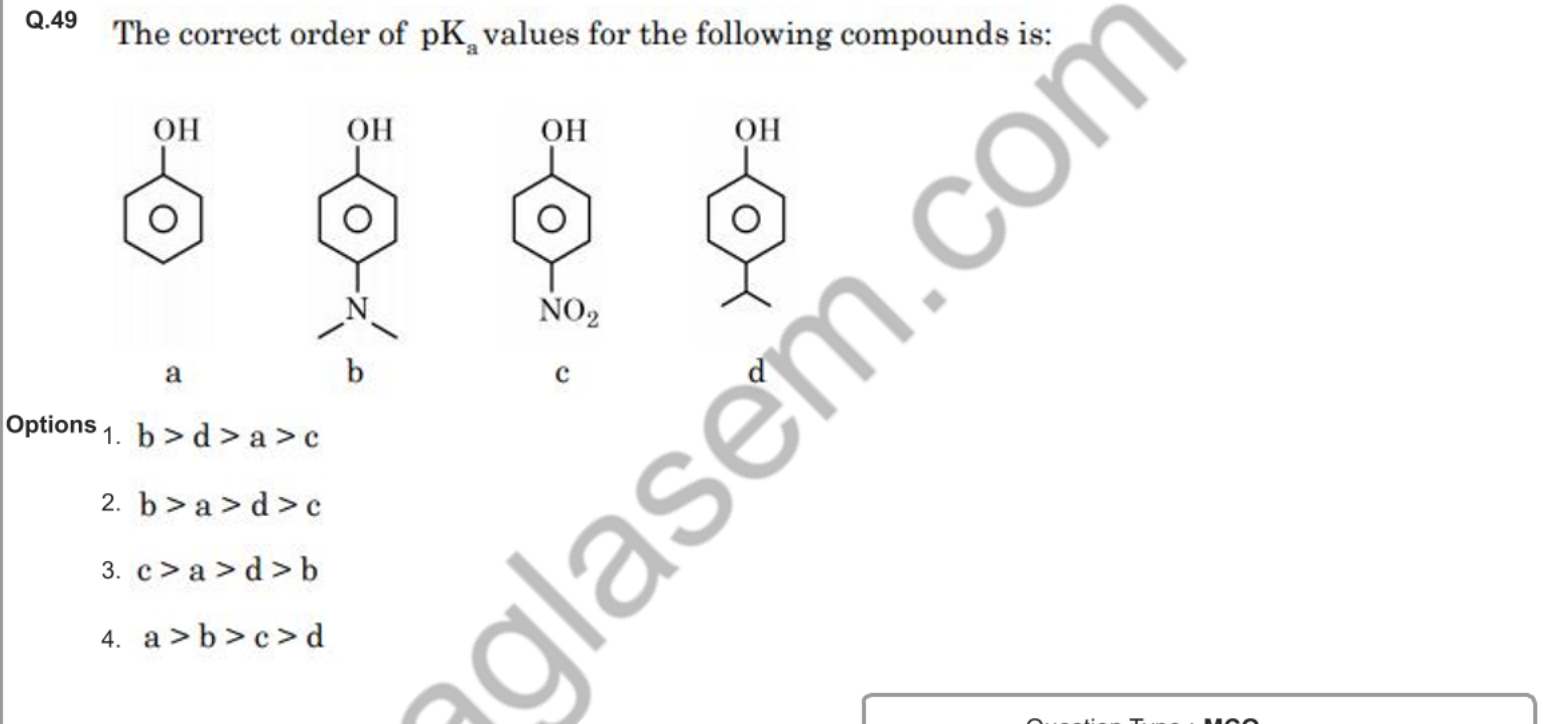
- Ab > d > a > c
- Bb > a > d > c
- Cc > a > d > b
- Da > b > c > d
View answer or solution
Answer
b > d > a > c
Chemical Bonding and Molecular Structure
Match List I with List II: List I (Complexes) A. [Ni(CO)₄] B. [Cu(NH₃)₄]²⁺ C. [Fe(NH₃)₆]²⁺ D. [Fe(H₂O)₆]²⁺ List II (Hybridisation) I. sp³ II. dsp² III. sp³d² IV. d²sp³ Choose the correct answer from the options given below:
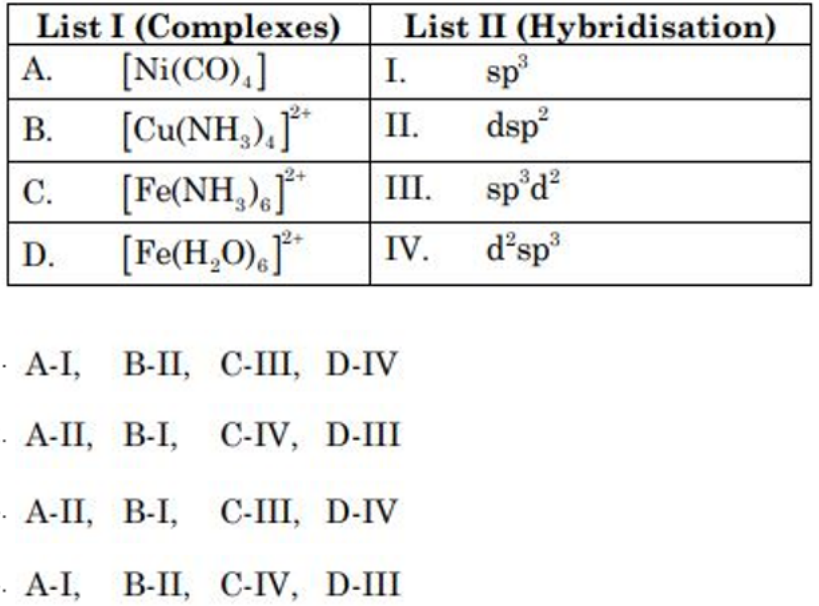
- AA-I, B-II, C-III, D-IV
- BA-II, B-I, C-IV, D-III
- CA-II, B-I, C-III, D-IV
- DA-I, B-II, C-IV, D-III
View answer or solution
Answer
A-I, B-II, C-IV, D-III
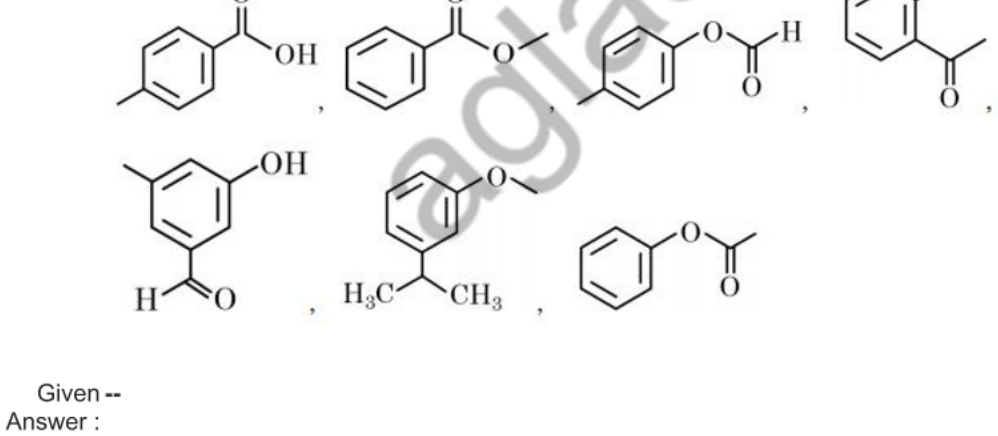
Number of compounds from the following which will not dissolve in cold NaHCO₃ and NaOH solutions but will dissolve in hot NaOH solution is ______ [1. benzene ring (hexagon with a circle inside) with a methyl group (short line) on the lower-left vertex and –C(=O)OH (C double-bonded up to O, single-bonded to the right to OH) on the upper-right vertex, 2. benzene ring with –C(=O)OCH₃ (C double-bonded up to O, single-bonded to the right to O bearing a methyl line) on the upper-right vertex, 3. benzene ring with a methyl group (short line) on the lower-left vertex and –OC(=O)H (O single-bonded on the upper-right vertex, C double-bonded down to O and bonded to H on the right) on the upper-right vertex, 4. benzene ring with OH on the upper-right vertex and –C(=O)CH₃ (C double-bonded down to O, bonded to CH₃ down to the right) on the lower-right vertex, 5. benzene ring with a methyl group (short line) on the upper-left vertex, OH on the upper-right vertex and –C(=O)H (C double-bonded to O down to the right, bonded to H down to the left) on the lower vertex, 6. benzene ring with –OCH₃ (O single-bonded on the upper vertex, bonded to a methyl line to the right) and –CH(CH₃)₂ (central CH on the lower vertex bearing CH₃ to the lower-left and CH₃ to the lower-right) on opposite vertices, 7. benzene ring with –OC(=O)CH₃ (O single-bonded on the right vertex, C double-bonded down to O and bonded to CH₃ to the right)]
View answer or solution
Answer
3
Some Basic Concepts in Chemistry
Iron oxide FeO, crystallises in a cubic lattice with a unit cell edge length of 5.0 Å. If density of the FeO in the crystal is 4.0 g cm⁻³, then the number of FeO units present per unit cell is __________. (Nearest integer) Given: Molar mass of Fe and O is 56 and 16 g mol⁻¹ respectively. Nₐ = 6.0×10²³ mol⁻¹
View answer or solution
Answer
4
Some Basic Concepts in Chemistry
A short peptide on complete hydrolysis produces 3 moles of glycine (G), two moles of leucine (L) and two moles of valine (V) per mole of peptide. The number of peptide linkages in it are ___________.
View answer or solution
Answer
6
Some Basic Concepts in Chemistry
The graph of log x/m vs log p for an adsorption process is a straight line inclined at an angle of 45° with intercept equal to 0.6020. The mass of gas adsorbed per unit mass of adsorbent at the pressure of 0.4 atm is ______ ×10⁻¹ (Nearest integer). Given: log 2 = 0.3010
View answer or solution
Answer
16
Some Basic Concepts in Chemistry
The strength of 50 volume solution of hydrogen peroxide is __________ g/L (Nearest integer). Given: Molar mass of H₂O₂ is 34 g mol⁻¹ Molar volume of gas at STP = 22.7 L.
View answer or solution
Answer
150
An organic compound undergoes first order decomposition. If the time taken for the 60% decomposition is 540 s, then the time required for 90% decomposition will be is __________ s. (Nearest integer). Given: ln 10 = 2.3; log 2 = 0.3
View answer or solution
Answer
1350
1 mole of ideal gas is allowed to expand reversibly and adiabatically from a temperature of 27°C. The work done is 3 kJ mol⁻¹. The final temperature of the gas is __________ K (Nearest integer). Given Cᵥ = 20 J mol⁻¹ K⁻¹
View answer or solution
Answer
150
Lead storage battery contains 38% by weight solution of H₂SO₄. The van't Hoff factor is 2.67 at this concentration. The temperature in Kelvin at which the solution in the battery will freeze is _______ (Nearest integer). Given K_f = 1.8 K kg mol⁻¹
View answer or solution
Answer
243
Redox Reactions and Electrochemistry
The electrode potential of the following half cell at 298 K X|X²⁺(0.001 M) || Y²⁺ (0.01 M)|Y is _______ × 10⁻² V (Nearest integer). Given: E°_X²⁺|X = −2.36 V E°_Y²⁺|Y = +0.36 V 2.303RT/F = 0.06 V
View answer or solution
Answer
275
Consider the following equation: 2SO₂(g) + O₂(g) ⇌ 2SO₃(g), ΔH = −190 kJ The number of factors which will increase the yield of SO₃ at equilibrium from the following is _______ A. Increasing temperature B. Increasing pressure C. Adding more SO₂ D. Adding more O₂ E. Addition of catalyst
View answer or solution
Answer
3