
// JEE (Main) / 2023
JEE (Main) 2023 Session 1, 29 January 2023, Shift 1 — Paper 1 (B.E / B.Tech) Chemistry
Chemistry · B.E / B.Tech
Work through the questions
30 questions
Take a moment to try each question before opening the available answer or solution.
Principles Related to Practical Chemistry
Which of the given compounds can enhance the efficiency of hydrogen storage tank?
- ADi-isobutylaluminium hydride
- BNaNi₅
- CLi/P₄
- DSiH₄
View answer or solution
Answer
NaNi₅
For 1 mol of gas, the plot of pV vs. p is shown below. p is the pressure and V is the volume of the gas. What is the value of compressibility factor at point A?
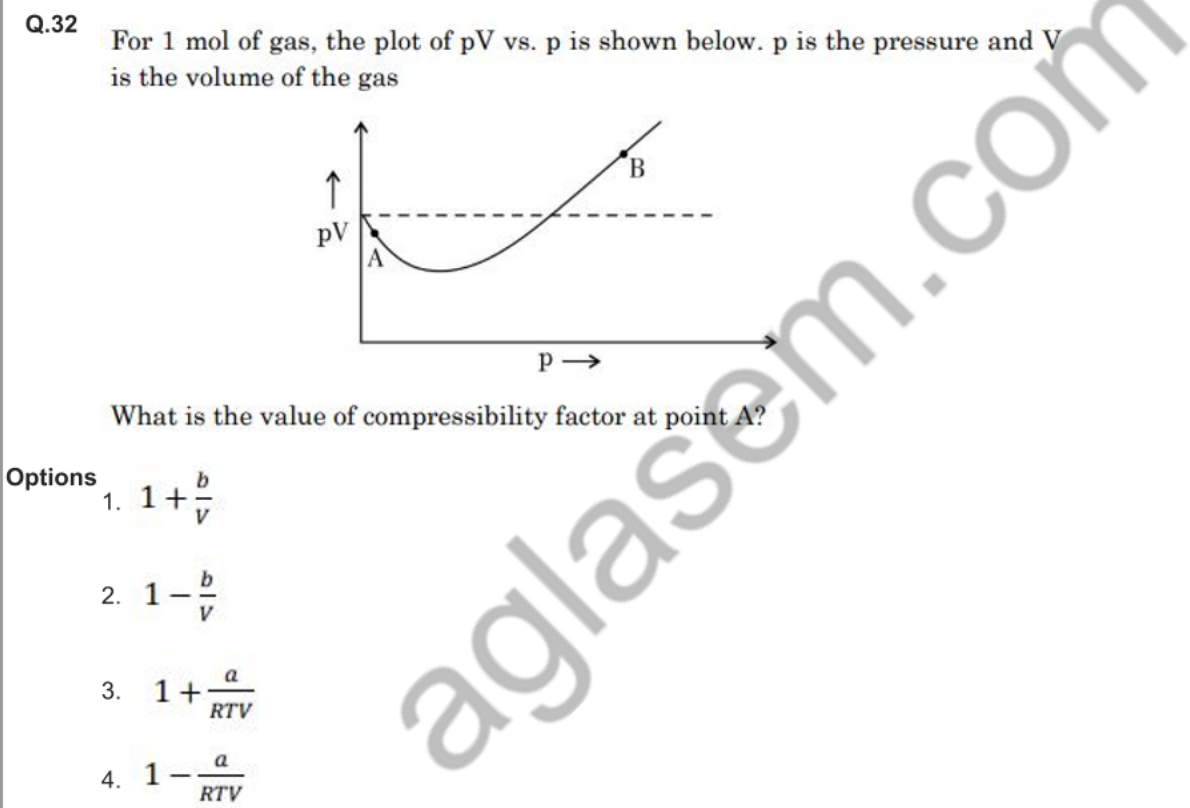
- A1 + b/V
- B1 − b/V
- C1 + a/RTV
- D1 − a/RTV
View answer or solution
Answer
1 − a/RTV
Number of cyclic tripeptides formed with 2 amino acids A and B is:
- A3
- B4
- C5
- D2
View answer or solution
Answer
4
Redox Reactions and Electrochemistry
“A” obtained by Ostwald’s method involving air oxidation of NH₃, upon further air oxidation produces “B”. “B” on hydration forms an oxoacid of Nitrogen along with evolution of “A”. The oxoacid also produces “A” and gives positive brown ring test. Identify A and B, respectively.
- ANO₂, N₂O₄
- BN₂O₃, NO₂
- CNO, NO₂
- DNO₂, N₂O₅
View answer or solution
Answer
NO, NO₂
Which of the following salt solutions would coagulate the colloid solution formed when FeCl₃ is added to NaOH solution, at the fastest rate?
- A10 mL of 0.2 mol dm⁻³ AlCl₃
- B10 mL of 0.1 mol dm⁻³ Na₂SO₄
- C10 mL of 0.15 mol dm⁻³ CaCl₂
- D10 mL of 0.1 mol dm⁻³ Ca₃(PO₄)₂
View answer or solution
Answer
10 mL of 0.2 mol dm⁻³ AlCl₃
Identify the correct order for the given property for following compounds. (A) Boiling Point: C₂H₅Cl < C₃H₇Cl < C₄H₉Cl (B) Density: C₂H₅Br < C₂H₅Cl < C₂H₅I (C) Boiling Point: C₂H₅Br < C₂H₄Br₂ < C₂H₃Br₃ (D) Density: C₂H₄BrI < C₃H₇Br < C₃H₆BrCl (E) Boiling Point: n-C₄H₉Cl > iso-C₄H₉Cl > tert-C₄H₉Cl Choose the correct answer from the option given below:
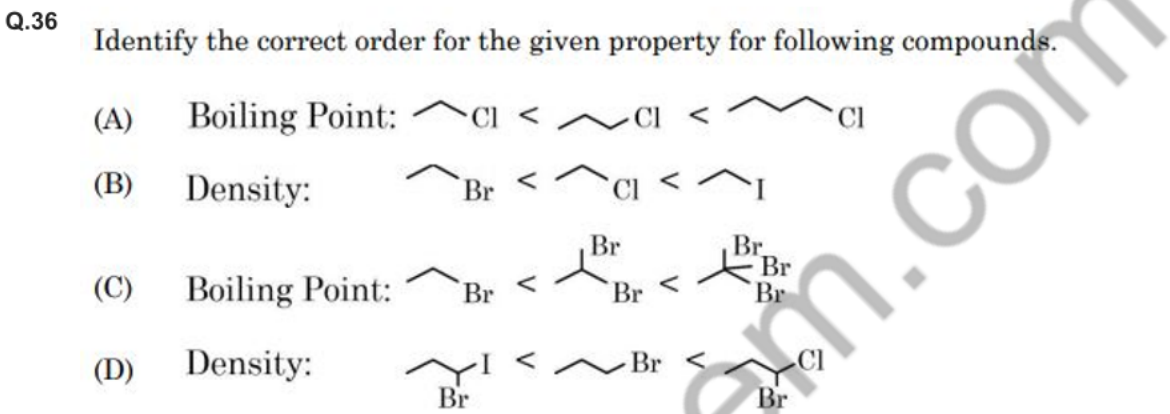
- A(B), (C) and (D) only
- B(A), (B) and (E) only
- C(A), (C) and (E) only
- D(A), (C) and (D) only
View answer or solution
Answer
(A), (C) and (E) only
Organic Compounds Containing Oxygen
The major product ‘P’ for the following sequence of reactions is: Ph–C(=O)–CH₂–CH₂–CH₂–C(=O)–NH₂ — 1) Zn/Hg, HCl 2) LiAlH₄ 3) H₃O⁺ → ‘P’ major product
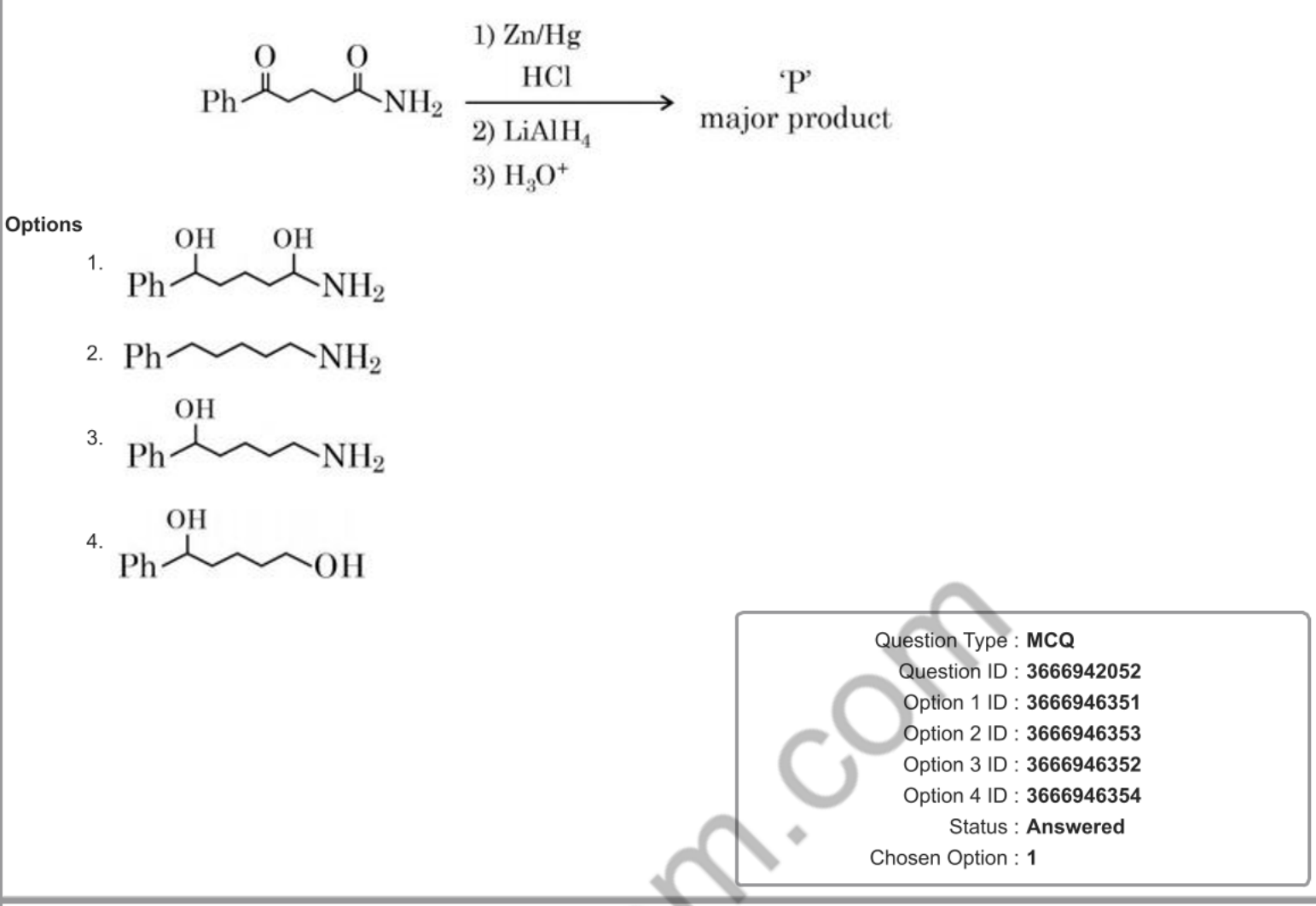
- APh–CH(OH)–CH₂–CH₂–CH₂–CH(OH)–NH₂
- BPh–CH₂–CH₂–CH₂–CH₂–CH₂–NH₂
- CPh–CH(OH)–CH₂–CH₂–CH₂–CH₂–NH₂
- DPh–CH(OH)–CH₂–CH₂–CH₂–CH₂–OH
View answer or solution
Answer
Ph–CH₂–CH₂–CH₂–CH₂–CH₂–NH₂
The correct order of hydration enthalpies is (A) K⁺ (B) Rb⁺ (C) Mg²⁺ (D) Cs⁺ (E) Ca²⁺ Choose the correct answer from the options given below:
- AC > A > E > B > D
- BC > E > A > D > B
- CE > C > A > B > D
- DC > E > A > B > D
View answer or solution
Answer
C > E > A > B > D
Redox Reactions and Electrochemistry
The standard electrode potential (M³⁺/M²⁺) for V, Cr, Mn & Co are −0.26 V, −0.41 V, +1.57 V and +1.97 V, respectively. The metal ions which can liberate H₂ from a dilute acid are
- AMn²⁺ and Co²⁺
- BCr²⁺ and Co²⁺
- CV²⁺ and Cr²⁺
- DV²⁺ and Mn²⁺
View answer or solution
Answer
V²⁺ and Cr²⁺
Chemical Bonding and Molecular Structure
The bond dissociation energy is highest for
- AF₂
- BCl₂
- CBr₂
- DI₂
View answer or solution
Answer
Cl₂
Organic Compounds Containing Nitrogen
Compound that will give positive Lassaigne's test for both nitrogen and halogen is:
- ANH₂OH.HCl
- BN₂H₄.HCl
- CNH₄Cl
- DCH₃NH₂.HCl
View answer or solution
Answer
CH₃NH₂.HCl
Correct statement about smog is:
- ANO₂ is present in classical smog
- BPhotochemical smog has high concentration of oxidizing agents
- CClassical smog also has high concentration of oxidizing agents
- DBoth NO₂ and SO₂ are present in classical smog
View answer or solution
Answer
Photochemical smog has high concentration of oxidizing agents
The magnetic behavior of Li₂O, Na₂O₂ and KO₂, respectively, are
- Adiamagnetic, diamagnetic and paramagnetic
- Bdiamagnetic, paramagnetic and diamagnetic
- Cparamagnetic, diamagnetic and paramagnetic
- Dparamagnetic, paramagnetic and diamagnetic
View answer or solution
Answer
diamagnetic, diamagnetic and paramagnetic
The shortest wavelength of hydrogen atom in Lyman series is λ. The longest wavelength in Balmer series of He⁺ is
- A5λ/9
- B5/(9λ)
- C9λ/5
- D36λ/5
View answer or solution
Answer
9λ/5
Principles Related to Practical Chemistry
During the borax bead test with CuSO₄, a blue green colour of the bead was observed in oxidising flame due to the formation of
- ACu₃B₂
- BCu(BO₂)₂
- CCuO
- DCu
View answer or solution
Answer
Cu(BO₂)₂
Match List I with List II. List I (Antimicrobials) — List II (Names) A. Narrow Spectrum Antibiotic — I. Furacin B. Antiseptic — II. Sulphur dioxide C. Disinfectants — III. Penicillin G D. Broad spectrum antibiotic — IV. Chloramphenicol Choose the correct answer from the options given below:
- A(A) – I, (B) – II, (C) – IV, (D) – III
- B(A) – III, (B) – I, (C) – IV, (D) – II
- C(A) – III, (B) – I, (C) – II, (D) – IV
- D(A) – II, (B) – I, (C) – IV, (D) – III
View answer or solution
Answer
(A) – III, (B) – I, (C) – II, (D) – IV
Organic Compounds Containing Oxygen
Match List I with List II. List I (Reaction) — List II (Reagents) A. Hoffmann Degradation — I. Conc.KOH, Δ B. Clemenson reduction — II. CHCl₃, NaOH/H₃O⊕ C. Cannizaro reaction — III. Br₂, NaOH D. Reimer-Tiemann Reaction — IV. Zn-Hg/HCl Choose the correct answer from the options given below:
- A(A) – II, (B) – I, (C) – III, (D) – IV
- B(A) – III, (B) – IV, (C) – II, (D) – I
- C(A) – II, (B) – IV, (C) – I, (D) – III
- D(A) – III, (B) – IV, (C) – I, (D) – II
View answer or solution
Answer
(A) – III, (B) – IV, (C) – I, (D) – II
The reaction representing the Mond process for metal refining is __________.
- AZr + 2I₂ ⟶[Δ] ZrI₄
- BNi + 4CO ⟶[Δ] Ni(CO)₄
- C2K[Au(CN)₂] + Zn ⟶[Δ] K₂[Zn(CN)₄] + 2Au
- DZnO + C ⟶[Δ] Zn + CO
View answer or solution
Answer
Ni + 4CO ⟶[Δ] Ni(CO)₄
Organic Compounds Containing Oxygen
The increasing order of pKₐ for the following phenols is (A) 2, 4 - Dinitrophenol (B) 4 - Nitrophenol (C) 2, 4, 5 - Trimethylphenol (D) Phenol (E) 3-Chlorophenol Choose the correct answer from the option given below:
- A(A), (E), (B), (D), (C)
- B(C), (E), (D), (B), (A)
- C(C), (D), (E), (B), (A)
- D(A), (B), (E), (D), (C)
View answer or solution
Answer
(A), (B), (E), (D), (C)
Chiral complex from the following is: Here en = ethylene diamine
- Atrans – [PtCl₂(en)₂]²⁺
- Btrans – [Co(NH₃)₄ Cl₂]⁺
- Ccis – [PtCl₂ (en)₂]²⁺
- Dcis – [PtCl₂ (NH₃)₂]
View answer or solution
Answer
cis – [PtCl₂ (en)₂]²⁺
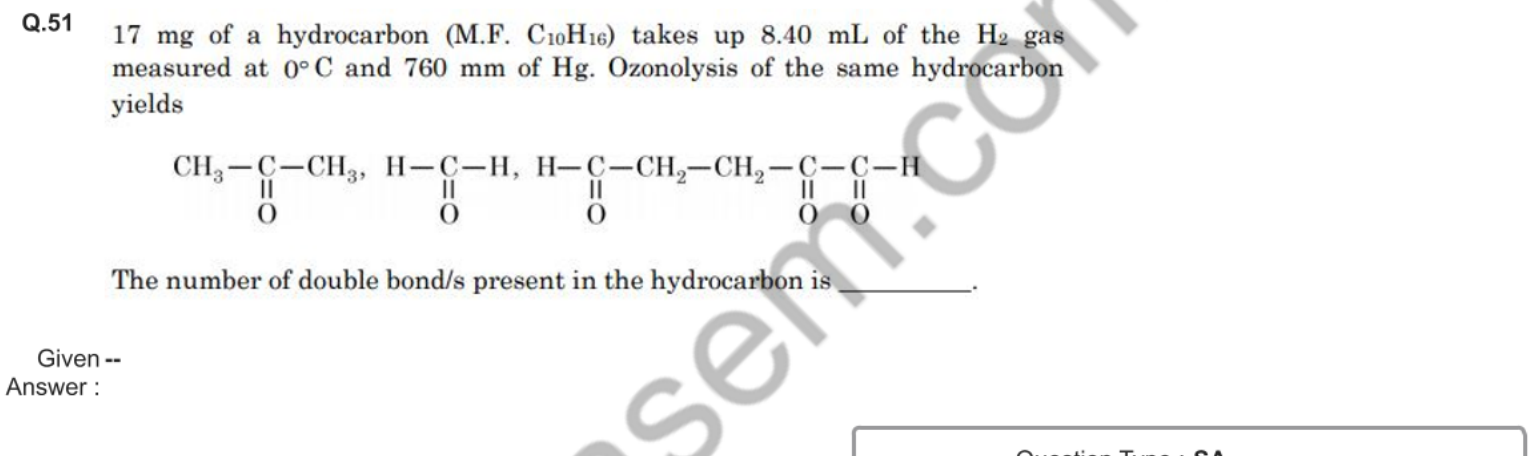
17 mg of a hydrocarbon (M.F. C₁₀H₁₆) takes up 8.40 mL of the H₂ gas measured at 0°C and 760 mm of Hg. Ozonolysis of the same hydrocarbon yields CH₃—C(=O)—CH₃, H—C(=O)—H, H—C(=O)—CH₂—CH₂—C(=O)—C(=O)—H The number of double bond/s present in the hydrocarbon is __________.
View answer or solution
Answer
3
Water decomposes at 2300 K H₂O(g) → H₂(g) + ½O₂(g) The percent of water decomposing at 2300 K and 1 bar is __________ (Nearest integer). Equilibrium constant for the reaction is 2×10⁻³ at 2300 K.
View answer or solution
Answer
2
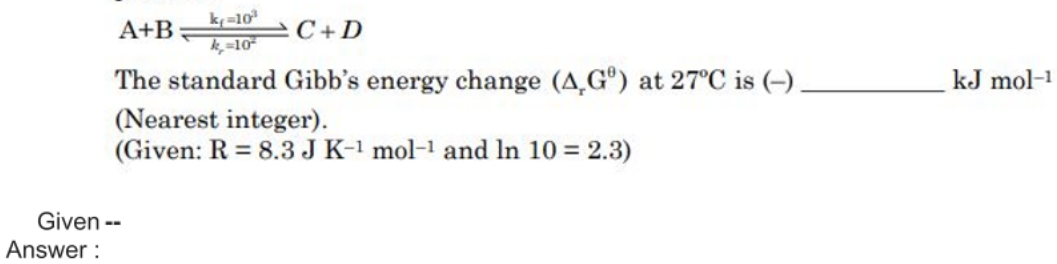
Consider the following reaction approaching equilibrium at 27°C and 1 atm pressure A+B ⇌ C+D The standard Gibb's energy change (ΔᵣGᶿ) at 27°C is (−) __________ kJ mol⁻¹ (Nearest integer). (Given: R = 8.3 J K⁻¹ mol⁻¹ and ln 10 = 2.3)
View answer or solution
Answer
6
Chemical Bonding and Molecular Structure
The number of molecules or ions from the following, which do not have odd number of electrons are __________. (A) NO₂ (B) ICl₄⁻ (C) BrF₃ (D) ClO₂ (E) NO₂⁺ (F) NO
View answer or solution
Answer
3
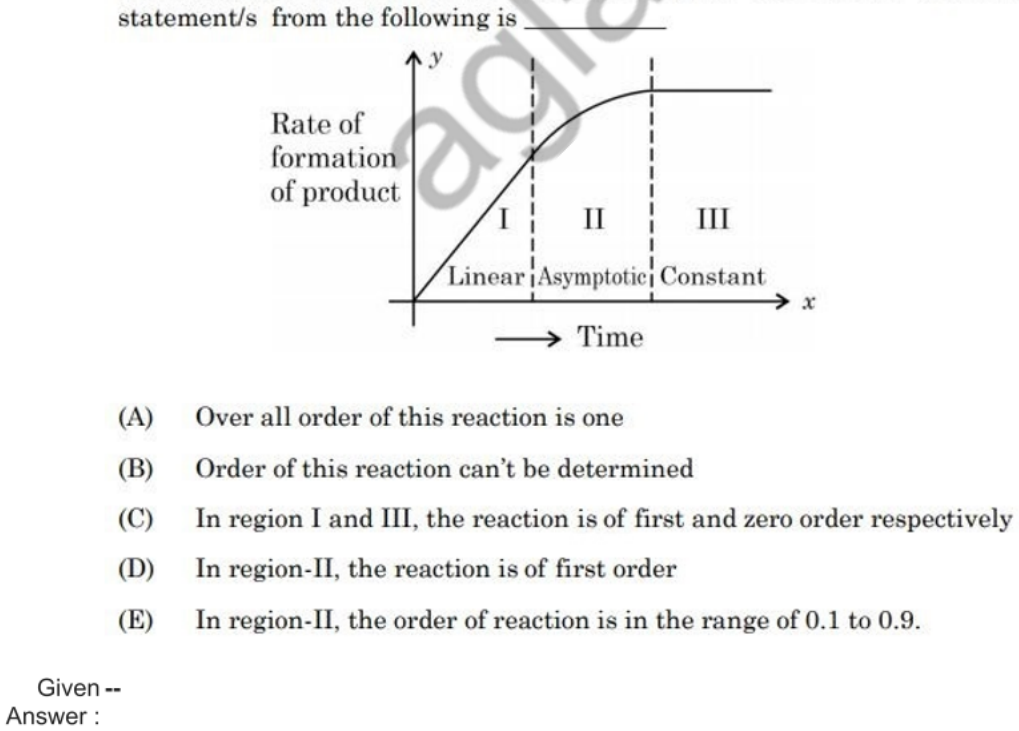
For certain chemical reaction X → Y, the rate of formation of product is plotted against the time as shown in the figure. The number of correct statement/s from the following is __________ (A) Over all order of this reaction is one (B) Order of this reaction can't be determined (C) In region I and III, the reaction is of first and zero order respectively (D) In region-II, the reaction is of first order (E) In region-II, the order of reaction is in the range of 0.1 to 0.9.
View answer or solution
Answer
2
Solid Lead nitrate is dissolved in 1 litre of water. The solution was found to boil at 100.15°C. When 0.2 mol of NaCl is added to the resulting solution, it was observed that the solution froze at −0.8°C. The solubility product of PbCl₂ formed is __________ × 10⁻⁶ at 298 K. (Nearest integer) Given : K_b = 0.5 K kg mol⁻¹ and K_f = 1.8 K kg mol⁻¹. Assume molality to be equal to molarity in all cases.
View answer or solution
Answer
13
Organic Compounds Containing Oxygen
The sum of bridging carbonyls in W(CO)₆ and Mn₂ (CO)₁₀ is __________.
View answer or solution
Answer
0
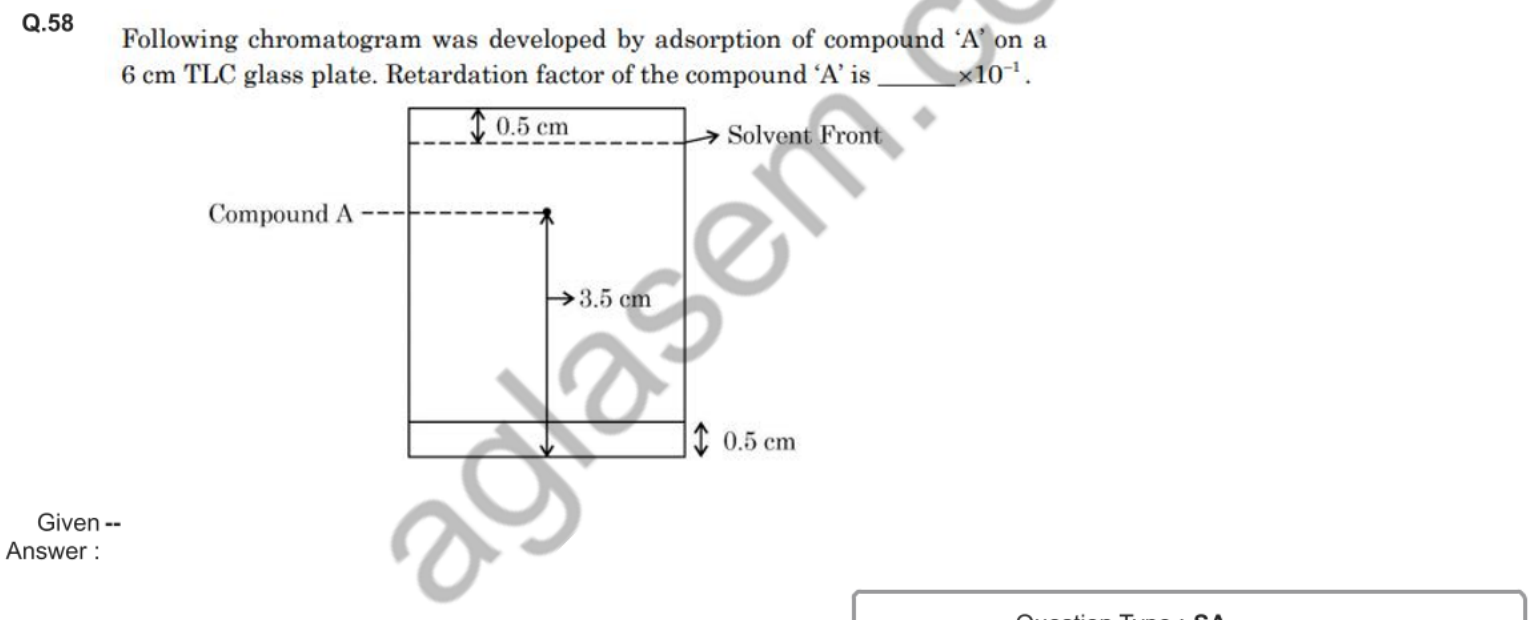
Following chromatogram was developed by adsorption of compound ‘A’ on a 6 cm TLC glass plate. Retardation factor of the compound ‘A’ is ______×10⁻¹ .
View answer or solution
Answer
6
Millimoles of calcium hydroxide required to produce 100 mL of the aqueous solution of pH 12 is x×10⁻¹ . The value of x is __________ (Nearest integer). Assume complete dissociation.
View answer or solution
Answer
5
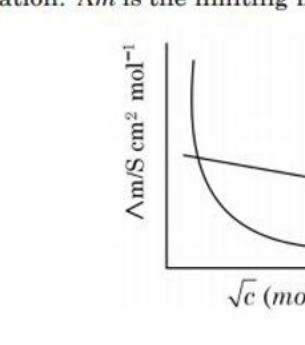
Following figure shows dependence of molar conductance of two electrolytes on concentration. Λm° is the limiting molar conductivity. The number of incorrect statement(s) from the following is ___________ (A) Λm° for electrolyte A is obtained by extrapolation (B) For electrolyte B, Λm vs √c graph is a straight line with intercept equal to Λm° (C) At infinite dilution, the value of degree of dissociation approaches zero for electrolyte B. (D) Λm° for any electrolyte A or B can be calculated using λ° for individual ions
View answer or solution
Answer
2